Femity
ItalyTable of Contents
Patient Information Leaflet
Femity 50 micrograms + 7 micrograms/24 hours, transdermal patch
Estradiol hemihydrate
Levonorgestrel
Please read all of this leaflet carefully before using this medicine, because it contains important information for you
- Keep this leaflet. You may need to read it again.
- If you have any questions, ask your doctor, pharmacist, or nurse.
- This medicine has been prescribed for you only. Do not give it to others, even if they have the same symptoms as yours, because it could be harmful.
- If you experience any side effects, including those not listed in this leaflet, talk to your doctor, pharmacist, or nurse. See section 4.
Contents of this leaflet:
- What Femity is and what it is used for
- What you need to know before using Femity
- How to use Femity
- Possible side effects
- How to store Femity
- Contents of the pack and other information
1. What Femity is and what it is used for
Femity is indicated for Hormone Replacement Therapy (HRT). It contains two types of female hormones:
an oestrogen (oestradiol hemihydrate) and a progestogen (levonorgestrel). Femity is used in women
who have been postmenopausal for more than one year.
Femity is used for:
Relief of symptoms occurring after the menopause
During the menopause, the amount of oestrogen produced by a woman's body decreases. This
can cause symptoms such as flushing of the face, neck and chest ("hot flushes"). Femity can relieve
these symptoms after the menopause. Femity will be prescribed to you only if your symptoms are
severe enough to interfere with your normal daily life.
Experience with treatment in women over the age of 65 is limited.
2. What you need to know before using Femity
Medical history and regular check-ups
HRT carries certain risks that must be considered when deciding whether to start or continue treatment.
Experience with treating premature menopause (due to ovarian dysfunction or surgical interventions) is limited. If you are experiencing early menopause, the risks associated with HRT may differ. Consult your doctor.
Before starting (or restarting) HRT, your doctor will ask about your personal and family medical history. Your doctor may decide to perform a medical examination, which may include a breast examination and/or a pelvic exam, if necessary.
Once you have started treatment with Femity, you should have regular medical check-ups (at least once a year). During these visits, you can discuss with your doctor the risks and benefits of continuing Femity treatment.
Undergo regular mammographic screening as recommended by your doctor.
Do not use Femity:
If any of the following conditions apply to you. If you have any doubts about any of the points listed below, consult your doctor before using Femity.
Do not use Femity
- If you have or have previously had breast cancer, or if breast cancer is suspected.
- If you have or are suspected to have a hormone-sensitive tumour, such as cancer of the uterine lining (endometrium).
- If you experience unexplained vaginal bleeding.
- If you have untreated excessive thickening of the uterine lining (endometrial hyperplasia).
- If you currently have or have previously been treated for blood clots (thrombosis) in a vein, for example in the legs (deep vein thrombosis) or lungs (pulmonary embolism).
- If you suffer from blood clotting disorders (e.g. protein C, protein S or antithrombin deficiency).
- If you currently suffer or have recently suffered from a disease caused by blood clots in the arteries, such as heart attack, stroke, or angina.
- If you have or have previously had liver disease and your liver function tests are not within normal limits.
- If you suffer from a rare inherited blood disorder called "porphyria".
- If you are allergic (hypersensitive) to estradiol hemihydrate and/or levonorgestrel or to any of the other ingredients of this medicine (listed in section 6).
If any of the above conditions occurs for the first time while using Femity, stop treatment immediately and consult your doctor without delay.
Warnings and precautions
Inform your doctor if you currently suffer or have previously suffered from any of the following conditions before starting treatment, as these conditions may recur or worsen during treatment with Femity. In such cases, more frequent medical check-ups may be necessary:
- Uterine fibroids;
- Endometriosis (growth of uterine tissue outside the uterus) or history of abnormal growth of the uterine lining (endometrial hyperplasia);
- Increased risk of developing blood clots (see "Blood clots in a vein (thrombosis)");
- Increased risk of hormone-sensitive tumours (such as having a mother, sister, or grandmother who had breast cancer);
- High blood pressure;
- Liver disorders, such as benign liver tumour;
- Diabetes;
- Gallstones;
- Migraine or severe headaches;
- Autoimmune disease affecting multiple organs (systemic lupus erythematosus, SLE);
- Epilepsy;
- Asthma;
- Otosclerosis (a condition affecting the eardrum and hearing);
- Very high levels of fats in the blood (triglycerides);
- Fluid retention due to heart or kidney problems.
Stop treatment with Femity and contact your doctor immediately if any of the following conditions occur during HRT:
- Any of the conditions listed under "Do not use Femity";
- Yellowing of the skin or whites of the eyes (jaundice), which may indicate liver disease;
- A significant increase in blood pressure (symptoms may include headache, fatigue, dizziness);
- A first occurrence of migraine-type headache;
- Pregnancy;
- Signs of a blood clot, such as:
- Painful swelling and redness in the legs;
- Sudden chest pain;
- Difficulty breathing.
For further information, see "Blood clots in a vein (thrombosis)".
Note: Femity is not a contraceptive. If less than 12 months have passed since your last menstrual period or if you are under 50 years of age, you may need to use additional contraceptive methods to prevent pregnancy. Consult your doctor for advice.
Femity and tumours
Excessive thickening of the uterine lining (endometrial hyperplasia) and cancer of the uterine lining (endometrial carcinoma)
HRT with oestrogen-only therapy increases the risk of excessive thickening of the uterine lining (endometrial hyperplasia) and cancer of the uterine lining (endometrial carcinoma).
The progestogen component in Femity protects against this additional risk.
On average, 5 out of 1000 women who still have their uterus and do not use HRT may be diagnosed with endometrial carcinoma between the ages of 50 and 65.
Among women aged 50 to 65 who still have their uterus and are treated with oestrogen-only HRT, the number of women diagnosed with endometrial carcinoma ranges from 10 to 60 per 1000 (i.e. 5 to 55 additional cases compared to non-users), depending on the dose and duration of treatment.
Irregular bleeding
You may experience irregular bleeding or spotting during the first 3–6 months of using Femity.
However, if irregular bleeding:
- Persists beyond the first 6 months of treatment;
- Occurs after more than 6 months of treatment with Femity;
- Persists after stopping treatment with Femity,
consult your doctor as soon as possible.
Breast cancer:
Overall evidence suggests an increased risk of breast cancer in women using combined oestrogen-progestogen HRT and possibly also in those using oestrogen-only HRT. The increased risk depends on the duration of HRT use. The additional risk becomes apparent after a few years of use but returns to normal levels within a few years (at most five) after stopping treatment.
Comparison
On average, 9 to 14 out of 1000 women aged 50 to 79 who do not use HRT may be diagnosed with breast cancer over a 5-year period. Among women aged 50 to 79 who use combined oestrogen-progestogen HRT for 5 years, the number increases to 13–20 per 1000 (i.e. 4 to 6 additional cases compared to non-users).
- Regularly examine your breasts. Consult your doctor if you notice any changes such as:
- Dimpling of the skin;
- Changes in the appearance of the nipple;
- Any visible or palpable lumps.
Additionally, you are advised to participate in mammographic screening programmes when available. For mammographic screening, it is important to inform the nurse/healthcare professional performing the X-ray that you are using hormone replacement therapy (HRT), as this therapy may increase breast density and thus affect the mammogram image. Increased breast density may make it more difficult for mammography to detect all lumps.
Ovarian cancer:
Ovarian cancer is rare—much rarer than breast cancer. The use of oestrogen-only or combined oestrogen-progestogen therapy has been associated with a slight increase in the risk of ovarian cancer.
The risk of ovarian cancer varies with age. For example, among women aged 50 to 54 who do not use HRT, approximately 2 out of 2000 will be diagnosed with ovarian cancer within 5 years. Among women who have used HRT for 5 years, this number increases to about 3 per 2000 (i.e. approximately 1 additional case).
Effect of Femity on the heart and circulation
Blood clots in a vein (thrombosis)
The risk of developing blood clots in the veins is approximately 1.3 to 3 times higher in women using HRT compared to non-users, especially during the first year of treatment.
Venous blood clots can be dangerous; if a clot travels to the lungs, it may cause chest pain, shortness of breath, fainting, or even death.
The likelihood of developing venous blood clots increases with age and with the presence of any of the following conditions. Therefore, inform your doctor if any of the following apply to you:
- You are unable to walk for prolonged periods due to major surgery, injury, or illness (see also section 3 if you are scheduled for surgery);
- You are severely overweight (BMI >30 kg/m²);
- You have a blood clotting disorder requiring long-term anticoagulant treatment;
- A close relative has had blood clots in the legs, lungs, or other organs;
- You have systemic lupus erythematosus (SLE);
- You have cancer.
For signs of blood clots, see "Stop treatment with Femity and contact your doctor immediately".
Comparison
Among women over 50 who do not use HRT, it can be expected that 4 to 7 out of 1000 will develop venous blood clots over a 5-year period.
Among women around age 50 using combined oestrogen-progestogen HRT for 5 years, the number increases to 9–12 per 1000 (i.e. 5 additional cases compared to non-users).
Heart disease (heart attack)
There is no evidence that HRT protects against heart attacks.
Women over 60 years of age who use combined oestrogen-progestogen HRT have a slightly higher risk of developing heart disease compared to women not using HRT.
Stroke
The risk of stroke is approximately 1.5 times higher in women using HRT compared to non-users. The number of additional stroke cases due to HRT use increases with age.
Comparison
Among women over 50 who do not use HRT, it can be expected that 8 out of 1000 will have a stroke over a 5-year period. Among women around age 50 using HRT, the number increases to 11 per 1000 over 5 years (i.e. 3 additional cases compared to non-users).
Other conditions
- HRT does not prevent memory loss. There is some evidence of an increased risk of memory loss in women who start HRT after age 65. Consult your doctor for advice.
Other medicines and Femity
Some medicines may interfere with the effect of Femity, potentially causing irregular bleeding. These include:
- Medicines for epilepsy (such as phenobarbital, phenytoin, and carbamazepine);
- Medicines for tuberculosis (such as rifampicin, rifabutin);
- Medicines for HIV infection (such as nevirapine, efavirenz, ritonavir, and nelfinavir);
- Herbal preparations containing St. John’s wort (Hypericum perforatum).
Inform your doctor or pharmacist if you are taking, have recently taken, or might take any other medicines.
Laboratory tests
If you need to have a blood test, inform your doctor or laboratory staff that you are taking Femity, as this medicine may affect the results of certain tests.
Pregnancy and breastfeeding
Femity is intended solely for postmenopausal women. If you become pregnant, stop using Femity and contact your doctor immediately.
3. How to use Femity
Dosage
Use this medicine exactly as directed by your doctor or pharmacist. If you have any doubts, consult your doctor or pharmacist.
Femity should be applied once a week; each patch must be replaced every 7 days. Femity is a continuous combined hormone replacement therapy (HRT), without a break period: when one patch is removed, the next one should be applied immediately.
Forgetting to replace the patch according to the recommended schedule may increase the likelihood of breakthrough bleeding or spotting.
In women who are not currently using HRT, or those switching from another continuous combined HRT product, treatment with Femity may be started at any time.
In women switching from sequential HRT regimens, treatment should begin immediately after the withdrawal bleed ends.
Your doctor will prescribe the lowest effective dose necessary to treat your symptoms for the shortest required duration. Contact your doctor if you think the dose is too strong or not sufficient for you.
Method of administration
Femity is applied to the skin (transdermal use). Wash and thoroughly clean the area where the patch will be placed, and dry the skin before application; if possible, apply the patch to a hair-free area.
Apply Femity to clean, dry, healthy skin (not irritated or abraded); do not apply to skin recently treated with cosmetic creams or sun protection products. Avoid using bath oils or shower gels containing moisturizing or oily ingredients, as these may affect the adhesion of the patch on any part of the body.
Femity should be applied to a flat skin area without deep folds—such as the buttocks or hips—that is not subject to friction from clothing (avoid the waistline and wearing tight clothes that could dislodge the transdermal patch). Do not attempt to check adhesion by lifting an edge, as this may cause the patch to detach.
Wait at least one hour after applying the patch before engaging in strenuous activities or physical exercise that may cause excessive sweating, as this could compromise patch adhesion.
Similarly, wait at least one hour after patch application before performing water-related activities such as bathing, showering, swimming, or using steam baths.
Other factors that may affect patch adhesion include:
- Excessive sweating, hot flushes, or naturally oily skin
- Hot and/or humid climatic conditions
Femity must not be applied on the breast or in its immediate vicinity.
It is advisable to avoid applying the patch to the same site consecutively. At least one week should elapse between two applications at the same site.
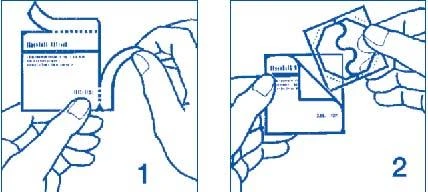
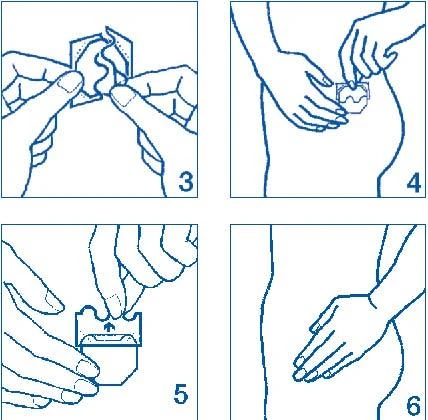
Application of the patch:
- Remove the patch from the sachet as shown in figures 1 and 2.
- Peel off half of the protective liner from the S-shaped notch side, and apply the patch to the skin as shown in figures 3 and 4. Avoid touching the adhesive surface of the patch with your fingers, as this may impair proper adhesion.
- Remove the other half of the protective liner, then press the patch firmly onto the skin with the palm of your hand for at least 30 seconds, as shown in figures 5 and 6. Body heat will enhance patch adhesion.
You may take a shower or bath without removing the transdermal patch. If the patch detaches prematurely—before day 7 (due to intense physical activity, excessive sweating, or abnormal clothing friction)—apply a new patch immediately. (To help maintain correct treatment adherence, it is recommended that the patient continues to change the patch on the originally scheduled day.)
Once applied, the transdermal patch should be covered by clothing to avoid direct exposure to sunlight.
Remove the transdermal patch slowly to avoid skin irritation.
If any adhesive residue remains on the skin, it can usually be removed by gently rubbing with an oily cream or lotion.
After use, fold Femity in half (with the adhesive side inward) and dispose of it properly.
If you use more Femity than you should
Overdose is unlikely, but may cause the following symptoms:
- Breast tenderness
- Abdominal/pelvic swelling
- Anxiety
- Irritability
- Nausea
- Vomiting
These symptoms are expected to gradually disappear after removing the patch. If symptoms persist, consult your doctor.
If you forget to change the Femity patch
Change the patch as soon as possible, then resume your regular schedule. Breakthrough bleeding is more likely if you forget to change the patch at the correct time. Do not apply a double dose to make up for forgetting to remove the previous patch.
If you stop using Femity
Symptoms related to estrogen deficiency (such as hot flushes affecting the face, neck, and chest) may return.
If you need to undergo surgery
If you are scheduled for surgery, inform your surgeon that you are using Femity. It may be necessary to stop using Femity approximately 4–6 weeks before the operation to reduce the risk of blood clots (see section 2, Blood clots in a vein).
Ask your doctor when you can resume using Femity.
If you have any questions about using this medicine, consult your doctor, pharmacist, or nurse.
4. Possible side effects
The following conditions occur more frequently in women using HRT than in women who do not use HRT:
- breast cancer;
- abnormal growth or cancer of the lining of the womb (endometrial hyperplasia or carcinoma);
- ovarian cancer;
- blood clots in the veins of the legs or lungs (venous thromboembolism);
- heart disease;
- stroke;
- possible loss of memory if HRT is started after the age of 65.
For further information on these side effects, see section 2. Like all medicines, this medicine can cause side effects, although not everybody gets them. Most of the side effects observed with Femity are mild to moderate in intensity and do not require discontinuation of treatment. If any of the following symptoms persist, consult your doctor, who will adjust your treatment accordingly: hot flushes, headache, bothersome vaginal dryness, nausea, vomiting, abdominal pain, chest tightness, eye irritation from contact lenses, irritability, heavy legs, and weight gain. If you experience heavy or irregular vaginal bleeding, contact your doctor.
The most frequent side effects may occur very commonly (in more than 1 in 10 patients):
- skin irritation at the application site (which disappears 2 or 3 days after patch removal);
- breast tenderness;
- bleeding or spotting.
The following side effects may occur commonly (up to 1 in 10 patients):
- breast pain (mastodynia);
- headache;
- indigestion (dyspepsia).
The following side effects may occur uncommonly (up to 1 in 100 patients):
- fluid retention, swelling (oedema);
- weight gain/loss;
- fatigue;
- leg cramps;
- dizziness;
- migraine;
- bloating sensation;
- abdominal cramps;
- malaise (nausea);
- hypertension;
- excessive thickening of the lining of the womb (endometrial hyperplasia);
- benign changes in breast tissue;
- depression.
The following potential side effects may occur rarely (up to 1 in 1000 patients):
- gallstones (cholelithiasis);
- yellowing of the skin or whites of the eyes (cholestatic jaundice);
- increase in size of uterine fibroids (uterine fibroids).
The following side effects have been reported with other HRTs:
- cholecystopathy;
- various skin disorders;
- skin discolouration, especially on the face or neck, known as "pregnancy mask" (chloasma);
- painful red nodules (erythema nodosum);
- skin rash with redness or ulceration in a target-like pattern (erythema multiforme);
- vascular purpura (occasional skin reddening).
Reporting of side effects
If you experience any side effect, including those not listed in this leaflet, talk to your doctor or pharmacist. You can also report side effects directly via the national reporting system at www.agenziafarmaco.gov.it/it/responsabili. By reporting side effects, you can help provide more information on the safety of this medicine.
5. How to store Femity
Keep this medicine out of the sight and reach of children.
Do not use this medicine after the expiry date. The expiry date refers to the last day of that month.
Do not store Femity above 30°C.
Keep the patches in their original sachets until ready to use.
Do not dispose of any medicine via wastewater or household waste. Ask your pharmacist how to dispose of medicines you no longer use. This will help protect the environment.
6. Package contents and other information
What Femity contains
The active substances are:
Estradiol hemihydrate and levonorgestrel. Each patch contains 1.5 mg of estradiol hemihydrate and 0.525 mg
of levonorgestrel in a patch with a surface area of 15 cm², from which 50 micrograms of
estradiol and 7 micrograms of levonorgestrel are released per 24 hours.
The other components are:
Backing layer: Polyethylene terephthalate (PET) sheet.
Adhesive matrix: Styrene-isoprene-styrene copolymer, glycerol esters of completely hydrogenated resins.
Protective liner: Silicone-coated polyethylene terephthalate (PET) sheet.
Description of the appearance of Femity and contents of the pack
Femity is a transdermal patch contained in a pouch. Each pack contains 4 or 12 pouches.
Marketing Authorisation Holder
Theramex Ireland Limited
Kilmore House, Park Lane, Spencer Dock
Dublin 1, D01 YE64
Ireland
Manufacturer:
Teva Pharmaceuticals Europe B.V., Swensweg 5, 2031 GA Haarlem, Netherlands
LTS Lohmann Therapie-Systeme AG, Lohmannstr. 2, 56626 Andernach, Germany
This medicinal product is authorised in the European Economic Area Member States under the
following names: FEM7 EVO / FEM7 PLUS / FEM7 CONTI