Fasturtec
Italy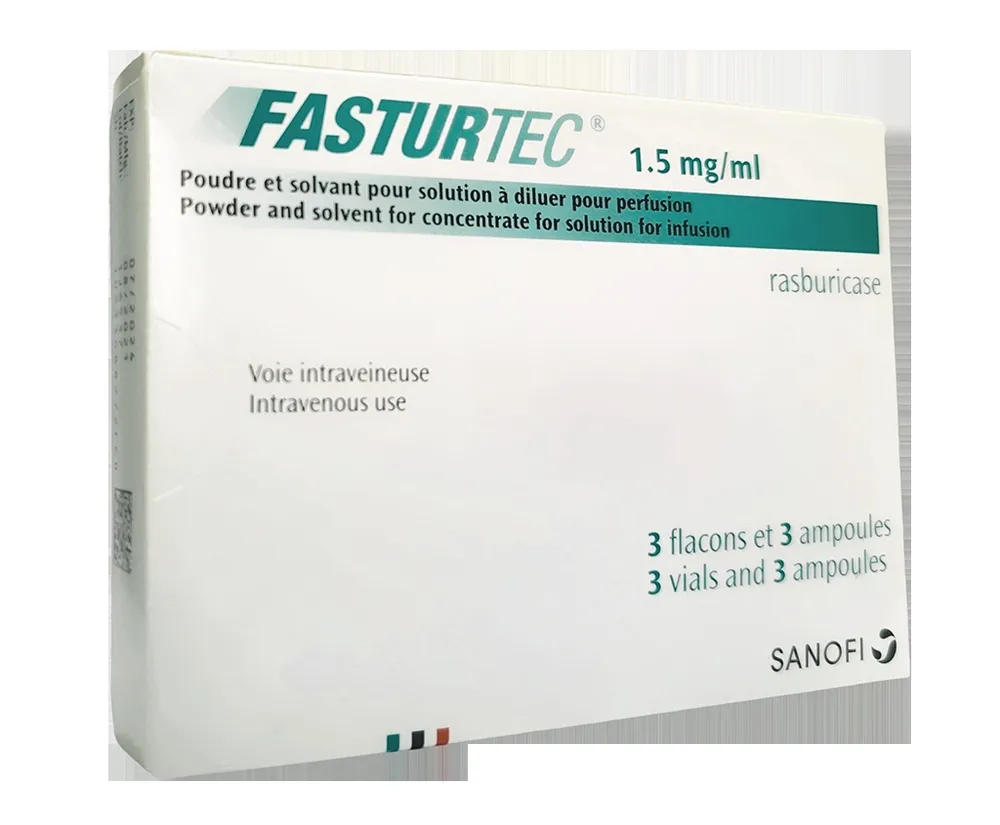
Table of Contents
- Package leaflet: Information for the user
- Fasturtec 1.5 mg/ml powder and solvent for concentrate for solution for infusion
- 1. What Fasturtec is and what it is used for
- 2. What you need to know before using Fasturtec
- 3. How to use Fasturtec
- 4. Possible side effects
- 5. How to store Fasturtec
- 6. Package contents and other information
- The following information is intended exclusively for healthcare professionals:
Package leaflet: Information for the user
Fasturtec 1.5 mg/ml powder and solvent for concentrate for solution for infusion
rasburicase
Please read all of this leaflet carefully before you are given this medicine because it contains important information for you.
- Keep this leaflet. You may need to read it again.
- If you have any questions, ask your doctor, nurse or hospital pharmacist.
- If you get any side effects, talk to your doctor, nurse or hospital pharmacist. This includes any side effects not listed in this leaflet. See section 4. Contents of this leaflet:
- What Fasturtec is and what it is used for
- What you need to know before being given Fasturtec
- How Fasturtec is given
- Possible side effects
- How to store Fasturtec
- Contents of the pack and other information
1. What Fasturtec is and what it is used for
Fasturtec contains the active substance rasburicase.
Rasburicase is used to treat or prevent elevated levels of uric acid in the blood that occur in adult patients, children, and adolescents (from 0 to 17 years of age) with blood cell disorders (hematological diseases) who are about to receive or are receiving chemotherapy treatment.
When chemotherapy is administered, cancer cells are destroyed, releasing large amounts of uric acid into the blood.
Fasturtec works by allowing uric acid to be more easily eliminated from the body through the kidneys.
2. What you need to know before using Fasturtec
Do not use Fasturtec:
- if you are allergic (hypersensitive) to rasburicase, to other uricases, or to any of the excipients of this medicine (listed in section 6);
- if you have previously had hemolytic anemia (a condition caused by abnormal destruction of red blood cells).
Warnings and precautions
Talk to your doctor, nurse, or hospital pharmacist if you have ever had any type of allergy. Inform your doctor if you have previously experienced any allergic-type reaction to other medicines; Fasturtec may cause allergic reactions, such as severe anaphylaxis including anaphylactic shock (sudden, life-threatening or fatal allergic reactions).
Inform your doctor immediately if you notice any of the following signs, as you may need to stop treatment:
- swelling of the face, lips, tongue, or throat
- cough or noisy breathing
- difficulty breathing or swallowing
- skin rash, itching, or hives (irritation-like redness)
These could be the first signs of a severe allergic reaction. Therefore, you may need to stop your treatment with Fasturtec and may require further treatment.
It is not known whether the risk of developing an allergic reaction increases if Fasturtec treatment is repeated.
If you develop blood disorders such as abnormally low red blood cells (hemolysis) or abnormal hemoglobin levels (methemoglobinemia), your doctor will immediately and permanently stop treatment with Fasturtec.
Other medicines and Fasturtec
Inform your doctor if you are taking, have recently taken, or might take any other medicines, including those not requiring a prescription.
Pregnancy and breastfeeding
Inform your doctor if you are pregnant, think you might be pregnant, or if you are breastfeeding.
Driving and using machines
There is no information available regarding the ability to drive or operate machinery.
Fasturtec contains sodium
This medicine contains up to 10.5 mg of sodium (the main component of table salt) per vial. This corresponds to 0.53% of the maximum recommended daily dietary intake for an adult.
3. How to use Fasturtec
Fasturtec should be administered before or at the beginning of the chemotherapy cycle.
Fasturtec is given by slow intravenous injection, which should last approximately 30 minutes.
The dose will be calculated based on body weight.
The recommended dose is 0.20 mg per kg of body weight per day, both in children and adults.
The medicine will be given once daily for up to 7 days.
During treatment with Fasturtec, your doctor will perform blood tests to monitor uric acid levels and determine how long your treatment should continue.
Your doctor may also carry out blood tests to ensure that you do not develop any blood disorders.
If more Fasturtec is administered than required
In such a case, your doctor will closely monitor the effects on red blood cells and treat any symptoms that may occur.
If you have further questions about the use of this medicine, ask your doctor, nurse, or hospital pharmacist.
4. Possible side effects
Like all medicines, this medicine can cause side effects, although not everyone experiences them.
Fasturtec will be administered together with other medicines which may also cause side effects.
If you suddenly notice:
- swelling of the face, lips, tongue or other parts of the body
- shortness of breath, breathing difficulties or wheezing
- skin rash, itching or hives
Tell your doctor, nurse or hospital pharmacist immediately, as these may be signs of a severe allergic reaction (anaphylaxis). These events are rare (may affect up to 1 in 1,000 people).
Very common side effects (may affect more than 1 in 10 people):
- diarrhoea
- vomiting
- nausea
- headache
- fever
Common side effects (may affect up to 1 in 10 people):
- allergic reactions, mainly skin redness and hives
Uncommon side effects (may affect up to 1 in 100 people):
- severe hypersensitivity reactions, such as anaphylaxis (rare), including anaphylactic shock (frequency not known), which may be fatal
- low blood pressure (hypotension)
- breathlessness or difficulty breathing (bronchospasm)
- blood disorders such as abnormally low red blood cells (haemolysis), destruction of red blood cells (haemolytic anaemia), or abnormal levels of haemoglobin (methaemoglobinaemia)
- epileptic seizures (convulsions)
Rare (may affect up to 1 in 1,000 people):
- runny or stuffy nose, sneezing, facial pain or pressure (rhinitis)
Frequency not known (frequency cannot be estimated from available data):
- involuntary muscle movements (involuntary muscle contraction)
If you notice any of these effects, inform your doctor, nurse or hospital pharmacist.
Reporting of side effects
If you experience any side effect, including those not listed in this leaflet, please contact your doctor, nurse or hospital pharmacist. You can also report side effects directly via the national reporting system listed in Annex V. By reporting side effects, you can help provide more information on the safety of this medicine.
5. How to store Fasturtec
Keep this medicine out of the sight and reach of children.
Do not use this medicine after the expiry date stated on the carton after "Exp". The expiry date refers to the last day of that month.
Store in a refrigerator (2°C – 8°C).
Do not freeze.
Keep in the original packaging in order to protect from light.
Do not use this medicine if you notice that the solution is not clear and/or contains particles.
6. Package contents and other information
What Fasturtec contains
- The active substance is rasburicase 1.5 mg/ml. Rasburicase is produced by recombinant DNA technology using a microorganism called Saccharomyces cerevisiae.
- The other excipients in the powder are: alanine, mannitol, dibasic sodium phosphate dodecahydrate, dibasic sodium phosphate dihydrate, monobasic sodium phosphate dihydrate.
- The other excipients in the solvent are: poloxamer 188 and water for injections.
Description of the appearance of Fasturtec and contents of the pack
Fasturtec is supplied as a powder for concentrate for solution for infusion (sterile powder concentrate) with solvent. The powder is a white or almost white, whole or broken granule (pellet). The solvent is a clear, colourless liquid.
Pack containing 3 vials of 1.5 mg rasburicase and 3 ampoules of 1 ml solvent. The powder is supplied in clear glass vials of 2 ml or 3 ml with a rubber stopper, and the solvent in a clear glass ampoule of 2 ml.
Pack containing 1 vial of 7.5 mg rasburicase and 1 ampoule of 5 ml solvent. The powder is supplied in a clear glass vial of 10 ml with a rubber stopper, and the solvent in a clear glass ampoule of 5 ml.
Not all pack sizes may be marketed.
Marketing Authorisation Holder
Sanofi Winthrop Industrie
82 avenue Raspail
94250 Gentilly
France
Manufacturers
Sanofi S.r.l.
Via Valcanello, 4
03012 Anagni (FR)
Italy
For further information about this medicinal product, please contact the local representative of the Marketing Authorisation Holder:
België/Belgique/Belgien
Lietuva
Sanofi Belgium
Tél/Tel: +32 (0)2 710 54 00
България
Luxembourg/Luxemburg
Sanofi Belgium
Tél/Tel: +32 (0)2 710 54 00 (Belgique/Belgien)
Česká republika
Magyarország
Sanofi s.r.o.
sanofi-aventis zrt.
Tel: +420 233 086 111
Tel.: +36 1 505 0050
Danmark
Malta
Sanofi-A/S
Sanofi S.r.l.
Tlf: +45 45 16 70 00
Tel: +39 02 39394275
Deutschland
Nederland
Sanofi-Aventis Deutschland GmbH
Sanofi B.V.
Tel: +31 (0)20 245 4000
Tel.: 0800 04 36 996
Tel. from abroad: +49 69 305 70 13
Eesti
Norge
sanofi-aventis Norge AS
Tlf: +47 67 10 71 00
Ελλάδα
Österreich
Sanofi-Aventis Μονοπρόσωπη ΑΕΒΕ
sanofi-aventis GmbH
Τηλ: +30 210 900 16 00
Tel: +43 1 80 185 – 0
España
Polska
sanofi-aventis, S.A.
Sanofi sp. z o.o
Tel: +34 93 485 94 00
Tel.: +48 22 280 00 00
France
Portugal
Sanofi Winthrop Industrie
Sanofi - Produtos Farmacêuticos, Lda.
Tél: 0 800 222 555
Tel: +351 21 35 89 400
From abroad: +33 1 57 63 23 23
Hrvatska
România
Sanofi Romania SRL
Tel: +40 (0) 21 317 31 36
Ireland
Slovenija
sanofi-aventis Ireland Ltd. T/A SANOFI
Tel: +353 (0) 1 403 56 00
Ísland
Slovenská republika
Vistor hf.
Sími: +354 535 7000
Italia
Suomi/Finland
sanofi S.r.l.
Sanofi Oy
Tel: 800536389
Puh/Tel: +358 (0) 201 200 300
Κύπρος
Sverige
Sanofi AB
Tel: +46 (0)8 634 50 00
Latvija
Other sources of information
More detailed information on this medicinal product is available on the website of the European Medicines Agency: http://www.ema.europa.eu/.
The following information is intended exclusively for healthcare professionals:
Refer to section 3, “How to use Fasturtec,” and the practical instructions on preparation and
handling provided below.
Fasturtec must be reconstituted with the entire volume of solvent supplied (for example, the 1.5 mg rasburicase vial must be reconstituted with the 1 ml solvent vial; the 7.5 mg rasburicase vial must be reconstituted with the 5 ml solvent vial). Reconstitution results in a solution with a concentration of 1.5 mg/ml, which must then be further diluted with sodium chloride 9 mg/ml (0.9%).
Reconstitution of the solution:
Add the contents of one solvent vial to a vial containing rasburicase, and mix gently by rotating the vial carefully under controlled and validated aseptic conditions.
Do not shake.
Inspect visually before use. Only clear, colourless solutions free from particles should be used.
For single use only; any unused solution must be discarded.
The solvent does not contain preservatives; therefore, the reconstituted solution must be diluted under controlled and validated aseptic conditions.
Dilution prior to infusion:
The volume of reconstituted solution required depends on the patient's body weight. It may be necessary to use multiple vials to obtain the required amount of rasburicase for a single administration. The required volume of reconstituted solution, drawn from one or more vials, must be further diluted with sodium chloride 9 mg/ml (0.9%) solution to achieve a total volume of 50 ml. The final concentration of rasburicase in the infusion solution depends on the patient's body weight.
Since the reconstituted solution contains no preservatives, the diluted solution must be administered immediately.
Infusion:
The final solution must be infused over 30 minutes.
Sample handling:
If monitoring of the patient's uric acid levels is required, strict sample handling procedures must be followed to minimize ex vivo degradation. Blood must be collected into pre-chilled tubes containing the anticoagulant heparin. Samples must be placed immediately into an ice/water bath. Plasma samples must be prepared promptly by centrifugation using a pre-cooled centrifuge (4°C). Finally, plasma must be kept on an ice/water bath and assayed for uric acid within 4 hours.