Fastjekt
Italy
Table of Contents
- Package leaflet: Information for the user
- Fastjekt 300 micrograms, injectable solution in a pre-filled pen
- 1. What Fastjekt is and what it is used for
- 2. What you need to know before using Fastjekt
- 3. How to use Fastjekt
- 4. Possible side effects
- 5. How to store Fastjekt
- 6. Package contents and other information
- Package leaflet: Information for the user
- Fastjekt 150 micrograms, solution for injection in pre-filled pen
- 1. What Fastjekt is and what it is used for
- 2. What you should know before using Fastjekt
- 3. How to use Fastjekt
- 4. Possible side effects
- 5. How to store Fastjekt
- 6. Package contents and other information
Package leaflet: Information for the user
Fastjekt 300 micrograms, injectable solution in a pre-filled pen
Adrenaline
Please read all of this leaflet carefully before you start using this medicine as it contains important information for you.
- Keep this leaflet. You may need to read it again.
- If you have any questions, ask your doctor, pharmacist or nurse.
- This medicine has been prescribed for you only. Do not give it to other people, even if their symptoms are the same as yours, as it may be harmful.
- If you experience any side effects, including those not listed in this leaflet, tell your doctor, pharmacist or nurse. See section 4.
Contents of this leaflet
- What Fastjekt is and what it is used for
- What you need to know before using Fastjekt
- How to use Fastjekt
- Possible side effects
- How to store Fastjekt
- Contents of the pack and other information
1. What Fastjekt is and what it is used for
Fastjekt is a sterile solution in a pre-filled pen for emergency injection into the
muscle (intramuscularly).
Fastjekt must be used for the emergency treatment of severe allergic reactions (anaphylaxis),
caused by allergens, for example foods, medications, insect stings or bites, as well as triggered
by exercise or unknown causes.
Fastjekt auto-injectors are designed for immediate administration to patients who are actually
at increased risk of anaphylaxis, including individuals with a history of anaphylactic reactions.
Symptoms indicating the onset of an anaphylactic reaction include: skin itching;
widespread skin rash (similar to hives); flushing; swelling of lips, throat, tongue, hands and
feet; wheezing; hoarseness; nausea; vomiting; abdominal cramps and, in some cases, loss of consciousness.
The medicine in the auto-injector (the pen) is adrenaline, which is an adrenergic drug.
It works directly on the cardiovascular system (heart and circulation) and respiratory system (lungs),
counteracting the potentially life-threatening effects of anaphylaxis by causing rapid constriction of blood
vessels, relaxing the muscles in the lungs to improve breathing, reducing swelling, and stimulating the heartbeat.
2. What you need to know before using Fastjekt
Do not use Fastjekt
There are no absolute contraindications to the use of Fastjekt during an allergic emergency.
Warnings and precautions
If you have asthma, you may have an increased risk of experiencing a severe allergic reaction.
Anyone who has experienced an episode of anaphylaxis should consult a doctor to be tested for substances to which they might be allergic, so these can be strictly avoided in the future. It is important to be aware that an allergy to one substance may lead to becoming allergic to a range of related substances.
If you have food allergies, it is important to check the ingredients of everything you ingest (including medicines), as even small amounts may cause severe reactions.
Inform your doctor if you have:
- heart disease
- overactive thyroid gland
- high blood pressure
- diabetes
- increased pressure in the eyes (glaucoma)
- severe kidney problems
- prostate tumour
- high calcium levels or low potassium levels in the blood
- Parkinson’s disease
Despite these risks, adrenaline is essential in the treatment of anaphylaxis. Patients with these conditions, or anyone who may need to administer Fastjekt to a patient experiencing an allergic reaction, must be adequately trained regarding situations requiring administration.
For athletes: using this medicine without therapeutic need constitutes doping and may lead to a positive anti-doping test.
The instructions for use must be carefully followed to avoid accidental injections.
Fastjekt must be injected only into the outer thigh. It must not be injected into the buttock due to the risk of accidental intravenous injection.
Warning: accidental injection into the hands or fingers may cause loss of blood flow to the affected area. In case of accidental injection into any of these areas, seek immediate medical attention at the nearest hospital emergency department for appropriate treatment.
If you have a thick layer of subcutaneous fat, there is a risk that a single dose of Fastjekt may not be sufficient. A second injection may be necessary. Follow carefully the instructions for use described in section 3.
Children and adolescents
Children weighing between 15 kg and 30 kg:
For children weighing between 15 kg and 30 kg, Fastjekt 150 micrograms is available—an auto-injector containing 150 micrograms of adrenaline per dose.
Children weighing less than 15 kg:
The appropriateness of Fastjekt 150 micrograms must be individually assessed by the doctor.
Use in children weighing less than 7.5 kg is not recommended unless in potentially life-threatening situations and under medical advice.
Other medicines and Fastjekt
Inform your doctor or pharmacist if you are taking, have recently taken, or might take any other medicines.
It is especially important if you are taking any of the following medicines:
- Antidepressants such as tricyclic antidepressants or monoamine oxidase inhibitors (MAO inhibitors), as the effects of adrenaline may be increased
- Medicines for the treatment of Parkinson’s disease, such as catechol-O-methyltransferase inhibitors (COMT inhibitors) and levodopa, as the effect of adrenaline may be enhanced
- Medicines that may make the heart sensitive to irregular heartbeats (arrhythmias), such as digitalis and quinidine
- Beta-blockers for heart conditions or medicines for nervous system disorders, as they may reduce the effect of adrenaline
- Medicines for thyroid diseases
- Medicines that help you breathe more easily, used for asthma (theophylline)
- Medicines used during childbirth (oxytocin)
- Medicines used for the treatment of allergies such as diphenhydramine or chlorpheniramine (antihistamines)
- Medicines acting on the nervous system (anticholinergics)
Diabetic patients should closely monitor their glucose levels after using Fastjekt, as adrenaline may affect the amount of insulin produced by the body, increasing blood glucose levels.
Fastjekt with food, drinks and alcohol
Food or drinks do not affect the use of Fastjekt.
Inform your doctor if you are consuming alcohol, as the effect of adrenaline may be increased.
Pregnancy and breastfeeding
Pregnancy
If you are pregnant, suspect you may be pregnant, planning to become pregnant, or breastfeeding, consult your doctor or pharmacist before taking this medicine.
In a potentially life-threatening situation, do not hesitate to use Fastjekt, as both your life and your baby’s life may be at risk.
Clinical experience with the use of adrenaline during pregnancy is limited.
Breastfeeding
Fastjekt is not expected to have any effect on the breastfed newborn.
Driving and using machines
Administration of an adrenaline injection does not impair the ability to drive or operate machinery, although this ability may be impaired by an anaphylactic reaction. In such a case, do not drive.
Fastjekt contains sodium metabisulfite (E223) and sodium chloride.
Sodium metabisulfite may rarely cause severe allergic reactions or breathing difficulties (bronchospasm).
This medicine contains less than 1 mmol of sodium (23 mg) per dose, i.e. it is essentially “sodium-free”.
3. How to use Fastjekt
When your doctor prescribes Fastjekt to you, you must ensure that you understand why it has been
prescribed. You must be certain about exactly how to use the device. Always use this medicine
exactly as instructed by your doctor or pharmacist. If you are unsure about how to use it,
please ask your doctor, nurse, or pharmacist to repeat the instructions.
It is recommended that members of your family, caregivers, or teachers also be trained in the correct use of Fastjekt.
If an injection is administered by an assistant, the patient’s leg must be immobilized during injection to minimize the risk of leg injury.
Under no circumstances should you reinsert a used needle.
A training device for Fastjekt is available for demonstration and practice purposes only (without drug, without needle). The training device and the functioning Fastjekt autoinjector must not be carried together in daily life to avoid confusion in emergency situations.
Fastjekt is intended for use in individuals weighing more than 30 kg.
For children weighing less than 30 kg, see the section “Children and adolescents” above.
Dosage
The dose will be determined by your doctor, who will adjust it according to your needs. The usual dose for adults in allergic emergencies is 300 micrograms of adrenaline administered intramuscularly.
If you experience signs of an acute allergic reaction, use Fastjekt immediately.
Each Fastjekt autoinjector delivers a single dose of 0.3 ml of liquid, equivalent to 300 micrograms of adrenaline. After use, a small volume of solution remains in the autoinjector and cannot be reused.
Sometimes a single dose of adrenaline may not be sufficient to counteract the effects of a severe allergic reaction. For this reason, your doctor may prescribe more than one Fastjekt autoinjector. If your symptoms do not improve or worsen within 5–15 minutes after the first injection, you or those with you should administer a second injection. For this reason, you should always carry more than one Fastjekt autoinjector with you.
How Fastjekt is administered
Fastjekt is designed to be easily used by people without any medical training. Fastjekt is simply pressed firmly against the outer thigh from a distance of approximately 10 cm. There is no need to select a specific site on the outer thigh. When you press Fastjekt firmly against the thigh, a spring-loaded plunger is activated, driving the concealed needle into the thigh muscle and delivering a dose of adrenaline. Fastjekt can be injected through clothing, if worn.
The instructions for using Fastjekt must be followed carefully.
Fastjekt must be injected ONLY into the outer thigh. It must not be injected into the buttock.
Instructions for use
You must know exactly how and when to use Fastjekt.
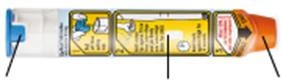
Blue safety cap Orange tip
Viewing window
Follow these instructions only when you are ready to use the medicine.
Hold the autoinjector in the center, never at the ends. For correct administration, refer to the figures and follow these steps:
- Do not place your thumb, fingers, or hand over the orange tip. Do not press or push the orange tip with your thumb, fingers, or hand.
- The needle will emerge from the orange tip.
- DO NOT remove the blue safety cap unless immediately before use.
- Hold Fastjekt in your dominant hand (the hand you write with),
with your thumb as close as possible to the blue safety cap, and
make a fist around the body of the autoinjector (with the orange tip
pointing downward).
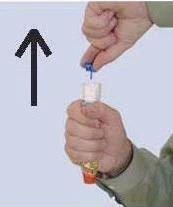
- Remove the blue safety cap by pulling it upward with the other hand.
- Hold Fastjekt approximately 10 cm away from the outer thigh. The
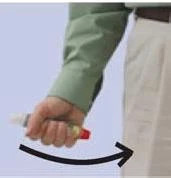
orange tip must be pointing toward the outer thigh.
- Press firmly with Fastjekt against the outer thigh at a 90-degree
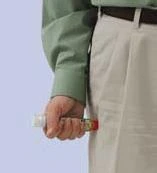
angle (you will hear a "click").
- Hold the device firmly against the thigh for 3 seconds. The injection is complete when the viewing window of the autoinjector turns dark.
- Remove Fastjekt (the orange needle cap will extend to cover the
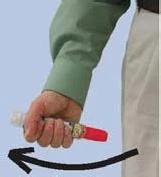
needle) and dispose of it safely.
Gently massage the injection site for 10 seconds.
Call 112 and request an ambulance for anaphylaxis.
A small air bubble may be present in the Fastjekt autoinjector. This does not affect the product’s effectiveness in any way.
Although most of the liquid (approximately 90%) remains in Fastjekt after use, it cannot be reused. Nevertheless, if the orange needle tip has extended and the viewing window is dark, you have received the correct dose of medication. After use, dispose of Fastjekt safely by placing it in the provided tube, and bring it with you when visiting your doctor, hospital, or pharmacy.
Since Fastjekt is strictly an emergency treatment, you must always seek immediate medical attention after using it. Call 112 and request an ambulance for “anaphylaxis,” even if symptoms appear to have improved. You will need to go to the hospital for observation and further treatment as required. This is because the reaction may recur at a later time.
While waiting for the ambulance, lie down with your legs elevated, unless this causes breathing difficulties—in which case, sit up. Ask someone to stay with you until the ambulance arrives, in case your condition worsens again.
Unconscious patients should be placed on their side in the recovery position.
If you use more Fastjekt than you should
In case of overdose or accidental injection of adrenaline, you must always seek immediate medical assistance.
4. Possible side effects
Like all medicines, this medicine can cause side effects, although not everyone will experience them.
Rare cases of serious skin and soft tissue infections (injection site infection) have been reported. If signs of infection at the injection site such as swelling, redness, warmth or pain occur, seek immediate medical attention.
Accidental injections of the pens into hands or feet have been reported, which may result in bleeding from the affected area. In case of accidental injection, always seek immediate medical attention.
Allergic reactions may occur in patients sensitive to sodium metabisulfite.
In rare cases (up to 1 in 1,000 patients) stress cardiomyopathy has been observed in patients treated with adrenaline.
Not known: frequency cannot be estimated from the available data): rapid or irregular heartbeat, sometimes strong, severe chest pain, high blood pressure, difficulty breathing, pallor, sweating, nausea, vomiting, headache, dizziness, weakness, tremor and agitation or anxiety, injection site reactions such as bruising, bleeding, redness.
Reporting of side effects
If you experience any side effect, including those not listed in this leaflet, talk to your doctor or pharmacist. You can also report side effects directly via the national reporting system at https://aifa.gov.it/content/segnalazioni-reazioni-avverse.
By reporting side effects, you can help provide more information on the safety of this medicine.
5. How to store Fastjekt
Keep this medicine out of the sight and reach of children.
Do not use this medicine after the expiry date stated on the carton and label after
Exp. The expiry date refers to the last day of that month.
Do not store above 25°C. Do not refrigerate or freeze.
Keep the container in the outer carton to protect the medicine from light. If exposed to air or
light, adrenaline deteriorates rapidly and turns pink or brown. Regularly check the
contents of the Fastjekt auto-injector glass cartridge to ensure that the liquid is
clear and colourless. Replace the auto-injector before the expiry date or earlier if the solution is
discoloured or contains a precipitate (solid material).
Do not dispose of medicines via wastewater or household waste. Ask your pharmacist how to
dispose of medicines no longer required. This will help protect the environment.
6. Package contents and other information
What Fastjekt contains
The active substance is adrenaline. Each dose contains 300 micrograms of adrenaline.
The other components are:
Sodium chloride
Sodium metabisulphite (E223)
Hydrochloric acid
Water for injections.
Description of the appearance of Fastjekt and contents of the pack
Clear, colourless solution in a pre-filled pen (auto-injector).
The auto-injector contains 2 ml of injectable solution. Each auto-injector delivers a single dose (0.3 ml) of 0.3 mg adrenaline.
The length of the exposed and protected needle is approximately 15 mm.
Packs:
1 auto-injector.
2 auto-injectors.
Not all pack sizes may be marketed.
Marketing Authorisation Holder
Viatris Healthcare Limited
Damastown Industrial Park
Mulhuddart, Dublin 15, Dublin
Ireland
Manufacturer responsible for batch release
MEDA Pharma GmbH & Co. KG
Benzstraße 1
D-61352 Bad Homburg
Germany
This medicinal product is authorised in the European Economic Area Member States under the following names:
| Member State | Medicinal Product Name |
| Bulgaria | Epipen 300 microgram injection solution in pre-filled pen |
| Greece | Epipen |
| Estonia | Epipen |
| Italy | Fastjekt 300 micrograms, solution for injection in pre-filled pen |
| France | EPIPEN 0.3 mg/0.3 ml, solution for injection in pre-filled pen |
| Romania | EpiPen 300 micrograms, solution for injection in pre-filled pen |
| Ireland | EpiPen 300 micrograms, Solution for injection in pre-filled pen |
| Lithuania | Epipen 300 micrograms, injection solution in pre-filled pen |
| Latvia | Epipen 300 micrograms, solution for injection in pre-filled pen |
| Portugal | Epipen 300 micrograms, solution for injection in pre-filled syringe |
| Slovenia | Epipen 300 micrograms/0.3 ml solution for injection in pre-filled pen |
| Sweden | Nepipe 300 microgram, injection liquid, solution in pre-filled injection pen |
Package leaflet: Information for the user
Fastjekt 150 micrograms, solution for injection in pre-filled pen
Adrenaline
Please read this leaflet carefully before using this medicine because it contains important information for you.
- Keep this leaflet. You may need to read it again.
- If you have any questions, ask your doctor, pharmacist or nurse.
- This medicine has been prescribed for you only. Do not give it to other people, even if their symptoms are the same as yours, as it could be dangerous.
- If you experience any side effects, including those not listed in this leaflet, talk to your doctor, pharmacist or nurse. See section 4.
Contents of this leaflet
- What Fastjekt is and what it is used for
- What you need to know before using Fastjekt
- How to use Fastjekt
- Possible side effects
- How to store Fastjekt
- Package contents and other information
1. What Fastjekt is and what it is used for
Fastjekt is a sterile solution in a prefilled pen for emergency injection into the muscle (intramuscular).
Fastjekt is intended for the emergency treatment of severe allergic reactions (anaphylaxis), caused by allergens such as those found in food, medications, insect stings or bites, as well as those triggered by exercise or unknown causes.
Fastjekt autoinjectors are designed for immediate administration to patients who are actually at increased risk of anaphylaxis, including individuals with a history of anaphylactic reactions.
Symptoms indicating the onset of an anaphylactic reaction include: skin itching; widespread skin rash (similar to hives); flushing; swelling of lips, throat, tongue, hands and feet; wheezing, hoarseness; nausea; vomiting; abdominal cramps; and, in some cases, loss of consciousness.
The medicine contained in the autoinjector (the pen) is adrenaline, which is an adrenergic drug.
It works directly on the cardiovascular (heart and circulation) and respiratory (lungs) systems, counteracting the potentially life-threatening effects of anaphylaxis by rapidly constricting blood vessels, relaxing the muscles in the lungs to improve breathing, reducing swelling in the throat, and stimulating the heartbeat.
2. What you should know before using Fastjekt
Do not use Fastjekt
There are no absolute contraindications to the use of Fastjekt during an allergic emergency.
Warnings and precautions
If you suffer from asthma, you may be at increased risk of experiencing a severe allergic reaction.
Anyone who has experienced an episode of anaphylaxis should consult a doctor to identify the substances to which they may be allergic, so that these can be strictly avoided in the future. It is important to be aware that an allergy to one substance may lead to becoming allergic to a range of related substances.
If you have food allergies, it is important to check the ingredients of everything you ingest (including medicines), as even small amounts may cause severe reactions.
Inform your doctor if you have:
- heart disease
- overactive thyroid
- high blood pressure
- diabetes
- increased pressure in the eyes (glaucoma)
- severe kidney problems
- prostate tumor
- high calcium levels or low potassium levels in the blood
- Parkinson’s disease
Despite these risks, adrenaline is essential in the treatment of anaphylaxis. Patients with these conditions, or anyone who may need to administer Fastjekt to a patient experiencing an allergic reaction, must be adequately trained regarding situations requiring administration.
For athletes: using this medicine without therapeutic need constitutes doping and may result in a positive anti-doping test.
Instructions for use must be carefully followed to avoid accidental injections.
Fastjekt must be injected only into the outer thigh. It must not be injected into the buttock due to the risk of accidental intravenous injection.
Warning: accidental injection into the hands or fingers may cause tissue discoloration or impaired blood flow to the affected area. In case of accidental injection into any of these areas, seek immediate medical attention at the nearest hospital emergency department for appropriate treatment.
If you have a thick layer of subcutaneous fat, there is a risk that a single dose of Fastjekt may not be sufficient. A second injection may be necessary. Carefully follow the instructions for use described in section 3.
Children and adolescents
Children weighing less than 15 kg:
The appropriateness of Fastjekt 150 micrograms must be individually assessed by the doctor.
Use in children weighing less than 7.5 kg is not recommended unless in potentially life-threatening situations and under medical advice.
Children and adolescents weighing more than 30 kg:
For these patients, the auto-injector Fastjekt 300 micrograms, containing 300 micrograms of adrenaline per dose, is available.
Other medicines and Fastjekt
Inform your doctor or pharmacist if you are currently taking, have recently taken, or might take any other medicines.
This is especially important if you are taking any of the following medicines:
- Antidepressants such as tricyclic antidepressants or monoamine oxidase inhibitors (MAO inhibitors), as the effects of adrenaline may be increased
- Medicines for the treatment of Parkinson’s disease, such as catechol-O-methyltransferase inhibitors (COMT inhibitors) and levodopa, as the effect of adrenaline may be enhanced
- Medicines that may make the heart sensitive to irregular heartbeats (arrhythmias), such as digitalis and quinidine
- Beta-blockers for heart conditions or medicines for nervous system disorders, as they may reduce the effect of adrenaline
- Medicines for thyroid disorders
- Medicines that make breathing easier, used for asthma (theophylline)
- Medicines used during labor (oxytocin)
- Medicines used for the treatment of allergies such as diphenhydramine or chlorpheniramine (antihistamines)
- Medicines acting on the nervous system (anticholinergics)
Diabetic patients should closely monitor their glucose levels after using Fastjekt, as adrenaline may affect the amount of insulin produced by the body, increasing blood glucose levels.
Fastjekt with food, drinks and alcohol
Food or drinks do not affect the use of Fastjekt.
Inform your doctor if you are consuming alcohol, as the effect of adrenaline may be increased.
Pregnancy and breastfeeding
Pregnancy
If you are pregnant, think you may be pregnant, planning to become pregnant, or breastfeeding, consult your doctor or pharmacist before taking this medicine.
In a potentially life-threatening situation, do not hesitate to use Fastjekt, as your life and your baby’s life may be at risk. Clinical experience with adrenaline use during pregnancy is limited.
Breastfeeding
Fastjekt should not have any effect on the breastfed newborn.
Driving and using machines
Not applicable.
Fastjekt contains sodium metabisulfite (E223) and sodium chloride.
Sodium metabisulfite may rarely cause severe allergic reactions or breathing difficulties (bronchospasm).
This medicine contains less than 1 mmol of sodium (23 mg) per dose, i.e. essentially “sodium-free”.
3. How to use Fastjekt
When your doctor prescribes Fastjekt, you must ensure that you understand why it has been prescribed to you. You must be certain that you know exactly how to use the device. Always use this medicine exactly as instructed by your doctor or pharmacist. If you are unsure about how to use it, ask your doctor, nurse, or pharmacist to repeat the instructions.
It is recommended that family members, caregivers, or teachers also be trained in the correct use of Fastjekt.
If an injection is administered by an assistant, the patient's leg must be immobilized during the injection to minimize the risk of leg injury.
Under no circumstances should you reinsert the used needle.
A training device for Fastjekt is available for demonstration and practice purposes (without medication, without needle). The training device and the functioning Fastjekt auto-injector must not be carried together in daily life to avoid confusion in emergency situations.
Fastjekt is indicated for use in children weighing between 15–30 kg.
For adults, adolescents, and children weighing more than 30 kg, the Fastjekt auto-injector containing 300 micrograms of adrenaline per dose is available.
For children weighing less than 15 kg, see the section “Children and adolescents” above.
Dosage
The dose will be determined by your doctor, who will adjust it according to your needs. The usual pediatric dose (15–30 kg) for allergic emergencies is 150 micrograms of adrenaline administered intramuscularly.
If you experience signs of an acute allergic reaction, use Fastjekt immediately.
Each Fastjekt auto-injector delivers a single dose of 0.3 ml of liquid, equivalent to 150 micrograms of adrenaline. After use, a small volume of solution will remain in the auto-injector, but it cannot be reused.
Sometimes a single dose of adrenaline may not be sufficient to counteract the effects of a severe allergic reaction. For this reason, your doctor may prescribe more than one Fastjekt auto-injector. If your symptoms do not improve or worsen within 5–15 minutes after the first injection, you or the people with you should administer a second injection. For this reason, you should always carry more than one Fastjekt auto-injector with you.
How Fastjekt is administered
Fastjekt is designed to be easily used by people without any medical training. Fastjekt is simply pressed firmly against the outer thigh from a distance of approximately 10 cm. There is no need to select a specific spot on the outer thigh. When you press Fastjekt firmly against the thigh, a spring-loaded plunger is activated, which drives the hidden needle into the thigh muscle, delivering a dose of adrenaline. Fastjekt can be injected through clothing, if worn.
The instructions for using Fastjekt must be followed carefully.
Fastjekt must be injected ONLY into the outer thigh. It must NOT be injected into the buttock.
Instructions for use
You must know exactly how and when to use Fastjekt.
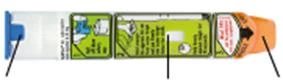
Blue safety cap Orange tip
Viewing window
Follow these instructions only when you are ready to use the medicine.
Hold the auto-injector in the center, never at the ends. For correct administration, refer to the figures and follow these steps:
- Do not place your thumb, fingers, or hand over the orange tip. Do not press or push the orange tip with your thumb, fingers, or hand.
- The needle will emerge from the orange tip.
- DO NOT remove the blue safety cap unless immediately before use.
- Hold Fastjekt in your dominant hand (the hand you write with), with your thumb as close as possible to the blue safety cap, and form a fist around the body of the auto-injector (with the orange tip pointing downward).
-
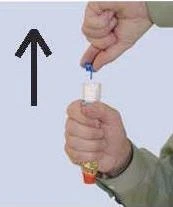
Remove the blue safety cap by pulling it upward with the other hand.
-
Hold Fastjekt approximately 10 cm away from the outer thigh.
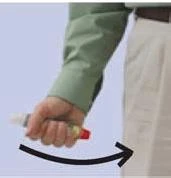
The orange tip must be pointing toward the outer thigh.
- Press firmly Fastjekt against the outer thigh at a right angle (90 degrees) (you will hear a "click").
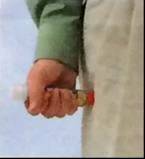
-
Hold the device firmly against the thigh for 3 seconds. The injection is complete when the viewing window of the auto-injector turns dark.
-
Remove Fastjekt (the orange needle cap will extend to cover the needle)
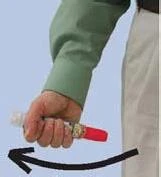
and dispose of it safely.
Gently massage the injection site for 10 seconds.
Call 112 and request an ambulance for anaphylaxis.
A small air bubble may be present in the Fastjekt auto-injector. This does not affect the effectiveness of the product in any way.
Although most of the liquid (approximately 90%) remains in Fastjekt after use, it cannot be used again. Nevertheless, if the orange needle tip has extended and the viewing window is dark, you have received the correct dose of the medicine. After use, dispose of Fastjekt safely by placing it in the provided tube, and bring it with you when you go to the doctor, hospital, or pharmacy.
Since Fastjekt is strictly an emergency treatment, you must always seek immediate medical attention after its use. Call 112 and request an ambulance for “anaphylaxis,” even if symptoms appear to have improved. You will need to go to the hospital for observation and further treatment as required. This is because the reaction may recur at a later time.
While waiting for the ambulance, lie down with your feet elevated unless this causes breathing difficulties, in which case you should sit up. Ask someone to stay with you until the ambulance arrives, in case you feel unwell again.
Unconscious patients should be turned onto their side into the recovery position.
If you use more Fastjekt than you should
In case of overdose or accidental injection of adrenaline, you must always seek immediate medical assistance.
4. Possible side effects
Like all medicines, this medicine can cause side effects, although not everybody gets them.
Rare cases of serious skin and soft tissue infections (injection site infection) have been reported. If signs of infection at the injection site occur, such as swelling, redness, warmth or pain, seek immediate medical attention.
Accidental injections of the pens into hands or feet have been reported, which may cause bleeding from the affected area. In case of accidental injection, always seek immediate medical attention.
Allergic reactions may occur in patients sensitive to sodium metabisulphite.
In rare cases (affecting up to 1 in 1,000 patients), stress-induced cardiomyopathy has been observed in patients treated with adrenaline.
Not known: frequency cannot be estimated from the available data): rapid or irregular heartbeat, sometimes pounding, severe chest pain, high blood pressure, difficulty breathing, pallor, sweating, nausea, vomiting, headache, dizziness, weakness, tremor and agitation or anxiety, injection site injuries such as bruising, bleeding, redness.
Reporting of side effects
If you experience any side effect, including those not listed in this leaflet, talk to your doctor or pharmacist. You can also report side effects directly via the national reporting system at https://aifa.gov.it/content/segnalazioni-reazioni-avverse.
By reporting side effects, you can help provide more information on the safety of this medicine.
5. How to store Fastjekt
Keep this medicine out of the sight and reach of children.
Do not use this medicine after the expiry date which is stated on the carton and label after
Exp. The expiry date refers to the last day of that month.
Do not store above 25°C. Do not refrigerate or freeze.
Keep the container in the carton to protect the medicine from light. If exposed to air or
light, adrenaline deteriorates rapidly and turns pink or brown. Check periodically the
contents of the glass cartridge of the Fastjekt auto-injector to ensure that the liquid is
clear and colourless. Replace the auto-injector before the expiry date or earlier if the solution is
discoloured or contains precipitate (solid material).
Do not dispose of medicines via wastewater or household waste. Ask your pharmacist how to
dispose of medicines no longer required. This will help protect the environment.
6. Package contents and other information
What Fastjekt contains
The active substance is adrenaline. Each dose contains 150 micrograms of adrenaline.
The other components are:
Sodium chloride
Sodium metabisulphite (E223)
Hydrochloric acid
Water for injections.
Description of the appearance of Fastjekt and contents of the pack
Clear, colourless solution in a pre-filled pen (auto-injector).
The auto-injector contains 2 ml of injectable solution. Each auto-injector delivers a single dose (0.3 ml) of 0.15 mg adrenaline.
The length of the exposed and protected needle is approximately 13 mm.
Pack sizes:
1 auto-injector.
2 auto-injectors.
Not all pack sizes may be marketed.
Marketing Authorisation Holder
Viatris Healthcare Limited
Damastown Industrial Park
Mulhuddart, Dublin 15, Dublin
Ireland
Responsible manufacturer for batch release
MEDA Pharma GmbH & Co. KG
Benzstraße 1
D-61352 Bad Homburg
Germany
This medicinal product is authorised in the European Economic Area countries under the following names:
| Member State Name | Medicinal Product Name |
| Bulgaria | Epipen 150 microgram injection solution in pre-filled pen |
| Greece | Epipen Jr. |
| Estonia | Epipen |
| Italy | Fastjekt 150 micrograms, solution for injection in pre-filled pen |
| France | EPIPEN 0.15 mg/ 0.3 ml, solution for injection in pre-filled pen |
| Romania | EpiPen 150 micrograms solution for injection in pre-filled pen |
| Ireland | EpiPen Junior 150 micrograms, Solution for injection in pre-filled pen |
| Lithuania | Epipen 150 micrograms injection solution in pre-filled injector |
| Latvia | Epipen 150 micrograms solution for injection in pre-filled syringe pen |
| Portugal | Epipen 150 micrograms, solution for injection in pre-filled syringe |
| Slovenia | Fastjekt for children 150 micrograms/ 0.3 ml solution for injection in pre-filled injection pen |
| Sweden | Nepipe Junior 150 microgram, injectable solution, liquid in pre-filled injection pen |