Farmaiod
Italy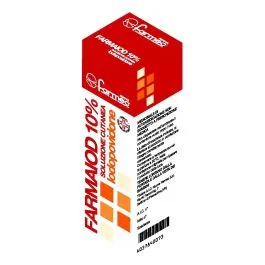
Table of Contents
- Package leaflet: Information for the user
- FARMAIOD 1% cutaneous solution
- 1. What FARMAIOD is and what it is used for
- 2. What you need to know before using FARMAIOD
- 3. How to use FARMAIOD
- 4. Possible side effects
- 5. How to store FARMAIOD
- 6. Contents of the pack and other information
- Package leaflet: Information for the user
- FARMAIOD 10% cutaneous solution
- 1. What FARMAIOD is and what it is used for
- 2. What you need to know before using FARMAIOD
- 3. How to use FARMAIOD
- 4. Possible side effects
- 5. How to store FARMAIOD
- 6. Package contents and other information
Package leaflet: Information for the user
FARMAIOD 1% cutaneous solution
Povidone-iodine
Please read all of this leaflet carefully before using this medicine because it contains important information for you.
Use this medicine exactly as described in this leaflet or as your doctor or pharmacist has instructed you.
- Keep this leaflet. You may need to read it again.
- If you would like more information or advice, consult your pharmacist.
- If you experience any side effects, including those not listed in this leaflet, consult your doctor or pharmacist. See section 4.
- Consult your doctor if you do not notice improvement or if you notice worsening of symptoms after a few days.
Contents of this leaflet:
- What FARMAIOD is and what it is used for
- What you need to know before using FARMAIOD
- How to use FARMAIOD
- Possible side effects
- How to store FARMAIOD
- Contents of the pack and other information
1. What FARMAIOD is and what it is used for
FARMAIOD contains the active substance povidone-iodine, which belongs to a group of medicines called antiseptics and disinfectants that reduce or inhibit the growth of germs.
FARMAIOD is indicated for cleaning and disinfecting the skin, both intact and in the presence of minor superficial wounds.
FARMAIOD is indicated for disinfecting the surgical field prior to surgical procedures.
Consult your doctor if you do not feel better or if you feel worse after a few days.
2. What you need to know before using FARMAIOD
Do not use FARMAIOD:
- if you are allergic to povidone-iodine or to any of the other ingredients of this medicine (listed in section 6);
- if the person to be treated with this medicine is a child under 6 months of age (see section “Children”);
- if you have thyroid disorders (thyroid diseases).
Do not apply this medicine to mucous membranes, burns, deep wounds, or large skin areas (also see
section “Warnings and precautions”).
FARMAIOD must not be used to disinfect the abdominal cavity (peritoneal washing) in case of infections (purulent peritonitis).
Warnings and precautions
Talk to your doctor or pharmacist before using FARMAIOD.
This medicine is for external use only (to be applied on the skin only).
Avoid applying FARMAIOD to the eyes.
Furthermore, do not ingest or inhale it, as serious, even fatal, consequences may occur.
High levels of iodine in the blood may cause adverse effects such as:
- increased levels of acid in the blood (metabolic acidosis);
- reduced levels of white blood cells in the blood (neutropia);
- thyroid problems (temporary hypothyroidism or thyrotoxic crisis in case of hyperthyroidism);
- interference with the results of certain thyroid function tests and stool and urine tests (occult blood testing) (See also section “Possible side effects”).
Avoid using FARMAIOD on very large skin areas
or under non-breathable (occlusive) dressings. If necessary, specific thyroid function tests are recommended.
Do not use FARMAIOD for prolonged periods, as allergic reactions (sensitization phenomena) may occur. In such cases, discontinue treatment and inform your doctor, who will determine appropriate therapy.
This medicine is flammable. Therefore, allow the medicine to dry completely before using electrical equipment.
If you are scheduled to undergo a thyroid scan using radioactive iodine (iodine-labelled scintigraphy), discontinue FARMAIOD treatment at least 10 days before the examination.
Children
In newborns, the application of antiseptic medicines containing iodine may cause thyroid problems
(hypothyroidism, thyroid dysfunction) (See section “Do not use FARMAIOD”).
In older children, this medicine should only be used when strictly necessary.
Other medicines and FARMAIOD
Inform your doctor or pharmacist if you are taking, have recently taken, or might take any other medicines.
During treatment with FARMAIOD, avoid using other similar medicines (disinfectants, detergents).
Also, do not apply on the affected area soaps or ointments containing mercury or benzoin compounds.
Pregnancy and breastfeeding
If you are pregnant, think you may be pregnant, planning to become pregnant, or are breastfeeding, consult your doctor or pharmacist before using this medicine.
Do not use this medicine during pregnancy unless clearly necessary and under strict medical supervision.
Driving and using machines
This medicine does not affect the ability to drive or operate machinery.
FARMAIOD contains ethanol
This medicine contains 869.2 mg of alcohol (ethanol) in 100 ml of solution, equivalent to 8.692% w/v.
It may cause a burning sensation on damaged skin.
3. How to use FARMAIOD
Use FARMAIOD exactly as instructed in this leaflet or as directed by your doctor or pharmacist. If you have any doubts, consult your doctor or pharmacist.
Apply undiluted FARMAIOD directly to the lesions or intact skin by dabbing with cotton wool thoroughly soaked in the solution. If necessary, repeat the application up to a maximum of 3–4 times a day.
Do not exceed the recommended doses.
If you use more FARMAIOD than you should
When used correctly, there is no risk of overdose.
In case of overdose, the following symptoms may occur:
- thyroid disorders (hypothyroidism, hyperthyroidism);
- metallic taste;
- increased salivation;
- burning or pain in the mouth and throat;
- eye irritation and swelling (tumefaction);
- allergic skin reactions (skin rashes);
- stomach and intestinal disorders (gastrointestinal disturbances);
- diarrhoea;
- increased levels of acid substances in the blood (metabolic acidosis) and of sodium (hypernatraemia);
- kidney problems (impaired renal function);
- fluid accumulation in the lungs (pulmonary oedema).
Additionally, if you apply the medicinal product to burns or to very extensive skin lesions (large areas devoid of epithelium), generalized (systemic) adverse effects may occur.
In case of accidental ingestion/overdose of a large amount of FARMAIOD, contact your doctor immediately or go to the nearest hospital.
4. Possible side effects
Like all medicines, this medicine can cause side effects, although not everybody gets them.
The following side effects may occur:
Frequency not known (frequency cannot be estimated from the available data):
- burning and irritation of the skin (intolerance);
- allergic reactions (tubercular dermatitis, dermatitis);
- iodine poisoning (iodism);
- delayed wound healing;
- alteration of results in certain thyroid function tests.
If you experience any of the symptoms listed above, discontinue treatment.
Reporting of side effects
If you experience any side effect, including those not listed in this leaflet, talk to your doctor or pharmacist.
You can also report side effects directly via the national reporting system at the following website: https://www.aifa.gov.it/content/segnalazioni-reazioni-avverse.
By reporting side effects, you can help provide more information on the safety of this medicine.
5. How to store FARMAIOD
Keep this medicine out of the sight and reach of children.
Do not use this medicine after the expiry date stated on the packaging after "Expiry".
The expiry date refers to the last day of that month.
Store below 30°C and in the original packaging, protected from light.
This medicine is highly flammable.
Do not dispose of any medicine via wastewater or household waste. Ask your pharmacist how to dispose of medicines you no longer use. This will help protect the environment.
6. Contents of the pack and other information
What FARMAIOD contains
- The active substance is povidone iodine. 100 g contain 1 g of povidone iodine (10% available free iodine).
- The other components are: ethyl alcohol 96%, isopropyl alcohol, colouring agents E110, E122, E131, purified water.
Description of the appearance of FARMAIOD and contents of the pack
Bottle of 250 ml, 500 ml and 1000 ml of solution.
Marketing Authorization Holder and Manufacturer
Nuova Farmec S.r.l. – Via W. Flemming, 7 – Settimo di Pescantina (VR)
Package leaflet: Information for the user
FARMAIOD 10% cutaneous solution
Povidone iodine
Please read this leaflet carefully before using this medicine because it contains important information for you.
Always use this medicine exactly as described in this leaflet or as your doctor or pharmacist has instructed you.
- Keep this leaflet. You may need to read it again.
- If you need further information or advice, consult your pharmacist.
- If you experience any adverse reaction, including effects not listed in this leaflet, contact your doctor or pharmacist. See section 4.
- Consult your doctor if you do not notice improvement or if you experience worsening of symptoms after a few days.
Contents of this leaflet:
- What FARMAIOD is and what it is used for
- What you need to know before using FARMAIOD
- How to use FARMAIOD
- Possible side effects
- How to store FARMAIOD
- Package contents and other information
1. What FARMAIOD is and what it is used for
FARMAIOD contains the active substance iodopovidone, which belongs to a group of medicines called antiseptics and disinfectants that reduce or inhibit the growth of germs.
FARMAIOD is indicated for cleaning and disinfecting the skin, both intact and in the presence of minor superficial wounds.
FARMAIOD is indicated for disinfecting the surgical field prior to surgical procedures.
Consult your doctor if you do not feel better or if you feel worse after a few days.
2. What you need to know before using FARMAIOD
Do not use FARMAIOD:
- if you are allergic to povidone-iodine or to any of the other ingredients of this medicine (listed in section 6);
- if the person to be treated is a child under 6 months of age (see section “Children”);
- if you have thyroid diseases (thyroid disorders).
Do not apply this medicine on mucous membranes, burns, deep wounds, or over large skin areas (also see section “Warnings and precautions”).
FARMAIOD must not be used to disinfect the abdominal cavity (peritoneal washing) in case of infections (purulent peritonitis).
Warnings and precautions
Talk to your doctor or pharmacist before using FARMAIOD.
This medicine is for external use only and must be applied only on the skin.
Avoid applying FARMAIOD to the eyes.
Furthermore, do not swallow or inhale it, as serious, even fatal, consequences may occur.
High levels of iodine in the blood may cause adverse effects such as:
- increased levels of acid in the blood (metabolic acidosis);
- reduced levels of white blood cells in the blood (neutropenia);
- thyroid problems (temporary hypothyroidism or thyrotoxic crisis in case of hyperthyroidism);
- interference with certain thyroid function tests and stool and urine analyses (occult blood testing) (see also section “Possible side effects”).
Avoid using FARMAIOD on very large skin areas or under occlusive (non-breathable) dressings.
If necessary, specific thyroid function tests are recommended.
Do not use FARMAIOD for prolonged periods, as allergic reactions (sensitization phenomena) may occur. In such cases, discontinue treatment and inform your doctor, who will determine appropriate therapy.
If you are scheduled for a thyroid scan using radioactive iodine (iodine-labelled scintigraphy), stop treatment with FARMAIOD at least 10 days before undergoing this test.
Children
In newborns, the application of antiseptic medicines containing iodine may cause thyroid problems (hypothyroidism, thyroid dysfunction) (see section “Do not use FARMAIOD”).
In older children, this medicine should be used only when strictly necessary.
Other medicines and FARMAIOD
Inform your doctor or pharmacist if you are currently taking, have recently taken, or might take any other medicines.
During treatment with FARMAIOD, avoid using other similar medicines (disinfectants, cleansing agents).
Also, do not apply on the affected area soaps or ointments containing mercury or benzoin compounds.
Pregnancy and breastfeeding
If you are pregnant, think you may be pregnant, planning to become pregnant, or breastfeeding, consult your doctor or pharmacist before using this medicine.
Do not use this medicine during pregnancy unless clearly necessary and under strict medical supervision.
Driving and using machines
This medicine does not impair the ability to drive or operate machinery.
3. How to use FARMAIOD
Use FARMAIOD exactly as directed in this leaflet or as instructed by your doctor or pharmacist. If you have any doubts, consult your doctor or pharmacist.
Apply FARMAIOD to lesions or intact skin by dabbing with cotton wool thoroughly soaked in the solution. If necessary, repeat the application up to 3–4 times daily.
Do not exceed the recommended doses.
If you use more FARMAIOD than you should
When used correctly, there is no risk of overdose.
In case of overdose, the following symptoms may occur:
- thyroid disorders (hypothyroidism, hyperthyroidism);
- metallic taste;
- increased salivation;
- burning or pain in the mouth and throat;
- eye irritation and swelling (tumefaction);
- allergic skin reactions (skin rashes);
- stomach and intestinal disturbances (gastrointestinal disorders);
- diarrhoea;
- increased levels of acidic substances (metabolic acidosis) and sodium in the blood (hypernatremia);
- kidney problems (impaired renal function);
- fluid accumulation in the lungs (pulmonary edema).
Additionally, if you apply the medicine to burns or to very extensive skin lesions (large denuded areas), generalized (systemic) adverse effects may occur.
In case of accidental ingestion/overdose of a large amount of FARMAIOD, inform your doctor immediately or go to the nearest hospital.
4. Possible side effects
Like all medicines, this medicine can cause side effects, although not everyone experiences them.
The following side effects may occur:
Frequency not known (frequency cannot be estimated from the available data):
- burning and skin irritation (intolerance);
- allergic reactions (tuberous dermatitis, dermatitis);
- iodine poisoning (iodism);
- delayed wound healing;
- alteration of results in certain thyroid function tests.
- If you experience these symptoms, stop treatment
Reporting of side effects
If you experience any side effect, including those not listed in this leaflet, consult your doctor or pharmacist.
You may also report side effects directly through the national reporting system at https://www.aifa.gov.it/content/segnalazioni-reazioni-avverse.
By reporting side effects, you can help provide more information on the safety of this medicine.
5. How to store FARMAIOD
Keep this medicine out of the sight and reach of children.
Do not use this medicine after the expiry date stated on the packaging after "Expiry".
The expiry date refers to the last day of that month.
Store below 30°C and in the original packaging, protected from light.
Do not dispose of any medicine via wastewater or household waste. Ask your pharmacist how to dispose of medicines you no longer use. This will help protect the environment.
6. Package contents and other information
What FARMAIOD contains
- The active substance is povidone-iodine. 100 g contain 1 g of povidone-iodine (10% available free iodine).
- The other components are: ethoxylated alcohol, dibasic sodium phosphate, anhydrous citric acid, sodium hydroxide, glycerin, purified water.
Description of the appearance of FARMAIOD and contents of the pack
Bottle of 100 ml, 250 ml, 500 ml and 1000 ml of solution.
Marketing Authorization Holder and Manufacturer
Nuova Farmec S.r.l. – Via W. Flemming, 7 – Settimo di Pescantina (VR)