Extraneal
Italy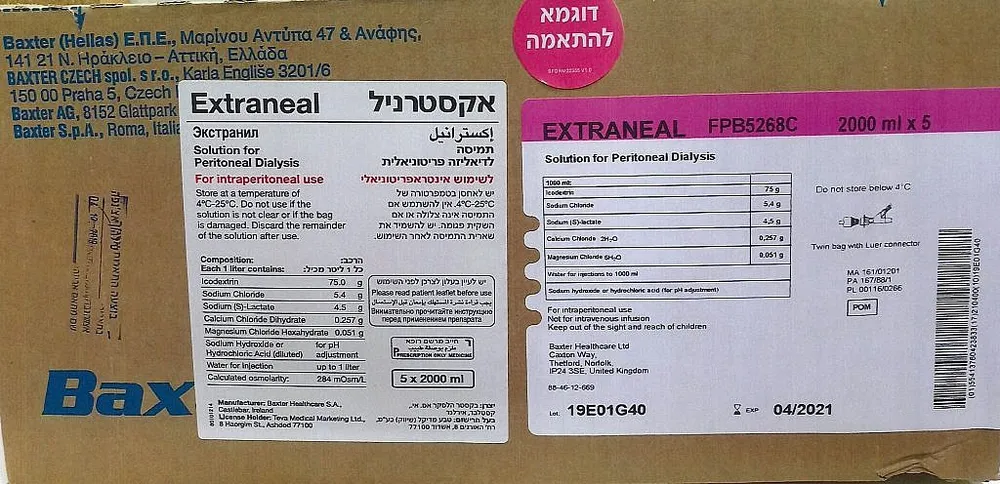
Instructions for Use
PACKAGE LEAFLET: INFORMATION FOR THE USER
EXTRANEAL, peritoneal dialysis solution
Read this leaflet carefully before using this medicine.
- Keep this leaflet. You may need to read it again.
- If you have any questions, consult your doctor.
- If you experience any side effects, including those not listed in this leaflet, consult your doctor. See section 4.
Contents of this leaflet:
- What EXTRANEAL is and what it is used for
- What you need to know before using EXTRANEAL
- How to use EXTRANEAL
- Possible side effects
- How to store EXTRANEAL
- Contents of the pack and other information
1. WHAT EXTRANEAL IS AND WHAT IT IS USED FOR
EXTRANEAL is a solution for peritoneal dialysis. The peritoneal cavity is the space within the abdomen (belly), located between the skin and the peritoneum. The peritoneum is the membrane surrounding internal organs such as the intestines and liver. EXTRANEAL solution is introduced into the peritoneal cavity, where it removes water and waste products from the blood. Additionally, it corrects abnormal levels of various blood components. EXTRANEAL may be prescribed to you if:
- You are an adult with permanent kidney failure requiring peritoneal dialysis.
- When standard glucose-based peritoneal dialysis solutions alone are not sufficient to remove adequate amounts of water.
2. WHAT YOU SHOULD KNOW BEFORE USING EXTRANEAL
The first time, this product must be used under medical supervision.
DO NOT USE EXTRANEAL
- if you are allergic to icodextrin or starch derivatives (e.g. corn starch) or to any of the other components of EXTRANEAL
- if you are intolerant to maltose or isomaltose (sugars derived from starch)
- if you have disorders affecting glycogen storage
- if you already have severe lactic acidosis (excess acid in the blood)
- if you have an abdominal wall or cavity condition that cannot be surgically corrected, or a non-correctable condition that increases the risk of abdominal infections
- if you have documented loss of peritoneal function due to significant peritoneal scarring
Warnings and precautions
Consult your doctor before using EXTRANEAL
- If you are elderly. There is a risk of dehydration.
- If you are diabetic and are using this solution for the first time. Adjustment of your insulin dosage may be necessary.
- If you need to monitor your blood glucose (e.g. if you are diabetic). Your doctor will advise you
on which type of test to use (see Other forms of interaction ).
- If you are at high risk of severe lactic acidosis (excess acid in the blood). You are at increased risk of lactic acidosis if:
- you have very low blood pressure
- you have a blood infection
- you have acute kidney failure
- you have an inherited metabolic disorder
- you are taking metformin (a medicine used to treat diabetes)
- you are taking medicines for the treatment of HIV, particularly medicines called NRTIs
- If you have abdominal pain or notice cloudiness or particles in the drained fluid. These signs may indicate peritonitis (inflamed peritoneum) or infection, and you must contact your medical team urgently. Note down the batch number and provide it to your medical team along with the bag of drained fluid. They will decide whether treatment should be stopped or corrective measures taken. For example, if you have an infection, your doctor may perform tests to determine the most appropriate antibiotic for you. Until the type of infection is identified, your doctor may administer an antibiotic effective against a wide range of different bacteria. This is known as a broad-spectrum antibiotic.
- During peritoneal dialysis, your body may lose proteins, amino acids, and vitamins. Your doctor will determine whether supplementation is necessary.
- If you have conditions affecting the abdominal wall or cavity. For example, in case of hernia or chronic inflammatory or infectious conditions affecting the intestine.
- If you have had an aortic graft.
- If you have severe lung disease, e.g. emphysema.
- If you have breathing difficulties.
- If you have disorders impairing normal nutrition.
- If you have potassium deficiency.
In addition, you should consider the following:
- A condition called encapsulating peritoneal sclerosis (EPS) is a rare known complication of peritoneal dialysis therapy. You, possibly together with your doctor, should be aware of this possible complication. EPS causes:
- inflammation of the abdomen (stomach)
- the growth of fibrous tissue layers that cover and bind organs, altering their normal movement. Rarely, this condition has been fatal.
- You, possibly together with your doctor, should keep a record of your fluid balance and body weight. Your doctor will monitor your blood parameters at regular intervals.
- Your doctor will regularly check your potassium levels. If they become too low, you may be given potassium chloride to compensate.
Sometimes treatment with this medicine is not recommended, for example if you have:
- Acute kidney disorders.
Children
The safety and efficacy of EXTRANEAL in children under 18 years of age have not been
established.
Other medicines and EXTRANEAL
Inform your doctor if you are taking, have recently taken, or might take any other
medicines.
- If you are taking other medicines, your doctor may need to increase their dosage. This is because peritoneal dialysis treatment increases the elimination of certain medicines.
- Be cautious if you are taking heart medications known as cardiac glycosides (e.g. digoxin). The heart medication may become less effective or its toxicity may increase. You might: need to take potassium and calcium supplements. or develop an irregular heartbeat (arrhythmia). Your doctor will monitor you closely during treatment, particularly watching potassium levels.
Other forms of interaction
EXTRANEAL interferes with blood glucose measurement when certain tests are used. If you
need to monitor your blood glucose, make sure to use a glucose-specific test kit.
Your doctor will advise you which one to use.
Using an inappropriate test may result in falsely elevated glucose readings, which could
lead you to administer excessive insulin doses. This may cause hypoglycemia (low blood glucose levels), potentially resulting in loss of consciousness, coma, neurological damage, or death. Additionally, a falsely elevated glucose reading may mask a true hypoglycemia and prevent its treatment, with similar consequences.
Falsely elevated glucose readings may persist for up to two weeks after discontinuation of
EXTRANEAL therapy. If hospitalized, you must inform doctors about this potential interaction, and they must carefully review the test product information to ensure a glucose-specific test is used.
Pregnancy and breastfeeding
If you are pregnant or breastfeeding, suspect you may be pregnant, or are planning pregnancy,
ask your doctor for advice before using this medicine.
EXTRANEAL is not recommended during pregnancy and breastfeeding, unless otherwise
advised by your doctor.
Driving and using machines
This treatment may cause fatigue, weakness, blurred vision, or dizziness. Under these
conditions, do not drive or operate machinery.
3. HOW TO USE EXTRANEAL
EXTRANEAL must be administered into your peritoneal cavity. The peritoneal cavity is the space
within your abdomen (belly), located between your skin and the peritoneum. The peritoneum is the membrane surrounding the internal organs, such as the intestines and liver.
Use this medicine exactly as directed by your peritoneal dialysis healthcare team. If you have any doubts, consult your doctor.
Recommended dose
- One bag per day according to the longer dwell time, i.e.:
- Overnight in continuous ambulatory peritoneal dialysis (CAPD)
- During the day in automated peritoneal dialysis (APD).
- It takes 10 to 20 minutes to instill the solution.
- With EXTRANEAL, the dwell time is 6–12 hours in CAPD and 14–16 hours in APD.
METHOD OF ADMINISTRATION
Before use:
- Warm the bag to 37°C using the designated warming device. Never heat the bag by immersing it in water.
- Use an aseptic technique throughout the entire administration of the solution, as instructed.
- Before starting the exchange, ensure that your hands and the area where the exchange will take place are clean.
- Before opening the overwrap, check that the solution, expiry date, and quantity (volume) are correct. Lift the dialysis bag to check for leaks (excess fluid in the overwrap). Do not use the bag if you detect any leaks.
- After removing the overwrap, examine the container for leaks by firmly pressing on the bag. Do not use the bag if you detect any leaks.
- Check that the solution is clear. Do not use the bag if the solution is cloudy or contains particles.
- Ensure that all connectors are properly attached before starting the exchange.
- Consult your doctor if you have any questions or doubts about this medicine or how to use it. For single use only. Discard any unused portion of the solution. After use, check that the drained fluid is not cloudy.
Compatibility with other medicines
Your doctor may prescribe other injectable medicines to be added directly into the EXTRANEAL bag. In this case, add the medicine through the medication port located at the bottom of the bag. Use the product immediately after adding the medicine. If in doubt, ask your doctor.
If you have used more than one bag of EXTRANEAL in 24 hours
If you use more EXTRANEAL than you should, the following may occur:
- abdominal distension
- feeling of fullness and/or
- shortness of breath
Contact your doctor immediately. They will advise you on what to do.
If you stop treatment with EXTRANEAL
Do not stop peritoneal dialysis without your doctor’s consent. Stopping treatment may lead to life-threatening consequences.
4. POSSIBLE ADVERSE REACTIONS
Like all medicines, EXTRANEAL can cause adverse reactions, although not everyone experiences them.
If you experience any adverse reaction, contact your doctor. This includes any adverse reaction not listed in this leaflet.
If any of the following conditions occur, inform your doctor or peritoneal dialysis center immediately:
- Hypertension (blood pressure higher than normal),
- Swollen legs or ankles, swollen eyes, shortness of breath, or chest pain (hypervolemia),
- Hypersensitivity (allergic reaction) which may include swelling of the face, throat, or around the eyes (angioedema),
- Abdominal pain,
- Chills (trembling/flu-like symptoms).
These conditions could indicate serious adverse reactions. You may require urgent medical attention.
Adverse reactions commonly observed (may affect up to 1 in 10 patients) in patients treated with EXTRANEAL:
- Skin redness and peeling, rash, or itching
- Dizziness or vertigo, thirst (dehydration)
- Reduction in blood volume (hypovolemia)
- Changes in laboratory test results
- Weakness, headache, fatigue
- Swollen legs or ankles
- Drop in blood pressure (hypotension)
- Ringing in the ears
Other adverse reactions related to the peritoneal dialysis procedure or common to all peritoneal dialysis solutions:
- Cloudy dialysis fluid drained from the peritoneum, stomach ache.
- Peritoneal hemorrhage, pus, swelling, pain or infection at the catheter exit site, catheter blockage, injuries, or catheter-related complications.
- Low blood sugar concentration (hypoglycemia)
- Shock or coma caused by low blood sugar concentration
- High blood sugar concentration (hyperglycemia)
- Nausea, vomiting, loss of appetite, dry mouth, constipation, diarrhea, flatulence (gas), gastrointestinal disorders such as intestinal obstruction, gastric ulcer, gastritis (inflamed stomach), indigestion.
- Abdominal distension, abdominal cavity hernia (which may lead to inguinal hernia).
- Changes in blood test results.
- Altered liver function tests
- Weight gain or weight loss
- Pain, fever, malaise
- Cardiac disorders, rapid heartbeat, shortness of breath, or chest pain
- Anemia (reduced red blood cells, causing pale skin, weakness, or shortness of breath); increased or decreased white blood cell count; reduced platelet count, leading to increased risk of bleeding or bruising
- Numbness, tingling, burning sensation
- Hyperkinesia (increased movement and inability to stay still)
- Blurred vision
- Loss of taste
- Fluid in the lungs (pulmonary edema), shortness of breath, difficulty breathing or breathlessness, cough, hiccups
- Kidney pain
- Nail disorders
- Skin disorders such as urticaria, psoriasis, skin ulcers, eczema, dry skin, skin discoloration, blistering of the skin, allergic or contact dermatitis, rash, and itching
- Rashes may be itchy, with red spots covered by swellings, eruptions, or skin peeling. The following three serious types of skin reactions may occur:
- Toxic epidermal necrolysis (TEN). This causes:
- Red rashes on many parts of the body
- Loss of the outer layer of skin
- Erythema multiforme. An allergic skin reaction causing spots, red or purple bruise-like streaks, or blistered areas. In addition, mouth, eyes, and other moist body surfaces may be affected.
- Vasculitis. Inflammation of blood vessels in certain parts of the body. Clinical symptoms depend on the affected body part, but may include red or purple spots or marks on the skin, or symptoms similar to an allergic reaction, including rash, joint pain, and fever.
- Muscle cramps, pain in bones, joints, muscles, back, neck
- Drop in blood pressure upon standing (orthostatic hypotension)
- Peritonitis (inflamed peritoneum), including fungal or bacterial infection-related peritonitis
- Infections including flu-like syndrome, boils
- Abnormal thinking, anxiety, nervousness
- Toxic epidermal necrolysis (TEN). This causes:
Reporting of adverse reactions
If you experience any adverse reaction, including those not listed in this leaflet, inform your doctor. You may also report adverse reactions directly via the national reporting system at https://www.aifa.gov.it/content/segnalazioni-reazioni-avverse. By reporting adverse reactions, you can help provide more information on the safety of this medicine.
5. HOW TO STORE EXTRANEAL
- Keep out of the sight and reach of children.
- Store in the original packaging.
- Do not store below 4 °C.
- Do not use EXTRANEAL after the expiry date. The date is stated on the label of the packaging and on the bag after the abbreviation Exp. and the symbol . The expiry date refers to the last day of the month. Dispose of EXTRANEAL as indicated during your training.
6. CONTENTS OF THE PACKAGE AND OTHER INFORMATION
This leaflet does not contain all the information about this medicine. If you have any doubts or
are unsure about something, ask your doctor.
What EXTRANEAL contains
The active substances are:
| Icodextrin | 75 g/l |
| Sodium chloride | 5.4 g/l |
| Sodium S-lactate | 4.5 g/l |
| Calcium chloride | 0.257 g/l |
| Magnesium chloride | 0.051 g/l |
| Sodium | 133 mmol/l |
| Calcium | 1.75 mmol/l |
| Magnesium | 0.25 mmol/l |
| Chloride | 96 mmol/l |
| Lactate | 40 mmol/l |
The excipients are:
- Water for injections.
- Sodium hydroxide or hydrochloric acid.
Description of the appearance of EXTRANEAL and contents of the pack
- EXTRANEAL is supplied in flexible plastic bags containing 1.5, 2.0 or 2.5 litres.
- The solution in the bags is clear and colourless.
- Each bag is packed in an outer wrapper and supplied in cardboard boxes.
Volume Number of units per box Product packaging Type of connector
1.5 l 8 Single bag (APD) luer / spike
1.5 l 8 Double bag (CAPD) luer / spike
1.5 l 6 Single bag (APD) luer / spike
1.5 l 6 Double bag (CAPD) luer / spike
2.0 l 8 Single bag (APD) luer / spike
2.0 l 8 Double bag (CAPD) luer / spike
2.0 l 6 Single bag (APD) luer / spike
2.0 l 6 Double bag (CAPD) luer / spike
2.0 l 5 Single bag (APD) luer / spike
2.0 l 5 Double bag (CAPD) luer / spike
2.5 l 5 Single bag (APD) luer / spike
2.5 l 5 Double bag (CAPD) luer / spike
2.5 l 4 Single bag (APD) luer / spike
2.5 l 4 Double bag (CAPD) luer / spike
Not all pack sizes may be marketed.
For further information about this medicinal product, contact the local representative of the marketing authorisation holder:
Marketing Authorisation Holder
Vantive S.r.l.
Via del Serafico, 89 – 00142 ROME
Manufacturer
Vantive Manufacturing Limited
Moneen Road - Castlebar, County Mayo - Ireland
This patient information leaflet was last revised on:
Similar Medications
-
CAPD 17
Form: solution for peritoneal dialysis
Active substance Dosage PERITONEAL DIALYSIS SOLUTION — Manufacturer: FRESENIUS MEDICAL CARE ITALIA S.P.A.
-
CAPD 19
Form: solution for peritoneal dialysis
Active substance Dosage PERITONEAL DIALYSIS SOLUTION — Manufacturer: FRESENIUS MEDICAL CARE ITALIA S.P.A.
-
Capd 18
Form: solution for peritoneal dialysis
Active substance Dosage PERITONEAL DIALYSIS SOLUTION — Manufacturer: FRESENIUS MEDICAL CARE ITALIA S.P.A.
-
Icothera
Form: solution for peritoneal dialysis
Active substance Dosage PERITONEAL DIALYSIS SOLUTION — Manufacturer: VIVISOL S.R.L.
-
Peritoneal dialysis solution FME
Form: solution for peritoneal dialysis
Active substance Dosage PERITONEAL DIALYSIS SOLUTION — Manufacturer: FRESENIUS MEDICAL CARE DEUTSCHLAND GMBH
-
Peritoneal dialysis solution Galenica Senese
Form: solution for peritoneal dialysis
Active substance Dosage PERITONEAL DIALYSIS SOLUTION — Manufacturer: INDUSTRIA FARMACEUTICA GALENICA SENESE S.R.L.
-
Peritoneal dialysis solution Vantive
Form: solution for peritoneal dialysis
Active substance Dosage SODIUM CHLORIDE — CALCIUM CHLORIDE DIHYDRATE — MAGNESIUM CHLORIDE HEXAHYDRATE — SODIUM LACTATE — GLUCOSE MONOHYDRATE — Manufacturer: VANTIVE SRL
This page has been machine-translated and may contain inaccuracies. The original data is available in the manufacturing country's language.
Last data check: May 11, 2026 · Data source: Agenzia Italiana del Farmaco (AIFA)