EuspiFlu
Italy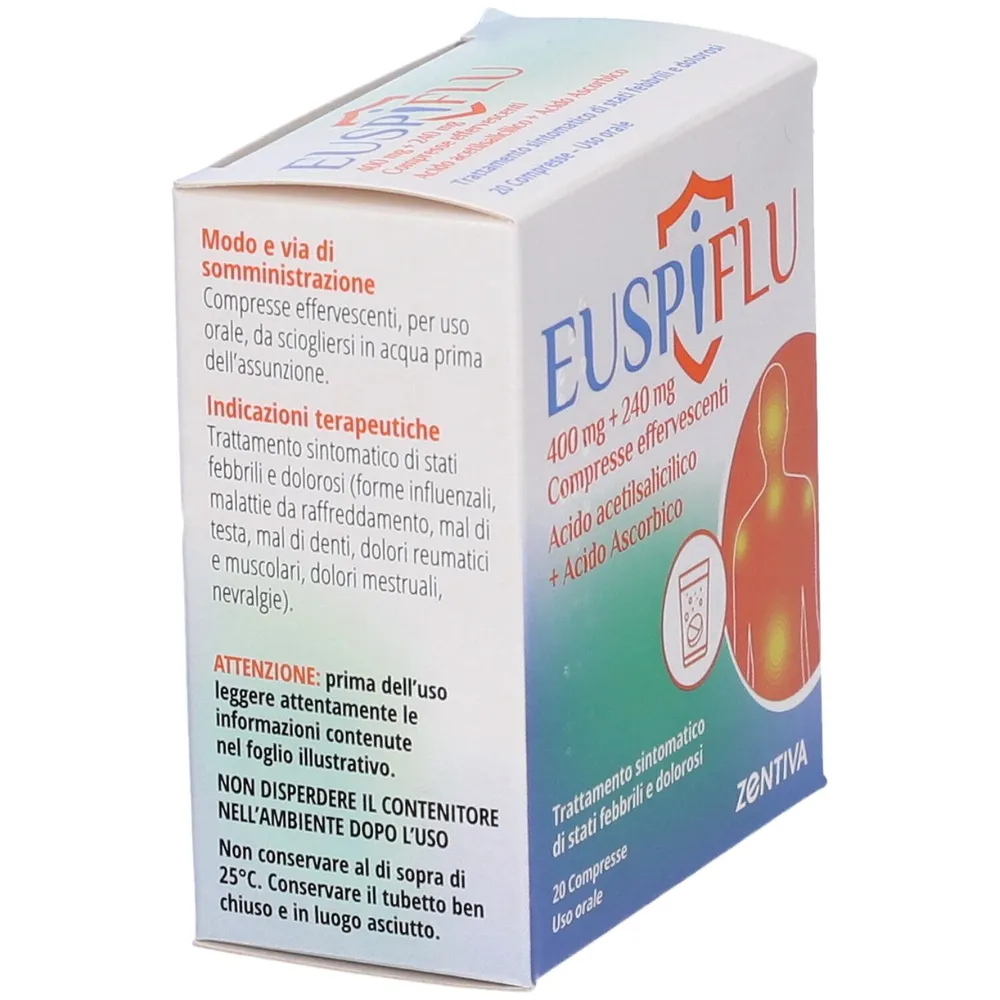
Table of Contents
Package leaflet: Information for the user
Euspiflu 400 mg + 240 mg effervescent tablets
Acetylsalicylic acid / ascorbic acid
Please read all of this leaflet carefully before you start taking this medicine because it contains important information for you.
Always take this medicine exactly as described in this leaflet or as your doctor or pharmacist has told you to do.
- Keep this leaflet. You may need to read it again.
- If you need more information or advice, consult your pharmacist.
- If you experience any side effects, including those not listed in this leaflet, talk to your doctor or pharmacist. See section 4.
- Talk to your doctor if you do not notice any improvement or if your symptoms worsen after 3 days.
Contents of this leaflet:
- What Euspiflu is and what it is used for
- What you need to know before taking Euspiflu
- How to take Euspiflu
- Possible side effects
- How to store Euspiflu
- Contents of the pack and other information
1. What Euspiflu is and what it is used for
Euspiflu contains two active substances, acetylsalicylic acid and ascorbic acid (vitamin C), and belongs to the group of analgesic (pain-relieving) and antipyretic (fever-reducing) medicinal products.
Euspiflu is used in adults for the symptomatic treatment of fever and painful conditions (influenza-like illnesses, colds, headache, toothache, rheumatic and muscular pain, menstrual pain, neuralgia).
2. What you need to know before taking Euspiflu
Do not take Euspiflu
- if you are allergic to acetylsalicylic acid, ascorbic acid, or to any of the other ingredients of this medicine (listed in section 6);
- if you are allergic to another salicylate (the group of substances to which acetylsalicylic acid belongs) or to other non-steroidal anti-inflammatory drugs (NSAIDs);
- if you currently have a gastric or duodenal ulcer or other gastropathies (stomach disorders);
- if you are at risk of bleeding, particularly if you have haemophilia or other blood coagulation disorders (such as reduced levels of prothrombin (a protein involved in the blood coagulation cascade) (hypoprothrombinemia), or vitamin K deficiency, which activates certain coagulation proteins);
- if you have or have had severely impaired kidney function (renal failure) or severe liver dysfunction (hepatic failure);
- if you suffer from bronchial asthma, particularly if associated with nasal polyps (nasal growths) and swelling of the skin and mucous membranes (angioedema);
- during the third trimester of pregnancy (see section “Pregnancy and breastfeeding”);
- in children and adolescents under 16 years of age.
Warnings and precautions
Talk to your doctor or pharmacist before taking Euspiflu.
Exercise particular caution with Euspiflu and inform your doctor:
- if you are elderly with reduced kidney function or if you have low levels of albumin in the blood, as this may increase the risk of toxicity;
- if you are over 70 years old, especially if you are undergoing other treatments;
- if you have a deficiency of the enzyme glucose-6-phosphate dehydrogenase, as this may lead to haemolysis (breakdown of red blood cells in the blood);
- if you are taking anticoagulant medicines (i.e., those that slow down or interrupt the blood coagulation process), as this may increase the risk of bleeding (see section “Other medicines and Euspiflu”);
- if you are taking corticosteroids (steroidal anti-inflammatory drugs), as this may increase the risk of gastrointestinal bleeding (see section “Other medicines and Euspiflu”);
- if you currently suffer or have previously suffered from nephrolithiasis (kidney stones);
- if you have a disease characterised by abnormal iron accumulation in organs and tissues (haemochromatosis), an inherited condition causing anaemia (thalassaemia), or sideroblastic anaemia;
- if you are taking diuretics (medicines used to increase urine production and excretion), such as spironolactone and furosemide, or medicines used to treat gout (see section “Other medicines and Euspiflu”);
- if you are scheduled for surgery, because acetylsalicylic acid administered before surgery may interfere with blood coagulation processes during the operation (intraoperative haemostasis).
After 3 days of taking the maximum dose or after 5–7 days of use without noticeable improvement,
consult your doctor.
Talk to your doctor before taking Euspiflu if prolonged or high-dose treatment is required.
If prolonged vomiting or profound drowsiness occurs during treatment, you must immediately
discontinue Euspiflu and consult your doctor.
Children and adolescents
Euspiflu must not be used in children and adolescents under 16 years of age.
In adolescents over 16 years of age with viral infections such as influenza or varicella,
consult your doctor before administering this medicine.
Other medicines and Euspiflu
Inform your doctor or pharmacist if you are currently taking, have recently taken, or might take any other medicines.
In particular, inform your doctor or pharmacist if you are taking:
- anticoagulants (such as coumarin derivatives and heparin) used to slow down or interrupt the blood coagulation process, because acetylsalicylic acid may enhance their effect, especially with long-term treatment;
- methotrexate, a medicine used to treat autoimmune diseases and neoplasms, because acetylsalicylic acid may increase its adverse effects;
- corticosteroids (steroidal anti-inflammatory drugs), because acetylsalicylic acid may increase the risk of gastrointestinal bleeding;
- other non-steroidal anti-inflammatory drugs (NSAIDs), because acetylsalicylic acid may increase their adverse effects;
- oral hypoglycaemic agents (sulfonylureas), used to treat type II diabetes (or adult-onset diabetes), because acetylsalicylic acid may enhance their effect;
- diuretics (used to increase urine production and excretion), such as spironolactone and furosemide, or antigout medicines (used to treat gout), because acetylsalicylic acid may reduce their effectiveness.
Laboratory tests and Euspiflu
Talk to your doctor before taking Euspiflu if you are scheduled for a diagnostic test, because ascorbic acid may interfere with the results of certain tests, particularly urine glucose testing, and it may therefore be necessary to stop taking vitamin C a few days before undergoing diagnostic tests.
Pregnancy and breastfeeding
If you are pregnant, think you may be pregnant, are planning to become pregnant, or are breastfeeding, consult your doctor or pharmacist before taking this medicine.
If you continue or start treatment with Euspiflu during pregnancy as directed by your doctor, use Euspiflu as advised by your doctor and do not exceed the recommended dose.
Euspiflu must not be taken during the last trimester of pregnancy.
Last three months of pregnancy
Do not take acetylsalicylic acid in doses exceeding 100 mg per day during the last three months of pregnancy, as this may harm the foetus or cause complications during delivery. It may cause kidney and heart problems in the foetus. It may affect the tendency of both mother and baby to bleed and may delay or prolong labour.
If you take acetylsalicylic acid at low doses (up to 100 mg per day), strict obstetric monitoring is required as advised by your doctor.
First six months of pregnancy
You should not take Euspiflu during the first six months of pregnancy unless absolutely necessary and advised by your doctor. If treatment is needed during this period or while trying to conceive, use the lowest possible dose for the shortest possible time. If taken for more than a few days starting from week 20 of pregnancy, Euspiflu may cause kidney problems in the foetus, thereby reducing the levels of amniotic fluid surrounding the baby (oligohydramnios), and may cause constriction of a blood vessel (ductus arteriosus) in the baby’s heart. If treatment is required for more than a few days, your doctor may recommend additional monitoring.
Breastfeeding
During breastfeeding, avoid taking high doses of acetylsalicylic acid.
Driving and using machines
No effects on the ability to drive or operate machinery are known.
Euspiflu contains sodium
This medicine contains 19.5 mmol (or 448.5 mg) of sodium per effervescent tablet.
Talk to your doctor or pharmacist if you need to take one or more effervescent tablets daily for a prolonged period, especially if you have been advised to follow a low-sodium diet.
3. How to take Euspiflu
Take this medicine exactly as stated in this leaflet or as directed by your doctor or pharmacist. If you have any doubts, consult your doctor or pharmacist.
Elderly people, adults and adolescents above 16 years of age
- As an antipyretic and analgesic for mild to moderate pain: 1 tablet, repeating the dose if necessary at intervals of up to 4–6 hours, depending on the intensity of symptoms.
- As an analgesic for rheumatic, muscular pain and neuralgia: 1 or 2 tablets, repeating the dose if necessary up to 2–3 times daily.
Warning: Do not exceed the recommended doses without medical advice.
In particular, elderly patients should adhere to the lowest dosages indicated above.
Euspiflu should only be used for short-term treatment.
Consult your doctor if the condition occurs repeatedly or if you notice any change in symptoms.
Method of administration:
Take the tablets with food.
Dissolve the effervescent tablets in a glass of water.
If you take more Euspiflu than you should
In case of accidental overdose, contact your doctor immediately or go to the nearest hospital.
If you forget to take Euspiflu
Do not take a double dose to make up for the missed tablet.
If you stop taking Euspiflu
If you have any doubts about how to use this medicine, consult your doctor or pharmacist.
4. Possible side effects
Like all medicines, this medicine can cause side effects, although not everyone experiences them.
During treatment with Euspiflu, the following may occur:
- reduction in platelets (thrombocytopenia).
- gastrointestinal disturbances such as burning sensation (pyrosis) or pain (epigastralgia), constipation (constipation), or nausea,
- gastrointestinal bleeding (haemorrhages) and gastrointestinal ulcers.
- dermatological allergic reactions (such as skin redness, itching, etc.) and respiratory reactions such as narrowing of the bronchial lumen (bronchospasm), swelling in the area just below the vocal cords before the trachea (laryngeal oedema),
- acute asthma attacks, increased nasal secretion (rhinorrhoea), sudden and transient swelling of the skin or mucous membranes (angioedema), and nasal polyps. Moreover, at higher doses, the following may occur:
- hearing loss and sensation of ringing in the ear (tinnitus).
- headache
- gastrointestinal disturbances with laxative effect. In such cases, the doctor should be contacted, the dosage reduced, or treatment temporarily discontinued. In patients with impaired renal function, acetylsalicylic acid may induce acute renal failure (see section 2 "Do not take Euspiflu").
Following the instructions contained in this leaflet reduces the risk of side effects.
These side effects are generally transient. However, if they occur, it is advisable to consult a doctor or pharmacist.
Reporting of side effects
If you experience any side effect, including those not listed in this leaflet, consult your doctor or pharmacist. You may also report side effects directly via the national reporting system at https://www.aifa.gov.it/content/segnalazioni-reazioni-avverse. By reporting side effects, you can help provide more information on the safety of this medicine.
5. How to store Euspiflu
Keep this medicine out of the sight and reach of children.
Do not store above 25°C.
Keep the tube tightly closed and in a dry place.
Do not use this medicine after the expiry date stated on the packaging.
The expiry date refers to the last day of that month.
Do not dispose of any medicine via wastewater or household waste. Ask your pharmacist how to dispose of
medicines you no longer use. This will help protect the environment.
6. Package contents and other information
What Euspiflu contains
- The active substances are acetylsalicylic acid and ascorbic acid. Each effervescent tablet contains 400 mg of acetylsalicylic acid and 240 mg of ascorbic acid.
- The other components are: sodium bicarbonate, citric acid, sodium carbonate.
Description of the appearance of Euspiflu and package contents
Euspiflu is available as effervescent tablets for oral use, contained in a bottle.
Pack sizes: 10 or 20 tablets.
It is possible that not all pack sizes are marketed.
Marketing Authorisation Holder and Manufacturer
Marketing Authorisation Holder
Zentiva Italia S.r.l. - Via P. Paleocapa, 7
20121 Milan, Italy
Manufacturer
E-Pharma Trento S.p.A., Via Provina, 2 Ravina (TN), Italy