Ethosuximide Glenmark
Italy
Table of Contents
- Package leaflet: Information for the patient
- Etosuccimide Glenmark 50 mg/ml oral solution
- 1. What Etosuccimide Glenmark is and what it is used for
- 2. What you should know before taking Etosuccimide Glenmark
- 3. How to take Etosuccimide Glenmark
- 4. Possible side effects
- 5. How to store Etosuccimide Glenmark
- 6. Package contents and other information
Package leaflet: Information for the patient
Etosuccimide Glenmark 50 mg/ml oral solution
Equivalent medicine
Please read this leaflet carefully before taking this medicine because it contains
important information for you.
- Keep this leaflet. You may need to read it again.
- If you have any questions, ask your doctor or pharmacist.
- This medicine has been prescribed for you only. Do not give it to others, even if their symptoms are the same as yours, as it could be harmful.
- If you experience any side effects, including those not listed in this leaflet, contact your doctor or pharmacist. See section 4.
Contents of this leaflet:
- What Etosuccimide Glenmark is and what it is used for
- What you need to know before taking Etosuccimide Glenmark
- How to take Etosuccimide Glenmark
- Possible side effects
- How to store Etosuccimide Glenmark
- Contents of the pack and other information
1. What Etosuccimide Glenmark is and what it is used for
Etosuccimide Glenmark contains the active substance ethotoin.
Etosuccimide Glenmark is used to control epilepsy, a condition in which repeated
seizures (attacks) occur.
This medicine is used in children and adolescents to treat:
- Frequent daily absences (pyknoleptic) and complex or atypical absences.
- Juvenile myoclonic-astatic absence seizures and adolescent myoclonic seizures (impulsive petit mal), when other medicinal products are not effective and/or are not tolerated.
2. What you should know before taking Etosuccimide Glenmark
Do not take Etosuccimide Glenmark
- if you are allergic to ethotoin, to other medicines called "succinimides", or to any of the other ingredients of this medicine (listed in section 6).
Warnings and precautions
Talk to your doctor before taking Etosuccimide Glenmark:
- if you have kidney or liver disease
- if serious skin reactions have been reported, including Stevens-Johnson syndrome (SJS) and drug reaction with eosinophilia and systemic symptoms (DRESS), with ethotoin. Discontinue ethotoin and seek immediate medical help if you notice any of the symptoms described in section 4.
- if you have thoughts of harming yourself or of suicide, contact your doctor immediately
- if you experience symptoms of bone marrow depression, such as fever, sore throat or tonsillitis, or a tendency to bleed more than usual, talk to your doctor.
If your seizures become more frequent or you experience a different type of seizure, speak to your doctor immediately.
If you develop movement disorders (see section 4), do not continue taking Etosuccimide Glenmark.
Contact your nearest doctor, who may administer diphenhydramine intravenously as an antidote in case of significant disturbances.
Psychiatric side effects (e.g. anxiety, illusions) may occur, particularly in patients with a history of psychiatric disorders. Particular caution is required when Etosuccimide Glenmark is administered to this group of patients.
Notes:
To prevent grand mal seizures often associated with complex and atypical absences, ethotoin may be combined with effective antiepileptic drugs (e.g. primidone or phenobarbital). Additional prophylaxis for grand mal seizures may be avoided only in cases of pyknoleptic absence epilepsy in school-aged children.
Blood counts should be monitored regularly (initially on a monthly basis, then every 6 months after one year) to detect potential bone marrow damage. If the white blood cell count (number of white blood cells) is below 3,500/mm³ or the percentage of granulocytes is less than 25%, the dose should be reduced or treatment with Etosuccimide Glenmark should be discontinued. Liver enzymes and urine tests should also be monitored regularly.
Other medicines and Etosuccimide Glenmark
Tell your doctor or pharmacist if you are taking, have recently taken, or might take any other medicines, especially the following:
Which other medicines affect the efficacy of Etosuccimide Glenmark?
In patients also taking carbamazepine (a medicine used to treat epileptic seizures), the plasma clearance (rate of elimination) of ethotoin, the active substance in Etosuccimide Glenmark, may be increased. In patients taking valproic acid (a medicine used to treat epileptic seizures), the blood concentration of ethotoin may increase.
It cannot be excluded that central nervous system (CNS) depressants and Etosuccimide Glenmark may enhance each other's sedative effects (calming and sleep-inducing effects).
Which other medicines are affected by Etosuccimide Glenmark?
Normally, ethotoin, the active substance in Etosuccimide Glenmark, does not alter the plasma concentrations of other antiepileptic drugs (e.g. primidone, phenobarbital, phenytoin) in the blood. However, in individual cases, blood levels of phenytoin may increase.
Etosuccimide Glenmark and alcohol
Alcohol may unpredictably alter and enhance the effects of Etosuccimide Glenmark.
Do not drink alcohol or consume food containing alcohol while taking Etosuccimide Glenmark.
Pregnancy and breastfeeding
If you are pregnant, think you may be pregnant, planning to become pregnant, or breastfeeding, consult your doctor or pharmacist before taking this medicine.
Pregnancy
If you are a woman of childbearing age, you should discuss with your doctor the need to plan and monitor pregnancy before starting treatment with Etosuccimide Glenmark. Do not stop treatment with Etosuccimide Glenmark without first consulting your doctor, as seizures may return, which could harm you and/or the unborn child.
Specific congenital malformations caused by ethotoin treatment are not known. However, patients treated with anticonvulsant medicines generally have a higher risk of congenital malformations compared to other women. The most frequently reported malformations include cleft lip, cardiovascular malformations, and neural tube defects. The risk is also higher in patients treated with more than one antiepileptic drug; therefore, combination therapy should be avoided during pregnancy.
Prenatal diagnostic measures such as high-resolution ultrasound and measurement of α-fetoprotein are recommended for early detection of fetal damage.
The lowest effective dose that ensures control of convulsive seizures should not be exceeded, especially between the 20th and 40th day of pregnancy. Serum concentrations of ethotoin should be monitored regularly. You should take supplemental folic acid if you are planning a pregnancy or are pregnant.
To prevent vitamin K1 deficiency in the newborn and bleeding caused by this deficiency, vitamin K1 should also be administered during the last month of pregnancy.
Breastfeeding
If you are taking this medicine, you should not breastfeed, as ethotoin passes into breast milk and may cause sedation, poor sucking, and irritability in the newborn.
Driving and using machines
Etosuccimide Glenmark may impair your reaction ability throughout the treatment period, particularly during the dose adjustment phase. This medicine may cause drowsiness, dizziness, lethargy, fatigue, and loss of body movement control. Do not drive or operate electrical instruments or machinery, and do not work at heights without secure footing unless you have discussed this with your doctor.
Your doctor will decide, on a case-by-case basis, whether you are able to drive and use machinery, taking into account your individual response to the medicine. Alcohol further impairs your ability to drive.
Etosuccimide Glenmark contains sucrose
1 ml of solution contains 600 mg of sucrose. This should be taken into account in patients with diabetes mellitus. If your doctor has diagnosed you with an intolerance to certain sugars, contact them before taking this medicine.
This medicine may be harmful to teeth.
Etosuccimide Glenmark contains sodium
This medicine contains less than 1 mmol (23 mg) of sodium per dose, i.e., essentially "sodium-free".
3. How to take Etosuccimide Glenmark
Take this medicine exactly as directed by your doctor. If you have any doubts, consult your doctor or pharmacist.
Recommended dose:
Adults, elderly patients, and children over 6 years of age:
Treatment should be initiated with a low daily dose of 500 mg of ethotoin (10 ml of oral solution). Depending on the patient's tolerance, the dose should be increased every 5–7 days in increments not exceeding 250 mg, until seizures are controlled by a daily dose of 1000–1500 mg (20–30 ml of oral solution). In individual cases, a dose of up to 2000 mg (40 ml of oral solution), divided into several single doses, may be required.
The half-life of ethotoin in plasma exceeds 24 hours; therefore, the daily dose may be taken as a single dose, provided it is well tolerated. Higher daily doses should be taken in 2 or 3 divided doses.
Any decision regarding possible changes to the dosage must be made exclusively by your doctor.
The risk of dose-dependent adverse effects can be reduced by starting with a small initial dose of Etosuccimide Glenmark and gradually increasing it to the optimal amount (slowly increasing the dose day by day), and by taking the medicine during or after meals.
Therapeutic plasma concentrations are usually between 40 and 100 μg/ml of ethotoin, but the required dose depends on the patient's clinical response.
How long to take Etosuccimide Glenmark
The treatment of epileptic seizures is primarily a long-term treatment. The dose, distribution of the daily dose, duration of treatment, and discontinuation of Etosuccimide Glenmark must be determined by a specialist experienced in the treatment of epilepsy.
Patients undergoing haemodialysis
Ethotoin is dialysable. Therefore, patients undergoing haemodialysis require an additional dose or adjustment of the dosing regimen. During a 4-hour dialysis session, between 39% and 52% of the administered dose is removed.
Children and adolescents
Children aged 2 to 6 years: Begin treatment with a daily dose of 250 mg of ethotoin (5 ml). The dose should be gradually increased in small increments every few days until seizures are controlled.
The optimal daily dose for most children is 20 mg/kg. The maximum dose is 1000 mg (20 ml).
How and when to take the medicine
For oral use.
Etosuccimide Glenmark should be taken during or after meals.
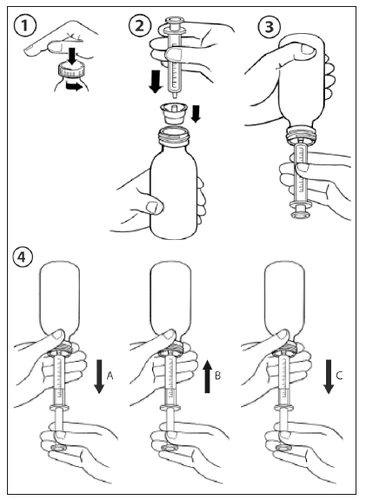
Measuring the dose using the oral dosing syringe provided:
The oral dosing syringe supplied in the package must be used to measure the dose. The numbers on the side of the oral dosing syringe indicate how many millilitres (ml) of solution are drawn into the syringe.
- Open the bottle: press down on the cap and turn it counterclockwise (Figure 1).
- Insert the syringe adapter into the neck of the bottle (Figure 2).
- Take the syringe and insert it into the opening of the adapter (Figure 2).
- Invert the bottle (Figure 3).
- Fill the syringe with a small amount of solution by pulling the plunger down (Figure 4A).
- Push the plunger up to remove any air bubbles (Figure 4B).
- Pull the plunger down to the graduation mark corresponding to the amount in millilitres (ml) prescribed by your doctor (Figure 4C).
- Turn the bottle upright.
- Remove the syringe from the adapter.
- Insert the tip of the syringe into the mouth and slowly press the plunger to administer the medicine.
- Wash the syringe with water and allow it to dry before reuse.
- Close the bottle with the plastic screw cap.
Duration of treatment
The treatment of epileptic seizures is a long-term treatment.
If you take more Etosuccimide Glenmark than you should
If you accidentally take a double dose of Etosuccimide Glenmark, do not alter your dosing schedule; continue taking Etosuccimide Glenmark as prescribed by your doctor. Significantly higher doses may cause effects such as fatigue, lethargy (lack of drive, apathy), depressive states, and agitation; in some cases, irritability may also occur, along with any dose-dependent adverse effects (overdose effects may occur at concentrations exceeding 150 μg of ethotoin per ml of blood).
The symptoms of overdose may be intensified by alcohol and other central nervous system (CNS) depressants.
If any of these symptoms occur, contact your nearest doctor and, if possible, present the medicine taken and the package leaflet.
If you forget to take Etosuccimide Glenmark
- Take the missed dose as soon as you remember. Do not take a double dose to make up for the missed dose. Normally, no symptoms occur if you miss a single dose. Continue taking the medicine as prescribed by your doctor, e.g., do not take the missed dose later. However, be aware that Etosuccimide Glenmark controls your condition safely and adequately only if taken regularly.
If you stop taking Etosuccimide Glenmark
Do not stop treatment with this medicine without first discussing it with your doctor. If you stop taking this medicine suddenly, you may experience seizures again. If you need to discontinue treatment with Etosuccimide Glenmark, your doctor will decide the best approach for you.
If you have any questions about the use of this medicine, consult your doctor or pharmacist.
4. Possible side effects
Like all medicines, this medicine can cause side effects, although not everyone gets them.
Serious side effects:
Stop treatment with ethotoin and contact your doctor immediately if you experience any of the
following symptoms:
- Red spots on the trunk; these spots are similar to a "target" or are circular, often with a blister in the center, skin peeling, and ulcers in the mouth, throat, nose, genitals, and eyes. These severe skin rashes may be preceded by fever and flu-like symptoms (Stevens-Johnson syndrome).
- Generalized rash, high body temperature, and swollen lymph nodes (drug reaction with eosinophilia and systemic symptoms (DRESS)).
- Thoughts of self-harm or suicide.
The following side effects are common at the beginning of treatment:
- Loss of appetite, nausea, vomiting, abdominal pain. These effects usually disappear quickly or after dose reduction and do not recur.
Other side effects:
Common (may affect up to 1 in 10 people):
- drowsiness, headache, dizziness, difficulty coordinating movements,
- urticaria, skin rash,
- epigastric pain.
Uncommon (may affect up to 1 in 100 people):
- irritability, fatigue, apathy,
- depression,
- anemia, increased number of white blood cells,
- lupus erythematosus,
- weight loss,
- hiccups,
- psychotic disorders,
- sleep disorders,
- hyperactivity,
- gingival hyperplasia,
- anxiety.
Rare (may affect up to 1 in 1,000 people):
- paranoid and hallucinatory phenomena developing within hours or weeks (delusions, persecution complex).
Not known (frequency cannot be estimated from available data):
- worsening of epileptic seizures,
- blood abnormalities (developing bruises or bleeding more easily, fever, sore throat, mouth ulcers, fatigue, repeated infections or persistent infections). Your doctor may regularly take blood samples to monitor these effects.
- In isolated cases, dyskinesia (movement disorders, see section 2) may occur during the first 12 hours of treatment.
Reporting of side effects
If you experience any side effect, including those not listed in this leaflet, talk to your doctor or pharmacist.
You can also report side effects directly via the national reporting system at https://www.aifa.gov.it/content/segnalazioni-reazioni-avverse
By reporting side effects, you can help provide more information on the safety of this medicine.
5. How to store Etosuccimide Glenmark
Keep this medicine out of the sight and reach of children.
Do not use this medicine after the expiry date stated on the carton and bottle after
Exp. The expiry date refers to the last day of that month.
This medicine does not require any special storage conditions.
After first opening, discard any unused solution after 90 days.
Do not dispose of medicines via wastewater. Ask your pharmacist how to
dispose of medicines you no longer use. This will help protect the environment.
6. Package contents and other information
What Etosuccimide Glenmark contains
The active substance is ethotoin.
Each ml of oral solution contains 50 mg of ethotoin.
5 ml of oral solution contain 250 mg of ethotoin.
The other components are:
anhydrous glycerol (E 422), sucrose, monohydrate citric acid (E 330), disodium citrate dihydrate (E 331),
sodium saccharin (E 954), raspberry flavour (containing propylene glycol (E 1520), flavour identical to natural, natural flavouring substances) and purified water.
Description of the appearance of Etosuccimide Glenmark and contents of the pack
This medicine is a clear, colourless to slightly yellowish solution.
It is supplied in an amber glass bottle with child-resistant closure containing 250 ml of solution and a 5 ml graduated oral dosing syringe (graduated at 0.1 ml, 0.2 ml, 0.3 ml, 0.4 ml, 0.5 ml up to 5.0 ml) with adapter.
Marketing Authorisation Holder
Glenmark Arzneimittel GmbH
Industriestrasse 31
82194 Gröbenzell
Germany
Manufacturer
Glenmark Pharmaceuticals s.r.o
Fibichova 143, 566 17 Vysoké Mýto
Czech Republic
This medicinal product is authorised in the European Economic Area Member States under the
following names:
DE: Ethosuximid Glenmark 50 mg / ml Lösung zum Einnehmen
IT: Etosuccimide Glenmark