Esafosfina
Italy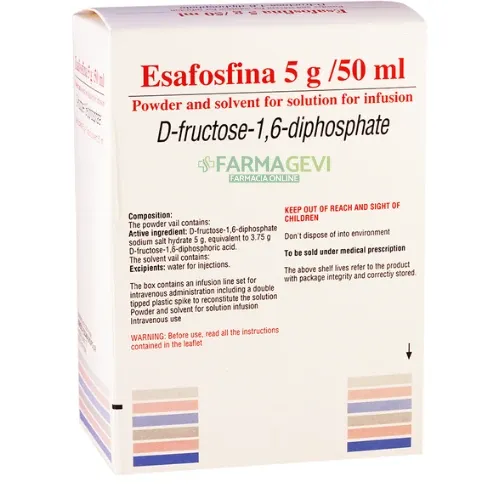
Table of Contents
- Package leaflet: Information for the user
- Esafosfina 0.5 g/10 ml powder and solvent for solution for infusion, 5 g/50 ml powder and solvent for solution for infusion, 10 g/100 ml solution for infusion
- 1. What Esafosfina is and what it is used for
- 2. What you need to know before using Esafosfina
- 3. How to Take Esafosfina
- 4. Possible side effects
- 5. How to store Esafosfina
- 6. Package Contents and Other Information
Package leaflet: Information for the user
Esafosfina 0.5 g/10 ml powder and solvent for solution for infusion, 5 g/50 ml powder and solvent for solution for infusion, 10 g/100 ml solution for infusion
- Fructose-1,6-diphosphate
Please read all of this leaflet carefully before you start taking this medicine because it contains important information for you.
- Keep this leaflet. You may need to read it again.
- If you have any questions, ask your doctor or pharmacist.
- This medicine has been prescribed for you only. Do not give it to other people, even if they have the same symptoms as yours, because it may be harmful.
- If you experience any side effects, including those not listed in this leaflet, contact your doctor or pharmacist. See section 4.
Contents of this leaflet:
- What Esafosfina is and what it is used for
- What you need to know before taking Esafosfina
- How to take Esafosfina
- Possible side effects
- How to store Esafosfina
- Contents of the pack and other information
1. What Esafosfina is and what it is used for
Esafosfina contains D-fructose-1,6-diphosphate (FDP), a natural intermediate in glucose metabolism within cells. Esafosfina is a medicine used for the treatment of confirmed hypophosphatemia (low levels of phosphorus in the blood).
2. What you need to know before using Esafosfina
Do not take Esafosfina:
- If you are allergic to D-fructose-1,6-diphosphate or to any of the other ingredients of this medicine (listed in section 6)
- If you have hereditary fructose intolerance
- If you have hyperphosphatemia (high levels of phosphorus in the blood)
- If you have renal failure.
Warnings and precautions
Talk to your doctor, pharmacist or nurse before using Esafosfina.
It is advisable to monitor blood electrolyte concentrations during treatment.
In patients with kidney problems, monitoring of serum phosphate levels (phosphorus concentration in the blood) is recommended, with a possible reduction of the dosage.
During infusion, local pain and irritation may occur (see section 4 "Possible side effects").
Children and adolescents
If agitation or sweating occurs during treatment with Esafosfina, especially in a neonate or an infant not yet weaned, the infusion must be immediately stopped and appropriate measures must be taken, as these symptoms could indicate fructose intolerance.
Other medicines and Esafosfina
Inform your doctor or pharmacist if you are taking, have recently taken, or might take any other medicines.
Esafosfina must not be mixed with other medicines, as studies have not been conducted to determine whether D-Fructose-1,6-diphosphate can be combined with other solutions without losing its characteristics.
Pregnancy and breastfeeding
If you are pregnant, think you might be pregnant, planning a pregnancy, or breastfeeding, consult your doctor or pharmacist before using this medicine.
Driving and using machines
Esafosfina does not affect or affects negligibly the ability to drive or use machinery.
Esafosfina contains sodium and sodium metabisulfite.
This medicine contains, in the dosage forms 0.5 g/10 ml, 5 g/50 ml and 10 g/100 ml, respectively 3 mmol, 30 mmol and 44 mmol of sodium. This should be taken into consideration in patients with impaired renal function or those on a low-sodium diet.
Due to the presence of sodium metabisulfite, administration of Esafosfina 10 g/100 ml infusion solution may rarely cause hypersensitivity reactions and bronchospasm (narrowing of the bronchial lumen).
3. How to Take Esafosfina
Take this medicine exactly as directed by your doctor or pharmacist. If you have
any doubts, consult your doctor or pharmacist.
The recommended daily dose, depending on the severity of the condition, ranges between 70 mg/kg and
160 mg/kg of active substance, generally corresponding in adults to 1–2 vials per day of Esafosfina 5 g/50 ml
powder and solvent for infusion solution, or 1 vial per day of Esafosfina 10 g/100 ml
infusion solution, unless otherwise prescribed by your doctor.
Your doctor will determine the dose based on your individual condition (blood phosphorus levels, possible parenteral nutrition).
For higher dosages, it is advisable to divide the total daily dose into two administrations.
For lower dosages, Esafosfina 0.5 g/10 ml powder and solvent for infusion solution may be used.
Do not exceed the recommended doses.
Use in children and adolescents
The dosage will be determined by the doctor according to body weight.
Method of Administration
Esafosfina 0.5 g/10 ml powder and solvent for infusion solution
Reconstitute the solution in the vial of powder by withdrawing the water from the solvent vial using a syringe equipped with a suitable needle. Remove the aluminum cap from the vial and disinfect the rubber stopper with an alcohol-soaked cotton swab. Insert the needle of the syringe through the center of the rubber stopper into the vial, directing the stream of water toward the glass wall of the vial. Gently shake to ensure complete dissolution, then administer the resulting solution by intravenous route.
Esafosfina 5 g/50 ml powder and solvent for infusion solution
First, reconstitute the solution under aseptic conditions as follows:
- Remove the aluminum cap from the powder vial and disinfect the stopper with an alcohol-soaked cotton swab;
- Remove only one cap from the single-use double-ended needle perforator (transfer device) and insert the tip into the powder vial through the center of the rubber stopper;
- Remove the aluminum cap from the water vial and disinfect the rubber stopper; remove the second cap from the transfer device and insert the tip into the water vial, turning it upside down;
- Briefly shake to facilitate the flow of water into the powder vial; once the water vial is completely emptied, remove the transfer device and shake to promote dissolution. The administration of the reconstituted solution by intravenous route is then performed as follows:
- Disinfect the vial stopper again, then remove the cap from the perforator at the end of the infusion set and insert it into the center of the vial stopper;
- Apply the roller clamp and fully close it on the tube;
- Remove the cap from the needle adapter and attach the needle;
- Squeeze the drip chamber to fill it about halfway, then open the roller clamp until all air has been expelled from the infusion set;
- Fully close the roller clamp, insert the needle into the vein, and slowly reopen the roller clamp until the desired flow rate is achieved. It is recommended to administer the solution at a rate of approximately 10 ml/min.
Esafosfina 10 g/100 ml infusion solution
Administer the ready-to-use solution intravenously using the infusion set provided in the package (or another suitable intravenous infusion device), following the instructions above (from point 5 to point 9), after removing the plastic overcap by twisting it off the vial.
It is recommended to infuse the solution at a rate of approximately 10 ml/min.
Important: Use immediately after opening the containers. The reconstituted solution or ready-to-use solution must be clear and free from visible particles. It is intended for single, uninterrupted administration, and any unused portion must not be retained.
If you take more Esafosfina than you should
Excessive doses and/or doses administered too close together may cause an excessive increase in blood phosphorus levels, which in turn may lead to a reduction in blood calcium levels.
In case of overdose, inform your doctor immediately or go to the nearest hospital emergency department.
4. Possible side effects
Like all medicines, this medicine can cause side effects, although not everyone will experience them.
Rapid infusion may cause pain and irritation at the injection site, particularly when using the "10 g/100 ml infusion solution" pack. If the infusion rate exceeds 10 ml/min, patients may additionally experience flushing, palpitations, and tingling in the extremities.
As with all intravenous infusion solutions, fever reactions, injection site infections, venous thrombosis (blood clots in veins), or phlebitis (vein inflammation) may occur, as well as extravasation (leakage of fluid from the vein into surrounding tissues).
Allergic reactions of varying severity, up to anaphylactic shock, have been reported, although rarely.
In case of an adverse reaction, discontinue administration and retain the remaining unadministered fluid for possible testing.
Reporting of side effects
If you experience any side effect, including those not listed in this leaflet, talk to your doctor or pharmacist. You may also report side effects directly via the national reporting system at http://www.agenziafarmaco.gov.it/it/responsabili.
By reporting side effects, you can help provide more information on the safety of this medicine.
5. How to store Esafosfina
Keep this medicine out of the sight and reach of children.
Do not use this medicine after the expiry date stated on the label after Exp.
The expiry date refers to the last day of that month.
Do not store above 30°C.
Do not use this medicine if you notice the presence of particles, abnormal discoloration, numbness, or precipitate.
A slightly yellow colour is considered normal.
Do not dispose of any medicine via wastewater or household waste. Ask your pharmacist how to dispose of medicines you no longer use. This will help protect the environment.
6. Package Contents and Other Information
What Esafosfina Contains
Esafosfina 0.5 g/10 ml powder and solvent for solution for infusion
Each vial of powder contains:
Active substance: -fructose-1,6-diphosphate sodium salt hydrate 0.5 g, equivalent to -fructose-1,6-diphosphoric acid 0.375 g.
Each solvent ampoule contains:
Excipient: water for injections.
The reconstituted solution contains 50 mg/ml of -fructose-1,6-diphosphate sodium salt hydrate, equivalent to 37.5 mg/ml of -fructose-1,6-diphosphoric acid. This solution provides approximately 0.235 mEq/ml of phosphorus.
Esafosfina 5 g/50 ml powder and solvent for solution for infusion
The powder vial contains:
Active substance: -fructose-1,6-diphosphate sodium salt hydrate 5 g, equivalent to -fructose-1,6-diphosphoric acid 3.75 g.
The solvent vial contains:
Excipient: water for injections.
The reconstituted solution contains 100 mg/ml of -fructose-1,6-diphosphate sodium salt hydrate, equivalent to 75 mg/ml of -fructose-1,6-diphosphoric acid. This solution provides approximately 0.47 mEq/ml of phosphorus.
Esafosfina 10 g/100 ml solution for infusion
The vial contains:
Active substance: -fructose-1,6-diphosphate sodium salt hydrate 10 g, equivalent to -fructose-1,6-diphosphoric acid 7.5 g.
Excipients: sodium metabisulfite (E223), water for injections.
The solution contains 100 mg/ml of -fructose-1,6-diphosphate sodium salt hydrate, equivalent to 75 mg/ml of -fructose-1,6-diphosphoric acid. This solution provides approximately 0.47 mEq/ml of phosphorus.
Description of the Appearance of Esafosfina and Contents of the Package
Esafosfina 0.5 g/10 ml powder and solvent for solution for infusion
The carton contains 4 powder vials of 0.5 g and 4 solvent ampoules of 10 ml.
Esafosfina 5 g/50 ml powder and solvent for solution for infusion
The carton contains: one 5 g powder vial, one 50 ml solvent vial, and one intravenous infusion set including a double-ended needle (transfer device) for the extemporaneous preparation of the solution.
Esafosfina 10 g/100 ml solution for infusion
The carton contains one 100 ml vial of ready-to-use infusion solution and one intravenous infusion set.
Esafosfina 10 g/100 ml solution for infusion without infusion set
The carton contains either 1 vial or 20 vials of 100 ml ready-to-use infusion solution.
Marketing Authorization Holder
Biomedica Foscama Industria Chimico-Farmaceutica S.p.A.
Via dei Castelli Romani, 22
00071 Pomezia (RM) - Italy
Manufacturer
Biomedica Foscama Industria Chimico-Farmaceutica S.p.A.
Manufacturing Site: Via Morolense, 87
03013 Ferentino (FR) – (Italy)