Equimet
Italy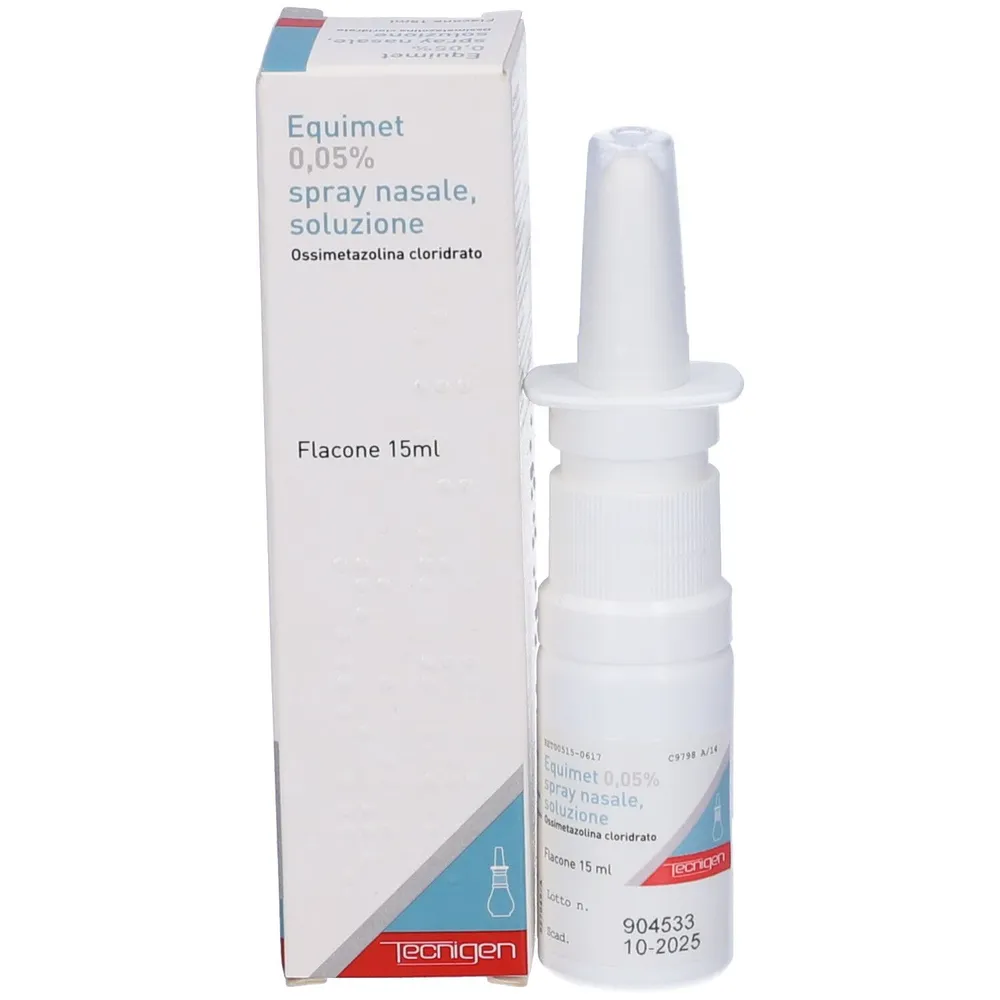
Table of Contents
Package leaflet: Information for the patient
Equimet 0.5 mg/ml nasal spray, solution
oxymetazoline hydrochloride
Please read all of this leaflet carefully before you start using this medicine because it contains
important information for you.
Always use this medicine exactly as described in this leaflet or as your doctor or
pharmacist has told you to.
- Keep this leaflet. You may need to read it again.
- If you need more information or advice, consult your pharmacist.
- If any of the side effects occur, including those not listed in this leaflet, consult your doctor or pharmacist. See section 4.
- Consult your doctor if you do not notice any improvement or if your symptoms worsen after 4 days of treatment.
Contents of this leaflet:
- What Equimet is and what it is used for
- What you need to know before using Equimet
- How to use Equimet
- Possible side effects
- How to store Equimet
- Contents of the pack and other information
1. What Equimet is and what it is used for
Equimet is a medicine containing oxymetazoline, a decongestant agent effective for local (topical) use, which provides prolonged relief from nasal congestion.
Equimet is used as a decongestant for the nasal mucosa (to relieve a blocked nose), particularly in cases of colds.
Consult your doctor if you do not feel better or if you feel worse after 4 days of treatment.
2. What you need to know before using Equimet
Do not use Equimet
- if you are allergic to oxymetazoline or to any of the other ingredients of this medicine (listed in section 6);
- if you have an enlarged prostate (prostatic hypertrophy);
- if you have heart disease and/or very high blood pressure (severe arterial hypertension);
- if you have an optic nerve disorder (glaucoma);
- if you have excessive production of thyroid hormones (hyperthyroidism);
- if you are being treated with antidepressant medicines or within two weeks after such treatment;
- if you have inflammation or lesions of the oral mucosa or of the skin around the nostrils;
- if you are under 12 years of age (see “Children”).
Warnings and precautions
Talk to your doctor or pharmacist before using Equimet.
Prolonged use of medicines that constrict blood vessels (vasoconstrictors) may alter the normal function of the nasal and paranasal sinus mucosa, potentially leading to tolerance to the medicine (rebound effect). Repeated applications over long periods may be harmful.
Patients with thyroid disorders, diabetes, or difficulty in urination due to an enlarged prostate should not take oxymetazoline unless otherwise directed by a doctor.
Temporary discomfort such as burning, stinging, sneezing, or increased nasal discharge may occur.
Use, especially prolonged use, of topical products may lead to allergic reactions (sensitization); if this occurs, discontinue treatment and consult your doctor to establish appropriate therapy. In any case, if you do not notice significant improvement within a few days, consult your doctor.
Do not extend treatment beyond 4 days to avoid rebound effects and drug-induced rhinitis.
Do not use this medicine by mouth. If accidentally ingested or used for prolonged periods in excessive doses, the medicine may cause toxic effects. Keep Equimet out of the reach of children, as accidental ingestion may cause marked sedation (see “If you use more Equimet than you should”).
Avoid contact of the liquid with the eyes.
Exercise particular caution with Equimet:
- If you have heart or circulatory diseases (cardiovascular diseases), especially if you have high blood pressure (hypertension); consult your doctor regularly.
- If you are elderly, due to the risk of urinary retention (difficulty urinating). Consult your doctor even if such disorders occurred in the past.
- If you are pregnant or breastfeeding (see “Pregnancy and breastfeeding”).
For those engaged in sports activities: the medicine contains substances prohibited in doping. Any use differing from the prescribed treatment regimen or route of administration is forbidden.
Children
Equimet must not be used in children under 12 years of age.
Other medicines and Equimet
Tell your doctor or pharmacist if you are using, have recently used, or might use any other medicines.
Do not use this medicine during treatment with antidepressants or within two weeks after such treatment (see “Do not use Equimet”).
Oxymetazoline may reduce the effectiveness of beta-blockers and antihypertensive agents. Hypertensive episodes and arrhythmias may occur when tricyclic antidepressants are administered together with sympathomimetic drugs such as oxymetazoline. Increased cardiovascular toxicity may occur when sympathomimetic drugs are administered concomitantly with antiparkinsonian agents such as bromocriptine.
Pregnancy and breastfeeding
If you are pregnant, suspect you may be pregnant, planning a pregnancy, or breastfeeding, you must not use this medicine. Always consult your doctor or pharmacist before using this medicine.
During pregnancy, especially during the first months, and during breastfeeding, use Equimet only after consulting your doctor and carefully evaluating with him the risk/benefit ratio in your individual case.
3. How to use Equimet
Use this medicine exactly as stated in this leaflet or as instructed by your doctor or pharmacist. If you have any doubts, consult your doctor or pharmacist.
Recommended dose: For adults and children over 12 years of age, the recommended dose is one spray per nostril every 6–12 hours, as needed.
Instructions for use: Remove the plastic cap; insert the tip of the bottle into the nostril and press rapidly and firmly, breathing deeply through the nose.
Caution: Do not exceed the recommended doses.
Do not use for longer than 4 days unless otherwise directed by your doctor.
Consult your doctor if symptoms recur frequently or if you notice any recent changes in their characteristics.
If you use more Equimet than you should
If you accidentally ingest or take an excessive dose of Equimet, contact your doctor immediately or go to the nearest hospital.
In case of overdose, alternating periods of stimulation and depression of the cardiopulmonary system and central nervous system may occur, causing symptoms such as, but not limited to, increased blood pressure (arterial hypertension), rapid heartbeat (tachycardia), painful sensitivity to light (photophobia), severe headache (intense cephalalgia), sensation of chest tightness, and, in children, excessive lowering of body temperature (hypothermia) and severe depression of the central nervous system with excessive calmness (marked sedation), which require appropriate emergency measures.
Oral ingestion, particularly in children, may cause symptoms such as nausea, vomiting, lethargy, tachycardia, reduced respiration, bradycardia, hypotension, hypertension, sedation, drowsiness, mydriasis, stupor, hypothermia, salivation, and coma.
In severe cases, intubation and artificial respiration may be required.
If you forget to use Equimet
Do not use a double dose to make up for the missed dose.
If you stop using Equimet
If you have any doubts about using this medicine, consult your doctor or pharmacist.
4. Possible side effects
Like all medicines, this medicine can cause side effects, although not everyone experiences them.
The medicine may cause local allergic reactions and a worsening of the sensation of nasal congestion.
Due to the rapid absorption of the medicine through inflamed mucous membranes, systemic effects on the body may occur, such as increased blood pressure (arterial hypertension), reduced heart rate (reflex bradycardia), headache (cephalalgia), difficulty urinating (urinary disorders), eye irritation, discomfort or redness, epistaxis (nosebleed), nasal, oral or throat irritation or discomfort, sneezing, tachycardia (accelerated heartbeat), palpitations, elevated arterial pressure, reflex bradycardia (reduced heart rate), insomnia, nervousness, tremor, anxiety, agitation, irritability and headache, nausea.
Following the instructions provided in the package leaflet reduces the risk of side effects.
Reporting of side effects
If you experience any side effect, including those not listed in this leaflet, contact your doctor or pharmacist. You may also report side effects directly via the national reporting system at www.aifa.gov.it/content/segnalazioni-reazioni-avverse.
By reporting side effects, you can help provide further information on the safety of this medicine.
5. How to store Equimet
Keep this medicine out of the sight and reach of children.
Do not use this medicine after the expiry date stated on the label after "EXP".
The expiry date refers to the last day of that month. The stated expiry date applies to the product when unopened and stored correctly.
After first opening the bottle, the medicine should be used within 4 weeks; after this period, any remaining product should be discarded.
Do not refrigerate.
Do not dispose of medicines via wastewater or household waste. Ask your pharmacist how to dispose of medicines no longer required. This will help protect the environment.
6. Package contents and other information
What Equimet contains
- The active substance is oxymetazoline hydrochloride. 100 ml contain 0.050 g of oxymetazoline hydrochloride. One spray corresponds to 0.1 ml of solution and contains 0.05 mg of oxymetazoline.
- The other components are: Benzalkonium chloride, potassium dihydrogen phosphate, anhydrous disodium hydrogen phosphate, purified water.
Description of the appearance of Equimet and contents of the pack
Equimet is a nasal spray.
The pack contains a 15 ml bottle of solution.
Marketing Authorisation Holder and Manufacturer
Marketing Authorisation Holder
Tecnigen S.r.l.
Via Galileo Galilei, 40
20092 - Cinisello Balsamo (MI)
Italy
Manufacturer
Laboratorios Alcalà Farma, S.L.
Avenida de Madrid, 82
28802 Alcalà de Henares (Madrid)
Spain