Epitifibatide Accord
Italy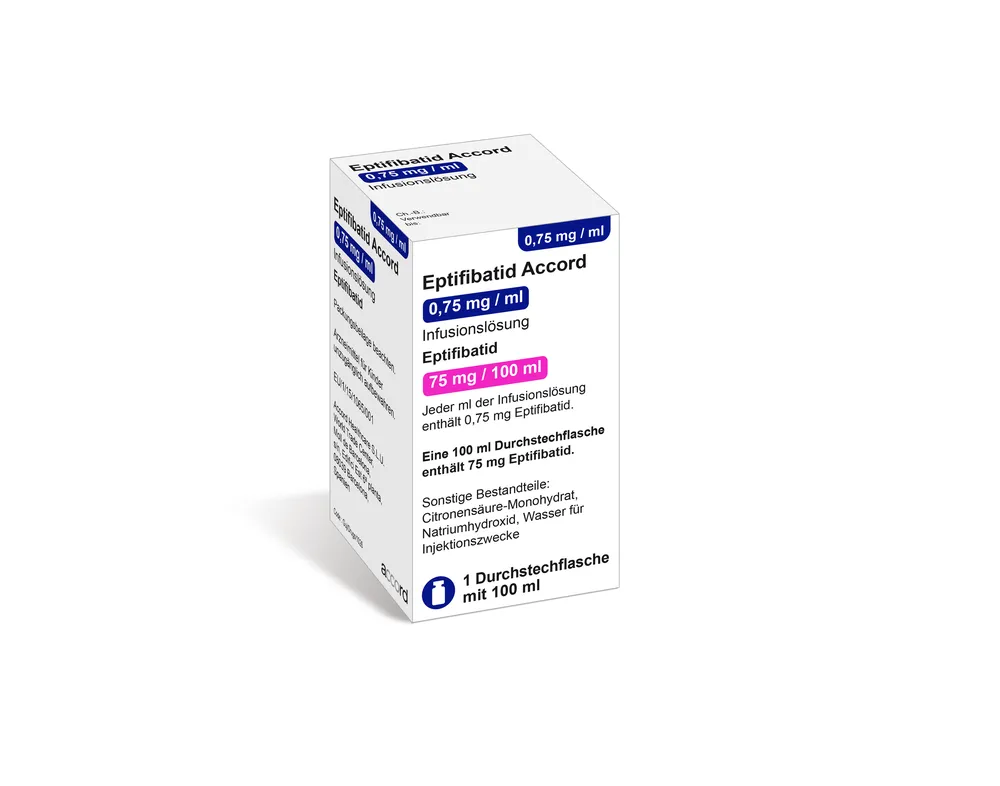
Table of Contents
- Patient Information Leaflet
- Eptifibatide Accord 0.75 mg/ml solution for infusion
- 1. What Eptifibatide Accord is and what it is used for
- 2. What you should know before being given Eptifibatide Accord
- 3. How to use Eptifibatide Accord
- 4. Possible side effects
- 5. How to store Eptifibatide Accord
- 6. Package contents and other information
- Patient Information Leaflet
- Eptifibatide Accord 2 mg/ml solution for injection
- 1. What Eptifibatide Accord is and what it is used for
- 2. What you need to know before being given Eptifibatide Accord
- 3. How to use Eptifibatide Accord
- 4. POSSIBLE ADVERSE REACTIONS
- 5. How to store Eptifibatide Accord
- 6. Package contents and other information
Patient Information Leaflet
Eptifibatide Accord 0.75 mg/ml solution for infusion
eptifibatide
Please read this leaflet carefully before you start receiving this medicine because it contains important information for you.
- Keep this leaflet. You may need to read it again.
- If you have any questions, ask your doctor, hospital pharmacist, or nurse.
- If you get any side effects, including those not listed in this leaflet, tell your doctor, hospital pharmacist, or nurse. See section 4.
Contents of this leaflet:
- What Eptifibatide Accord is and what it is used for
- What you need to know before you are given Eptifibatide Accord
- How to use Eptifibatide Accord
- Possible side effects
- How to store Eptifibatide Accord
- Contents of the pack and other information
1. What Eptifibatide Accord is and what it is used for
Eptifibatide Accord is a platelet aggregation inhibitor, which means that it helps prevent the formation of blood clots.
It is used in adults with severe coronary insufficiency presenting as recent spontaneous chest pain associated with abnormal electrical activity of the heart () or with changes in biochemical parameters (cardiac enzymes).
Eptifibatide Accord is usually administered together with aspirin and unfractionated heparin.
2. What you should know before being given Eptifibatide Accord
Eptifibatide Accord must not be given to you if:
- you are allergic to eptifibatide or to any of the other ingredients of this medicine (listed in section 6);
- you have recently had bleeding from the stomach, intestines, spleen or other organs, for example if you have noticed abnormal blood loss in your urine or stools (except menstrual blood) within the last 30 days;
- you have had a stroke within the last 30 days or have ever had a haemorrhagic stroke (make sure your doctor is aware of this);
- you have had a brain tumour or diseases that may affect the blood vessels in the brain;
- you have undergone major surgery or suffered severe trauma within the previous 6 weeks;
- you have had or currently have bleeding problems;
- you have had or currently have coagulation disorders or a low platelet count;
- you have had or currently suffer from severe hypertension (high blood pressure);
- you have had or currently suffer from severe kidney or liver problems;
- you have previously been treated with a medicine of the same type as Eptifibatide Accord.
If you have any of these conditions, inform your doctor. If you have any doubts, ask for advice from your doctor, hospital pharmacist or nurse.
Warnings and precautions
- Eptifibatide Accord is recommended only for adult patients hospitalised in coronary care units.
- Eptifibatide Accord is not indicated for use in children or adolescents under 18 years of age.
- Before and during treatment with Eptifibatide Accord, blood samples may be taken as a precautionary measure to minimise the risk of unexpected bleeding.
- While receiving Eptifibatide Accord, you will be closely monitored for any signs of unusual or unexpected bleeding.
Before being given Eptifibatide Accord, talk to your doctor, hospital pharmacist or nurse.
Other medicines and Eptifibatide Accord:
To avoid possible interactions with other medicines, inform your doctor, hospital pharmacist or nurse if you are taking, have recently taken or might take any other medicines, including those obtained without a prescription. In particular:
- blood thinners (oral anticoagulants), or
- medicines that prevent blood clots such as warfarin, dipyridamole, ticlopidine, aspirin (except those administered as part of treatment with Eptifibatide Accord).
Pregnancy, breastfeeding and fertility
Eptifibatide Accord is generally not recommended for use during pregnancy.
If you are pregnant, suspect you may be pregnant, or are planning a pregnancy, consult your doctor. Your doctor will assess the benefit of using Eptifibatide Accord for you during pregnancy against the potential risk to the unborn child.
If you are breastfeeding, breastfeeding must be discontinued during treatment.
Eptifibatide Accord contains sodium
This medicine contains 172 mg of sodium (the main component of table salt) per vial. This is equivalent to 8.6% of the maximum daily dietary intake recommended of 2 g of sodium for an adult.
3. How to use Eptifibatide Accord
Eptifibatide Accord is administered intravenously as a direct injection, followed by an infusion (drip). The dose administered is based on body weight. The recommended dose is 180 micrograms/kg given as a bolus (rapid intravenous injection), followed by an infusion (drip) of 2 micrograms/kg/min for up to 72 hours. If you have a kidney disease, the infusion dose may be reduced to 1 microgram/kg/min.
If you undergo a percutaneous coronary intervention (PCI) during treatment with Eptifibatide Accord, the intravenous infusion may be continued for up to 96 hours.
You will also be given aspirin and heparin (unless contraindicated in your case).
If you have any further questions about the use of this medicine, consult your doctor, hospital pharmacist, or nurse.
4. Possible side effects
Like all medicines, this medicine can cause side effects, although not everyone experiences them.
Very common side effects
May occur in more than 1 person out of 10
- Bleeding of minor or major severity (for example, blood in urine, blood in faeces, blood in vomit, or bleeding following surgical procedures);
- Anaemia (reduced number of red blood cells in the blood)
Common side effects
May occur in up to 1 person out of 10
- Inflammation of a vein
Uncommon side effects
May occur in up to 1 person out of 100
- Reduction in the number of platelets (blood cells necessary for clotting)
- Reduced blood flow to the brain
Very rare side effects
May occur in up to 1 person out of 10,000
- Severe bleeding (e.g., internal bleeding in the abdomen, brain, or lungs)
- Bleeding leading to death
- Marked reduction in the number of platelets (blood cells necessary for clotting)
- Skin rash (such as urticaria)
- Sudden and severe allergic reactions
If you notice any signs of bleeding, inform your doctor, hospital pharmacist, or nurse immediately. Very rarely, bleeding has led to serious consequences and even death. Safety measures to prevent these events include blood tests and careful monitoring by the healthcare staff caring for you.
If you experience a severe allergic reaction or urticaria, inform your doctor, hospital pharmacist, or nurse immediately.
Other side effects that may occur in patients requiring this type of treatment include those related to the conditions being treated, such as rapid or irregular heartbeat, low blood pressure, shock, or cardiac arrest.
Reporting of side effects
If you experience any side effect, including those not listed in this leaflet, consult your doctor, hospital pharmacist, or nurse. You may also report side effects directly via the national reporting system listed in Annex V*.
By reporting side effects, you can help provide more information on the safety of this medicine.
5. How to store Eptifibatide Accord
Keep this medicine out of the sight and reach of children.
Do not use this medicine after the expiry date stated on the packaging and on the vial after (Exp.). The expiry date refers to the last day of the month.
Store in a refrigerator (2°C - 8°C).
Keep the vial in the outer packaging to protect the medicine from light. However,
it is not necessary to protect the Eptifibatide Accord solution from light during
administration.
The contents of the vial should be inspected visually before use.
Eptifibatide Accord must not be used if particulate matter or any change in colour of the solution is observed.
Any unused content remaining after opening must be discarded.
Do not dispose of medicines via wastewater or household waste. Ask your pharmacist how to dispose of medicines no longer required. This will help protect the environment.
6. Package contents and other information
What Eptifibatide Accord contains
- The active substance is eptifibatide.
- Eptifibatide Accord 0.75 mg/ml: Each ml of infusion solution contains 0.75 mg of eptifibatide. A 100 ml vial of infusion solution contains 75 mg of eptifibatide.
- The other components are citric acid monohydrate, sodium hydroxide and water for injections.
Description of the appearance of Eptifibatide Accord and contents of the pack
Eptifibatide Accord 0.75 mg/ml infusion solution: 100 ml vial, carton pack containing one vial.
Eptifibatide Accord 0.75 mg/ml: The clear, colourless solution is contained in a 100 ml vial with a butyl rubber stopper and an aluminium flip-off seal.
Marketing Authorisation Holder and Manufacturer
Marketing Authorisation Holder:
Accord Healthcare S.L.U.
World Trade Center, Moll de Barcelona, s/n,
Edifici Est 6ª planta,
08039 Barcelona,
Spain
Manufacturers:
Accord Healthcare Polska Sp.z o.o.,
ul. Lutomierska 50, 95-200 Pabianice, Poland
Accord Healthcare Single Member S.A.
64th Km National Road Athens, Lamia, Schimatari, 32009, Greece
For further information about this medicinal product, please contact the local representative of the Marketing Authorisation Holder:
AT / BE / BG / CY / CZ / DE / DK / EE / ES / FI / FR / HR / HU / IE / IS / IT / LT / LV / LU / MT /
NL / NO / PL / PT / RO / SE / SI / SK
Accord Healthcare S.L.U.
Tel: +34 93 301 00 64
EL
Win Medica Α.Ε.
Tel: +30 210 74 88 821
This leaflet was last updated on
More detailed information on this medicinal product is available on the European Medicines Agency website: http://www.ema.europa.eu
Patient Information Leaflet
Eptifibatide Accord 2 mg/ml solution for injection
eptifibatide
Please read this leaflet carefully before you start using this medicine as it contains
important information for you.
- Keep this leaflet. You may need to read it again.
- If you have any questions, ask your doctor, hospital pharmacist, or nurse.
- If you experience any side effect, including those not listed in this leaflet, tell your doctor, pharmacist, or nurse. See section 4.
Contents of this leaflet:
- What Eptifibatide Accord is and what it is used for
- What you need to know before Eptifibatide Accord is administered to you
- How to use Eptifibatide Accord
- Possible side effects
- How to store Eptifibatide Accord
- Contents of the pack and other information
1. What Eptifibatide Accord is and what it is used for
Eptifibatide Accord is a platelet aggregation inhibitor, which means that it helps prevent the formation of blood clots.
It is used in adults with severe coronary insufficiency presenting as recent spontaneous chest pain associated with either altered electrical activity of the heart or changes in biochemical parameters (cardiac enzymes). Eptifibatide Accord is usually administered together with aspirin and unfractionated heparin.
2. What you need to know before being given Eptifibatide Accord
Eptifibatide Accord must not be administered to you if:
- you are allergic to eptifibatide or to any of the other ingredients of this medicine (listed in section 6);
- you have recently had bleeding from the stomach, intestine, spleen or other organs, for example if you have noticed abnormal blood loss in your urine or stools (excluding menstrual blood) within the last 30 days;
- you have had a stroke within the last 30 days or any episode of haemorrhagic stroke (make sure your doctor is aware of this);
- you have had a brain tumour or diseases that may affect the blood vessels in the brain;
- you have undergone major surgery or suffered severe trauma within the previous 6 weeks;
- you have had or currently have bleeding problems;
- you have had or currently have coagulation disorders or a low platelet count;
- you have had or currently suffer from severe hypertension (high blood pressure);
- you have had or currently suffer from severe kidney or liver problems;
- you have previously been treated with a medicine of the same type as Eptifibatide Accord.
If you have any of these conditions, inform your doctor. If you have any doubts, ask for advice from your doctor, hospital pharmacist or nurse.
Warnings and precautions
- Eptifibatide Accord is recommended only for adult patients hospitalised in coronary care units.
- Eptifibatide Accord is not indicated for use in children or adolescents under 18 years of age.
- Before and during treatment with Eptifibatide Accord, blood samples may be taken as a precautionary measure to minimise the risk of unexpected bleeding.
- While receiving Eptifibatide Accord, you will be closely monitored for any signs of unusual or unexpected bleeding.
Before being given Eptifibatide Accord, speak with your doctor, hospital pharmacist or nurse.
Other medicines and Eptifibatide Accord:
To avoid possible interactions with other medicines, inform your doctor, hospital pharmacist or nurse if you are taking, have recently taken or might take any other medicines, including those without a prescription. In particular:
- blood thinners (oral anticoagulants) or
- medicines that prevent blood clot formation such as warfarin, dipyridamole, ticlopidine, aspirin (except those administered as part of the treatment with Eptifibatide Accord).
Pregnancy, breastfeeding and fertility
Eptifibatide Accord is generally not recommended for use during pregnancy.
If you are pregnant, suspect you may be pregnant, or are planning a pregnancy, consult your doctor. Your doctor will evaluate the benefit of using Eptifibatide Accord for you during pregnancy against the potential risk to the unborn child.
If you are breastfeeding, breastfeeding must be discontinued during the treatment period.
3. How to use Eptifibatide Accord
Eptifibatide Accord is administered intravenously as a direct injection, followed by an infusion (drip). The dose administered is based on body weight. The recommended dose is 180 micrograms/kg given as a bolus (rapid intravenous injection), followed by an infusion (drip) of 2 micrograms/kg/min for up to 72 hours. If you have a kidney disease, the infusion dose may be reduced to 1 microgram/kg/min.
If you undergo a percutaneous coronary intervention (PCI) during treatment with Eptifibatide Accord, the intravenous infusion may be continued for up to 96 hours.
You will also be given aspirin and heparin (unless contraindicated in your case).
If you have any further questions about the use of this medicine, consult your doctor, hospital pharmacist, or nurse.
Eptifibatide Accord contains sodium
This medicine contains 34.5 mg of sodium (a main component of table salt) per vial. This is equivalent to 1.7% of the maximum recommended daily dietary intake of 2 g of sodium for an adult.
4. POSSIBLE ADVERSE REACTIONS
Like all medicines, this medicine can cause adverse reactions, although not everybody gets them.
Very common adverse reactions
May occur in more than 1 out of 10 people
- Bleeding of minor or major severity (for example, blood in urine, blood in stools, blood in vomit, or bleeding following surgical procedures);
- Anaemia (reduced number of red blood cells in the blood)
Common adverse reactions
May occur in up to 1 out of 10 people
- Inflammation of a vein
Uncommon adverse reactions
May occur in more than 1 out of 100 people
- Reduction in the number of platelets (blood cells necessary for coagulation)
- Reduced blood flow to the brain
Very rare adverse reactions
May occur in up to 1 out of 10,000 people
- Severe bleeding (e.g., internal abdominal, cerebral, or pulmonary bleeding)
- Bleeding leading to death
- Marked reduction in the number of platelets (blood cells necessary for coagulation)
- Skin rash (such as urticaria)
- Sudden and severe allergic reactions
If you notice any signs of bleeding, inform your doctor, hospital pharmacist, or nurse immediately.
Very rarely, bleeding has led to serious consequences and even resulted in death. Safety measures to prevent these events include blood tests and careful monitoring by the healthcare personnel caring for you.
If you develop a severe allergic reaction or urticaria, inform your doctor, hospital pharmacist, or nurse immediately.
Other adverse reactions that may occur in patients requiring this type of therapy include those related to the conditions being treated, such as rapid or irregular heartbeat, low blood pressure, shock, or cardiac arrest.
Reporting of adverse reactions
If you experience any adverse reaction, including those not listed in this leaflet, consult your doctor, hospital pharmacist, or nurse. You may also report adverse reactions directly through the national reporting system reported in Annex V*.
By reporting adverse reactions, you can help provide more information on the safety of this medicine.
5. How to store Eptifibatide Accord
Keep this medicine out of the sight and reach of children.
Do not use this medicine after the expiry date stated on the packaging and vial after (Exp.). The expiry date refers to the last day of the month.
Store in a refrigerator (2°C - 8°C).
Keep the vial in the outer packaging to protect the medicine from light. However,
protection of the Eptifibatide Accord solution from light during administration is not required.
The contents of the vial should be inspected visually before use.
Eptifibatide Accord must not be used if particulate matter or any change in colour of the solution is observed.
Any unused contents after opening must be discarded.
Do not dispose of medicines via wastewater or household waste. Ask your pharmacist how to dispose of medicines no longer in use. This will help protect the environment.
6. Package contents and other information
What Eptifibatide Accord contains
- The active substance is eptifibatide.
- Eptifibatide Accord 2 mg/ml: Each ml of injectable solution contains 2 mg of eptifibatide. A 10 ml vial of injection solution contains 20 mg of eptifibatide.
- The other components are monohydrate citric acid, sodium hydroxide and water for injections.
Description of the appearance of Eptifibatide Accord and package contents
Eptifibatide Accord 2 mg/ml solution for injection: 10 ml vial, carton containing one vial.
Eptifibatide Accord 2 mg/ml: The clear, colourless solution is contained in a 10 ml vial sealed with a butyl rubber closure and an aluminium flip-off seal.
Marketing Authorisation Holder and Manufacturer
Marketing Authorisation Holder
Accord Healthcare S.L.U.
World Trade Center, Moll de Barcelona, s/n,
Edifici Est 6ª planta,
08039 Barcelona,
Spain
Manufacturers:
Accord Healthcare Polska Sp.z o.o.,
ul. Lutomierska 50, 95-200 Pabianice, Poland
Accord Healthcare Single Member S.A.
64th Km National Road Athens, Lamia, Schimatari, 32009, Greece
For further information about this medicinal product, please contact the local representative of the Marketing Authorisation Holder:
AT / BE / BG / CY / CZ / DE / DK / EE / ES / FI / FR / HR / HU / IE / IS / IT / LT / LV / LU / MT /
NL / NO / PL / PT / RO / SE / SI / SK
Accord Healthcare S.L.U.
Tel: +34 93 301 00 64
EL
Win Medica Α.Ε.
Tel: +30 210 74 88 821
This leaflet was last updated on
More detailed information on this medicinal product is available on the European Medicines Agency website: http://www.ema.europa.eu