Epidyolex
Italy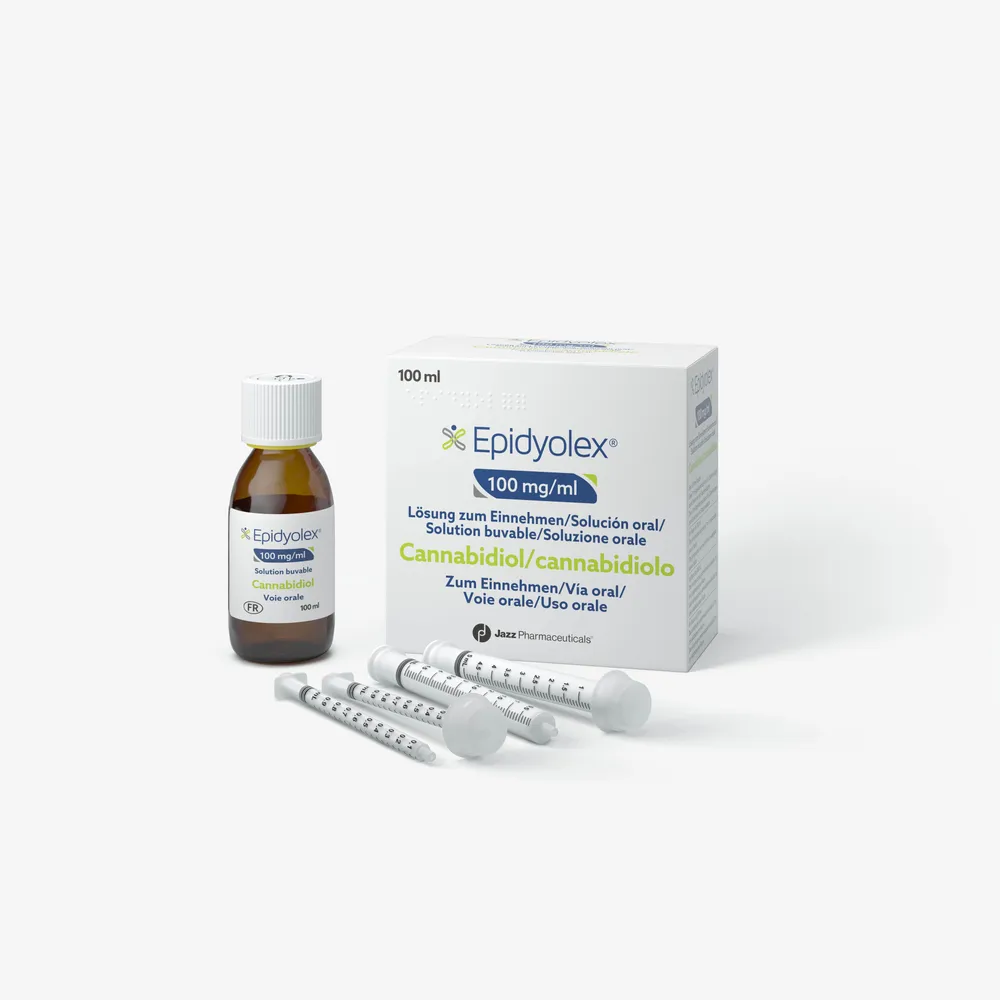
Table of Contents
- Patient Information Leaflet: Information for the Patient
- Epidyolex 100 mg/mL oral solution
- 1. What Epidyolex is and what it is used for
- 2. What you or the patient should know before taking Epidyolex
- 3. How you or the patient should take Epidyolex
- 4. Possible side effects
- 5. How to store Epidyolex
- 6. Package contents and other information
Patient Information Leaflet: Information for the Patient
Epidyolex 100 mg/mL oral solution
cannabidiol
Please read all of this leaflet carefully before you or the patient starts taking this medicine, as it contains important information for you or the patient.
- Keep this leaflet. You may need to read it again.
- If you have any questions, consult your doctor or pharmacist.
- This medicine has been prescribed for you only. Do not give it to other people, even if their symptoms are the same as yours, as it could be harmful.
- If any adverse reaction occurs, including those not listed in this leaflet, consult your doctor or pharmacist. See section 4.
Contents of this leaflet
- What Epidyolex is and what it is used for
- What you or the patient should know before taking Epidyolex
- How you or the patient should take Epidyolex
- Possible side effects
- How to store Epidyolex
- Contents of the pack and other information
1. What Epidyolex is and what it is used for
Epidyolex contains cannabidiol, a medicine that can be used for the treatment of epilepsy, a disease characterized by the occurrence of seizures.
Epidyolex is used in combination with clobazam or with clobazam and other antiepileptic medicines for the treatment of epileptic seizures occurring in two rare diseases called Dravet syndrome and Lennox-Gastaut syndrome. It can be used in adults, adolescents and children aged 2 years and older.
Epidyolex is also used in combination with other antiepileptic medicines for the treatment of epileptic seizures occurring in a genetic disease called tuberous sclerosis complex (TSC). It can be used in adults, adolescents and children aged 2 years and older.
2. What you or the patient should know before taking Epidyolex
Do not take Epidyolex
- If you are allergic to cannabidiol or to any of the other ingredients of this medicine (listed in section 6).
- If your doctor determines that certain blood test results related to your liver are abnormal.
Warnings and precautions
Talk to your doctor or pharmacist before taking Epidyolex or during treatment if:
- You have or have had liver problems, as your doctor may need to adjust the dose of Epidyolex or may decide that Epidyolex is not suitable for you. Your doctor may order blood tests to monitor your liver function before starting treatment with this medicine or during treatment, because Epidyolex
can cause liver problems. If the liver does not function properly, this treatment
may need to be stopped.
- You notice unusual changes in mood or behaviour, or have thoughts of self-harm or suicide. Contact your doctor or go to hospital immediately (see section 4).
- Epidyolex may cause drowsiness. Avoid driving, operating machinery, or engaging in activities requiring alertness and precise control (such as cycling), until you understand how Epidyolex affects you.
- You stop taking Epidyolex suddenly (see section 3).
- While taking Epidyolex, seizures occur more frequently or you experience a severe seizure. Contact your doctor or go to hospital immediately.
- You experience weight loss or fail to gain weight. Your doctor will monitor your weight and assess whether treatment with Epidyolex should continue.
Children and adolescents
The use of Epidyolex is not recommended in children under 2 years of age.
Other medicines and Epidyolex
Inform your doctor or pharmacist if you are taking, have recently taken, or might take any other medicines. Taking Epidyolex together with certain other medicines may cause unwanted effects, affect the action of other medicines, or affect the action of Epidyolex. Do not start or stop treatment with other medicines without first consulting your doctor or pharmacist.
Inform your doctor if you are taking any of the following medicines, as it may be necessary to adjust their dose:
- Other antiepileptic medicines, such as carbamazepine, clobazam, lamotrigine, lorazepam, phenytoin, stiripentol, and valproate used to treat seizures
- Other medicines used to treat TSC, including everolimus or tacrolimus
- Medicines used to treat reflux (heartburn or acid regurgitation), such as omeprazole
- Mitotane (a medicine used to treat adrenal gland tumours)
- Morphine or diflunisal (medicines used to treat pain)
- Efavirenz (a medicine used to treat HIV/AIDS)
- Theophylline (a medicine used to treat asthma)
- Caffeine (a medicine used in infants with breathing problems)
- Propofol (an anaesthetic used during surgical procedures)
- Simvastatin, fenofibrate, gemfibrozil (medicines used to lower cholesterol/lipids)
- Enzalutamide (a medicine used to treat prostate cancer)
- Bupropion (a medicine used to help stop smoking or to treat obesity)
- St John’s wort (Hypericum perforatum) (a herbal remedy used to treat mild anxiety)
- Medicines used to treat bacterial infections, such as rifampicin, clarithromycin, and erythromycin
Epidyolex with food
Always take Epidyolex exactly as instructed by your doctor and consistently with or without food, including foods high in fat (such as in a ketogenic diet). If you take Epidyolex with food, you should consume similar types of food (e.g., foods with a similar fat content), if possible. (See also section 3, “How to take Epidyolex”).
Pregnancy, breastfeeding and fertility
If you are pregnant, think you might be pregnant, or are planning a pregnancy, consult your doctor or pharmacist before taking this medicine. Do not take Epidyolex during pregnancy unless your doctor has determined that the benefits outweigh the potential risks.
Avoid breastfeeding during treatment with Epidyolex, as Epidyolex is likely to be present in breast milk.
Driving and using machines
Talk to your doctor about driving, using machinery, or participation in sports activities by the child (such as cycling), as taking this medicine may cause drowsiness.
Avoid driving, using machinery, or participating in activities requiring alertness and precise control until you are certain that your ability to perform such activities is not impaired.
Epidyolex contains refined sesame oil, alcohol (ethanol), and strawberry flavour (including
benzyl alcohol).
Epidyolex contains refined sesame oil, which may rarely cause a severe allergic reaction.
Each mL of Epidyolex contains 79 mg of ethanol, equivalent to 10% v/v of anhydrous ethanol, i.e., up to 691.3 mg of ethanol per maximum single dose of Epidyolex (12.5 mg/kg) in a 70 kg adult (9.9 mg of ethanol per kg). For a 70 kg adult, this is equivalent to 17 millilitres (mL) of beer or 7 mL of wine per dose. The small amount of alcohol in this medicine will not produce significant effects.
This medicine contains 0.0003 mg/mL of benzyl alcohol, corresponding to 0.0026 mg per maximum dose of Epidyolex (Epidyolex 12.5 mg/kg dose in a 70 kg adult).
Benzyl alcohol may cause allergic reactions.
Do not use for more than one week in young children (under 3 years of age) unless otherwise recommended by your doctor or pharmacist.
Consult your doctor or pharmacist if you are pregnant or breastfeeding. Large amounts of benzyl alcohol may accumulate in the body and cause unwanted effects (such as metabolic acidosis).
Consult your doctor or pharmacist if you have liver or kidney disease. Large amounts of benzyl alcohol may accumulate in the body and cause unwanted effects (such as metabolic acidosis).
3. How you or the patient should take Epidyolex
Take this medicine exactly as your doctor has told you. If you have any doubts, consult your doctor or pharmacist.
Epidyolex is an oral solution (a liquid to be swallowed). Your doctor and pharmacist will determine the amount (in mL) of Epidyolex to take each day, how many times a day to take it, and which syringe (1 mL or 5 mL) to use for the prescribed dose.
Your doctor will calculate the dose based on body weight. Treatment may start at a low dose, which your doctor will gradually increase over time. Contact your doctor if you have any questions about the dose to take or if you think a dose adjustment is needed.
Taking Epidyolex with food may increase the amount of medicine absorbed by your body. Try as much as possible to take Epidyolex consistently in relation to your eating habits and daily routine, to achieve the same effect each time. If you take Epidyolex with food, try to consume similar types of food (e.g. with a similar fat content), if possible.
If necessary, Epidyolex can be administered via nasogastric or gastrostomy tube. Your doctor will provide instructions on how to proceed in these cases. If in doubt, consult your doctor or pharmacist.
If you have liver problems, inform your doctor, as your dose may need to be adjusted.
Do not reduce the dose or stop taking this medicine unless instructed by your doctor.
Instructions for oral administration of Epidyolex
The pack containing 1 vial includes the following items:
- one vial of Epidyolex oral solution
- one plastic pouch containing two 1 mL syringes and one dedicated vial adapter
- one plastic pouch containing two 5 mL syringes and one dedicated vial adapter
The pack containing 3 vials includes the following items:
- three vials of Epidyolex oral solution
- one plastic pouch containing two 1 mL syringes and one dedicated vial adapter
- one plastic pouch containing two 5 mL syringes and two dedicated vial adapters
The pack also contains one spare syringe for each size, in case a syringe is damaged or lost. For the 3-vial pack, all three adapters from both syringe pouches are required.
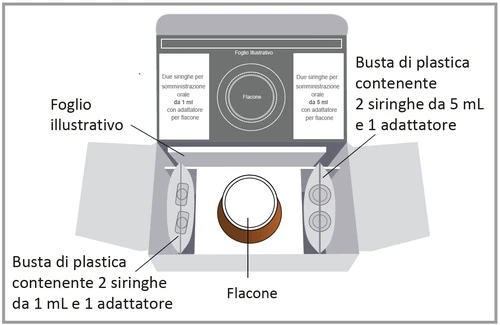
The figure above is for illustrative purposes only.
- Open the pouch containing the syringe to be used for measuring the prescribed oral dose.
- If the prescribed dose is equal to or less than 1 mL (100 mg), the small 1 mL syringe must be used.
- If the prescribed dose is greater than 1 mL (100 mg), the large 5 mL syringe must be used.
- If the prescribed dose is greater than 5 mL (500 mg), the large 5 mL syringe must be used more than once. In this case, keep track of how many times the syringe is filled (e.g. by writing down each 5 mL dose) to avoid dosing errors.
It is important to use the correct dosing syringe for the prescribed oral dose. Your doctor or pharmacist will advise which syringe to use based on the prescribed dose.
As advised by your doctor or pharmacist, the pouch containing the unused syringes and adapter should be removed from the packaging and discarded, unless your doctor or pharmacist has advised keeping both syringes until the final dose is established. If a 3-vial pack is prescribed, all three adapters must be kept.
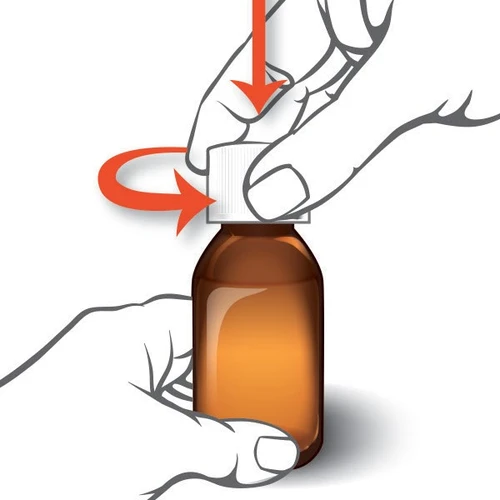
- Remove the child-resistant cap from the vial by pressing down and simultaneously turning the cap counterclockwise.
- Push the dedicated adapter firmly into the neck of the vial, ensuring it is fully inserted. If not properly secured, the adapter could detach and cause choking.
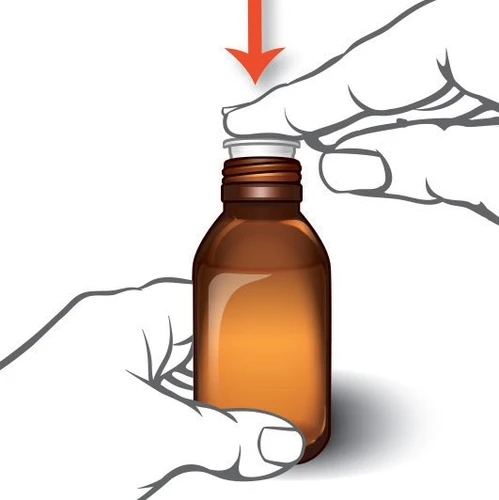
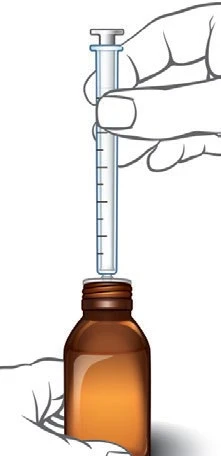 | 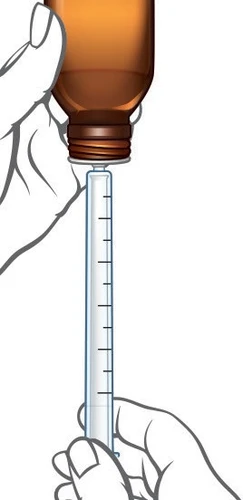 |
- Insert the tip of the chosen oral syringe completely into the vial adapter and, holding it firmly, turn the vial upside down.
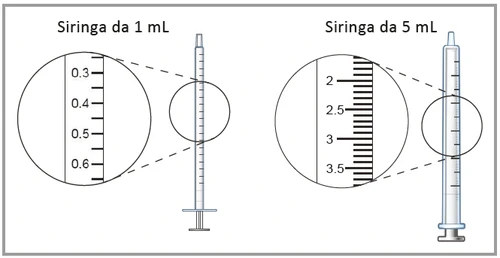
- Slowly pull back the plunger of the syringe to draw the required volume (amount in mL) of
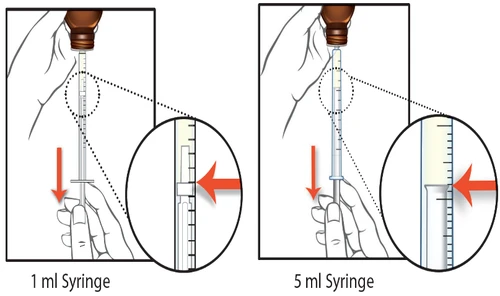
solution into the syringe. Align the end of the plunger with the prescribed volume marking required, as shown in the adjacent figure.
If there is an air bubble in the syringe, return the liquid back into the vial, keeping the vial inverted at all times, and repeat step 5 until the air bubble has disappeared.
- Upright the vial and
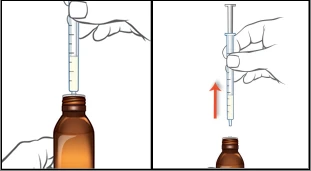
carefully remove the oral administration syringe from the adapter.
- Insert the tip of the oral administration syringe
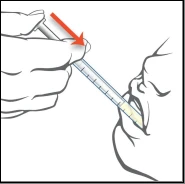
inside the cheek and gently push the plunger to release the medicine. Do not push the plunger forcefully or direct the medicine onto the palate or into the throat.
If the prescribed dose is greater than 5 mL, repeat the procedure from step 4 to step 7 to administer the dose using the 5 mL syringe.
- Close the vial securely
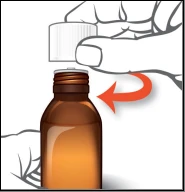
by screwing the child-resistant cap clockwise. It is not necessary to remove the adapter (the cap will fit perfectly over the adapter).
-
Fill a cup with warm soapy water and clean the oral administration syringe by filling and emptying it several times.
-
Remove the plunger from the barrel of the syringe and rinse both parts under running water. The oral administration syringe must not be washed in a dishwasher.
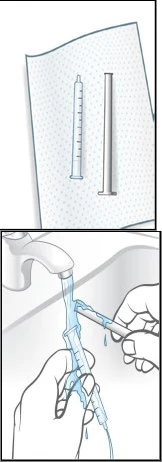
Shake the syringe parts to remove excess water and leave them to air-dry until next use. Ensure that the oral administration syringe is completely dry before reuse; if water enters the vial, the solution may become cloudy.
If the solution in the vial appears cloudy, this does not affect the effectiveness of the medicine. Continue to use the medicine as normal.
If you or the patient takes more Epidyolex than you should
If you accidentally take more Epidyolex than prescribed, inform your doctor or pharmacist immediately, or go to the nearest Emergency Room, taking the medicine with you.
Signs that you may have taken too much Epidyolex include diarrhea and drowsiness.
If you or the patient forgets to take Epidyolex
If a dose is forgotten, do not take a double dose to make up for the missed dose. Take the next dose at the usual scheduled time. If several doses have been missed, consult your doctor to determine the correct dose to take.
If you or the patient stops treatment with Epidyolex
Do not reduce the prescribed dose or stop treatment with Epidyolex without first consulting your doctor. Abruptly stopping this treatment may increase epileptic seizures. Your doctor will advise you on how to gradually discontinue treatment with Epidyolex.
If you have any questions about the use of this medicine, consult your doctor or pharmacist.
4. Possible side effects
Like all medicines, this medicine can cause side effects, although not everyone experiences them.
The following side effects can be very serious:
Common side effects (may affect more than 1 in 100 people):
- Elevated liver enzymes (increased transaminases) detected in blood tests (possible sign of liver damage) have been reported in patients treated with Epidyolex.
Side effects with unknown frequency (frequency cannot be estimated from the available data):
- People taking this medicine may have thoughts of self-harm or suicide. If you experience thoughts of this kind at any time, contact your doctor immediately.
The following side effects may occur with this medicine. Contact your doctor if you experience any of the side effects listed below:
Very common side effects (may affect more than 1 in 10 people):
- Sleepiness
- Diarrhoea
- Decreased appetite
- Fever
- Vomiting
- Feeling tired
Common side effects (may affect more than 1 in 100 people):
- Seizures
- Irritability (mood disturbances, aggression)
- Rash
- Lack of energy
- Cough
- Pneumonia
- Weight loss
- Malaise
- Urinary tract infections
Reporting of side effects
If you experience any side effect, including those not listed in this leaflet, talk to your doctor or pharmacist. You can also report side effects directly via the national reporting system detailed in Annex V.
By reporting side effects, you can help provide more information on the safety of this medicine.
5. How to store Epidyolex
Keep this medicine out of the sight and reach of children.
Do not use this medicine after the expiry date stated on the bottle. The expiry date refers to the last
day of that month.
If any solution remains in the bottle after 12 weeks from first opening, do not use it any longer.
This medicine does not require any special storage conditions.
Do not dispose of medicines via wastewater or household waste. Ask your pharmacist how to dispose
of medicines you no longer use. This will help protect the environment.
6. Package contents and other information
What Epidyolex contains
- The active substance is cannabidiol. Each mL of oral solution contains 100 mg of cannabidiol.
- The other ingredients are refined sesame oil, anhydrous ethanol, sucralose and strawberry flavour (including benzyl alcohol) (see section 2).
Description of the appearance of Epidyolex and contents of the pack
Epidyolex is an oral solution that is transparent and varies in colour from colourless to yellow.
It is supplied in an amber glass bottle with a child-resistant screw cap.
The following pack sizes of Epidyolex are available:
100 mL (1 bottle of 100 mL) together with 2 calibrated 5 mL syringes and 2 calibrated 1 mL syringes
for oral administration and two bottle adapters.
300 mL (3 bottles of 100 mL) together with 2 calibrated 5 mL syringes and 2 calibrated 1 mL syringes
for oral administration and three bottle adapters.
The 5 mL syringes are graduated in 0.1 mL increments; the 1 mL syringes are graduated in
0.05 mL increments.
Not all pack sizes may be marketed.
Marketing Authorisation Holder
Jazz Pharmaceuticals Ireland Ltd
5th Floor
Waterloo Exchange
Waterloo Road
Dublin 4
D04 E5W7
Ireland
E-mail: [email protected]
Manufacturer
Jazz Pharmaceuticals Netherlands B.V.,
Stationsplein 13A, 3818 LE, Amersfoort
The Netherlands
E-mail: [email protected]
For further information on this medicinal product, please contact the local representative of the Marketing Authorisation Holder:
| Belgium/Belgium/Belgium Tel: +31 207176898 | Lithuania Tel: +353 1 968 1631 |
| Bulgaria Tel: +353 1 968 1631 | Luxembourg/Luxembourg Tel/Tel: +31 207176898 |
| Czech Republic Tel: +353 1 968 1631 | Hungary Tel: +353 1 968 1631 |
| Denmark Tlf: +45 69918419 | Malta Tel: +353 1 968 1631 |
| Germany Tel: +49(0)3022957821 | Netherlands Tel: +31 207176898 |
| Estonia Tel: +353 1 968 1631 | Norway Tlf: +353 1 968 1631 |
| Greece Tel: +353 1 968 1631 | Austria Tel: +353 1 968 1631 |
| Spain Jazz Pharmaceuticals Iberia, S.L. Tel: +34 914142493 | Poland Tel: +353 1 968 1631 |
| France Marketing Authorisation Holder: Jazz Pharmaceuticals France SAS Tel: +33 176728925 | Portugal Tel: +351 308805626 |
| Croatia Tel: +353 1 968 1631 | Romania Tel: +353 1 968 1631 |
| Ireland Tel: +353 1 968 1631 | Slovenia Tel: +353 1 968 1631 |
| Iceland Tel: +353 1 968 1631 | Slovakia Tel: +353 1 968 1631 |
| Italy Jazz Healthcare Italy S.r.l. Tel: +39 (0)800959164 | Finland Tel/Tel: +353 1 968 1631 |
| Cyprus Tel: +353 1 968 1631 | Sweden Tel: +46 406688521 |
| Latvia Tel: +353 1 968 1631 |
Other sources of information
More detailed information on this medicine is available on the website of the European Medicines Agency: https://www.ema.europa.eu/. In addition, links to other websites on rare diseases and related therapeutic treatments are provided.