Enwylma
Italy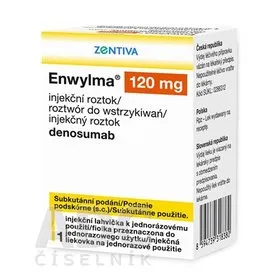
Table of Contents
Patient Information Leaflet
Enwylma 120 mg injection solution
denosumab
This medicinal product is subject to additional monitoring. This will allow for rapid identification of new safety information. You can help by reporting any side effects you experience while taking this medicine. See the end of section 4 for information on how to report side effects.
Please read this leaflet carefully before using this medicine because it contains important information for you.
- Keep this leaflet. You may need to read it again.
- If you have any questions, ask your doctor, pharmacist, or nurse.
- This medicine has been prescribed for you only. Do not give it to other people, even if their symptoms are the same as yours, as it may be harmful.
- If you experience any side effect, including those not listed in this leaflet, contact your doctor, pharmacist, or nurse. See section 4.
- Your doctor will provide you with a patient reminder card containing important safety information that you must know before and during treatment with Enwylma.
Contents of this leaflet
- What Enwylma is and what it is used for
- What you need to know before using Enwylma
- How to use Enwylma
- Possible side effects
- How to store Enwylma
- Contents of the pack and other information
1. What Enwylma is and what it is used for
Enwylma contains denosumab, a protein (monoclonal antibody) that works by reducing bone destruction caused by the spread of cancer to the bone (bone metastases) or by giant cell bone tumour.
Enwylma is used in adults with advanced cancer to prevent serious complications caused by bone metastases (e.g. fracture, pressure on the spinal cord, or need for radiotherapy or surgery).
Enwylma is also used to treat giant cell bone tumour that cannot be treated surgically or when surgery is not the best option, in adults and in adolescents whose bones have stopped growing.
2. What you need to know before using Enwylma
Do not use Enwylma
- if you are allergic to denosumab or to any of the other ingredients of this medicine (listed in section 6).
The healthcare provider will not administer Enwylma if you have severely low calcium levels in your blood that have not been treated.
The healthcare provider will not administer Enwylma if you have unhealed wounds from dental or oral surgery.
Warnings and precautions
Talk to your doctor before using Enwylma.
Calcium and vitamin D supplementation
You must take calcium and vitamin D supplements while being treated with Enwylma, except if your blood calcium levels are high. Your doctor will discuss this with you. If your blood calcium level is low, your doctor may decide to give you calcium supplements before starting treatment with Enwylma.
Low calcium levels in the blood
Tell your doctor immediately if, during treatment with Enwylma, you experience muscle spasms, twitches or cramps, and/or numbness or tingling in the fingers of your hands or feet or around your mouth, and/or seizures, confusion or loss of consciousness. You may have low calcium levels in your blood.
Kidney problems
Tell your doctor if you currently have or have ever had severe kidney problems, kidney failure, or if you have undergone dialysis, as these conditions may increase the risk of low calcium levels in the blood, especially if you are not taking calcium supplements.
Problems with mouth, teeth or jaw
A side effect called osteonecrosis of the jaw/mandible (a serious deterioration of the jaw/mandible bone tissue) has been commonly reported (may occur in up to 1 in 10 people) in patients who received Enwylma injections for cancer-related conditions. Osteonecrosis of the jaw/mandible may also occur after stopping treatment.
It is important to try to prevent the development of osteonecrosis of the jaw/mandible, as it is a painful condition that may be difficult to treat. To reduce the risk of developing osteonecrosis of the jaw/mandible, you should take the following precautions:
- Before receiving treatment, inform your doctor/nurse (healthcare provider) if you have any mouth or dental problems. Your doctor should delay starting treatment if you have unhealed mouth wounds following dental procedures or oral surgery. Your doctor may ask you to have a dental examination before starting treatment with Enwylma.
- During treatment, you must maintain good oral hygiene and have regular dental check-ups. If you wear dentures, ensure they are properly fitted.
- If you are currently undergoing dental treatment or are planning to have dental surgery (e.g. tooth extractions), inform your doctor about the dental treatment and inform your dentist that you are being treated with Enwylma.
- Contact your doctor and dentist immediately if you notice any new mouth or dental problems, such as loose teeth, pain or swelling, or failure of mouth sores to heal or presence of discharge, as these may be signs of osteonecrosis of the jaw/mandible.
Patients who are receiving chemotherapy and/or radiotherapy, who are taking steroids or anti-angiogenic medicines (used to treat cancer), who undergo dental surgery, who do not receive routine dental care, who have gum problems, or who smoke may have a higher risk of developing osteonecrosis of the jaw/mandible.
Unusual fractures of the thigh bone (femur)
Some people have developed unusual fractures of the femur during treatment with Enwylma. Contact your doctor if you experience new or unusual pain in your hip, groin, or thigh.
High calcium levels in the blood after stopping treatment with Enwylma
Some patients with giant cell tumour of the bone have developed high calcium levels in the blood weeks to months after stopping treatment. Your doctor will monitor you for signs and symptoms of high calcium levels after you stop taking Enwylma.
Children and adolescents
Enwylma is not recommended for children and adolescents under 18 years of age, except for adolescents with giant cell tumour of the bone whose bones have stopped growing. The use of Enwylma in children and adolescents with other tumours that have invaded the bones has not been studied.
Other medicines and Enwylma
Tell your doctor or pharmacist if you are taking, have recently taken, or might take any other medicines. This includes medicines obtained without a prescription. In particular, it is important that you inform your doctor if you are taking:
- another medicine containing denosumab
- a bisphosphonate
You must not take Enwylma together with other medicines containing denosumab or bisphosphonates.
Pregnancy and breastfeeding
Enwylma has not been studied in pregnant women. If you are pregnant, think you may be pregnant, or are planning to become pregnant, ask your doctor for advice before taking this medicine. The use of Enwylma is not recommended during pregnancy. Women of childbearing potential must use effective contraception while taking Enwylma and for at least 5 months after stopping treatment with Enwylma.
If you become pregnant during treatment with Enwylma or within 5 months after stopping treatment with Enwylma, inform your doctor.
It is not known whether denosumab is excreted in human milk. It is important that you inform your doctor if you are breastfeeding or planning to breastfeed. Your doctor will then help you decide whether to discontinue breastfeeding or discontinue denosumab, taking into account the benefits of breastfeeding for the child and the benefits of denosumab for the mother.
If you are breastfeeding during treatment with Enwylma, inform your doctor.
Ask your doctor or pharmacist for advice before taking any medicine.
Driving and using machines
Enwylma has no or negligible influence on the ability to drive and use machines.
Enwylma contains sorbitol
This medicine contains 78 mg of sorbitol per vial.
Enwylma contains sodium
This medicine contains less than 1 mmol (23 mg) of sodium per 120 mg dose, i.e., essentially ‘sodium-free’.
Enwylma contains polysorbate 20 (E432)
This medicine contains 0.17 mg of polysorbate 20 (E 432) per vial, equivalent to 0.1 mg/mL. Polysorbates may cause allergic reactions. Inform your doctor if you have known allergies.
3. How to use Enwylma
Enwylma must be administered under the supervision of a healthcare professional.
The recommended dose of Enwylma is 120 mg given once every 4 weeks, as a single
subcutaneous injection (under the skin). Enwylma will be injected into the thigh, abdomen, or upper arm. If you are being treated for giant cell bone tumor, you will receive additional doses 1 week and 2 weeks after the first dose.
Do not shake.
During treatment with Enwylma, you should also take calcium and vitamin D supplements unless you have high levels of calcium in your blood. Your doctor will discuss this with you.
If you have any doubts about how to use this medicine, consult your doctor, pharmacist, or nurse.
4. Possible side effects
Like all medicines, this medicine can cause side effects, although not everyone gets them.
Contact your doctor immediately if, during treatment with Enwylma, you notice any of the following symptoms (these may affect more than 1 in 10 people):
- muscle spasms, contractions, cramps, numbness or tingling in the fingers of the hands and feet or around the mouth and/or seizures, confusion or loss of consciousness. These signs could indicate low levels of calcium in the blood. Low calcium levels may also lead to a change in heart rhythm called QT prolongation, which is seen on an electrocardiogram (ECG).
Contact your doctor and dentist immediately if, during treatment with Enwylma or after stopping treatment with Enwylma, you notice any of the following symptoms (these may occur in up to 1 in 10 people):
- persistent pain in the mouth and/or jaw, and/or swelling or failure of sores in the mouth or jaw to heal, presence of discharge, numbness or a feeling of heaviness in the jaw, or loosening of a tooth, as these signs could indicate a serious deterioration of the jawbone (osteonecrosis).
Very common side effects (may occur in more than 1 in 10 people):
- bone, joint and/or muscle pain, sometimes severe,
- shortness of breath (dyspnoea),
- diarrhoea.
Common side effects (may occur in up to 1 in 10 people):
- low levels of phosphate in the blood (hypophosphataemia),
- tooth extraction,
- excessive sweating,
- in patients with advanced tumour: development of another type of tumour.
Uncommon side effects (may occur in up to 1 in 100 people):
- high levels of calcium in the blood (hypercalcaemia) after stopping treatment in patients with giant cell tumour of the bone,
- new or unusual pain in the hip, groin or thigh (this could be an early sign of a possible fracture of the thigh bone),
- rash which may appear on the skin or sores in the mouth (drug-induced lichenoid eruptions).
Rare side effects (may occur in up to 1 in 1,000 people):
- allergic reactions (for example, wheezing or difficulty breathing; swelling of the face, lips, tongue, throat or other parts of the body; skin rash, itching or hives). In rare cases, allergic reactions may be severe.
Not known (frequency cannot be estimated from the available data):
Inform your doctor if you experience ear pain, ear discharge, and/or an ear infection. These could be signs of damage to the ear bone.
Reporting of side effects
If you experience any side effects, including those not listed in this leaflet, talk to your doctor, pharmacist or nurse. You can also report side effects directly via the national reporting system listed in Annex V. By reporting side effects, you can help provide more information on the safety of this medicine.
5. How to store Enwylma
Keep this medicine out of the sight and reach of children.
Do not use this medicine after the expiry date stated on the label after EXP and on the
carton after Exp. The expiry date refers to the last day of that month.
Store in a refrigerator (2°C – 8°C).
Do not freeze.
Keep the vial in the outer packaging to protect the medicine from light.
The vial may be removed from the refrigerator and allowed to reach room temperature (up to 25°C) before injection. This will make the injection more comfortable. Once the vial has reached room temperature (up to 25°C), it must be used within 30 days.
Do not dispose of any medicine via wastewater or household waste. Ask your pharmacist how to dispose of medicines you no longer use. This will help protect the environment.
6. Package contents and other information
What Enwylma contains
- The active substance is denosumab. Each vial contains 120 mg of denosumab in 1.7 ml of solution (corresponding to 70 mg/ml).
- The other components are glacial acetic acid, sodium hydroxide, sorbitol (E420), polysorbate 20, and water for injections.
Description of the appearance of Enwylma and contents of the pack
Enwylma is an injectable solution (injectable).
Enwylma is a clear, colourless to slightly yellow solution. It may contain traces of transparent to white particles.
Each pack contains one single-use vial.
Not all pack sizes may be marketed.
Marketing Authorisation Holder
Zentiva k.s.
U Kabelovny 130
102 37 Prague 10
Czech Republic
Manufacturer
GH GENHELIX S.A.
Parque Tecnológico de León
Edificio GENHELIX
C/Julia Morros, s/n
Armunia, 24009 León
Spain
For further information about this medicine, please contact the local representative of the Marketing Authorisation Holder:
België/Belgique/Belgien Lietuva
Zentiva, k.s. Zentiva, k.s.
Tél/Tel: +32 (78) 700 112 Tel: +370 52152025
[email protected] [email protected]
България Luxembourg/Luxemburg
Zentiva, k.s. Zentiva, k.s.
Тел: + 35924417136 Tél/Tel: +352 208 82330
[email protected] [email protected]
Česká republika Magyarország
Zentiva, k.s. Zentiva Pharma Kft.
Tel: +420 267 241 111 Tel.: +36 1 299 1058
[email protected] [email protected]
Danmark Malta
Zentiva Denmark ApS Zentiva, k.s.
Tlf.: +45 787 68 400 Tel: +356 2034 1796
[email protected] [email protected]
Deutschland Nederland
Zentiva Pharma GmbH Zentiva, k.s.
Tel: +49 (0) 800 53 53 010 Tel: +31 202 253 638
[email protected] [email protected]
Eesti Norge
Zentiva, k.s. Zentiva Denmark ApS
Tel: +372 52 70308 Tlf: +45 787 68 400
[email protected] [email protected]
Ελλάδα Österreich
Zentiva, k.s. Zentiva, k.s.
Τηλ: +30 211 198 7510 Tel: +43 720 778 877
[email protected] [email protected]
España Polska
Zentiva Spain S.L.U. Zentiva Polska Sp. z o.o.
Tel: +34 671 365 828 Tel: + 48 22 375 92 00
[email protected] [email protected]
France Portugal
Zentiva France Zentiva Portugal, Lda
Tél: +33 (0) 800 089 219 Tel: +351210601360
[email protected] [email protected]
Hrvatska România
Zentiva d.o.o. ZENTIVA S.A.
Tel: +385 1 6641 830 Tel: +4 021.304.7597
[email protected] [email protected]
Ireland Slovenija
Zentiva, k.s. Zentiva, k.s.
Tel: +353 818 882 243 Tel: +386 360 00 408
[email protected] [email protected]
Ísland Slovenská republika
Zentiva Denmark ApS Zentiva, a.s.
Sími: +354 539 5025 Tel: +421 2 3918 3010
[email protected] [email protected]
Italia Suomi/Finland
Zentiva Italia S.r.l. Zentiva Denmark ApS
Tel: +39 800081631 Puh/Tel: +358 942 598 648
[email protected] [email protected]
Κύπρος Sverige
Zentiva, k.s. Zentiva Denmark ApS
Τηλ: +30 211 198 7510 Tel: +46 840 838 822
[email protected] [email protected]
Latvija
Zentiva, k.s.
Tel: +371 67893939
[email protected]
More detailed information on this medicine is available on the website of the European Medicines Agency: https://www.ema.europa.eu/.
The following information is intended for healthcare professionals only:
- Before administration, the Enwylma solution should be inspected visually. The solution may contain traces of translucent to white protein particles. Do not inject the solution if it is cloudy, discoloured, or contains a large number of particles or foreign particulate matter.
- Do not shake.
- To minimize discomfort at the injection site, allow the vial to reach room temperature (up to 25°C) before injection, and inject slowly.
- The entire contents of the vial must be administered.
- A 27-gauge steel needle is recommended for administration of denosumab.
- The vial must not be reused.
Any unused medicine and waste material derived from this medicine must be disposed of in accordance with local regulations.