Entecavir Accord
Italy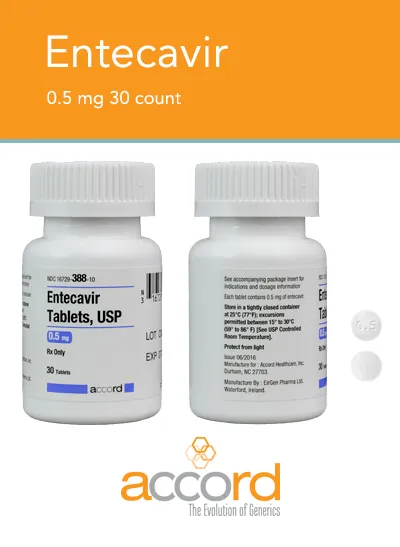
Table of Contents
- Package leaflet: Information for the user
- Entecavir Accord 0.5 mg film-coated tablets, 1 mg film-coated tablets
- 1. What Entecavir Accord is and what it is used for
- 2. What you should know before taking Entecavir Accord
- 3. How to take Entecavir Accord
- 4. Possible side effects
- 5. How to store Entecavir Accord
- 6. Package contents and other information
Package leaflet: Information for the user
Entecavir Accord 0.5 mg film-coated tablets, 1 mg film-coated tablets
entecavir
Please read all of this leaflet carefully before you start taking this medicine because it contains
important information for you.
-
- Keep this leaflet. You may need to read it again.
-
- If you have any questions, ask your doctor or pharmacist.
-
- This medicine has been prescribed for you only. Do not give it to other people, even if they have the same symptoms as yours, because it may be harmful.
-
- If you experience any side effects, including those not listed in this leaflet, tell your doctor or pharmacist. See section 4.
Contents of this leaflet:
- What Entecavir Accord is and what it is used for
- What you need to know before taking Entecavir Accord
- How to take Entecavir Accord
- Possible side effects
- How to store Entecavir Accord
- Contents of the pack and other information
1. What Entecavir Accord is and what it is used for
Entecavir Accord tablets are an antiviral medicine, used in adults for the treatment of chronic (long-term) hepatitis B virus infection. Entecavir Accord can be used in patients whose liver is damaged but still functions properly (compensated liver disease) and in patients whose liver is damaged and does not function properly (decompensated liver disease).
Entecavir Accord tablets are also used for the treatment of chronic (long-term) hepatitis B virus infection in children and adolescents from 2 years of age up to but below 18 years of age. Entecavir Accord can be used in children whose liver is damaged but still functions properly (compensated liver disease).
Hepatitis B virus infection can cause liver damage. Entecavir Accord reduces the amount of virus in the body and improves the condition of the liver.
2. What you should know before taking Entecavir Accord
Do not take Entecavir Accord
- if you are allergic (hypersensitive) to entecavir or to any of the other ingredients of this medicine (listed in section 6).
- Warnings and precautions
- Talk to your doctor or pharmacist before taking Entecavir Accord
- if you have had kidney problems, inform your doctor. This is important because Entecavir Accord is eliminated from the body through the kidneys and you may need a dose adjustment or modified dosing schedule.
- do not stop taking Entecavir Accord without medical advice, as hepatitis may worsen after stopping treatment. If treatment with Entecavir Accord is discontinued, your doctor will continue to monitor you and perform blood tests for several months.
- discuss with your doctor whether your liver is functioning properly, and if not, what effects this may have on your treatment with Entecavir Accord.
- if you are also infected with HIV (human immunodeficiency virus), inform your doctor. You must not take Entecavir Accord to treat hepatitis B infection unless you are already receiving medications for HIV, as the effectiveness of future HIV treatment may be reduced. Entecavir Accord will not control your HIV infection.
- taking Entecavir Accord will not prevent you from transmitting the hepatitis B virus (HBV) to others through sexual contact or body fluids (including blood contamination). Therefore, it is important to take precautions to avoid spreading the hepatitis B virus (HBV) to others. A vaccine is available to protect those at risk of acquiring hepatitis B virus (HBV) infection.
- Entecavir Accord belongs to a class of medicines that can cause lactic acidosis (excess lactic acid in the blood) and enlargement of the liver. Symptoms such as nausea, vomiting, and stomach pain may indicate the development of lactic acidosis. This rare but serious side effect has occasionally been fatal. Lactic acidosis occurs more frequently in women, especially those who are significantly overweight. Your doctor will monitor you regularly during treatment with Entecavir Accord.
- if you have previously received treatment for chronic hepatitis B, inform your doctor.
Children and adolescents
Entecavir Accord must not be given to children under 2 years of age or who weigh less than 10 kg.
Other medicines and Entecavir Accord
Inform your doctor or pharmacist if you are taking, have recently taken, or might take any other medicines.
Entecavir Accord with food and drink
In most cases, you can take Entecavir Accord with or without food. However, if you have previously been treated with a medicine containing the active substance lamivudine, consider the following. If you have switched to treatment with Entecavir Accord because lamivudine therapy was not successful, you must take Entecavir Accord once daily on an empty stomach. If your liver disease is very advanced, your doctor will instruct you to take Entecavir Accord on an empty stomach. An empty stomach means at least 2 hours after a meal and at least 2 hours before the next meal.
Children and adolescents (from 2 years of age up to 18 years of age) may take Entecavir Accord with or without food.
Pregnancy, breastfeeding and fertility
Inform your doctor if you are pregnant or planning to become pregnant. The use of Entecavir Accord during pregnancy has not been proven safe. Unless specifically indicated by your doctor, Entecavir Accord must not be used during pregnancy. It is important that women of childbearing potential use an effective method of contraception during treatment with Entecavir Accord to avoid pregnancy.
You must not breastfeed while taking Entecavir Accord. Inform your doctor if you are breastfeeding. It is not known whether entecavir, the active substance in Entecavir Accord, is excreted in human breast milk.
Driving and using machines
Dizziness, fatigue, and somnolence are common side effects that may impair your ability to drive or operate machinery. For any clarification, consult your doctor.
Entecavir Accord, soy polysaccharide and sodium
This medicine contains soy polysaccharides. If you are allergic to soy, do not take this medicine.
This medicine contains less than 1 mmol (23 mg) of sodium per tablet, i.e., essentially ‘sodium-free’.
3. How to take Entecavir Accord
Not all patients need to take the same dose of Entecavir Accord.
Always take this medicine exactly as your doctor has instructed you. If you have any doubts, consult your doctor or pharmacist.
For adults, the recommended dose is 0.5 mg or 1 mg, taken once daily by mouth (orally).
Your dose will depend on:
- whether you have previously received treatment for hepatitis B virus (HBV) infection, and which medicine you were treated with.
- whether you have kidney problems. Your doctor may prescribe you a lower dose or advise you to take it less than once daily.
- the condition of your liver.
For children and adolescents (from 2 years of age up to below 18 years of age), Entecavir Accord 0.5 mg tablets are available, or an oral solution of entecavir may be available.
Your child’s doctor will determine the correct dose based on your child’s weight. Children weighing at least 32.6 kg may take the 0.5 mg tablets or may be given an oral solution of entecavir. An oral solution of entecavir is recommended for patients weighing from 10 kg to 32.5 kg. Each dose should be administered once daily by mouth (orally). There are no recommendations for the use of entecavir in children under 2 years of age or with body weight below 10 kg.
Your doctor will inform you of the correct dosage. To ensure the medicine is fully effective and to reduce the development of resistance to therapy, always take the dose recommended by your doctor. Take Entecavir Accord for the entire duration prescribed by your doctor. Your doctor will advise you whether and when to stop treatment.
Some patients must take Entecavir Accord on an empty stomach (see Entecavir Accord with food and drink in section 2). If your doctor has told you to take Entecavir Accord on an empty stomach, this means at least 2 hours after a meal and at least 2 hours before the next meal.
Entecavir Accord is available only as 0.5 mg and 1 mg film-coated tablets. For patients who have difficulty swallowing or for whom a dose reduction is recommended, other formulations containing entecavir that are more suitable may be available.
If you take more Entecavir Accord than you should
Contact your doctor immediately.
If you forget to take Entecavir Accord
It is important that you do not miss any doses. If you forget a dose of Entecavir Accord, take it as soon as possible, and then take the next dose at the scheduled time. If it is almost time for the next dose, do not take the missed dose. Wait and take the next dose at the scheduled time. Do not take a double dose to make up for a missed dose.
Do not stop treatment with Entecavir Accord without consulting your doctor
Many patients experience very severe hepatitis symptoms when they stop taking Entecavir Accord. Inform your doctor immediately if you notice any changes in your symptoms after stopping treatment.
If you have any doubts about how to use this medicine, consult your doctor or pharmacist.
4. Possible side effects
Like all medicines, this medicine can cause side effects, although not everybody gets them.
The following side effects have been reported in patients treated with Entecavir Accord:
Adults
- Common (affects at least 1 in 100 patients): headache, insomnia (inability to sleep), fatigue (excessive tiredness), dizziness, somnolence (drowsiness), vomiting, diarrhoea, nausea, dyspepsia (indigestion), and increased levels of liver enzymes in the blood.
- Uncommon (affects at least 1 in 1,000 patients): skin rash, hair loss.
- Rare (affects at least 1 in 10,000 patients): severe allergic reaction.
Children and adolescents
Side effects observed in children and adolescents are similar to those observed in adults as described above, with the following difference:
Very common (affects at least 1 in 10 patients): low levels of neutrophils (a type of white blood cells important in fighting infections).
If you experience any side effect, including those not listed in this leaflet, talk to your doctor or pharmacist.
Reporting of side effects
If you get any side effects, including those not listed in this leaflet, talk to your doctor or pharmacist. You can also report side effects directly via the national reporting system listed in Appendix V. By reporting side effects, you can help provide more information on the safety of this medicine.
5. How to store Entecavir Accord
Keep this medicine out of the sight and reach of children.
Do not use this medicine after the expiry date which is stated on the bottle, blister pack or carton
after Exp. The expiry date refers to the last day of that month.
Use within 90 days of opening the bottle.
This medicine does not require any special storage conditions.
Do not dispose of medicines via wastewater or household waste. Ask your pharmacist how to dispose of medicines you no longer use. This will help protect the environment.
6. Package contents and other information
What Entecavir Accord contains
The active substance is entecavir.
Entecavir Accord 0.5 mg film-coated tablets
Each tablet contains entecavir monohydrate equivalent to 0.5 mg of entecavir.
Entecavir Accord 1 mg film-coated tablets
Each tablet contains entecavir monohydrate equivalent to 1 mg of entecavir.
The other excipients are:
Tablet core: calcium carbonate, pregelatinized starch, sodium carmellose, soy polysaccharide, citric acid monohydrate, sodium stearyl fumarate.
Tablet coating:
Entecavir Accord 0.5 mg film-coated tablets
Hypromellose, titanium dioxide (E171), macrogol, polysorbate 80
Entecavir Accord 1 mg film-coated tablets
Hypromellose, titanium dioxide (E171), macrogol, red iron oxide (E172)
See section 2 “Entecavir Accord soy polysaccharide and sodium”.
Description of the appearance of Entecavir Accord and contents of the pack
Entecavir Accord 0.5 mg: white to almost white, triangular-shaped, biconvex film-coated tablets marked with "J" on one side and "110" on the other.
Entecavir Accord 1 mg: pink, triangular-shaped, biconvex film-coated tablets marked with "J" on one side and "111" on the other.
Entecavir Accord is available in cartons containing 30 x 1 or 90 x 1 film-coated tablets (in divisible blisters for single dose) and in bottles containing 30 film-coated tablets.
Not all pack sizes may be marketed.
Marketing Authorization Holder
Accord Healthcare S.L.U.
World Trade Center, Moll de Barcelona, s/n,
Edifici Est 6ª planta,
08039 Barcelona,
Spain
Manufacturer
Pharmadox Healthcare Ltd.
KW20A Kordin Industrial Park
Paola, PLA 3000
Malta
Accord Healthcare Polska Sp.z o.o.,
ul. Lutomierska 50, 95-200 Pabianice, Poland
For further information about this medicinal product, please contact the local representative of the Marketing Authorization Holder:
Accord Healthcare Limited, UK
Tel: 0044 208 863 1427
Other sources of information
More detailed information on this medicinal product is available on the website of the European Medicines Agency: http://www.ema.europa.eu/.