Enjaymo
Italy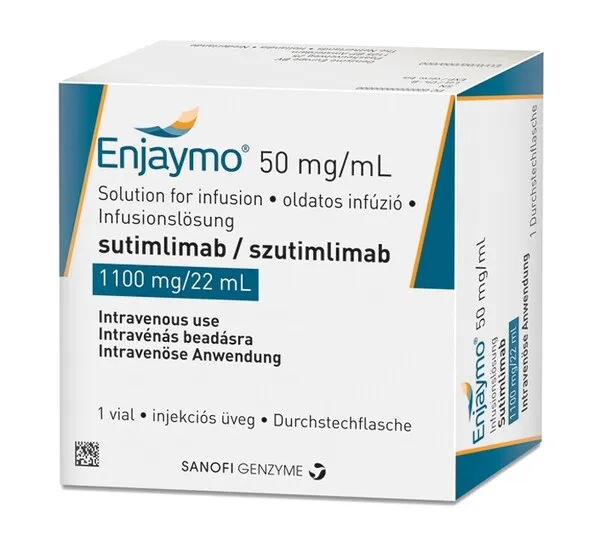
Table of Contents
- Package leaflet: Information for the patient
- Enjaymo 50 mg/mL solution for infusion
- 1. What Enjaymo is and what it is used for
- 2. What you need to know before using Enjaymo
- 3. How Enjaymo is administered
- 4. Possible side effects
- 5. How to store Enjaymo
- 6. Package contents and other information
- The following information is intended exclusively for healthcare professionals:
Package leaflet: Information for the patient
Enjaymo 50 mg/mL solution for infusion
sutimlimab
▼Medicinal product subject to additional monitoring. This will allow for rapid identification of
new safety information. You can help by reporting any side effects you experience while taking
this medicine. See the end of section 4 for information on how to report side effects.
Please read this leaflet carefully before you are given this medicine because it contains
important information for you.
- Keep this leaflet. You may need to read it again.
- If you have any questions, ask your doctor or nurse.
- If you get any side effects, including those not listed in this leaflet, talk to your doctor or nurse. See section 4.
Contents of this leaflet
- What Enjaymo is and what it is used for
- What you need to know before you are given Enjaymo
- How Enjaymo will be administered
- Possible side effects
- How to store Enjaymo
- Contents of the pack and other information
1. What Enjaymo is and what it is used for
Enjaymo contains the active substance sutimlimab and belongs to a class of medicines called
monoclonal antibodies.
In cold agglutinin disease (CAD), a rare blood disorder, certain antibodies of the immune system bind to red blood cells. This causes the destruction of red blood cells (hemolytic anemia) through activation of the classical complement pathway (part of the immune system). Enjaymo blocks the activation of this part of the immune system.
Enjaymo is used to treat the breakdown of red blood cells (hemolytic anemia) in adults with cold agglutinin disease (cold agglutinin disease, CAD). This reduces anemia and decreases fatigue.
2. What you need to know before using Enjaymo
Do not receive Enjaymo
- if you are allergic to sutimlimab or to any of the other ingredients of this medicine (listed in section 6).
Warnings and precautions
Talk to your doctor before you are given Enjaymo.
Infections
Inform your doctor if you have an infection, for example, an ongoing infection such as HIV, hepatitis B,
or hepatitis C, or if you have a reduced ability to fight infections.
Vaccinations
Check with your doctor that you are adequately vaccinated, including meningococcal and streptococcal
vaccines.
It is recommended that you are vaccinated at least 2 weeks before starting Enjaymo. You should be aware
that vaccination may not always be able to prevent these types of infection. Contact your doctor immediately
if any signs of infection occur; see section 4 “Possible side effects”.
Allergic reactions
Seek immediate medical help if you notice signs of an allergic reaction during or after administration of
this medicine. For symptoms, see section 4 “Possible side effects”.
Infusion-related reactions
You may experience infusion-related reactions during or immediately after the infusion. Inform the
healthcare provider immediately if you experience symptoms related to the infusion of Enjaymo. For
symptoms, see section 4 “Possible side effects”.
Systemic lupus erythematosus (SLE)
Inform your doctor if you have an autoimmune disease such as systemic lupus erythematosus (SLE),
commonly known as lupus. Consult a doctor if you develop symptoms of SLE such as joint pain or swelling,
a rash on the cheeks and nose, or unexplained fever.
Children and adolescents
Enjaymo must not be used in children and adolescents under 18 years of age, as CAD is generally not
occurring in this age group.
Other medicines and Enjaymo
Inform your doctor if you are taking, have recently taken, or might take any other medicines.
Pregnancy and breastfeeding
Pregnancy
If you are pregnant, suspect you may be pregnant, or are planning a pregnancy, consult your doctor before
receiving this medicine. It is not known whether Enjaymo may affect the unborn child. If you are pregnant,
Enjaymo should only be administered if clearly recommended by your doctor.
Breastfeeding
It is not known whether Enjaymo passes into breast milk. If you are breastfeeding or planning to breastfeed,
talk to your doctor before using this medicine, so that you and your doctor can decide whether you should
breastfeed or whether you should be given Enjaymo.
Driving and using machines
This medicine has no effect or negligible effect on the ability to drive and use machines.
Enjaymo contains sodium
This medicine contains 3.5 mg per mL or 77 mg of sodium (a main component of table/cooking salt) per
vial. This is equivalent to 3.85% of the maximum daily recommended dietary intake of sodium for an adult.
3. How Enjaymo is administered
Enjaymo will be administered to you by a healthcare professional. It is given as an intravenous infusion (drip) into a vein (i.e. intravenously). The dose administered depends on body weight.
The infusion usually takes from 1 to 2 hours. After each infusion, you will be monitored for allergic reactions: after the first infusion you will be monitored for at least 2 hours; after subsequent infusions you will be monitored for at least 1 hour.
You will usually receive:
- an initial dose of Enjaymo
- a dose of Enjaymo one week later
- thereafter, you will start receiving Enjaymo every 2 weeks
Home infusion
- You will receive Enjaymo for at least three months at a healthcare facility.
- After that, your doctor may consider that you can receive Enjaymo infusions at home.
- The home infusion will be performed by a healthcare professional.
If more Enjaymo is administered than you should receive
This medicine will be administered by a healthcare professional. If you think you have accidentally received too much Enjaymo, consult your doctor for advice.
If you forget to use Enjaymo
If you miss an appointment for Enjaymo infusion, you must contact your doctor immediately to reschedule the infusion.
If you stop treatment with Enjaymo
The effects of Enjaymo will diminish after treatment ends. If you discontinue administration of Enjaymo, your doctor must monitor for possible recurrence of signs and symptoms of CAD. Symptoms are caused by the breakdown of red blood cells and may include fatigue, shortness of breath, rapid heartbeat, or dark urine.
If you have any questions about the use of this medicine, consult your doctor.
4. Possible side effects
Like all medicines, this medicine can cause side effects, although not everybody gets them.
Immediately inform the doctor who administered Enjaymo to you if you notice signs of an
allergic reaction during or immediately after administration of this medicine. Signs may include:
- difficulty breathing or swallowing
- swelling of the face, lips, tongue, or throat
- severe skin itching, with red rash or raised bumps
- feeling faint.
If any of these symptoms occur during infusion, the infusion must be stopped immediately.
Immediately inform the doctor who administered Enjaymo to you if you notice signs of an
infusion-related reaction during administration of this medicine. These are common events that may affect 1 in 10 people. Signs may include:
- nausea
- feeling of flushing
- headache
- shortness of breath
- rapid heartbeat.
Inform your doctor as soon as possible if you develop symptoms or signs of an infection such as:
- fever with or without rash, chills, flu-like symptoms, cough/breathing difficulties, headache with nausea, vomiting, stiff neck, back stiffness, confusion, sensitivity of the eyes to light, pain during urination or more frequent urination.
Infections: urinary tract infections, upper respiratory tract infections, stomach and intestinal infections, common cold, runny nose are very common (may affect more than 1 in 10 people). - Infections: lower respiratory tract infections, urinary tract infections, and herpes infections are common (may affect up to 1 in 10 people).
Tell your doctor or nurse if you experience any of the following additional side effects:
Very common (may affect more than 1 in 10 people)
- headache
- high blood pressure
- poor circulation causing abnormal skin coloration of hands and feet in response to cold and stress (Raynaud's phenomenon, acrocyanosis)
- stomach pain
- nausea
Common (may affect up to 1 in 10 people)
- infusion-related reactions
- fever
- feeling cold
- dizziness
- aura
- low blood pressure
- diarrhea
- stomach discomfort
- mouth ulcer (aphthous ulcer)
- chest discomfort
- itching
Reporting of side effects
If you get any side effects, including ones not listed in this leaflet, talk to your doctor or nurse. You can also report side effects directly via the national reporting system listed in Annex V. By reporting side effects, you can help provide more information on the safety of this medicine.
5. How to store Enjaymo
Keep this medicine out of the sight and reach of children.
Do not use this medicine after the expiry date stated on the label and carton after
EXP. The expiry date refers to the last day of that month.
Store in a refrigerator (2°C – 8°C). Do not freeze.
Keep in the original packaging to protect the medicine from light.
Enjaymo must not be disposed of via wastewater or household waste. Healthcare professionals are responsible for the proper disposal of any unused product. This will help protect the environment.
6. Package contents and other information
What Enjaymo contains
- The active substance is sutimlimab. Each 22 mL vial of solution contains 1,100 mg of sutimlimab.
- The other components are polysorbate 80 (E 433), sodium chloride, disodium phosphate (E 339), monosodium phosphate (E 339), and water for injections.
This medicinal product contains sodium (see section 2 “Enjaymo contains sodium”).
Description of the appearance of Enjaymo and contents of the pack
Enjaymo is an opalescent, colourless to slightly yellow solution for infusion, essentially free from particles.
Each pack contains 1 or 6 vials.
It is possible that not all pack sizes are marketed.
Marketing Authorisation Holder
Recordati Rare Diseases
Tour Hekla
52 avenue du Général de Gaulle
92800 Puteaux
France
Manufacturer
Sanofi-Aventis Deutschland GmbH
Brüningstr. 50
Frankfurt am Main, 65926
Germany
Other sources of information
More detailed information on this medicinal product is available on the website of the European Medicines Agency: http://www.ema.europa.eu. Links to other websites on rare diseases and their treatments are also provided.
This patient information leaflet is available in all EU/EEA languages on the European Medicines Agency website and at the following website: www.enjaymo.info.sanofi, or by scanning the QR code below (also included on the outer packaging) with a smartphone.
The following information is intended exclusively for healthcare professionals:
Traceability
In order to improve the traceability of biological medicinal products, the name and batch number of the administered medicinal product must be clearly documented.
Preparation
Enjaymo is supplied as a solution in a single-dose vial and must be prepared by a healthcare professional using aseptic technique.
- Remove Enjaymo from the refrigerator. To minimize foam formation, do not shake.
- Visually inspect the vial for particulate matter and discoloration prior to administration. The solution is an opalescent, colourless to slightly yellow liquid. Do not administer if discoloration is observed or if foreign particles are present.
- Withdraw the calculated volume from the appropriate number of vials according to the recommended dose (refer to Table 1 for infusion guidance) and transfer it into an empty infusion bag. Discard any unused portion remaining in the vial.
- The prepared solution should be administered immediately.
Administration
- Prior to administration, allow the infusion solution to reach room temperature (18°C – 25°C). Refer to Table 1 for infusion rate. The infusion should be administered over 1–2 hours depending on the patient's body weight. Administer Enjaymo infusion only through a 0.22 micron filter with a polyethersulfone (PES) membrane. Infusion warmers may be used, but the temperature must not exceed 40°C.
- The infusion catheter and tubing should be primed with the dosing solution immediately before infusion and flushed immediately after completion of the infusion with an adequate amount (approximately 20 mL) of sodium chloride 9 mg/mL (0.9%) for injection.
- No incompatibilities have been observed between the Enjaymo infusion solution and infusion bags made of di-(2-ethylhexyl)phthalate (DEHP)-plasticized polyvinyl chloride (PVC), ethylene vinyl acetate (EVA), and polyolefin (PO); administration sets made of DEHP-plasticized PVC, DEHP-free polypropylene (PP), and polyethylene (PE); and vial adapters made of polycarbonate (PC) and acrylonitrile butadiene styrene (ABS).
Table 1 - Infusion reference table
| Body weight range | Dose (mg) | Number of vials required | Volume (mL) | Maximum infusion rate |
| Between 39 kg and less than 75 kg | 6 500 | 6 | 130 | 130 mL/hour |
| Equal to or greater than 75 kg | 7 500 | 7 | 150 | 150 mL/hour |
Storage conditions
Unopened vial
- Store in the refrigerator (at 2°C - 8°C). Do not freeze.
- Keep in the original packaging to protect the medicine from light.
After opening
- Chemical and physical in-use stability has been demonstrated for 16 hours at temperatures from 18°C to 25°C or for 72 hours at temperatures from 2°C to 8°C. From a microbiological point of view, the product should be used immediately.
- If not used immediately, the times and conditions of in-use storage prior to use are the responsibility of the user and normally should not exceed 24 hours at a temperature between 2°C and 8°C or 8 hours at room temperature, unless the vial has been opened and the pooling into the infusion bag has been carried out under controlled, validated aseptic conditions.
Home infusion
Home infusions must be performed by a healthcare professional.
The decision to consider home infusion should be based on the patient's specific clinical characteristics and individual needs. Transitioning infusion from a clinical setting to home administration requires ensuring that adequate infrastructure and resources are available and in line with the treating physician's recommendations. Home infusion of Enjaymo may be considered for patients who have tolerated the infusion well in a clinical setting and who have not experienced infusion-related reactions. When assessing a patient's suitability for home infusion, their underlying comorbidities and ability to comply with home infusion requirements should be taken into account. In addition, the following criteria must be considered:
- The patient must not have any ongoing concomitant medical conditions that, in the physician's judgment, could expose the patient to a higher risk when receiving the infusion at home rather than in a clinical setting. A comprehensive assessment must be completed before initiating home infusion to ensure that the patient is clinically stable.
- The patient must have successfully received Enjaymo infusions in a clinical setting (hospital or outpatient) for at least three months under the supervision of a physician or healthcare professional experienced in managing patients with CAD.
- The patient must demonstrate willingness and ability to adhere to home infusion procedures and recommendations provided by the treating physician or healthcare professional.
- The healthcare professional administering the home infusion must be present at all times during the home infusion and for at least 1 hour after the infusion.
If the patient experiences adverse reactions during home infusion, the infusion process must be stopped immediately, appropriate medical treatment must be initiated, and the treating physician must be informed. In such cases, the treating physician must decide whether subsequent infusions should proceed and, if so, whether they should be administered in a hospital or in a supervised outpatient care setting.