ENHERTU
Italy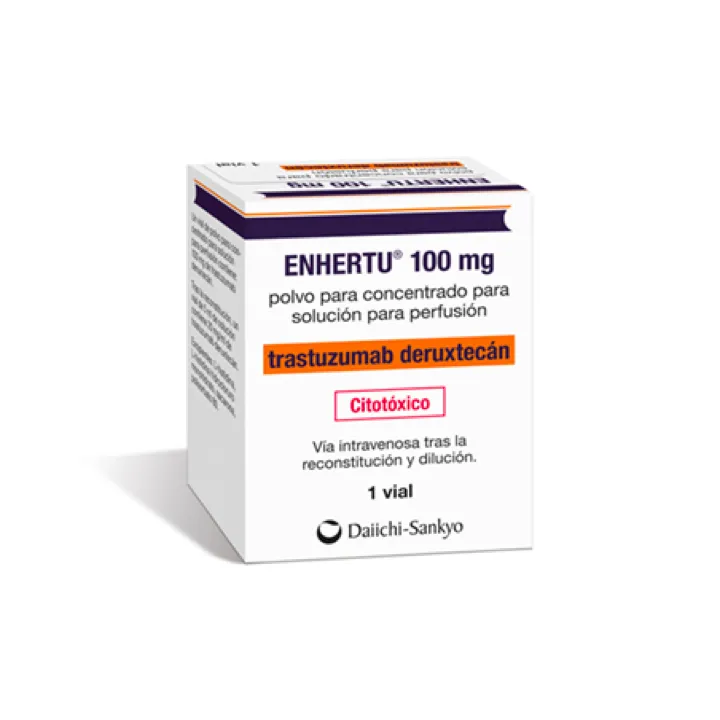
Table of Contents
- Package leaflet: Information for the patient
- Enhertu 100 mg powder for concentrate for solution for infusion
- 1. What Enhertu is and what it is used for
- 2. What you need to know before receiving Enhertu
- 3. How Enhertu is administered
- 4. Possible side effects
- 5. How to store Enhertu
- 6. Package contents and other information
- The following information is intended exclusively for healthcare professionals:
Package leaflet: Information for the patient
Enhertu 100 mg powder for concentrate for solution for infusion
trastuzumab deruxtecan
This medicinal product is subject to additional monitoring. This will allow for rapid identification of new safety information. You can help by reporting any side effects you experience while taking this medicine. See the end of section 4 for information on how to report side effects.
Please read this leaflet carefully before receiving this medicine because it contains important information for you.
Keep this leaflet. You may need to read it again.
If you have any questions, ask your doctor or nurse.
If you experience any side effect, including those not listed in this leaflet, contact your doctor or nurse. See section 4.
Contents of this leaflet
- What Enhertu is and what it is used for
- What you need to know before receiving Enhertu
- How Enhertu is administered
- Possible side effects
- How to store Enhertu
- Contents of the pack and other information
1. What Enhertu is and what it is used for
What Enhertu is
Enhertu is an anticancer medicine that contains the active substance trastuzumab deruxtecan.
Part of the medicine is a monoclonal antibody that specifically binds to cells expressing the HER2 protein on their surface (HER2-positive), as occurs in certain cancer cells. The other active component of Enhertu is DXd, a substance capable of killing cancer cells. When the medicine binds to HER2-positive cancer cells, DXd enters the cells and kills them.
What Enhertu is used for
Enhertu is used to treat adults who have:
a HER2-positive breast cancer that has spread to other parts of the body (metastatic disease) or cannot be surgically removed, and who have previously received one or more other treatments specifically for HER2-positive breast cancer.
a breast cancer with low levels of HER2 expression (HER2-low or HER2-ultralow) that has spread to other parts of the body (metastatic disease) or cannot be surgically removed, and who have received prior therapy. A test will be performed to confirm whether Enhertu is the appropriate treatment for you.
a HER2-mutated non-small cell lung cancer that has spread to other parts of the body or cannot be surgically removed, and who have received prior treatment. A test will be performed to confirm whether Enhertu is the appropriate treatment for you.
a HER2-positive stomach cancer that has spread to other parts of the body or nearby areas and cannot be surgically removed, and who have previously received another treatment specifically for HER2-positive stomach cancer.
2. What you need to know before receiving Enhertu
Do not receive Enhertu
if you are allergic to trastuzumab deruxtecan or to any of the other ingredients of this
medicinal product (listed in section 6).
If you are unsure whether you are allergic, consult your doctor or nurse before receiving Enhertu.
Warnings and precautions
Talk to your doctor or nurse before receiving Enhertu, or during treatment, if you experience:
cough, shortness of breath, fever, or new or worsening respiratory problems. These may be symptoms of a serious and potentially fatal lung disease called interstitial lung disease. A history of lung disease or kidney problems may increase the risk of developing interstitial lung disease. Your doctor may need to monitor your lungs during treatment with this medicinal product;
chills, fever, mouth ulcers, stomach pain, or pain when urinating. These may be symptoms of an infection caused by a low number of white blood cells called neutrophils;
new or worsening shortness of breath, cough, fatigue, swelling of the ankles or legs, irregular heartbeat, sudden weight gain, dizziness, or loss of consciousness. These may be symptoms of a condition in which the heart fails to pump enough blood (reduced left ventricular ejection fraction);
liver problems. Your doctor may need to monitor your liver during treatment with this medicinal product.
Your doctor will perform tests before and during treatment with Enhertu.
Children and adolescents
Enhertu is not recommended for patients under 18 years of age, as there is insufficient information on its efficacy in this age group.
Other medicines and Enhertu
Tell your doctor or nurse if you are taking, have recently taken, or might take any other medicines.
Pregnancy, breastfeeding, contraception, and fertility
Pregnancy
Enhertu is not recommended during pregnancy because this medicinal product may harm the unborn child.
Consult your doctor immediately if you are pregnant, suspect you are pregnant, or are planning a pregnancy before or during treatment.
Breastfeeding
You must not breastfeed during treatment with Enhertu and for at least 7 months after the last dose, as it is unknown whether Enhertu passes into breast milk. Discuss this with your doctor.
Contraception
Use effective contraceptive measures (birth control) to avoid becoming pregnant during treatment with Enhertu.
Women taking Enhertu should continue using effective contraception for at least 7 months after the last dose of Enhertu.
Men taking Enhertu who have partners of childbearing age should use effective contraception:
- during treatment and
- for at least 4 months after the last dose of Enhertu.
Consult your doctor about the most appropriate contraceptive method for you. Also consult your doctor before stopping contraception.
Fertility
Men treated with Enhertu should not have intercourse intended for procreation for 4 months after the end of treatment and should receive counseling on sperm preservation before starting treatment, as the medicinal product may reduce fertility. Therefore, discuss this with your doctor before starting treatment.
Driving and use of machines
It is unlikely that Enhertu will reduce your ability to drive or use machines. However, be cautious if you experience fatigue, dizziness, or headache.
Enhertu contains polysorbate 80
This medicinal product contains 1.5 mg of polysorbate 80 per 100 mg vial.
Polysorbates may cause allergic reactions. Inform your doctor if you have known allergies.
3. How Enhertu is administered
Enhertu will be administered to you in a hospital or clinic.
The recommended dose of Enhertu for the treatment of:
HER2-positive, HER2-low, or HER2-ultralow breast cancer is 5.4 mg per
kilogram of body weight, every 3 weeks;
HER2-mutated non-small cell lung cancer is 5.4 mg per kilogram
of body weight, every 3 weeks;
HER2-positive gastric cancer is 6.4 mg per kilogram of body weight, every
3 weeks.
Your doctor or nurse will administer Enhertu to you as an intravenous infusion (drip) into a vein.
The first infusion will be given over 90 minutes. If this is well tolerated, subsequent infusions may be administered over 30 minutes.
Your doctor will decide how many treatments you will need.
Before each Enhertu infusion, your doctor may give you medicines to help prevent nausea and vomiting.
If you experience infusion-related symptoms, your doctor or nurse may slow down the infusion or suspend or stop the treatment.
Before and during treatment with Enhertu, your doctor will perform tests, which may include:
blood tests to monitor blood cells, liver, and kidney function;
examinations to monitor the heart and lungs.
Depending on any side effects, your doctor may reduce the dose or temporarily or permanently stop treatment.
If you miss an appointment for Enhertu administration
Contact your doctor immediately to reschedule the appointment.
It is very important not to miss a dose of this medicine.
If you stop treatment with Enhertu
Do not stop treatment with Enhertu without consulting your doctor.
If you have any questions about the use of this medicine, speak with your doctor or nurse.
4. Possible side effects
Like all medicines, this medicine can cause side effects, although not everybody will experience them.
If you experience any side effect, including those not listed in this leaflet, contact your doctor.
Contact your doctor immediately if you notice any of the following symptoms, which may be signs of a
serious, potentially life-threatening condition. Receiving immediate medical treatment may help prevent
these problems from becoming more severe.
Very common (may affect more than 1 in 10 people)
A lung disease called interstitial lung disease, with symptoms that may include cough, shortness of
breath, fever, or new onset or worsening of other breathing problems.
An infection due to a low number of neutrophils (a type of white blood cell), with symptoms that
may include chills, fever, mouth ulcers, stomach pain, or pain when urinating.
A heart problem called left ventricular dysfunction, with symptoms that may include new onset or
worsening shortness of breath, cough, fatigue, swelling of the ankles or legs, irregular heartbeat,
sudden weight gain, dizziness, or loss of consciousness.
Other side effects
The frequency and severity of side effects may vary depending on the dose received. Inform your doctor
or nurse if you notice any of the following side effects:
Very common (may affect more than 1 in 10 people)
nausea (feeling unwell), vomiting
fatigue
blood tests showing a decrease in red blood cells, white blood cells, or platelets
reduced appetite
hair loss
diarrhoea
constipation
blood tests showing increased levels of liver enzymes such as transaminases
muscle and bone pain
abdominal pain (stomach pain)
weight loss
fever
nose and throat infections, including flu-like symptoms
headache
blood tests showing low potassium levels
blisters inside the mouth or around the mouth
cough
indigestion
swelling of the ankles and feet
Common (may affect up to 1 in 10 people)
difficulty breathing
lung infection
blood tests showing increased levels of bilirubin, alkaline phosphatase, or creatinine
nosebleeds
dizziness
rash
blood tests showing a decrease in red blood cells, white blood cells, and platelets (pancytopenia)
altered/unpleasant taste in the mouth
dry eyes
itching
stomach bloating
blurred vision
change in skin colour
feeling thirsty, dry mouth
fever accompanied by a reduced number of white blood cells called neutrophils
excess gas in the stomach or intestines
inflammation of the stomach
reactions related to the infusion of the medicine, which may include fever, chills, flushing,
itching, or rash
Reporting of side effects
If you experience any side effect, including those not listed in this leaflet, contact your doctor or nurse.
You can also report side effects directly via the national reporting system listed in Annex V. By reporting
side effects, you can help provide more information on the safety of this medicine.
5. How to store Enhertu
Enhertu will be stored by healthcare professionals at the hospital or clinic where you will receive your treatment. The storage details are as follows:
- keep this medicine out of the sight and reach of children
- do not use this medicine after the expiry date stated on the outer carton and vial after Exp./EXP. The expiry date refers to the last day of that month
- store in a refrigerator (2 °C - 8 °C). Do not freeze
- the prepared infusion solution is stable for up to 24 hours at a temperature of 2 °C - 8 °C, protected from light, and must then be discarded.
Do not dispose of any medicine via wastewater or household waste. Ask your pharmacist how to dispose of medicines you no longer use. This will help protect the environment.
6. Package contents and other information
What Enhertu contains
- The active substance is trastuzumab deruxtecan. One vial of powder for concentrate for solution for infusion contains 100 mg of trastuzumab deruxtecan. After reconstitution, a 5 mL vial of solution contains 20 mg/mL of trastuzumab deruxtecan.
- The other components are L-histidine, L-histidine monohydrochloride monohydrate, sucrose, polysorbate 80 (E433).
Description of the appearance of Enhertu and contents of the pack
Enhertu is a lyophilized powder, white to slightly yellowish white in colour, supplied in a clear amber glass vial with a rubber stopper, aluminium seal and a plastic tamper-evident cap.
Each pack contains 1 vial.
Marketing Authorisation Holder
Daiichi Sankyo Europe GmbH
Zielstattstrasse 48
81379 Munich
Germany
For further information on this medicinal product, please contact the local representative of the Marketing Authorisation Holder:
België/Belgique/Belgien Lietuva
Daiichi Sankyo Belgium N.V.-S.A UAB AstraZeneca Lietuva
Tél/Tel: +32-(0) 2 227 18 80 Tel: +370 5 2660550
България Luxembourg/Luxemburg
АстраЗенека България ЕООД Daiichi Sankyo Belgium N.V.-S.A
Тел.: +359 24455000 Tél/Tel: +32-(0) 2 227 18 80
Česká republika Magyarország
AstraZeneca Czech Republic s.r.o. AstraZeneca Kft.
Tel: +420 222 807 111 Tel.: +36 1 883 6500
Danmark Malta
Daiichi Sankyo Nordics ApS Daiichi Sankyo Europe GmbH
Tlf.: +45 (0) 33 68 19 99 Tel: +49-(0) 89 7808 0
Deutschland Nederland
Daiichi Sankyo Deutschland GmbH Daiichi Sankyo Nederland B.V.
Tel: +49-(0) 89 7808 0 Tel: +31-(0) 20 4 07 20 72
Eesti Norge
AstraZeneca Daiichi Sankyo Nordics ApS
Tel: +372 6549 600 Tlf: +47 (0) 21 09 38 29
Ελλάδα Österreich
AstraZeneca A.E. Daiichi Sankyo Austria GmbH
Τηλ: +30 210 6871500 Tel: +43 (0) 1 485 86 42 0
España Polska
Daiichi Sankyo España, S.A. AstraZeneca Pharma Poland Sp. z o.o.
Tel: +34 91 539 99 11 Tel: +48 22 245 73 00
France Portugal
Daiichi Sankyo France S.A.S. Daiichi Sankyo Portugal, Unip. LDA
Tél: +33 (0) 1 55 62 14 60 Tel: +351 21 4232010
Hrvatska România
AstraZeneca d.o.o. AstraZeneca Pharma SRL
Tel: +385 1 4628 000 Tel: +40 21 317 60 41
Ireland Slovenija
Daiichi Sankyo Ireland Ltd AstraZeneca UK Limited
Tel: +353-(0) 1 489 3000 Tel: +386 1 51 35 600
Ísland Slovenská republika
Icepharma hf AstraZeneca AB, o.z.
Sími: +354 540 8000 Tel: +421 2 5737 7777
Italia Suomi/Finland
Daiichi Sankyo Italia S.p.A. Daiichi Sankyo Nordics ApS
Tel: +39-06 85 2551 Puh/Tel: +358 (0) 9 3540 7081
Κύπρος Sverige
Αλέκτωρ Φαρµακευτική Λτδ Daiichi Sankyo Nordics ApS
Τηλ: +357 22490305 Tel: +46 (0) 40 699 2524
Latvija
SIA AstraZeneca Latvija
Tel: +371 67377100
This medicinal product has been granted a conditional marketing authorisation. This means that further data on this medicinal product are required.
The European Medicines Agency will review new information annually on this medicinal product and this patient information leaflet will be updated as necessary.
Other sources of information
More detailed information on this medicinal product is available on the website of the European Medicines Agency, https://www.ema.europa.eu.
The following information is intended exclusively for healthcare professionals:
To avoid medication errors, check the vial labels to ensure that the
medication being prepared and administered is Enhertu (trastuzumab deruxtecan) and not
trastuzumab or trastuzumab emtansine.
Appropriate procedures for the handling of cytotoxic medicinal products must be used. Adequate
aseptic techniques must be followed for the reconstitution and dilution procedures described below.
Reconstitution
- Reconstitute immediately before dilution.
- More than one vial may be required for a complete dose. Calculate the required dose (mg), the total volume of reconstituted Enhertu solution needed, and the number of Enhertu vials required.
- Reconstitute each 100 mg vial by using a sterile syringe to slowly inject 5 mL of Water for Injections into each vial, to achieve a final concentration of 20 mg/mL.
- Gently swirl the vial until the powder is completely dissolved. Do not shake.
- From a microbiological standpoint, the medicinal product should be used immediately. If not used immediately, chemical and physical in-use stability has been demonstrated for up to 48 hours at 2 °C to 8 °C. Store reconstituted Enhertu vials in a refrigerator at 2 °C to 8 °C, protected from light. Do not freeze.
- The reconstituted product contains no preservatives and is for single use only.
Dilution
- Withdraw the calculated amount from the vial (or vials) using a sterile syringe. Inspect the reconstituted solution for particulate matter and discoloration. The solution should be clear and colourless to pale yellow. Do not use if visible particles are observed or if the solution is cloudy or discoloured.
- Dilute the calculated volume of reconstituted Enhertu in an infusion bag containing 100 mL of 5% glucose solution for infusion. Do not use sodium chloride solution. A polyvinylchloride or polyolefin (ethylene and polypropylene copolymer) infusion bag is recommended.
- Gently invert the infusion bag to ensure complete mixing. Do not shake.
- Cover the infusion bag to protect from light.
- If not used immediately, store at room temperature (≤ 30 °C) for up to 4 hours, including preparation and infusion time, or store in a refrigerator at 2 °C to 8 °C for up to 24 hours, protected from light. Do not freeze.
- Discard any unused portion remaining in the vial.
Administration
- If the infusion solution has been stored in the refrigerator (2 °C – 8 °C), allow it to reach room temperature before administration, protecting it from light.
- Administer Enhertu as an intravenous infusion using only an in-line filter made of polyethersulfone (PES) or polysulfone (PS) with a pore size of 0.20 or 0.22 micron.
- The initial dose should be administered as a 90-minute intravenous infusion. If the previous infusion was well tolerated, subsequent doses of Enhertu may be administered as 30-minute infusions. Do not administer as a rapid intravenous injection or bolus.
- Cover the infusion bag to protect from light.
- Do not mix Enhertu with other medicinal products and do not administer other medicinal products through the same infusion line.
Disposal
Any unused medicinal product and waste material derived from this medicinal product should be disposed of in accordance with local regulations.