Endolucinbeta
Italy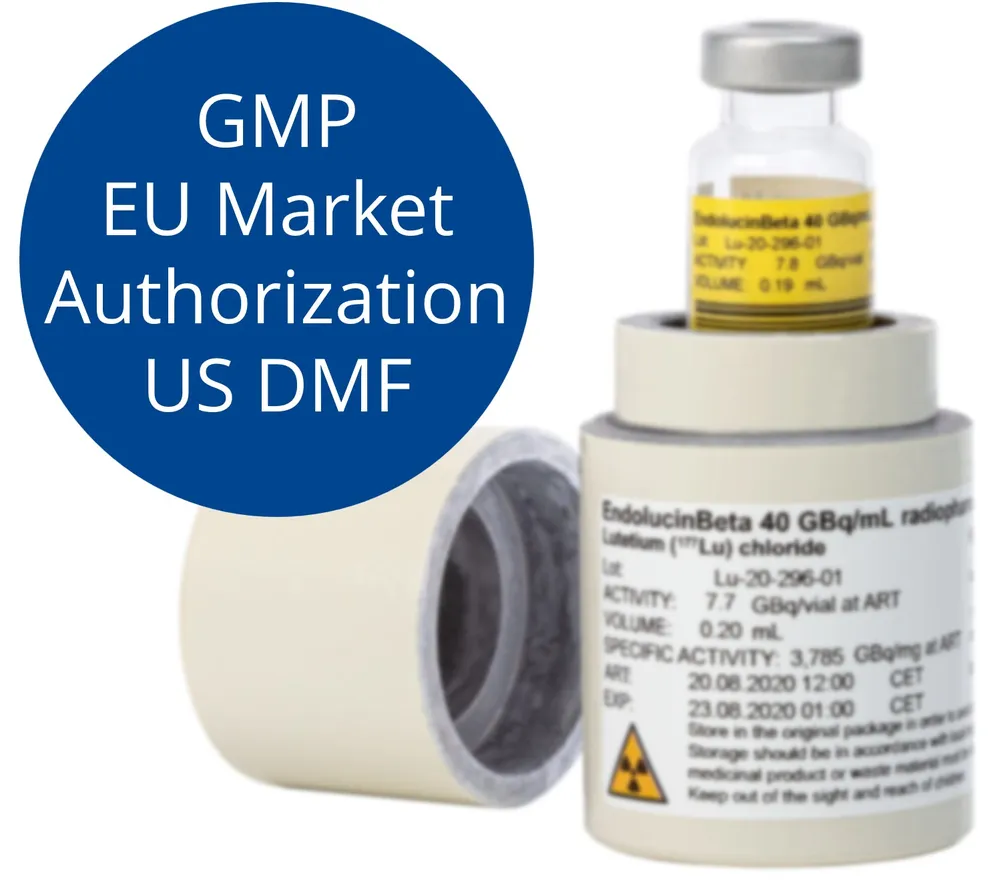
Table of Contents
- Package leaflet: Information for the patient
- EndolucinBeta 40 GBq/ml radiopharmaceutical precursor, solution
- 1. What EndolucinBeta is and what it is used for
- 2. What you should know before the medicinal product labelled with EndolucinBeta is used
- 3. How to use the medicinal product labelled with EndolucinBeta
- 4. Possible side effects
- 5. How to store EndolucinBeta
- 6. Package contents and other information
- The following information is intended for healthcare professionals only:
Package leaflet: Information for the patient
EndolucinBeta 40 GBq/ml radiopharmaceutical precursor, solution
lutetium (Lu) chloride
Read this leaflet carefully before using the medicinal product in combination with EndolucinBeta
because it contains important information for you.
- Keep this leaflet. You may need to read it again.
- If you have any questions, consult the nuclear medicine physician in charge of the procedure.
- If you experience any side effects, including those not listed in this leaflet, contact the nuclear medicine physician. See section 4.
Contents of this leaflet
- What EndolucinBeta is and what it is used for
- What you need to know before using the medicinal product labelled with EndolucinBeta
- How to use the medicinal product labelled with EndolucinBeta
- Possible side effects
- How to store EndolucinBeta
- Contents of the pack and other information
1. What EndolucinBeta is and what it is used for
EndolucinBeta is not a medicine and is not intended to be used on its own. It must be used in
association with other medicines (vectors or carriers).
It is a type of product known as a radiopharmaceutical precursor. It contains the active substance
lutetium (Lu) chloride, which emits beta radiation, enabling a localized radioactive effect. This
radiation is used for the treatment of certain diseases.
Before administration, EndolucinBeta must be combined with a vector medicine in a process called
radiolabelling. The vector medicine then carries EndolucinBeta to the site of the disease.
These vector medicines have been specifically developed for use with lutetium (Lu) chloride and
may be substances designed to recognize a particular type of cell in the body.
Using a medicine labelled with EndolucinBeta involves exposure to radioactivity. Your doctor and
the nuclear medicine specialist have determined that the clinical benefit you will receive from the
radiopharmaceutical procedure outweighs the risk associated with radiation exposure.
Please consult the package leaflet of the medicine to be labelled with EndolucinBeta.
2. What you should know before the medicinal product labelled with EndolucinBeta is used
The medicinal product labelled with EndolucinBeta must not be used
- if you are allergic to lutetium (Lu) chloride or to any of the other ingredients of this medicinal product (listed in section 6);
- if you are pregnant or think you might be pregnant.
Please consult the package leaflet of the medicinal product to be labelled with EndolucinBeta for further information.
Warnings and precautions
EndolucinBeta must not be administered directly to patients.
Exercise particular caution with the medicinal product labelled with EndolucinBeta:
- if you have kidney problems or bone marrow disease. Treatment with lutetium (Lu) may cause the following undesirable effects:
- reduced number of red blood cells (anaemia);
- reduced number of platelets in the blood (thrombocytopenia); platelets are important for stopping bleeding;
- reduced number of white blood cells (leucopenia, lymphopenia or neutropenia); white blood cells are important for protecting the body against infections.
These events are mostly mild and temporary. In some patients, a reduced number of all three types of blood cells (red blood cells, platelets and white blood cells – pancytopenia) has been reported, which required treatment interruption.
Since lutetium (Lu) may, in some cases, affect blood cells, your doctor will perform blood tests before starting treatment and at regular intervals during treatment. Contact your doctor if you experience shortness of breath, bruising, nosebleeds, bleeding gums, or develop a fever.
During peptide receptor radionuclide therapy for neuroendocrine tumours, radiolabelled somatostatin analogues are excreted via the kidneys. Therefore, your doctor will take a blood sample to assess your kidney function before and during treatment.
Treatment with lutetium (Lu) may cause liver function disorders. During treatment, your doctor will perform blood tests to monitor your liver function.
Medicinal products labelled with lutetium (Lu) may be administered directly into a vein through a device (tube) known as a cannula. Cases of fluid leakage into surrounding tissue (extravasation) have been reported. Inform your doctor if you experience swelling or pain in your arm.
After treatment of neuroendocrine tumours with lutetium (Lu), patients may develop symptoms related to hormone release from tumour cells, known as carcinoid crisis. Inform your doctor if you feel faint, dizzy, or develop flushing or diarrhoea after treatment.
Treatment with lutetium (Lu) may cause tumour lysis syndrome, due to rapid breakdown of tumour cells. This may lead, within one week of treatment, to abnormal blood test results, irregular heartbeat, kidney failure, or seizures. Your doctor will perform blood tests to monitor you. Report any occurrence of muscle cramps, muscle weakness, confusion, or shortness of breath to your doctor.
Please consult the package leaflet of the medicinal product to be labelled with EndolucinBeta for further warnings and precautions.
Children and adolescents
EndolucinBeta must not be used directly in children and adolescents under 18 years of age.
Other medicines and medicinal products labelled with EndolucinBeta
Inform the nuclear medicine physician if you are taking, have recently taken, or might take any other medicines, as they could interfere with the procedure.
It is not known whether lutetium (Lu) chloride may interact with other medicines, as no specific interaction studies have been conducted.
Pregnancy and breastfeeding
Before administration of medicinal products labelled with EndolucinBeta, you must inform the nuclear medicine physician if you might be pregnant, if you have missed a menstrual period, or if you are breastfeeding.
If in doubt, it is important to consult the nuclear medicine specialist responsible for the procedure.
If you are a woman of childbearing potential
You must use effective contraception during treatment with medicinal products labelled with EndolucinBeta and for 7 months after the end of treatment.
If you are pregnant
Medicinal products labelled with EndolucinBeta must not be administered during pregnancy.
If you are breastfeeding
You will be asked to discontinue breastfeeding.
Ask your nuclear medicine physician when you may resume breastfeeding.
If you are a man
You must use effective contraception during treatment with medicinal products labelled with EndolucinBeta and for 4 months after the end of treatment.
Driving and use of machinery
Your ability to drive and use machinery may be affected by the medicinal product used in combination with EndolucinBeta. Please read the package leaflet of that medicinal product carefully.
3. How to use the medicinal product labelled with EndolucinBeta
There are strict regulations regarding the use, handling, and disposal of radiopharmaceuticals. Medicinal products labelled with EndolucinBeta will only be used in special, controlled areas. This medicine will be handled and administered solely by trained and qualified personnel experienced in its safe use. Personnel will take particular care to ensure the safe use of the medicine and will keep you informed about their actions.
The nuclear medicine physician responsible for the procedure will determine the amount of medicinal product labelled with EndolucinBeta to be used in your case. This will be the minimum quantity necessary to achieve the appropriate result, depending on the medicinal product administered with lutetium (Lu) chloride and its intended use.
Administration of the medicinal product labelled with EndolucinBeta and performance of the procedure
EndolucinBeta must only be used in combination with another medicinal product (a vector or carrier) that has been specifically developed and authorized for combination with lutetium (Lu) chloride. The administration will depend on the type of vector used. Please read the package leaflet of that medicinal product carefully.
Duration of the procedure
The nuclear medicine specialist will inform you about the usual duration of the procedure.
After administration of the medicinal product labelled with EndolucinBeta
The nuclear medicine physician will inform you of any special precautions to be taken after administration of the medicinal product labelled with EndolucinBeta. For any questions, please consult your nuclear medicine physician.
If you have been administered more medicinal product labelled with EndolucinBeta than you should have received
Since the medicinal product labelled with EndolucinBeta is handled by a nuclear medicine physician under strictly controlled conditions, the risk of overdose is very limited. However, in the event of an overdose or accidental intravenous injection of the unlabelled product, you will receive appropriate treatment to eliminate the radionuclide from the body.
If you have any further questions about the use of the medicinal product labelled with EndolucinBeta, please consult the nuclear medicine physician responsible for the procedure.
4. Possible side effects
Like all medicines, the medicinal product labelled with EndolucinBeta may cause side effects,
although not everyone experiences them.
'Dry mouth', of a temporary nature, has been reported in patients with prostate cancer who
were treated with lutetium ( Lu).
Very common side effects (may affect more than 1 in 10 people):
- Reduction in the number of blood cells (platelets, red blood cells or white blood cells)
- Nausea
- Vomiting
Side effects reported in patients treated for neuroendocrine tumours:
Very common (may affect more than 1 in 10 people):
- Mild and temporary hair loss
Common (may affect up to 1 in 10 people):
- Bone marrow tumour (myelodysplastic syndrome)
- Low number of white blood cells (neutropenia)
Uncommon (may affect up to 1 in 100 people):
- Bone marrow tumour (acute myeloid leukaemia)
Not known (frequency cannot be estimated from the available data):
- Carcinoid crisis
- Tumour lysis syndrome (rapid breakdown of tumour cells)
- Low number of red blood cells, platelets and white blood cells (pancytopenia)
- Dry mouth
Bone marrow tumours (myelodysplastic syndrome and acute myeloid leukaemia) have been reported
many years after treatment with peptide receptor radionuclide therapy using lutetium ( Lu) for neuroendocrine tumours.
After administration of the medicinal product labelled with EndolucinBeta, a certain amount of ionizing radiation (radioactivity) will be released, which may pose a risk of cancer and development
of hereditary defects. In all cases, the potential benefit of administering the labelled medicinal product outweighs the radiation risk.
For further information, please consult the package leaflet of the specific medicinal product to be labelled.
Reporting of side effects
If you experience any side effect, including those not listed in this leaflet, please contact your nuclear medicine specialist. You may also report side effects directly through the national reporting system listed in Annex V. By reporting side effects, you can help provide more information on the safety of this medicinal product.
5. How to store EndolucinBeta
You must not store this medicinal product. This medicinal product is stored under the responsibility of the specialist in suitable premises. Storage of radiopharmaceuticals must comply with national regulations concerning radioactive materials.
The following information is intended for specialists only: keep this medicinal product out of the sight and reach of children.
EndolucinBeta must not be used after the expiry date and time stated on the label after the wording "Exp.". EndolucinBeta should be stored in its original packaging, which provides protection from radiation.
This medicinal product does not require any special storage temperature.
6. Package contents and other information
What EndolucinBeta contains
- The active substance is lutetium (Lu) chloride. One ml of sterile solution contains 40 GBq of lutetium (Lu) chloride at the reference date and time (ART, activity reference time) (corresponding to 10 micrograms of lutetium (Lu) (as chloride). (GBq: the Gigabecquerel is the unit used to measure radioactivity).
- The other component is hydrochloric acid, diluted.
Description of the appearance of EndolucinBeta and contents of the pack
EndolucinBeta is a radiopharmaceutical precursor. It is supplied as a clear, colourless solution in a
2 ml or 10 ml colourless type I glass vial with a V-shaped bottom and flat base, closed with a bromobutyl stopper and an aluminium seal.
Each vial is placed in a lead container for protective shielding and packaged in a metal can and an outer cardboard box.
The volume in a vial ranges from 0.075 to 3.75 ml of solution (corresponding to an activity between 3 and 150 GBq at the reference date and time). The volume depends on the amount of medicinal product to be combined with EndolucinBeta required for administration by the nuclear medicine physician.
Marketing Authorisation Holder and Manufacturer
ITM Medical Isotopes GmbH
Lichtenbergstrasse 1
D-85748 Garching/Munich
Germany
[email protected]
Further information
More detailed information on this medicinal product is available on the website of the European Medicines Agency: https://www.ema.europa.eu./
The following information is intended for healthcare professionals only:
The complete product characteristics summary of EndolucinBeta is provided as a separate document in the medicinal product’s packaging, in order to supply healthcare professionals with additional scientific and practical information on the administration and use of this radiopharmaceutical.
Refer to the product characteristics summary.