Emmetre
Italy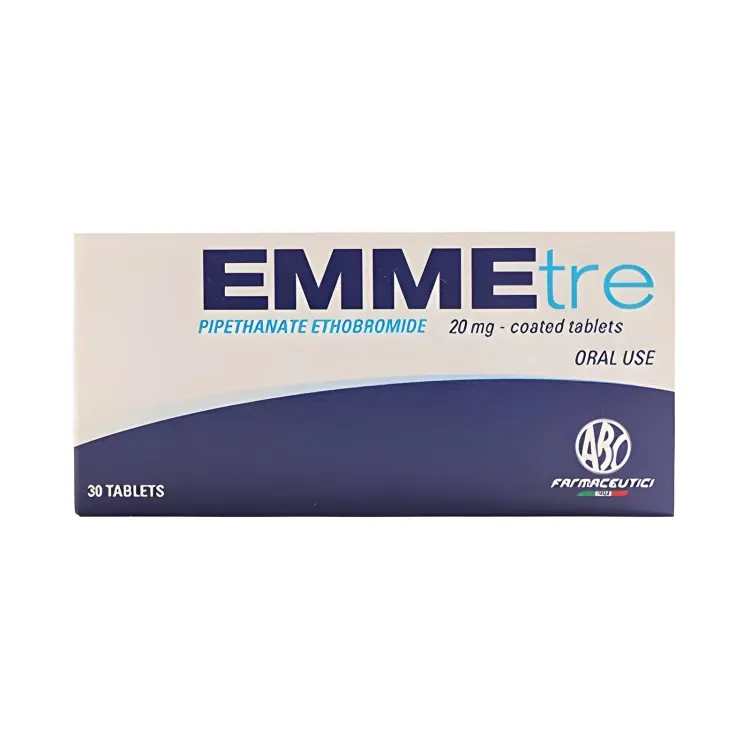
Table of Contents
- Package Leaflet: Information for the User
- EMMETRE 10 mg/ml injection solution
- 1. What Emmetre is and what it is used for
- 2. What you need to know before taking Emmetre
- 3. How to take Emmetre
- 4. Possible side effects
- 5. How to store Emmetre
- 6. Package contents and other information
- Package leaflet: information for the user
- EMMETRE 10 mg film-coated tablets, 20 mg film-coated tablets
- 7. What Emmetre is and what it is used for
- 8. What you need to know before taking Emmetre
- 9. How to take Emmetre
- 10. Possible side effects
- 11. How to store Emmetre
- 12. Package contents and other information
Package Leaflet: Information for the User
EMMETRE 10 mg/ml injection solution
Pipenzolate etobromide
Please read this leaflet carefully before using this medicine as it contains important information for you.
- Keep this leaflet. You may need to read it again.
- If you have any questions, ask your doctor or pharmacist.
- This medicine has been prescribed for you only. Do not give it to others, even if their symptoms are the same as yours, as it could be harmful.
- If you experience any side effects, including those not listed in this leaflet, contact your doctor or pharmacist. See section 4.
Contents of this leaflet:
- What Emmetre is and what it is used for
- What you need to know before using Emmetre
- How to use Emmetre
- Possible side effects
- How to store Emmetre
- Contents of the pack and other information
1. What Emmetre is and what it is used for
Emmetre contains the active substance pipenzolate bromide, belonging to the class of antispasmodic medicines of the cholinergic type. These medicines work by relieving cramps and abdominal pain, reducing painful and repetitive contractions of abdominal organs (spasms and spastic conditions). Emmetre is used in the following cases:
- abdominal pain caused by prolonged contractions of the stomach and intestinal muscles (spastic conditions, spasms, and hypermotility of the gastrointestinal tract);
- abdominal pain associated with disorders of the urinary and biliary tracts (dyskinesias);
- premedication prior to examinations, i.e. as a medicine administered before undergoing invasive procedures that may cause painful spasms, such as gastroscopies, colonoscopies, cystoscopies, hysteroscopies, etc.;
- preparation for and performance of various radiographic examinations.
2. What you need to know before taking Emmetre
Do not take Emmetre
- if you are allergic to pipethidate hydrobromide or to any of the other ingredients of this medicine (listed in section 6);
- if you have an enlarged prostate (prostatic hypertrophy) or other causes of urinary retention;
- if you have high pressure in the eye (glaucoma);
- if you have intestinal muscle paralysis (paralytic ileus) or other obstructive gastrointestinal motility disorders;
- if you have intestinal inflammation with lesions (severe ulcerative colitis) or if you have been diagnosed with an enlarged colon (toxic megacolon).
The use of Emmetre is not recommended during pregnancy and breastfeeding.
Emmetre must not be administered to neonates or premature infants.
Warnings and precautions
Talk to your doctor or pharmacist before taking Emmetre.
The use of Emmetre is not recommended during pregnancy and breastfeeding (see section Pregnancy and breastfeeding).
Other medicines and Emmetre
Tell your doctor or pharmacist if you are taking, have recently taken, or might take any other medicines.
Do not take Emmetre if you are taking any of the following medicines:
- antihistamines, medicines used to relieve allergy symptoms;
- butyrophenones and phenothiazines, medicines used to treat mental disorders (psychosis);
- tricyclic antidepressants, medicines used to treat depression;
- amantadine, an antiviral medicine also used in the treatment of Parkinson's disease.
Pregnancy and breastfeeding
If you are pregnant, think you might be pregnant, planning a pregnancy, or breastfeeding, consult your doctor or pharmacist before using this medicine.
If you are pregnant or breastfeeding, use this medicine only if clearly needed and always under direct medical supervision.
Driving and using machines
This medicine does not affect your ability to drive vehicles or operate machinery.
Emmetre injectable solution contains benzyl alcohol
This medicine contains 20 mg of benzyl alcohol per vial, which may cause allergic reactions.
Benzyl alcohol has been associated with a risk of serious adverse effects, including breathing problems (gasping syndrome), in young children.
Do not administer to neonates up to 4 weeks of age unless otherwise recommended by the doctor.
Do not use for more than one week in young children (under 3 years of age) unless otherwise recommended by the doctor or pharmacist.
Consult your doctor or pharmacist if you are pregnant or breastfeeding. This is because large amounts of benzyl alcohol may accumulate in the body and cause adverse effects (such as metabolic acidosis).
Consult your doctor or pharmacist if you have liver or kidney disease. This is because large amounts of benzyl alcohol may accumulate in the body and cause adverse effects (such as metabolic acidosis).
3. How to take Emmetre
Take this medicine exactly as your doctor or pharmacist has told you. If you have any doubts, consult your doctor or pharmacist.
This medicine will be administered to you either as an injection into a vein (intravenous route) or into a muscle (intramuscular route), depending on your needs.
The recommended dose is 1–2 vials per day, unless otherwise prescribed by your doctor.
If you take more Emmetre than you should
In case of overdose, treatment should be symptomatic, as a specific antidote is not known.
If you are concerned that you may have been given too high a dose of the medicine, inform your doctor immediately or go to the nearest hospital.
If you forget to take Emmetre
Do not take a double dose to make up for the missed dose.
If you have any doubts about how to use this medicine, consult your doctor, pharmacist, or nurse.
4. Possible side effects
Like all medicines, this medicine can cause side effects, although not everybody gets them.
The following side effects may occur:
Rare (may affect fewer than 1 in 1,000 people):
- dry mouth;
- visual disturbances.
These symptoms resolve completely and without sequelae upon dose reduction or discontinuation of treatment.
Reporting of side effects
If you experience any side effects, including those not listed in this leaflet, talk to your doctor or pharmacist. You can also report side effects directly via the website:
https://www.aifa.gov.it/content/segnalazioni-reazioni-avverse
By reporting side effects, you can help provide more information on the safety of this medicine.
5. How to store Emmetre
Keep this medicine out of the sight and reach of children.
Do not use this medicine after the expiry date stated on the packaging after "Expiry".
The expiry date refers to the last day of that month.
Do not dispose of any medicine via wastewater or household waste. Ask your pharmacist how to dispose of
medicines you no longer use. This will help protect the environment.
6. Package contents and other information
What Emmetre contains
The active substance is pipethidine etobromide. Each vial contains 10 mg of pipethidine etobromide.
The other components are: polyethylene glycol 300, benzyl alcohol and water for injectable preparations.
Description of the appearance of Emmetre and contents of the package
Pack: 6 vials of 1 ml each.
Marketing Authorization Holder
ABC Farmaceutici S.p.A. – Corso Vittorio Emanuele II, 72 – 10121 Turin, Italy
Manufacturer
ESSETI Farmaceutici S.r.l. – Via Campobello, 15 – 00071 Pomezia (RM), Italy
Package leaflet: information for the user
EMMETRE 10 mg film-coated tablets, 20 mg film-coated tablets
Pipenzolate ethobromide
Please read this leaflet carefully before taking this medicine because it contains important information for you.
- Keep this leaflet. You may need to read it again.
- If you have any doubts, consult your doctor or pharmacist.
- This medicine has been prescribed for you only. Do not give it to others, even if their symptoms are the same as yours, as it could be harmful.
- If you experience any adverse reaction, including those not listed in this leaflet, consult your doctor or pharmacist. See section 4.
Contents of this leaflet:
- What Emmetre is and what it is used for
- What you need to know before taking Emmetre
- How to take Emmetre
- Possible side effects
- How to store Emmetre
- Contents of the pack and other information
7. What Emmetre is and what it is used for
Emmetre contains the active substance pipethionate etobromide, belonging to the class of antispasmodic medicines of cholinergic type. These medicines work by relieving cramps and abdominal pain by reducing painful and repetitive contractions of abdominal organs (spasms and spastic conditions).
Emmetre is used in the following cases:
- abdominal pain caused by prolonged contractions of the stomach and intestinal muscles (spastic conditions, spasms, and hypermotility of the gastrointestinal tract);
- abdominal pain associated with disorders of the urinary and biliary tracts (dyskinesias);
- premedication prior to examinations, i.e. as a medicine administered before undergoing invasive procedures that may cause painful spasms, such as gastroscopies, colonoscopies, cystoscopies, hysteroscopies, etc.;
- preparation for and performance of various radiographic examinations.
8. What you need to know before taking Emmetre
Do not take Emmetre
- if you are allergic to piperidolate hydrobromide or any of the other ingredients of this medicine (listed in section 6);
- if you have an enlarged prostate (prostatic hypertrophy) or other causes of urinary retention;
- if you have high pressure in the eye (glaucoma);
- if you have intestinal muscle paralysis (paralytic ileus) or other obstructive gastrointestinal motility disorders;
- if you have inflammatory bowel disease with lesions (severe ulcerative colitis) or if you have been diagnosed with an enlarged colon (toxic megacolon);
The use of Emmetre is not recommended during pregnancy and breastfeeding.
Emmetre must not be administered in early infancy.
Warnings and precautions
Talk to your doctor or pharmacist before taking Emmetre.
The use of Emmetre is not recommended during pregnancy and breastfeeding (see section Pregnancy and breastfeeding).
Other medicines and Emmetre
Tell your doctor or pharmacist if you are taking, have recently taken, or might take any other medicines.
Do not take Emmetre if you are taking any of the following medicines:
- antihistamines, medicines used to relieve allergy symptoms;
- butyrophenones and phenothiazines, medicines used to treat mental disorders (psychosis);
- tricyclic antidepressants, medicines used to treat depression;
- amantadine, an antiviral medicine also used in the treatment of Parkinson's disease.
Pregnancy and breastfeeding
If you are pregnant, think you may be pregnant, planning a pregnancy, or are breastfeeding, consult your doctor or pharmacist before taking this medicine.
If you are pregnant or breastfeeding, take this medicine only if clearly needed and always under direct medical supervision.
Driving and using machines
This medicine does not affect the ability to drive vehicles or operate machinery.
Emmetre film-coated tablets contain lactose and sucrose
If your doctor has diagnosed you with an intolerance to certain sugars, contact your doctor before taking this medicine.
9. How to take Emmetre
Take this medicine exactly as directed by your doctor or pharmacist. If you have
any doubts, consult your doctor or pharmacist.
The recommended dose is 1 – 2 tablets per day, taken 2 to 4 times a day, unless otherwise prescribed
by a physician.
Use in children
Emmetre must not be administered in early infancy.
If you take more Emmetre than you should
In case of overdose, symptomatic treatment should be administered, as a specific antidote is not known.
If you have taken more medicine than you should, inform your doctor immediately or go to the nearest
hospital.
If you forget to take Emmetre
Do not take a double dose to make up for the missed dose.
If you have any doubts about the use of this medicine, consult your doctor or pharmacist.
10. Possible side effects
Like all medicines, this medicine can cause side effects, although not everybody gets them.
The following side effects may occur:
Rare (may affect less than 1 in 1,000 people):
- dry mouth;
- visual disturbances. These symptoms completely resolve without any sequelae upon dose reduction or discontinuation of treatment.
Reporting of side effects
If you experience any side effect, including those not listed in this leaflet, consult your doctor or pharmacist. You may also report side effects directly via the website:
https://www.aifa.gov.it/content/segnalazioni-reazioni-avverse
By reporting side effects, you can help provide further information on the safety of this medicine.
11. How to store Emmetre
Keep this medicine out of the sight and reach of children.
Do not use this medicine after the expiry date stated on the packaging after "Expiry".
The expiry date refers to the last day of that month.
Do not dispose of any medicine via wastewater or household waste. Ask your pharmacist how to dispose of
medicines you no longer use. This will help protect the environment.
12. Package contents and other information
What Emmetre contains
Emmetre 10 mg film-coated tablets
The active substance is pipethanate etobromide. Each tablet contains 10 mg of pipethanate etobromide.
The other components are: lactose, maize starch, microcrystalline cellulose, talc, magnesium stearate, precipitated silica, sucrose.
Emmetre 20 mg film-coated tablets
The active substance is pipethanate etobromide. Each tablet contains 20 mg of pipethanate etobromide.
The other components are: lactose, maize starch, microcrystalline cellulose, talc, magnesium stearate, precipitated silica, sucrose.
Description of the appearance of Emmetre and package contents
Emmetre 10 mg film-coated tablets
Pack size: 30 film-coated tablets
Emmetre 20 mg film-coated tablets
Pack size: 30 film-coated tablets
Marketing Authorization Holder
ABC Farmaceutici S.p.A. – Corso Vittorio Emanuele II, 72 – 10121 Turin, Italy
Manufacturer
ABC Farmaceutici S.p.A. – Canton Moretti, 29 – 10015 San Bernardo d’Ivrea (TO), Italy