Elfabrio
Italy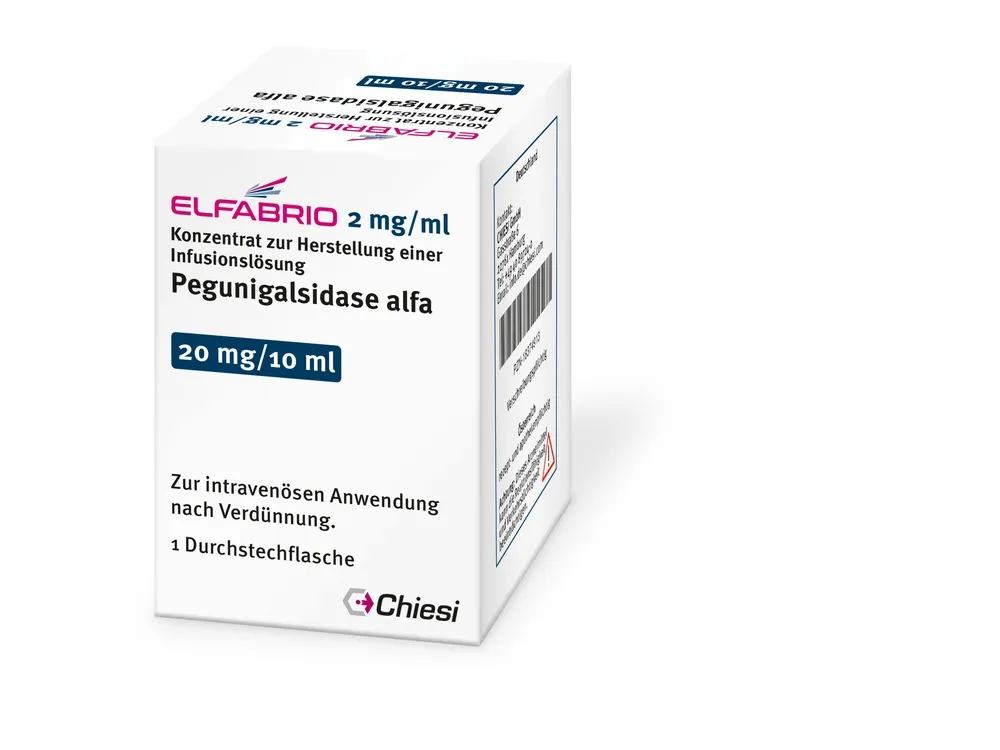
Table of Contents
- Package leaflet: Information for the user
- Elfabrio 2 mg/mL concentrate for solution for infusion
- 1. What Elfabrio is and what it is used for
- 2. What you need to know before Elfabrio is administered to you
- 3. How Elfabrio is administered
- 4. Possible side effects
- 5. How to store Elfabrio
- 6. Package contents and other information
- The following information is intended exclusively for healthcare professionals:
Package leaflet: Information for the user
Elfabrio 2 mg/mL concentrate for solution for infusion
pegunigalsidase alfa
This medicinal product is subject to additional monitoring. This will allow for rapid identification of new safety information. You can help by reporting any side effects you experience while taking this medicine. See the end of section 4 for information on how to report side effects.
Please read all of this leaflet carefully before you start using this medicine because it contains important information for you.
- Keep this leaflet. You may need to read it again.
- If you have any questions, ask your doctor or pharmacist.
- This medicine has been prescribed for you only. Do not give it to others, even if they have the same symptoms as you, because it may be harmful.
- If you experience any side effect, including those not listed in this leaflet, talk to your doctor or pharmacist. See section 4.
What this leaflet contains
- What Elfabrio is and what it is used for
- What you need to know before being given Elfabrio
- How Elfabrio is administered
- Possible side effects
- How to store Elfabrio
- Contents of the pack and other information
1. What Elfabrio is and what it is used for
Elfabrio contains the active substance pegunigalsidase alfa and is used as enzyme replacement therapy
in adult patients with confirmed Fabry disease. Fabry disease is a rare genetic disorder
that can affect many parts of the body. In patients with Fabry disease, fatty substances are not
removed from the body's cells and accumulate in the walls of blood vessels, contributing to
organ dysfunction. These fats accumulate in patients' cells because they do not have sufficient amounts of an enzyme called α-galactosidase A, which is responsible for breaking them down. Elfabrio is used long-term to supplement or replace this enzyme in adult patients with confirmed Fabry disease.
2. What you need to know before Elfabrio is administered to you
Do not use Elfabrio
- if you are severely allergic to pegunigalsidase alfa or to any of the other ingredients of this medicine (listed in section 6).
Warnings and precautions
Talk to your doctor before using Elfabrio.
If you are treated with Elfabrio, you may experience an adverse effect during or immediately after the intravenous infusion used to administer the medicine (see section 4). This effect is known as an infusion-related reaction and may sometimes be serious.
- Infusion-related reactions include dizziness, headache, nausea, low blood pressure, fatigue, and fever. If you experience an infusion-related reaction, contact your doctor immediately.
- If you have an infusion-related reaction, you may be given additional medicines to treat or help prevent future reactions. These include medicines used to treat allergies (antihistamines), medicines used to treat fever (antipyretics), and medicines to control inflammation (corticosteroids).
- If the infusion-related reaction is serious, your doctor will immediately stop the infusion and provide appropriate medical treatment or reduce the infusion rate.
- If infusion-related reactions are severe and/or there is a loss of effectiveness of the medicine, your doctor will perform a blood test to check for antibodies that could affect the treatment outcome.
- Most of the time, Elfabrio can still be administered to you even if you experience an infusion-related reaction.
In very rare cases, your immune system may fail to recognize Elfabrio, leading to an immunological kidney disease (membranoproliferative glomerulonephritis). During clinical studies, only one case occurred, and the only reported symptom was a temporary reduction in kidney function with excess protein in the urine. Symptoms resolved upon discontinuation of treatment.
Treatment monitoring
In patients switching to Elfabrio at a dose of 2 mg/kg body weight once every 4 weeks, regular monitoring (e.g. after 3, 6, 12, 18, and 24 months) should be performed. Monitoring should include at least an assessment of Lyso-Gb3, renal parameters (eGFR, proteinuria), cardiac parameters (LVMi, NT-proBNP, troponin or ECG), and biochemical parameters. Any changes in individual parameters should be interpreted in the context of the patient's overall clinical condition, and clinically relevant worsening should prompt a reassessment of the treatment regimen.
Children and adolescents
This medicine must not be used in children and adolescents. The safety and efficacy of Elfabrio in children and adolescents aged 0 to 17 years have not yet been established.
Other medicines and Elfabrio
Inform your doctor if you are taking, have recently taken, or might take any other medicines.
Pregnancy and breastfeeding
You must not use Elfabrio during pregnancy, as there is no experience with the use of Elfabrio in pregnant women. If you are pregnant, suspect you may be pregnant, or are planning to become pregnant, consult your doctor before receiving this medicine.
It is not known whether Elfabrio is excreted in human breast milk. Inform your doctor if you are breastfeeding or planning to breastfeed. Your doctor will help you decide whether to discontinue breastfeeding or discontinue treatment with Elfabrio, taking into account the benefits of breastfeeding for the infant and the benefits of Elfabrio for you.
Driving and using machines
Elfabrio may cause dizziness or vertigo. If you experience dizziness, vertigo, or fainting (syncope) on the day of Elfabrio treatment, do not drive or operate machinery until you feel better.
Elfabrio contains sodium
This medicine contains 46 mg of sodium (a key component of common table salt) per 10 mL vial. This is equivalent to 2% of the maximum daily dietary intake recommended for an adult.
This medicine contains 11.5 mg of sodium (a key component of common table salt) per 2.5 mL vial. This is equivalent to 1% of the maximum daily dietary intake recommended for an adult.
3. How Elfabrio is administered
This medicinal product must only be used under the supervision of a physician experienced in the treatment of Fabry disease or other similar disorders and must be administered only by a healthcare professional.
The recommended dose is 1 mg/kg of body weight, administered once every two weeks.
Treatment may also be administered at a dose of 2 mg/kg body weight every four weeks in stable patients on ERT therapy.
Your doctor may recommend home infusion if you meet certain criteria. Please contact your doctor if you wish to receive treatment at home.
Special populations
Hepatic impairment
No dose adjustment is required in patients with hepatic impairment.
Renal impairment
No dose adjustment is required in patients with renal impairment. Renal function should be regularly assessed during treatment with Elfabrio.
The presence of extensive kidney damage (eGFR <60 mL/min) may limit the renal response to enzyme replacement therapy, possibly due to underlying irreversible pathological changes. In such cases, loss of kidney function remains within the expected range of natural disease progression. Regular assessment of estimated glomerular filtration rate (eGFR) changes is recommended during treatment with Elfabrio.
Please read the information intended for healthcare professionals at the end of this leaflet.
4. Possible side effects
Like all medicines, this medicine can cause side effects, although not everyone will experience them. Most side effects occur during or shortly after the infusion ("infusion-related reaction", see section 2 "Warnings and precautions"). During treatment with Elfabrio, you may experience one of the following reactions:
Serious side effects
Common side effects (may affect up to 1 in 10 people)
- hypersensitivity and severe allergic reaction (symptoms include prolonged and excessive contraction of the airway muscles causing breathing difficulties [bronchospasm], swelling of the face, mouth and throat, wheezing, low blood pressure, hives, difficulty swallowing, rash, shortness of breath, flushing, chest discomfort, itching, nausea, chills, sneezing and nasal congestion)
If you experience these side effects, contact a doctor immediately and stop the infusion. Your doctor will provide pharmacological treatment if necessary.
Other side effects include
Common (may affect up to 1 in 10 people)
- infusion-related reactions
- weakness
- nausea
- rash
- abdominal pain
- dizziness
- pain
- chest pain
- headache
- muscle and joint pain
- sensations such as numbness, tingling or pins and needles (paresthesia)
- itching
- diarrhea
- vomiting
- chills
- skin redness (erythema)
- sensation of spinning (vertigo), irritability or confusion
- changes in normal heart rhythm
- agitation
Uncommon (may affect up to 1 in 100 people)
- tremor
- high blood pressure (hypertension)
- bronchospasm (contraction of bronchial muscles causing obstruction of the airways) and difficulty breathing
- throat irritation
- throat tightness
- increased body temperature
- difficulty sleeping (insomnia)
- restless legs syndrome
- nerve damage in arms and legs causing pain or numbness, burning and tingling (peripheral neuropathy)
- nerve pain (neuralgia)
- burning sensation
- fainting (syncope)
- flushing
- gastroesophageal reflux disease (where stomach acid flows back into the esophagus)
- inflammation of the stomach lining (dyspepsia)
- indigestion
- gas (flatulence)
- decreased sweating (hypohidrosis)
- immune-mediated kidney disease causing excess protein in the urine and kidney malfunction (membranoproliferative glomerulonephritis)
- chronic kidney disease
- excess protein in the urine (proteinuria)
- tissue damage when the medicine normally infused into a vein leaks out or is accidentally infused into surrounding tissue (infusion site extravasation)
- swelling of the lower legs or hands (edema)
- swelling of arms or legs
- influenza-like illness
- nasal congestion and sneezing
- infusion site pain
- increased uric acid in the blood, increased urine protein/creatinine ratio, white blood cells in the urine, as detected by laboratory tests
- weight gain
- low blood pressure (hypotension)
Reporting of side effects
If you experience any side effect, including those not listed in this leaflet, talk to your doctor. You may also report side effects directly via the national reporting system detailed in Annex V. Reporting side effects can help provide more information on the safety of this medicine.
5. How to store Elfabrio
Keep this medicine out of the sight and reach of children.
Do not use this medicine after the expiry date stated on the label and carton after "EXP" / "Scad.". The expiry date refers to the last day of that month.
Store in the refrigerator (2 °C - 8 °C).
After dilution, the diluted solution should be used immediately. If not used immediately, the diluted solution must be stored for no more than 24 hours in the refrigerator (2 °C - 8 °C) or for no more than 8 hours at room temperature (below 25 °C).
Do not use this medicine if you notice particulate matter or discoloration.
Do not dispose of medicines via wastewater or household waste. Ask your pharmacist how to dispose of medicines you no longer use. This will help protect the environment.
6. Package contents and other information
What Elfabrio contains
- The active substance is pegunigalsidase alfa. Each vial contains 20 mg of pegunigalsidase alfa in 10 mL or 5 mg of pegunigalsidase alfa in 2.5 mL (2 mg/mL).
- The other components are: trisodium citrate dihydrate, citric acid and sodium chloride (see section 2 "Elfabrio contains sodium").
Description of the appearance of Elfabrio and contents of the pack
Clear, colourless solution in a clear glass vial with a rubber stopper and sealed with an aluminium flip-off cap.
Pack sizes: 1, 5 or 10 vials.
Not all pack sizes may be marketed.
Marketing Authorisation Holder
Chiesi Farmaceutici S.p.A.
Via Palermo 26/A
43122 Parma
Italy
Manufacturer
Chiesi Farmaceutici S.p.A.
Via San Leonardo 96
43122 Parma
Italy
For further information on this medicinal product, please contact the local representative of the Marketing Authorisation Holder:
België/Belgique/Belgien Lietuva
Chiesi sa/nv Chiesi Pharmaceuticals GmbH
Tél/Tel: + 32 (0)2 788 42 00 Tel: + 43 1 4073919
България Luxembourg/Luxemburg
ExCEEd Orphan Distribution d.o.o. Chiesi sa/nv
Тел.: +359 87 663 1858 Tél/Tel: + 32 (0)2 788 42 00
Česká republika Magyarország
Chiesi CZ s.r.o. ExCEEd Orphan Distribution d.o.o.
Tel: + 420 261221745 Tel.: +36 70 612 7768
Danmark Malta
Chiesi Pharma AB Chiesi Farmaceutici S.p.A.
Tlf: + 46 8 753 35 20 Tel: + 39 0521 2791
Deutschland Nederland
Chiesi GmbH Chiesi Pharmaceuticals B.V.
Tel: + 49 40 89724-0 Tel: + 31 88 501 64 00
Eesti Norge
Chiesi Pharmaceuticals GmbH Chiesi Pharma AB
Tel: + 43 1 4073919 Tlf: + 46 8 753 35 20
Ελλάδα Österreich
Chiesi Hellas AEBE Chiesi Pharmaceuticals GmbH
Τηλ: + 30 210 6179763 Tel: + 43 1 4073919
España Polska
Chiesi España, S.A.U. ExCEEd Orphan Distribution d.o.o.
Tel: + 34 934948000 Tel.: +48 799 090 131
France Portugal
Chiesi S.A.S. Chiesi Farmaceutici S.p.A.
Tél: + 33 1 47688899 Tel: + 39 0521 2791
Hrvatska România
Chiesi Pharmaceuticals GmbH Chiesi Romania S.R.L.
Tel: + 43 1 4073919 Tel: + 40 212023642
Ireland Slovenija
Chiesi Farmaceutici S.p.A. CHIESI SLOVENIJA, d.o.o.
Tel: + 39 0521 2791 Tel: + 386-1-43 00 901
Ísland Slovenská republika
Chiesi Pharma AB Chiesi Slovakia s.r.o.
Sími: +46 8 753 35 20 Tel: + 421 259300060
Italia Suomi/Finland
Chiesi Italia S.p.A. Chiesi Pharma AB
Tel: + 39 0521 2791 Puh/Tel: +46 8 753 35 20
Κύπρος Sverige
Chiesi Farmaceutici S.p.A. Chiesi Pharma AB
Τηλ: + 39 0521 2791 Tel: +46 8 753 35 20
Latvija
Chiesi Pharmaceuticals GmbH
Tel: + 43 1 4073919
Other sources of information
More detailed information on this medicinal product is available on the website of the European Medicines Agency: https://www.ema.europa.eu. In addition, links to other websites on rare diseases and their therapeutic treatments are provided.
The following information is intended exclusively for healthcare professionals:
Dilution (use aseptic technique)
- Determine the total number of vials required for the infusion.
The number of vials needed is based on the total dose required for each individual patient and requires a weight-based dose calculation.
An example of total dose calculation for an 80 kg patient prescribed 1 mg/kg is as follows:
- Patient weight (in kg) ÷ 2 = dose volume (in mL)
- Example: 80 kg patient ÷ 2 = 40 mL (volume to be withdrawn)
- In this example, 4 vials of 10 mL (or 16 vials of 2.5 mL) are required.
An example of total dose calculation for an 80 kg patient prescribed 2 mg/kg is as follows:
- Patient weight (in kg) = dose volume (in mL)
- Example: 80 kg patient = 80 mL (volume to be withdrawn)
- In this example, 8 vials of 10 mL (or 32 vials of 2.5 mL) are required.
- Allow the required number of vials to reach room temperature before dilution (approximately 30 minutes).
Visually inspect the vials. Do not use if the closure cap is missing or damaged. Do not use if particulate matter is present or if discoloration occurs.
Do not shake or agitate the vials. - Withdraw from the infusion bag and discard a volume of 9 mg/mL (0.9%) sodium chloride infusion solution equal to the volume calculated in step 1.
- Withdraw the required volume of Elfabrio solution from the vials and dilute it with 9 mg/mL (0.9%) sodium chloride infusion solution to a total volume based on the patient's body weight, as specified in the table below.
Minimum total infusion volume for patients based on body weight
| Patient weight | Minimum total infusion volume |
| < 70 kg | 150 mL |
| 70-100 kg | 250 mL |
| > 100 kg | 500 mL |
Inject the Elfabrio solution directly into the infusion bag.
DO NOT inject into the air space within the infusion bag.
Gently invert the infusion bag to mix the solution, avoiding shaking or vigorous agitation.
The diluted solution must be administered using a low protein-binding 0.2 μm in-line filter.