Elaprase
Italy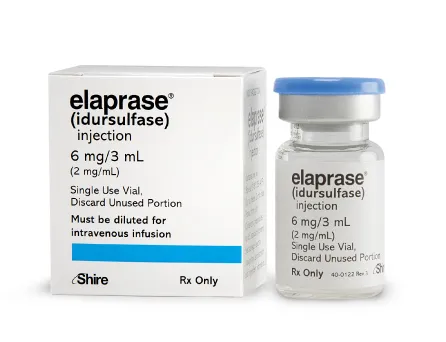
Table of Contents
- Patient Information Leaflet
- Elaprase 2 mg/ml concentrate for solution for infusion
- 1. What Elaprase is and what it is used for
- 2. What you need to know before using Elaprase
- 3. How to use Elaprase
- 4. Possible side effects
- 5. How to store Elaprase
- 6. Package contents and other information
- The following information is intended exclusively for healthcare professionals:
- Instructions for use, handling and disposal
Patient Information Leaflet
Elaprase 2 mg/ml concentrate for solution for infusion
idursulfase
This medicinal product is subject to additional monitoring. This will allow for rapid identification of new safety information. You can help by reporting any side effects you experience while taking this medicine. See the end of section 4 for information on how to report side effects.
Please read this leaflet carefully before using this medicine because it contains important information for you.
- Keep this leaflet. You may need to read it again.
- If you have any questions, ask your doctor, pharmacist or nurse.
- This medicine has been prescribed for you only. Never give it to other people, even if they have the same symptoms as you, because it may be harmful.
- If you experience any side effect, including those not listed in this leaflet, talk to your doctor, pharmacist or nurse. See section 4.
Contents of this leaflet:
- What Elaprase is and what it is used for
- What you need to know before using Elaprase
- How to use Elaprase
- Possible side effects
- How to store Elaprase
- Contents of the pack and other information
1. What Elaprase is and what it is used for
Elaprase is used as an enzyme replacement therapy for the treatment of Hunter syndrome
(mucopolysaccharidosis II) in pediatric and adult patients in whom the level of the enzyme
iduronate-2-sulfatase in the body is below normal, and helps to improve the symptoms of the
disease. In patients with Hunter syndrome, a carbohydrate called glycosaminoglycan, which
is normally broken down by the body, remains intact and gradually accumulates in various
organs of the body. This leads to abnormalities in cellular function; this causes problems in multiple
organs, resulting in tissue destruction and organ dysfunction or failure.
Organs in which glycosaminoglycan typically accumulates include the spleen, liver, lungs, heart, and
connective tissue. In some patients, glycosaminoglycan also accumulates in the brain. Elaprase
contains the active substance idursulfase, which acts as a replacement for the deficient enzyme,
breaking down this carbohydrate within affected cells.
Enzyme replacement therapy is usually administered long-term.
2. What you need to know before using Elaprase
Do not use Elaprase
- if you have had severe or life-threatening allergic reactions to idursulfase or to any of the other ingredients of this medicine (listed in section 6), and these reactions cannot be adequately managed with appropriate medical therapy.
Warnings and precautions
Talk to your doctor or nurse before using this medicine.
If you are treated with Elaprase, you may experience adverse effects during or after the infusion (see section 4 Possible side effects). The most common symptoms are itching, rash, hives, fever, headache, increased blood pressure, and flushing (reddening of the skin). In most cases, administration of this medicine can continue despite these symptoms. If you notice any allergic-type adverse reaction following administration of this medicine, contact your doctor immediately. You may be given other medicines, such as antihistamines and corticosteroids, to treat or help prevent allergic reactions.
If you experience severe allergic reactions, your doctor will immediately stop the infusion and start appropriate treatment. Hospitalization may be required.
The nature of your genotype (the genetic map of all active genes in human cells, which determines individual characteristics) may influence your response to treatment with this medicine and the risk of developing antibodies and infusion-related adverse effects. In individual cases, so-called "neutralizing antibodies" may develop, which could reduce the activity of Elaprase and its therapeutic effect. The long-term effects of antibody development on treatment response have not been established. For further information, consult your doctor.
Maintenance of a registry
To improve the traceability of biological medicines, the name and batch number of the administered medicine must be clearly recorded by the healthcare professional. If in doubt, speak with your healthcare provider.
Other medicines and Elaprase
No interactions between this medicine and other medicines are known.
Inform your doctor, pharmacist, or nurse if you are taking, have recently taken, or might take any other medicines.
Pregnancy and breastfeeding
If you are pregnant, think you might be pregnant, are planning to become pregnant, or are breastfeeding, consult your doctor or pharmacist before taking this medicine.
Driving and using machines
This medicine does not affect or has a negligible effect on the ability to drive or operate machinery.
Elaprase contains sodium
This medicine contains 11.1 mg of sodium (a key component of table salt) per vial. This corresponds to 0.6% of the maximum daily recommended dietary intake of sodium for an adult.
3. How to use Elaprase
Use this medicine exactly as your doctor has told you. If you have any doubts, consult your doctor.
This medicine is administered under the supervision of a doctor or nurse who is well informed about the treatment of Hunter syndrome or other inherited metabolic disorders.
The recommended dose is an infusion of 0.5 mg (half a milligram) per kilogram of body weight.
Before use, Elaprase must be diluted with sodium chloride solution for infusion 9 mg/ml (0.9%). Once diluted, this medicine will be administered into a vein (intravenous infusion).
The infusion usually lasts from 1 to 3 hours and is given once a week.
Use in children and adolescents
The recommended dosage for children and adolescents is the same as for adults.
If you use more Elaprase than you should
In case of overdose with this medicine, contact your doctor.
If you forget to use Elaprase
If you have missed an infusion of Elaprase, contact your doctor.
If you have any doubts about the use of Elaprase, consult your doctor or nurse.
4. Possible side effects
Like all medicines, this medicine can cause side effects, although not everybody gets them.
Most side effects are mild or moderate and related to the infusion; however, some may be serious.
Over time, the number of these infusion-related reactions decreases.
If you have difficulty breathing, with or without bluish skin discoloration, inform your doctor immediately and seek medical assistance.
Very common side effects (may affect more than 1 in 10 people) are:
Headache
Flushing (reddening of the skin)
Shortness of breath, wheezing
Abdominal pain, nausea, vomiting, frequent and/or loose bowel movements
Chest pain
Hives, rash, itching, skin redness
Fever
Infusion-related reaction (see section titled "Warnings and precautions")
Common side effects (may affect up to 1 in 10 people) are:
Dizziness, tremor
Fast heartbeat, irregular heartbeat, bluish skin discoloration
Increased blood pressure, decreased blood pressure
Difficulty breathing, cough, low levels of oxygen in the blood
Swelling of the tongue, indigestion
Joint pain
Swelling at the infusion site, swelling of the extremities, facial swelling
Uncommon side effects (may affect up to 1 in 100 people) are:
Rapid breathing
Side effects with unknown frequency (cannot be estimated from the available data):
Severe allergic reactions
Reporting of side effects
If you experience any side effect, including those not listed in this leaflet, talk to your doctor, pharmacist, or nurse. You can also report side effects directly through the national reporting system listed in Annex V. By reporting side effects, you can help provide more information on the safety of this medicine.
5. How to store Elaprase
Keep this medicine out of the sight and reach of children.
Do not use this medicine after the expiry date stated on the label and carton after 'Exp.'. The expiry date refers to the last day of that month.
Store in a refrigerator (2 °C – 8 °C).
Do not freeze.
Do not use this medicine if you notice the presence of foreign particles or changes in colour.
Do not dispose of any medicine via wastewater or household waste. Ask your pharmacist how to dispose of medicines no longer required. This will help protect the environment.
6. Package contents and other information
What Elaprase contains
The active substance is idursulfase, a form of the human enzyme iduronate-2-sulfatase. Idursulfase is
produced in a human cell line using recombinant DNA technology (which involves the introduction of
genetic material into human cells in the laboratory to produce the desired product).
Each vial of Elaprase contains 6 mg of idursulfase. Each ml contains 2 mg of idursulfase.
The excipients are polysorbate 20, sodium chloride, disodium phosphate heptahydrate, monosodium
phosphate monohydrate and water for injections.
Description of the appearance of Elaprase and contents of the pack
This medicine is a concentrate for solution for infusion. It is supplied in a glass vial as a clear or
slightly opalescent, colourless solution.
Each vial contains 3 ml of concentrate for solution for infusion.
Elaprase is available in packs of 1, 4 and 10 vials per carton. Not all pack sizes may be marketed.
Marketing Authorisation Holder and Manufacturer
Marketing Authorisation Holder
Takeda Pharmaceuticals International AG Ireland Branch
Block 2 Miesian Plaza
50-58 Baggot Street Lower
Dublin 2
D02 HW68
Ireland
Manufacturer
Takeda Pharmaceuticals International AG Ireland Branch
Block 2 Miesian Plaza
50-58 Baggot Street Lower
Dublin 2
D02 HW68
Ireland
Shire Pharmaceuticals Ireland Limited
Block 2 & 3 Miesian Plaza
50 – 58 Baggot Street Lower
Dublin 2
Ireland
For further information about this medicine, please contact the local representative of the Marketing
Authorisation Holder:
België/Belgique/Belgien Lietuva
Takeda Belgium NV Takeda, UAB
Tél/Tel: +32 2 464 06 11 Tel: +370 521 09 070
[email protected] [email protected]
България Luxembourg/Luxemburg
Такеда България ЕООД Takeda Belgium NV
Тел.: +359 2 958 27 36 Tél/Tel: +32 2 464 06 11
[email protected] [email protected]
Česká republika Magyarország
Takeda Pharmaceuticals Czech Republic s.r.o. Takeda Pharma Kft.
Tel: +420 234 722 722 Tel.: +36 1 270 7030
[email protected] [email protected]
Danmark Malta
Takeda Pharma A/S Τakeda HELLAS S.A.
Tlf: +45 46 77 10 10 Tel: +30 210 6387800
[email protected] [email protected]
Deutschland Nederland
Takeda GmbH Takeda Nederland B.V.
Tel: +49 (0)800 825 3325 Tel: +31 20 203 5492
[email protected] [email protected]
Eesti Norge
Takeda Pharma AS Takeda AS
Tel: +372 6177 669 Tlf: +47 800 800 30
[email protected] [email protected]
Ελλάδα Österreich
Τakeda ΕΛΛΑΣ Α.Ε. Takeda Pharma Ges.m.b.H.
Tηλ: +30 210 6387800 Tel: +43 (0) 800-20 80 50
[email protected] [email protected]
España Polska
Takeda Farmacéutica España S.A. Takeda Pharma Sp. z o.o.
Tel: +34 917 90 42 22 Tel.: +48223062447
[email protected] [email protected]
France Portugal
Takeda France SAS Takeda Farmacêuticos Portugal, Lda.
Tél: + 33 1 40 67 33 00 Tel: + 351 21 120 1457
[email protected] [email protected]
Hrvatska România
Takeda Pharmaceuticals Croatia d.o.o. Takeda Pharmaceuticals SRL
Tel: +385 1 377 88 96 Tel: +40 21 335 03 91
[email protected] [email protected]
Ireland Slovenija
Takeda Products Ireland Ltd Takeda Pharmaceuticals farmacevtska družba d.o.o.
Tel: 1800 937 970 Tel: + 386 (0) 59 082 480
[email protected] [email protected]
Ísland Slovenská republika
Vistor hf. Takeda Pharmaceuticals Slovakia s.r.o.
Sími: +354 535 7000 Tel: +421 (2) 20 602 600
[email protected] [email protected]
Italia Suomi/Finland
Takeda Italia S.p.A. Takeda Oy
Tel: +39 06 502601 Puh/Tel: 0800 774 051
[email protected] [email protected]
Κύπρος Sverige
Τakeda ΕΛΛΑΣ Α.Ε. Takeda Pharma AB
Τηλ: +30 210 6387800 Tel: 020 795 079
[email protected] [email protected]
Latvija United Kingdom (Northern Ireland)
Takeda Latvia SIA Takeda UK Ltd
Tel: +371 67840082 Tel: +44 (0) 2830 640 902
[email protected] [email protected]
This medicinal product has been authorised under “exceptional circumstances”.
This means that, because the disease is rare, it has not been possible to obtain complete information
about this medicine.
The European Medicines Agency will review any new information on this medicine annually, and this
package leaflet will be updated if necessary.
Other sources of information
More detailed information on this medicine is available on the website of the European Medicines Agency: http://www.ema.europa.eu/. Links to other websites on rare diseases and their treatments are also provided.
This leaflet is available in all languages of the European Union/European Economic Area on the website of the European Medicines Agency.
The following information is intended exclusively for healthcare professionals:
Instructions for use, handling and disposal
- Calculate the total dose to be administered and the number of Elaprase vials required.
- Dilute the required total volume of Elaprase concentrate for infusion solution in 100 ml of sodium chloride solution for injection 9 mg/ml (0.9%). It is recommended to administer the total infusion volume using an in-line filter of 0.2 µm. Since Elaprase does not contain preservatives or bacteriostatic agents, utmost care must be taken to ensure sterility of the prepared solution: aseptic techniques must therefore be used. After dilution, the solution should be gently mixed but not shaken.
- Before administration, the solution should be visually inspected for the presence of foreign particles or changes in colour. Do not shake.
- Administration should be initiated as soon as possible. From a physicochemical standpoint, the diluted solution is stable for 8 hours at 25 °C.
- Do not administer Elaprase in the same infusion line with other medicinal products.
- Single use only. Any unused medicine and waste material arising from this medicine must be disposed of in accordance with local regulations.