Efient
Italy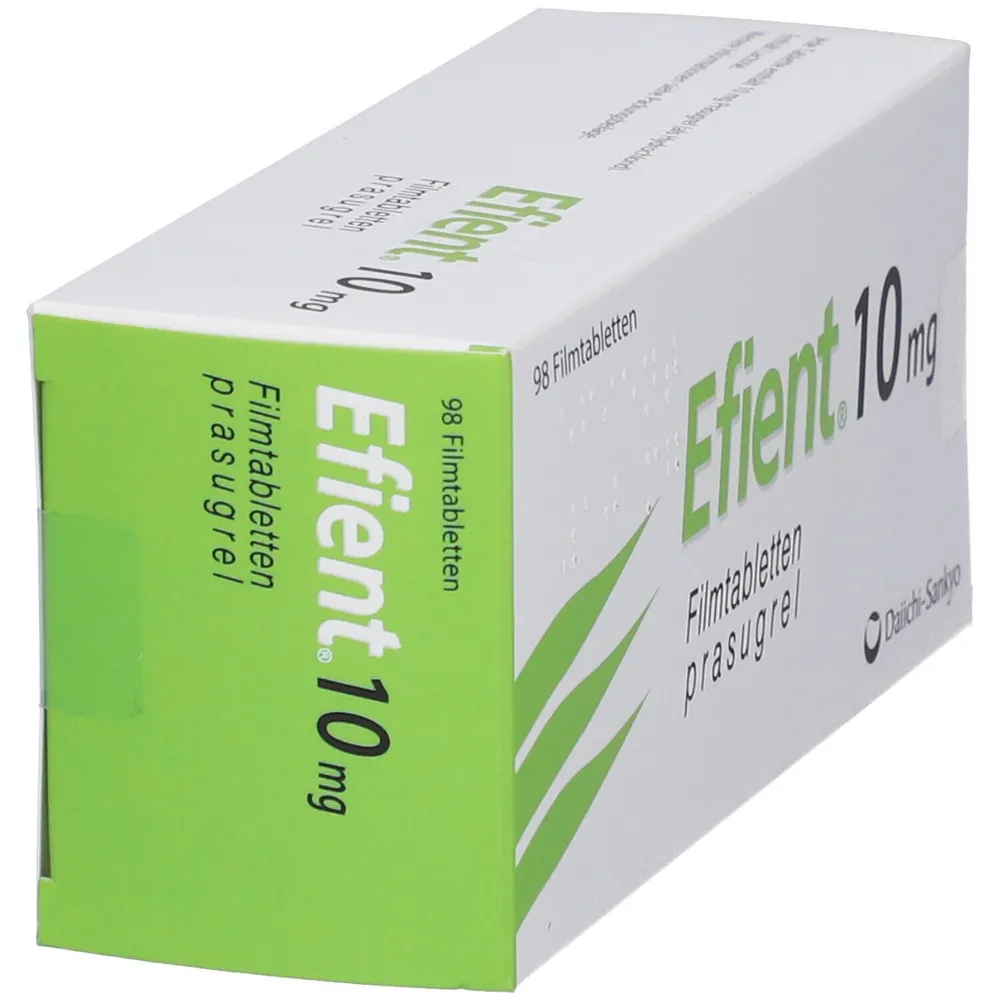
Table of Contents
- Package leaflet: Information for the user
- Efient 10 mg film-coated tablets, 5 mg film-coated tablets
- 1. What Efient is and what it is used for
- 2. What you need to know before taking Efient
- 3. How to take Efient
- 4. Possible side effects
- 5. How to store Efient
- 6. Package contents and other information
Package leaflet: Information for the user
Efient 10 mg film-coated tablets, 5 mg film-coated tablets
prasugrel
Please read this leaflet carefully before you start taking this medicine because it contains
important information for you.
- Keep this leaflet. You may need to read it again.
- If you have any questions, ask your doctor or pharmacist.
- This medicine has been prescribed for you only. Do not give it to other people, even if their symptoms are the same as yours, as it may be harmful.
- If you experience any side effect, including those not listed in this leaflet, tell your doctor or pharmacist. See section 4.
Contents of this leaflet
- What Efient is and what it is used for
- What you need to know before taking Efient
- How to take Efient
- Possible side effects
- How to store Efient
- Contents of the pack and other information
1. What Efient is and what it is used for
Efient, which contains the active substance prasugrel, belongs to a group of medicines called
antiplatelet agents. Platelets are very small cells that circulate in the blood. When a blood vessel is damaged,
for example if it is cut, platelets clump together to help form a blood clot (thrombus). Therefore, platelets are
essential in helping to stop bleeding. However, if clots form inside a hardened blood vessel, such as an artery,
they can be very dangerous because they can block the flow of blood, causing a heart attack (myocardial infarction),
stroke or death. Clots in the arteries supplying blood to the heart can also reduce blood flow to the heart,
causing unstable angina (severe chest pain).
Efient inhibits platelet aggregation and therefore reduces the likelihood of blood clots forming.
Efient has been prescribed for you because you have previously had a heart attack or unstable angina
and have been treated with a procedure to open blocked heart arteries. You may also have had one or more
stents placed in the blocked or narrowed artery to restore blood flow.
Efient reduces the likelihood that you will have another heart attack or stroke or die from such atherothrombotic events.
Your doctor will also prescribe acetylsalicylic acid (i.e. aspirin), another antiplatelet medicine.
2. What you need to know before taking Efient
Do not take Efient
- If you are allergic to prasugrel or to any of the other ingredients of this medicine (listed in section 6). An allergic reaction may cause a skin rash, itching, swelling of the face, swelling of the lips, or shortness of breath. If any of these occur, inform your doctor immediately.
- If you have a medical condition causing active bleeding, such as bleeding in the stomach or intestines.
- If you have previously had a stroke or a transient ischaemic attack (TIA).
- If you suffer from severe liver disease.
Warnings and precautions
- Before taking Efient:
Talk to your doctor before taking Efient
If any of the conditions listed below apply to you, inform your doctor before taking Efient:
- If you have a condition that increases your risk of bleeding, such as:
- 75 years of age or older. Your doctor will prescribe a daily dose of 5 mg because there is an increased risk of bleeding in patients aged 75 years and above.
- recent severe trauma
- recent surgery (including certain dental procedures)
- recent or recurrent bleeding in the stomach or intestines (e.g. gastric ulcer or colon polyp)
- body weight below 60 kg. Your doctor will prescribe a daily dose of 5 mg of Efient if your body weight is less than 60 kg
- moderate kidney or liver disease
- if you are taking certain medicines (see “Other medicines and Efient”)
- if you are scheduled to undergo elective surgery (including certain dental procedures) within the next seven days. Your doctor may advise you to temporarily stop taking Efient due to an increased risk of bleeding
- If you have had allergic reactions (hypersensitivity) to clopidogrel or to any other antiplatelet medicine, inform your doctor before starting treatment with Efient. If, after starting Efient, you experience allergic reactions such as skin rash, itching, swelling of the face, swelling of the lips, or shortness of breath, you must inform your doctor immediately.
- While taking Efient:
Inform your doctor immediately if you develop a medical condition called Thrombotic Thrombocytopenic Purpura (TTP), which may include fever and bruising under the skin appearing as tiny red spots, with or without unexplained severe fatigue, confusion, or yellowing of the skin or eyes (jaundice) (see section 4 ‘Possible side effects’).
Children and adolescents
Efient must not be used in children and adolescents under 18 years of age.
Other medicines and Efient
Inform your doctor if you are taking, have recently taken, or might take any other medicines, including those not requiring a prescription, dietary supplements, and herbal remedies.
It is particularly important that you inform your doctor if you are being treated with:
- clopidogrel (an antiplatelet medicine),
- warfarin (an anticoagulant),
- “non-steroidal anti-inflammatory drugs” to relieve pain and reduce fever (such as ibuprofen, naproxene, etoricoxib). When used together with Efient, these medicines may increase the risk of bleeding.
Inform your doctor if you are taking morphine or other opioids (used to treat severe pain).
Only take other medicines during treatment with Efient if your doctor says you may do so.
Pregnancy and breastfeeding
Inform your doctor if you are pregnant or planning a pregnancy while taking Efient. You should use Efient only after discussing with your doctor the potential benefits and any possible risks to the unborn child.
If you are pregnant, suspect you may be pregnant, are planning a pregnancy, or are breastfeeding, ask your doctor or pharmacist for advice before taking this medicine.
Driving and using machines
It is unlikely that Efient will affect your ability to drive or use machines.
Efient contains lactose and sodium
If your doctor has diagnosed you with an intolerance to certain sugars, contact your doctor before taking this medicine.
This medicine contains less than 1 mmol (23 mg) of sodium per tablet, i.e. it is essentially ‘sodium-free’.
3. How to take Efient
Take this medicine exactly as your doctor has told you. If you are unsure, consult your doctor or pharmacist.
The usual dose of Efient is 10 mg once daily. Treatment will begin with a single 60 mg loading dose.
If your body weight is less than 60 kg or if you are over 75 years of age, the dose is 5 mg of Efient once daily.
Your doctor will also instruct you to take acetylsalicylic acid; they will tell you the exact dose to take (usually between 75 mg and 325 mg daily).
You may take Efient with or without food. Take Efient at about the same time each day. Do not crush or break the tablet.
It is important that you inform your doctor, pharmacist, and dentist that you are taking Efient.
If you take more Efient than you should
Contact your doctor or the nearest hospital immediately due to the risk of excessive bleeding. Show your doctor your pack of Efient.
If you forget to take Efient
If you forget to take a dose, take one tablet as soon as you remember. If you forget to take your dose for the entire day, simply take your next normal dose the following day. Do not take a double dose to make up for a missed dose. For packs containing 14, 28, 56, 84, and 98 tablets, you can check the day on which you took your last Efient tablet by looking at the calendar printed on the blister.
If you stop taking Efient
Do not stop taking Efient without first consulting your doctor. If you stop taking Efient too early, your risk of myocardial infarction may increase.
If you have any doubts about how to use this medicine, ask your doctor or pharmacist.
4. Possible side effects
Like all medicines, this medicine can cause side effects, although not everyone will experience them.
You must contact your doctor immediately if you notice any of the following side effects:
- Sudden drowsiness or weakness in one arm, one leg, or one side of the face, especially if limited to one side of the body.
- Sudden confusion, difficulty speaking or understanding others.
- Sudden difficulty walking, loss of balance, or lack of coordination.
- Sudden dizziness or sudden severe headache with no known cause.
All of the above may be signs of a stroke. Stroke is an uncommon side effect of Efient in patients who have never had a stroke or transient ischemic attack (TIA).
Also contact your doctor immediately if you notice any of the following side effects:
- Fever and bruising under the skin appearing as tiny red spots, with or without unexplained severe fatigue, confusion, or yellowing of the skin or eyes (jaundice) (see section 2, ‘BEFORE YOU TAKE EFIENT’).
- Skin rash, itching, swelling of the face, swelling of the lips/tongue, or shortness of breath. All of these may be signs of a serious allergic reaction (see section 2, ‘What you need to know before taking Efient’).
You should promptly contact your doctor if you notice any of the following side effects:
- Blood in the urine.
- Bleeding from the rectum, blood in the stool, or black stools.
- Uncontrolled bleeding, for example from a cut.
All of the above may be signs of bleeding, the most common side effect with Efient. Although uncommon, severe bleeding can be life-threatening.
Common side effects (may affect up to 1 in 10 people)
- Bleeding in the stomach or intestines
- Bleeding from a needle puncture site
- Nosebleeds
- Skin rash
- Small red bruises on the skin (purpura)
- Blood in the urine
- Haematoma (bleeding under the skin at the site of an injection or in a muscle, causing swelling)
- Low haemoglobin or low red blood cell count (anaemia)
- Bruising
Uncommon side effects (may affect up to 1 in 100 people)
- Allergic reaction (skin rash, itching, swelling of lips/tongue, or shortness of breath)
- Spontaneous bleeding from the eye, rectum, gums, or abdomen around internal organs
- Bleeding after surgery
- Coughing up blood
- Blood in the stool
Rare side effects (may affect up to 1 in 1,000 people)
- Low number of platelets in the blood
- Subcutaneous haematoma (bleeding under the skin causing swelling)
Reporting of side effects
If you experience any side effect, including those not listed in this leaflet, talk to your doctor or pharmacist. You can also report side effects directly through the national reporting system referred to in Annex V. By reporting side effects, you can help provide more information on the safety of this medicine.
5. How to store Efient
Keep this medicine out of the sight and reach of children.
Do not use this medicine after the expiry date which is stated on the blister and on the carton after
EXP. The expiry date refers to the last day of the month.
Store in the original packaging to protect the medicine from air and moisture.
Do not dispose of any medicine via wastewater or household waste. Ask your pharmacist how to
dispose of medicines no longer in use. This will help protect the environment.
6. Package contents and other information
What Efient contains
- The active substance is prasugrel. Efient 10 mg: Each tablet contains 10 mg of prasugrel (as hydrochloride). Efient 5 mg: Each tablet contains 5 mg of prasugrel (as hydrochloride).
- Other ingredients are:
Microcrystalline cellulose, mannitol (E421), sodium croscarmellose, hypromellose (E464),
magnesium stearate, lactose monohydrate, titanium dioxide (E171), triacetin (E1518), iron
oxide red (only for 10 mg tablets) (E172), iron oxide yellow (E172) and talc.
Description of the appearance of Efient and pack sizes
Efient 10 mg: The tablets are beige, double-arrow shaped, engraved with "10 MG" on one side and "4759" on the other side.
Efient 5 mg: The tablets are yellow, double-arrow shaped, engraved with "5 MG" on one side and "4760" on the other side.
Efient is available in packs containing 14, 28, 30, 30 (x1), 56, 84, 90 (x1) and 98 tablets.
Not all pack sizes may be marketed.
Marketing Authorization Holder
SUBSTIPHARM
24 rue Erlanger
75016 Paris
France
Manufacturer
Daiichi Sankyo Europe GmbH
Luitpoldstrasse 1
85276 Pfaffenhofen
Germany
For further information about this medicinal product, please contact the local representative of the Marketing Authorization Holder:
België/Belgique/ Belgien Lietuva
SUBSTIPHARM SUBSTIPHARM
Tél/Tel: 080077098 Tel: +33 1 43 18 13 00
България Luxembourg/Luxemburg
Zentiva, k.s. SUBSTIPHARM
Тел.: +359 24417136 Tél/Tel: 80024806
Česká republika Magyarország
Zentiva, k.s. Zentiva Pharma Kft.
Tel: +420 267 241 111 Tel: +36 1 299 1058
Danmark Malta
Kurantis ApS SUBSTIPHARM
Tlf.: +45 33 60 89 88 Tel: +33 1 43 18 13 00
Deutschland Nederland
SUBSTIPHARM SUBSTIPHARM
Tel: 08001801783 Tel: 08000228089
Eesti Norge
SUBSTIPHARM Kurantis ApS
Tel: +33 1 43 18 13 00 Tlf: +45 33 60 89 88
Ελλάδα Österreich
ΦΑΡΜΑΣΕΡΒ ΕΛΛΑΣ Α.Ε.Β.Ε. SUBSTIPHARM
Τηλ: +30 210 620 8372 Tel: 0800298153
España Polska
SUBSTIPHARM Berlin-Chemie/Menarini Polska Sp. z o.o.
Tel: 900993317 Tel: +48 22 566 21 00
France Portugal
SUBSTIPHARM SUBSTIPHARM
Tél: +33 1 43 18 13 00 Tel: 800833006
Hrvatska România
SUBSTIPHARM SUBSTIPHARM
Tel: +33 1 43 18 13 00 Tel: +33 1 43 18 13 00
Ireland Slovenija
SUBSTIPHARM Zentiva, k.s.
Tel: 1800300170 Tel: +386 360 00 408
Ísland Slovenská republika
Kurantis ApS Zentiva, a.s.
Simi: +45 33 60 89 88 Tel: +421 2 3918 3010
Italia Suomi/Finland
SUBSTIPHARM Kurantis ApS
Tel: 800780088 Puh./Tel: +45 33 60 89 88
Κύπρος Sverige
SUBSTIPHARM Kurantis ApS
Τηλ: +33 1 43 18 13 00 Tel: +45 33 60 89 88
Latvija
SUBSTIPHARM
Tel.: +33 1 43 18 13 00
Other sources of information
More detailed information on this medicinal product is available on the website of the European Medicines Agency: http://www.ema.europa.eu.