Efavirenz Aurobindo
Italy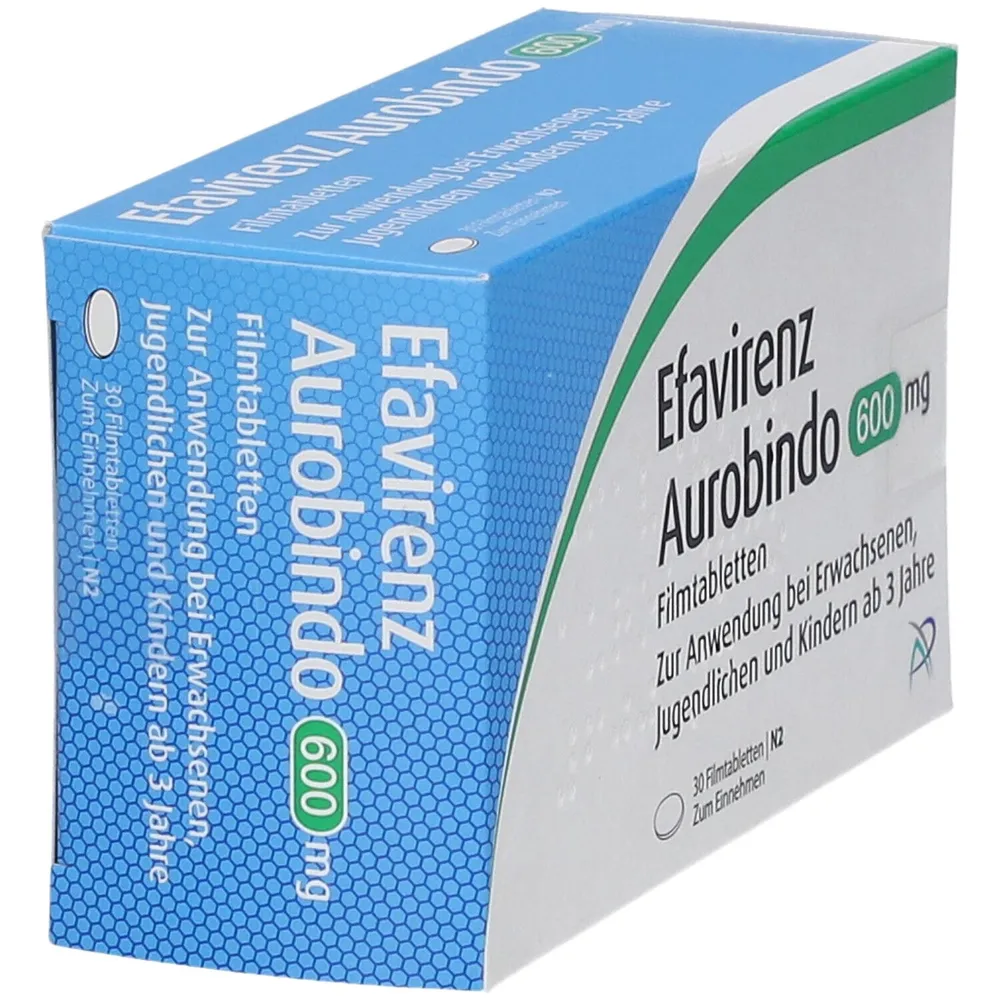
Table of Contents
- Package leaflet: Information for the user
- Efavirenz Aurobindo 600 mg film-coated tablets
- 1. What Efavirenz Aurobindo is and what it is used for
- 2. What you need to know before taking Efavirenz Aurobindo
- 3. How to take Efavirenz Aurobindo
- 4. Possible side effects
- 5. How to store Efavirenz Aurobindo
- 6. Package contents and other information
Package leaflet: Information for the user
Efavirenz Aurobindo 600 mg film-coated tablets
Generic medicine
Please read all of this leaflet carefully before you start taking this medicine because it contains important information for you.
- Keep this leaflet. You may need to read it again.
- If you have any questions, ask your doctor or pharmacist.
- This medicine has been prescribed for you only. Do not give it to other people, even if their symptoms are the same as yours, as it may be harmful.
- If you experience any side effects, including those not listed in this leaflet, tell your doctor or pharmacist. See section 4.
Contents of this leaflet:
- What Efavirenz Aurobindo is and what it is used for
- What you need to know before taking Efavirenz Aurobindo
- How to take Efavirenz Aurobindo
- Possible side effects
- How to store Efavirenz Aurobindo
- Contents of the pack and other information
1. What Efavirenz Aurobindo is and what it is used for
Efavirenz Aurobindo contains the active substance efavirenz and belongs to a class of antiretroviral medicines called non-nucleoside reverse transcriptase inhibitors (NNRTIs). It is an antiretroviral medicine that fights human immunodeficiency virus (HIV) infection by reducing the amount of virus in the blood. It is used in adults, adolescents, and children aged 3 months and older who weigh at least 3.5 kg.
Your doctor has prescribed Efavirenz Aurobindo because you have HIV infection.
Efavirenz Aurobindo, taken in combination with other antiretroviral medicines, reduces the amount of virus in the blood. This will strengthen your immune system and reduce the risk of developing HIV-related illnesses.
2. What you need to know before taking Efavirenz Aurobindo
Do not take Efavirenz Aurobindo
- If you are allergic to efavirenz or to any of the other ingredients of this medicine (listed in section 6). Consult your doctor or pharmacist for advice.
- If you have severe liver disease.
- If you have a heart condition, such as an abnormal heart rhythm or heart rate, slow heartbeat, or severe heart disease.
- If any of your family members (parents, grandparents, siblings) died suddenly due to a heart problem or if you were born with heart problems.
- If your doctor has told you that you have high or low levels of electrolytes such as potassium or magnesium in your blood.
- If you are currently taking any of the following medicines:
- astemizole or terfenadine (used to treat allergy symptoms);
- bepridil (used to treat heart disorders);
- cisapride (used to treat heartburn);
- ergot alkaloids (e.g., ergotamine, dihydroergotamine, ergonovine, and methylergonovine) (used to treat migraine and cluster headache);
- midazolam or triazolam (used to help you sleep);
- pimozide, imipramine, amitriptyline, or clomipramine (used to treat certain mental conditions);
- St. John’s Wort (Hypericum perforatum) (a herbal remedy used for depression and anxiety);
- flecainide, metoprolol (used to treat irregular heartbeat);
- some antibiotics (macrolides, fluoroquinolones, imidazoles);
- triazole antifungal agents;
- some antimalarial treatments;
- methadone (used to treat opioid dependence).
If you are taking any of these medicines, inform your doctor immediately. Taking these
medicines together with Efavirenz Aurobindo may result in serious and/or potentially life-threatening side effects, or may prevent Efavirenz Aurobindo from working properly.
Warnings and precautions
Talk to your doctor before taking Efavirenz Aurobindo.
-
Efavirenz Aurobindo must always be taken together with other medicines that act against the HIV virus. If you are starting Efavirenz Aurobindo because your current treatment has failed to prevent the virus from multiplying, you must also start taking another medicine that you have never taken before at the same time.
-
You can still transmit HIV even while taking this medicine, although the risk is reduced by effective antiretroviral therapy. Discuss with your doctor the necessary precautions to avoid infecting others. This medicine is not a cure for HIV infection, and you may still develop infections or other AIDS-related diseases.
-
While taking Efavirenz Aurobindo, you must remain under medical supervision.
-
Inform your doctor:
-
If you have had mental health problems, including depression, or substance or alcohol abuse. Inform your doctor immediately if you feel depressed, have suicidal thoughts, or experience unusual thoughts (see section 4, Possible side effects).
-
If you have had seizures (fits or convulsions) or if you are being treated with anticonvulsants such as carbamazepine, phenobarbital, or phenytoin. If you are taking any of these medicines, your doctor may need to monitor the level of anticonvulsant in your blood to ensure it is not altered while you are taking Efavirenz Aurobindo. Your doctor may prescribe a different anticonvulsant.
-
If you have had liver disease, including active chronic hepatitis. Patients with chronic hepatitis B or C who are treated with a combination of antiretroviral medicines have an increased risk of serious and potentially life-threatening liver problems. Your doctor may perform blood tests to check your liver function or may prescribe another medicine. Do not take Efavirenz Aurobindo if you have severe liver disease (see section 2, Do not take Efavirenz Aurobindo).
-
When you start taking Efavirenz Aurobindo, be aware of:
-
Symptoms such as dizziness, difficulty falling asleep, drowsiness, difficulty concentrating, or strange dreams. These side effects usually begin within the first 1–2 days of treatment and typically disappear after the first 2–4 weeks.
-
Any signs of skin rash. If you notice any signs of a severe rash with blisters or fever, stop taking Efavirenz Aurobindo and inform your doctor immediately. If you previously developed a rash while taking another non-nucleoside reverse transcriptase inhibitor, you may be at high risk of developing a rash with Efavirenz Aurobindo.
-
Any signs of inflammation or infection. In some patients with advanced HIV infection (AIDS) and a history of opportunistic infections, inflammatory signs and symptoms of previous infections may occur shortly after starting anti-HIV treatment. These symptoms are believed to result from an improved immune response, allowing the body to fight infections that may have been present without clear symptoms. If you notice any signs of infection, inform your doctor immediately. In addition to opportunistic infections, autoimmune disorders (a condition in which the immune system attacks healthy body tissue) may also occur after starting medicines for HIV infection. Autoimmune disorders may occur several months after starting treatment. If you notice any signs of infection or other symptoms such as muscle weakness, weakness starting in the hands and feet and moving up toward the trunk, palpitations, tremor, or hyperactivity, inform your doctor immediately to receive necessary treatment.
-
Bone problems. Some patients taking combination antiretroviral therapy may develop a bone disease called osteonecrosis (death of bone tissue due to reduced blood supply to the bone). Factors such as duration of combination antiretroviral therapy, corticosteroid use, alcohol consumption, severe immunosuppression, and higher body mass index, among others, may increase the risk of developing this condition. Signs of osteonecrosis include joint stiffness, discomfort, pain (especially in the hips, knees, and shoulders), and difficulty moving. Consult your doctor if you develop any of these symptoms.
Children and adolescents
Efavirenz Aurobindo is not recommended for children under 3 months of age or weighing less than 3.5 kg, as it has not been adequately studied in these patients.
Other medicines and Efavirenz Aurobindo
You must not take Efavirenz Aurobindo with certain medicines. These are listed at the beginning of section 2: Do not take Efavirenz Aurobindo. Included among these medicines are common drugs and a herbal remedy (St. John’s Wort) that may cause serious interactions.
Inform your doctor or pharmacist if you are taking, have recently taken, or might take any other medicines.
Efavirenz Aurobindo may interact with other medicines, including herbal preparations such as Ginkgo biloba extracts. This may alter the levels of Efavirenz Aurobindo or other medicines in your blood. This could prevent the medicines from working effectively or worsen side effects. In some cases, your doctor may need to adjust the dose or monitor blood levels. It is important to inform your doctor or pharmacist if you are taking any of the following medicines:
-
Other medicines used for HIV infection:
-
Protease inhibitors: darunavir, indinavir, lopinavir/ritonavir, ritonavir, atazanavir boosted with ritonavir, saquinavir, or fosamprenavir/saquinavir. Your doctor may decide to prescribe an alternative medicine or adjust the dose of protease inhibitors.
-
Maraviroc.
-
The fixed-dose combination tablet containing efavirenz, emtricitabine, and tenofovir must not be taken with Efavirenz Aurobindo unless specifically recommended by your doctor, as it contains efavirenz, the active substance in Efavirenz Aurobindo.
-
Medicines used to treat hepatitis C virus infection: boceprevir, telaprevir, simeprevir.
-
Medicines used to treat bacterial infections, including tuberculosis and AIDS-related Mycobacterium avium complex: clarithromycin, rifabutin, rifampicin. Your doctor may decide to
change the dose or prescribe an alternative antibiotic. In addition, your doctor may prescribe a higher dose of Efavirenz Aurobindo. -
Medicines used to treat fungal infections (antifungals):
-
Voriconazole. Efavirenz Aurobindo may reduce the amount of voriconazole in the blood, and voriconazole may increase the amount of Efavirenz Aurobindo in the blood. If you take these two medicines together, the dose of voriconazole should be increased and the dose of efavirenz reduced. Check with your doctor first.
-
Itraconazole. Efavirenz Aurobindo may reduce the amount of itraconazole in the blood.
-
Posaconazole. Efavirenz Aurobindo may reduce the amount of posaconazole in the blood.
-
Medicines used to treat malaria:
-
Artemether/lumefantrine: Efavirenz Aurobindo may reduce the amount of artemether/lumefantrine in the blood.
-
Atovaquone/proguanil: Efavirenz Aurobindo may reduce the amount of atovaquone/proguanil in the blood.
-
Medicines used to treat seizures/convulsions (anticonvulsants): carbamazepine, phenytoin, phenobarbital. Efavirenz Aurobindo may reduce or increase the amount of anticonvulsant in the blood. Carbamazepine may reduce the effectiveness of Efavirenz Aurobindo. Your doctor may decide to prescribe another anticonvulsant.
-
Medicines used to lower blood fats (also called statins): atorvastatin, pravastatin, simvastatin. Efavirenz Aurobindo may reduce the amount of statins in the blood. Your doctor will monitor your cholesterol levels and may consider adjusting the statin dose if necessary.
-
Methadone (a medicine used to treat opioid dependence): your doctor may adjust the methadone dose.
-
Sertraline (a medicine used to treat depression): your doctor may adjust the sertraline dose.
-
Bupropion (a medicine used to treat depression or to help you quit smoking): your doctor may adjust the bupropion dose.
-
Diltiazem or similar medicines (called calcium channel blockers, usually used for high blood pressure or heart problems): when you start taking Efavirenz Aurobindo, your doctor may need to adjust the dose of the calcium channel blocker.
-
Immunosuppressants such as cyclosporine, sirolimus, or tacrolimus (medicines used to prevent organ transplant rejection): when you start or stop taking Efavirenz Aurobindo, your doctor will closely monitor your plasma levels of the immunosuppressant and may need to adjust the dose.
-
Hormonal contraceptives, such as birth control pills, injectable contraceptives (e.g., Depo-Provera), or implant contraceptives (e.g., Implanon): you must use a reliable barrier contraceptive method (see Pregnancy, breastfeeding, and fertility). Efavirenz Aurobindo may reduce the effectiveness of hormonal contraceptives. Pregnancies have occurred in women using implant contraceptives while taking Efavirenz Aurobindo, although it has not been established that Efavirenz Aurobindo caused the contraceptive to fail.
-
Warfarin or acenocoumarol (medicines used to reduce blood clots): your doctor may need to adjust the dose of warfarin or acenocoumarol.
-
Ginkgo biloba extracts (a herbal preparation).
-
Medicines that affect heart rhythm:
-
Medicines used to treat heart rhythm problems such as flecainide or metoprolol.
-
Medicines used to treat depression such as imipramine, amitriptyline, or clomipramine.
-
Antibiotics, including the following types: macrolides, fluoroquinolones, or imidazoles.
Efavirenz Aurobindo with food and drink
Taking Efavirenz Aurobindo on an empty stomach may reduce side effects. Grapefruit juice should be avoided when taking Efavirenz Aurobindo.
Pregnancy, breastfeeding, and fertility
Women must not become pregnant during treatment with Efavirenz Aurobindo and for the following 12 weeks. Before starting treatment with Efavirenz Aurobindo, your doctor may require a pregnancy test to confirm you are not pregnant.
If you are able to become pregnant during treatment with Efavirenz Aurobindo, you must use a reliable barrier contraceptive (e.g., a condom) in addition to other contraceptive methods such as oral contraceptives (the pill) or other hormonal contraceptives (e.g., implants, injections). For a certain period after stopping treatment, Efavirenz Aurobindo may remain in the bloodstream. Therefore, after stopping Efavirenz Aurobindo, you must continue using contraceptives as described above for 12 weeks.
Inform your doctor immediately if you are pregnant or plan to become pregnant. You should take Efavirenz Aurobindo during pregnancy only if your doctor decides it is absolutely necessary. Consult your doctor or pharmacist before taking any medicine.
Serious congenital malformations have been observed in fetuses of animals and in infants of women treated with efavirenz or a combination medicine containing efavirenz, emtricitabine, and tenofovir during pregnancy. If you took Efavirenz Aurobindo or the fixed-dose combination tablet containing efavirenz, emtricitabine, and tenofovir during pregnancy, your doctor may recommend regular blood tests and other diagnostic tests to monitor your baby’s development.
You must not breastfeed while taking Efavirenz Aurobindo.
Driving and using machines
Efavirenz Aurobindo contains efavirenz and may cause dizziness, difficulty concentrating, and drowsiness. If you experience these symptoms, do not drive and do not operate tools or machinery.
Efavirenz Aurobindo contains lactose monohydrate. If your doctor has told you that you have an intolerance to certain sugars, consult them before taking this medicine.
3. How to take Efavirenz Aurobindo
Take this medicine exactly as your doctor or pharmacist has told you. If you are unsure, consult your doctor or pharmacist. Your doctor will determine the appropriate dose for you.
- The adult dose is 600 mg once daily.
- If you are also taking other medicines (see Other medicines and Efavirenz Aurobindo), the dose of Efavirenz Aurobindo may need to be increased or decreased.
- Efavirenz Aurobindo is for oral use. It is recommended to take Efavirenz Aurobindo on an empty stomach, preferably before bedtime. This may reduce certain side effects (for example, dizziness, drowsiness). An empty stomach is generally considered to be 1 hour before or 2 hours after a meal.
- It is recommended to swallow the tablet whole with water.
- Efavirenz Aurobindo must be taken every day.
- Efavirenz Aurobindo must never be used alone to treat HIV. Efavirenz Aurobindo must always be taken in combination with other anti-HIV medicines.
Use in children and adolescents
- Efavirenz Aurobindo film-coated tablets are not suitable for children weighing less than 40 kg.
- The dose for children weighing 40 kg and above is 600 mg once daily.
If you take more Efavirenz Aurobindo than you should
If you have taken too much Efavirenz Aurobindo, contact your doctor or the nearest emergency department immediately. Take the medicine container with you to help clearly explain what has been taken.
If you forget to take Efavirenz Aurobindo
Try not to miss any doses. If you miss a dose, take the next dose as soon as possible, but do not take a double dose to make up for the missed dose. If you need advice on the best times to take Efavirenz Aurobindo, consult your doctor or pharmacist.
If you stop taking Efavirenz Aurobindo
When your supply of Efavirenz Aurobindo starts to run low, contact your doctor or pharmacist to get more. This is very important because if you stop taking the medicine, even for a short time, the virus may start multiplying again, making it more difficult to control.
If you have any doubts about how to use this medicine, consult your doctor, pharmacist, or nurse.
4. Possible side effects
Like all medicines, this medicine can cause side effects, although not everyone experiences them.
When treating HIV infection, it is not always possible to determine whether some of the side effects are caused by Efavirenz Aurobindo, by other medicines you are taking at the same time, or by HIV itself.
During HIV treatment, increases in weight and in blood lipid and glucose levels may occur. This is partly related to improved health status and lifestyle, and in the case of blood lipids, sometimes also to the HIV medicines themselves. Your doctor will carry out tests to monitor these changes.
The most important side effects reported with efavirenz, in combination with other anti-HIV medicines, are skin rashes and nervous system symptoms.
You should always consult your doctor if you develop a skin rash, because some rashes can be serious. However, most rashes resolve without the need to change treatment with Efavirenz Aurobindo.
Skin rashes have been more frequent in children treated with efavirenz than in adults.
Nervous system symptoms tend to occur soon after starting treatment, but usually decrease within the first few weeks. In one study, nervous system symptoms often occurred within the first 3 hours after dosing. If you experience these symptoms, your doctor may suggest taking Efavirenz Aurobindo at bedtime and on an empty stomach. Some patients may experience more severe symptoms, which may affect their mood or their ability to think clearly. Some patients have actually committed suicide. These problems tend to occur more frequently in individuals with a history of mental illness. Always inform your doctor immediately if you experience these symptoms or any other side effect while taking Efavirenz Aurobindo.
Inform your doctor if you experience any of the following side effects:
Very common (affects more than 1 in 10 people)
- Skin rash.
Common (affects from 1 to 10 in 100 people)
- Abnormal dreams, difficulty concentrating, dizziness, headache, difficulty sleeping, drowsiness, problems with coordination or balance.
- Stomach discomfort, diarrhoea, feeling unwell (nausea), vomiting.
- Itching.
- Tiredness.
- Feeling anxious, feeling depressed. Tests may show:
- Increased liver enzymes in the blood.
- Increased triglycerides (fatty acids) in the blood.
Uncommon (affects from 1 to 10 in 1,000 people)
- Nervousness, memory loss, confusion, seizures (convulsions), abnormal thoughts.
- Blurred vision.
- Sensation of spinning or swaying (dizziness).
- Abdominal (stomach) pain caused by inflammation of the pancreas.
- Allergic reaction (hypersensitivity) which may cause severe skin reactions (erythema multiforme, Stevens-Johnson syndrome).
- Yellowing of the skin or eyes, itching or abdominal (stomach) pain caused by liver inflammation.
- Breast enlargement in men.
- Aggressive behaviour, mood disturbances, seeing or hearing things that are not real (hallucinations), mania (a mental condition characterised by episodes of hyperactivity, excitement, or irritability), paranoia, suicidal thoughts, catatonia (a condition in which the patient is immobile and mute for a period).
- Ringing, buzzing, or sensation of other persistent noises in the ears.
- Tremor.
- Redness. Tests may show:
- Increased cholesterol in the blood.
Rare (affects from 1 to 10 in 10,000 people):
- Itchy skin rash caused by a reaction to sunlight.
- Liver dysfunction has occurred with the use of efavirenz, which in some cases has led to death or liver transplantation. Most cases involved patients who already had liver disease, but there have been some reports in patients without pre-existing liver disease.
- Unexplained sense of stress not associated with hallucinations, but which may make it difficult to think clearly or rationally.
- Suicide.
Reporting of side effects
If you experience any side effect, including those not listed in this leaflet, talk to your doctor or pharmacist. You can also report side effects directly via the national reporting system at the following website: http://www.agenziafarmaco.gov.it/content/come-segnalare-una-sospetta-reazione-avversa .
By reporting side effects, you can help provide more information on the safety of this medicine.
5. How to store Efavirenz Aurobindo
Keep this medicine out of the sight and reach of children.
Do not use this medicine after the expiry date stated on the label and the packaging following "Exp.".
The expiry date refers to the last day of that month.
This medicine does not require any special storage conditions.
Do not dispose of medicines via wastewater or household waste. Ask your pharmacist how to dispose of medicines you no longer use. This will help protect the environment.
6. Package contents and other information
What Efavirenz Aurobindo contains
- The active substance is efavirenz. Each film-coated tablet contains 600 mg of efavirenz.
- The other components are: Tablet core: microcrystalline cellulose (Grade -101) (E460), low-substituted hydroxypropylcellulose (LH-21), monohydrate lactose, hydroxypropylcellulose (low viscosity grade), anhydrous colloidal silica, crospovidone (type B), sodium lauryl sulfate, microcrystalline cellulose (Grade 200) (E460), crospovidone (type A), magnesium stearate. Coating: hypromellose type 2910 (E464), macrogol, titanium dioxide (E171), yellow iron oxide (E172).
Description of the appearance of Efavirenz Aurobindo and package contents
Film-coated tablet.
Yellow, oval-shaped, beveled-edge, biconvex, film-coated tablet marked with "L" on one side and "11" on the other side. The tablet size is 20.1 x 9.6 mm.
Efavirenz Aurobindo 600 mg film-coated tablets are available in PVC/PVdC-aluminum foil blister packs and in HDPE opaque bottles with opaque polypropylene closures.
Blister pack: 30 and 90 tablets.
HDPE bottle: 30, 90 and 500 tablets.
Not all pack sizes may be marketed.
Marketing Authorization Holder
Aurobindo Pharma (Italia) S.r.l. – Via San Giuseppe, 102 – 21047 Saronno (Varese), Italy
Manufacturer
Milpharm Limited – Ares Block, Odyssey Business Park, West End Road, Ruislip HA4 6QD – United Kingdom
APL Swift Services (Malta) Limited – HF26, Hal Far Industrial Estate, Hal Far, Birzebbugia – BBG 3000, Malta
Zeta Analytical Limited – Colonial Way, Unit 3, Watford, Hertfordshire WD24 4YR – United Kingdom
This medicinal product is authorized in the Member States of the European Economic Area under the following names:
Cyprus: Efavirenz Aurobindo 600 mg Επικαλυμμένο με λεπτό υμένιο δισκία
Denmark: Efavirenz "Aurobindo"
Germany: Efavirenz Aurobindo 600 mg Filmtabletten
Finland: Efavirenz Aurobindo 600 mg kalvopäällysteinen tabletti
Italy: Efavirenz Aurobindo
Netherlands: Efavirenz Aurobindo 600 mg, filmomhulde tabletten
Portugal: Efavirenz Aurobindo
Spain: EFAVIRENZ AUROBINDO 600 mg comprimidos recubiertos con película EFG
Sweden: Efavirenz Aurobindo 600 mg filmdragerade tabletter
United Kingdom: Efavirenz Milpharm 600 mg film-coated tablets