Edronax
Italy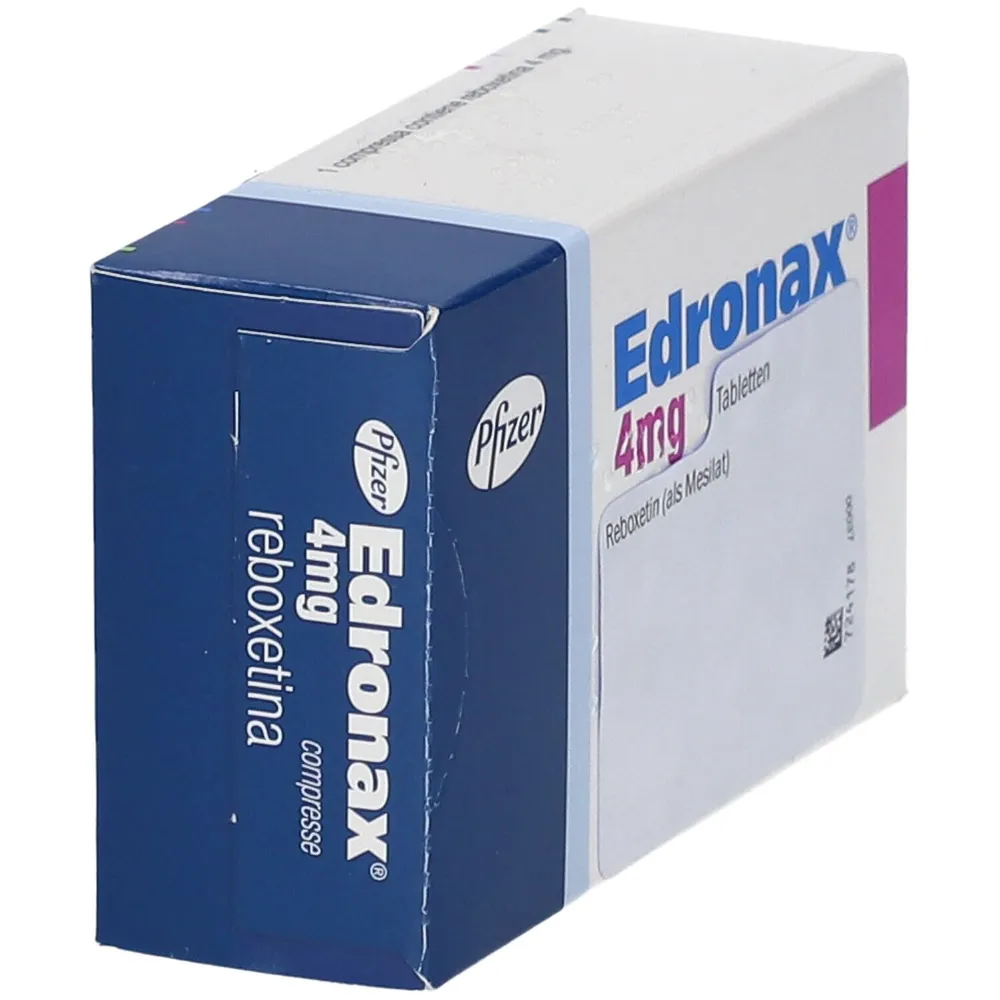
Table of Contents
PACKAGE LEAFLET: INFORMATION FOR THE USER
EDRONAX 4 mg tablets
reboxetine
Please read this leaflet carefully before taking this medicine because it contains
important information for you.
- Keep this leaflet. You may need to read it again.
- If you have any questions, ask your doctor or pharmacist.
- This medicine has been prescribed for you only. Do not give it to other people, even if they have the same symptoms as you, because it could be harmful.
- If you experience any side effects, including those not listed in this leaflet, tell your doctor or pharmacist. See section 4.
Contents of this leaflet:
- What Edronax is and what it is used for
- What you need to know before taking Edronax
- How to take Edronax
- Possible side effects
- How to store Edronax
- Contents of the pack and other information
1. What Edronax is and what it is used for
The active substance of Edronax is reboxetine, which belongs to the group of medicines known as antidepressants. Edronax is used for the acute treatment of depressive illness/major depression and to maintain improvement of its symptoms once an initial response to treatment with reboxetine has been achieved.
2. What you need to know before taking Edronax
Do not take Edronax
If you are allergic to reboxetine or to any of the other ingredients of this medicine
(listed in section 6).
Warnings and precautions
Talk to your doctor or pharmacist before taking Edronax if:
- you suffer from seizures or epilepsy. Treatment with reboxetine must be discontinued if epileptic seizures occur.
- you have any symptoms of urinary problems, enlarged prostate, or if you have had previous heart problems.
- you are taking medicines to lower blood pressure.
- you have liver or kidney problems. Your doctor may need to adjust the dose.
- you are taking a medicine called a "monoamine oxidase inhibitor" (MAOI) used for depression, or if you have taken an MAOI within the last 2 weeks. Your doctor may need to stop the MAOI at least 2 weeks before starting treatment with Edronax.
- you have experienced episodes of mania (hyperactive behaviour or thoughts).
- you have eye problems, such as certain types of glaucoma (increased eye pressure).
Serotonin syndrome:
Serotonin syndrome is a potentially life-threatening condition that may occur when taking Edronax, either alone or in combination with other medicines (see section 2 "Other medicines and Edronax"). Signs and symptoms of serotonin syndrome may include a combination of the following: confusion, restlessness, hallucinations, coma, rapid heartbeat, increased body temperature, rapid changes in blood pressure, sweating, hot flushes, tremor, hyperactive reflexes, nausea, vomiting, and diarrhoea.
Contact a doctor or go immediately to the nearest emergency room if you think you may have serotonin syndrome.
Suicidal thoughts and worsening of depression:
If you are depressed, you may sometimes have thoughts about harming yourself or committing suicide. This may be more likely at the beginning of antidepressant treatment, as all these medicines take time to work, usually about two weeks but sometimes longer.
You may be more likely to have these thoughts if:
- you have previously had thoughts of suicide or self-harm.
- you are young. Clinical trial data have shown an increased risk of suicidal behaviour in adults under 25 years of age with psychiatric disorders who are being treated with an antidepressant. If at any time you have thoughts about harming or killing yourself, contact your doctor immediately or go to hospital.
It may help to confide in a relative or friend that you are depressed and ask them to read this leaflet. You may ask them to watch for signs that your depression worsens or for any changes in your behaviour that concern them.
Children and adolescents
Edronax is normally not to be used in children and adolescents under 18 years of age. When this class of medicines is used, patients under 18 years of age have a higher risk of experiencing adverse effects such as suicide attempts, suicidal thoughts, and hostility (mainly aggression, oppositional behaviour, and anger). However, your doctor may decide to prescribe Edronax to patients under 18 years of age if strictly necessary for the patient's benefit. If your doctor has prescribed Edronax to a patient under 18 years of age and you would like more information, please contact your doctor.
Furthermore, if any of the symptoms listed above develop or worsen during treatment with Edronax in a patient under 18 years of age, you must inform the doctor.
The long-term effects of Edronax on growth, maturation, and cognitive and behavioural development have not yet been established in this patient group.
Other medicines and Edronax
Tell your doctor or pharmacist if you are taking, have recently taken, or might take any other medicines.
Edronax may affect or be affected by other medicines. These include:
- Certain antifungals, e.g. ketoconazole.
- Certain antibiotics, e.g. erythromycin, rifampicin.
- Medicines called ergotamine derivatives used to treat migraine or Parkinson's disease.
- Any potassium-depleting diuretic (medicines to remove fluid), e.g. thiazides.
- Medicines used to treat epilepsy, e.g. phenobarbital, carbamazepine, and phenytoin.
- Herbal medicines containing St John's wort ( Hypericum perforatum ).
- Medicines that, when taken with Edronax, may increase the risk of developing serotonin syndrome (see section 2 "Warnings and precautions"):
o Certain antidepressants called monoamine oxidase inhibitors (MAOIs), tricyclic and tetracyclic antidepressants, nefazodone, SSRIs (such as fluvoxamine), other serotonin-norepinephrine reuptake inhibitors (SNRIs), or lithium
o Medicines called triptans used to treat migraine
o Other MAO inhibitors such as linezolid (an antibiotic) and methylene blue (used to treat high levels of methaemoglobin in the blood)
o Medicines containing opioids (such as buprenorphine) used to treat severe pain and/or opioid dependence
o Medicines used to treat anxiety such as buspirone
o Products containing tryptophan (used for problems such as sleep or depression)
Your doctor will tell you whether you can take Edronax with other medicines. Inform your doctor or pharmacist if you are taking or have recently taken any other medicines, including those without a prescription, herbal medicines, as well as vitamins and minerals.
Edronax with food and drink
Edronax can be taken with or without food.
Pregnancy and breastfeeding
If you are pregnant, think you may be pregnant, are planning to become pregnant, or are breastfeeding, consult your doctor or pharmacist before taking this medicine.
Pregnancy
There is insufficient information on the use of Edronax during pregnancy. Do not take Edronax if you are pregnant unless your doctor, after careful clinical risk/benefit assessment, considers it strictly necessary. Inform your doctor immediately if you become pregnant or are planning a pregnancy.
Breastfeeding
Edronax passes into breast milk in small amounts. There is a risk of potential effects on the infant. Therefore, you must discuss this with your doctor, who will decide whether you should discontinue breastfeeding or stop treatment with Edronax.
Driving and using machines
Caution is advised when driving or operating machinery.
Do not drive or operate machinery until you know whether this medicine affects your ability to perform these activities (e.g. if you feel drowsy) and until you can do so safely.
3. How to take Edronax
Take this medicine exactly as instructed by your doctor or pharmacist.
If you have any doubts, consult your doctor or pharmacist.
The recommended dose in adults is 8 mg per day (one 4 mg tablet taken twice daily). Depending on your response to the medicine, after 3–4 weeks your doctor may increase your dose, if necessary, up to a maximum of 10 mg per day. The maximum daily dose must not exceed 12 mg.
- The initial dose in patients with reduced renal or hepatic function is 4 mg per day. This may be increased depending on individual response.
- The use of Edronax 4 mg is not recommended in elderly patients.
- Edronax must not be used in children and adolescents under 18 years of age.
The tablets should be taken in two separate doses, one in the morning and one in the evening.
Swallow the tablet with a glass of water. The tablets may be divided into equal doses. Do not chew the tablet.
To help you remember to take Edronax, it may be easier to take the tablets at the same time each day.
Like other medicines, Edronax will not relieve your symptoms immediately. You should begin to feel better within a few weeks.
It is important to continue taking the tablets even when you feel better, until your doctor advises you to stop treatment. Be patient, because if you stop treatment too early, your symptoms may return.
If you take more Edronax than you should
Never take more tablets than prescribed by your doctor. If you take too many tablets, contact your doctor or the nearest hospital immediately. If you take more Edronax tablets than prescribed, overdose symptoms may occur, including low blood pressure, anxiety, and hypertension.
If you forget to take Edronax
If you forget to take Edronax, take the next dose at the scheduled time. Do not take a double dose to make up for a missed dose.
If you stop taking Edronax
Do not stop taking this medicine without informing your doctor, as your symptoms may return.
There have been some cases of withdrawal symptoms, including headache, dizziness, nervousness, and nausea, in patients who have stopped treatment with Edronax.
If you have any questions about the use of this medicine, consult your doctor or pharmacist.
4. Possible side effects
Like all medicines, this medicine can cause side effects, although not everyone gets them. With Edronax, many of the side effects diminish or disappear after the first few weeks of treatment.
If any of the side effects worsen, or if you notice any side effects not listed in this leaflet, please inform your doctor or pharmacist.
Very common: may affect more than 1 in 10 people
- Difficulty sleeping (insomnia)
- Dizziness
- Dry mouth
- Constipation
- Nausea (feeling of disgust)
- Sweating
Common: may affect up to 1 in 10 people
- Headache
- Loss of appetite
- Agitation, anxiety
- Paresthesia (tingling), inability to sit or stand still, altered taste sensation
- Blurred vision
- Increased heart rate, palpitations (awareness of heartbeat)
- Swelling of veins, sudden drop in blood pressure when standing up, increased blood pressure
- Vomiting
- Rash
- Sensation of incomplete or slow bladder emptying, urinary tract infections, painful urination, inability to completely empty the bladder
- Erectile dysfunction (impotence), painful ejaculation or delayed ejaculation
- Chills
Uncommon: may affect up to 1 in 100 people
- Dilated pupils
- Confusional state
Rare: may affect up to 1 in 1,000 people
- Glaucoma (a condition causing increased eye pressure)
Not known: (frequency cannot be estimated from the available data):
- Serotonin syndrome (see section 2 “Warnings and precautions”)
- Hyponatremia (very low levels of sodium in the blood)
- Aggressive behaviour, hallucinations
- Suicidal ideation, suicidal behaviour
- Cases of suicidal ideation and suicidal behaviour have been reported during treatment with reboxetine or shortly after discontinuation of treatment (see section 2 “Warnings and precautions”)
- Cold sensation in extremities, Raynaud's phenomenon (poor circulation, usually in fingers and toes, but also in nose and ears; skin becomes white, cold and numb)
- Allergic skin inflammation
- Testicular pain
- Irritability
- Increased intraocular pressure
Reporting of side effects
If you experience any side effect, please inform your doctor or pharmacist. This includes any possible side effect not listed in this leaflet. You can also report side effects via:
http://www.aifa.gov.it/content/segnalazioni-reazioni-avverse
By reporting side effects, you can help provide more information on the safety of this medicine.
5. How to store Edronax
Keep this medicine out of the sight and reach of children.
Do not use this medicine after the expiry date stated on the carton. The expiry date refers to the last day of that month.
Do not store Edronax at temperatures above 25°C.
Do not dispose of any medicine via wastewater or household waste. Ask your pharmacist how to dispose of medicines you no longer use. This will help protect the environment.
6. Package contents and other information
What Edronax contains
The active substance is reboxetine.
- Each tablet contains 4 mg of reboxetine. The excipients are:
- microcrystalline cellulose, dibasic calcium phosphate dihydrate, crospovidone, colloidal hydrated silica and magnesium stearate.
Description of the appearance of Edronax and package contents:
Edronax tablets are white, round, biconvex, with a score line.
To the left of the score line there is a "P" and to the right an "U". The opposite side of the tablet
is marked "7671". The tablets can be divided into two equal doses.
Edronax is available in packs of 10, 20, 50, 60, 100, 120 and 180 tablets in blisters, and in
multiple packs containing 180 (3x60), 300 (5x60) and 600 (10x60) tablets in blisters.
Not all pack sizes may be marketed.
Marketing Authorisation Holder and Manufacturer
Marketing Authorisation Holder:
PFIZER ITALIA S.r.l – Via Isonzo, 71 – 04100 Latina
Manufacturer:
Pfizer Italia S.r.l, Località Marino del Tronto - 63100 Ascoli Piceno
This medicinal product is authorised in the European Economic Area Member States and in the United Kingdom (Northern Ireland) under the following names:
Austria, Belgium, Denmark, Ireland, Italy, Luxembourg, Portugal, Sweden and United Kingdom (Northern Ireland): Edronax
Spain: Norebox
This leaflet was last updated on