Ebrantil
Italy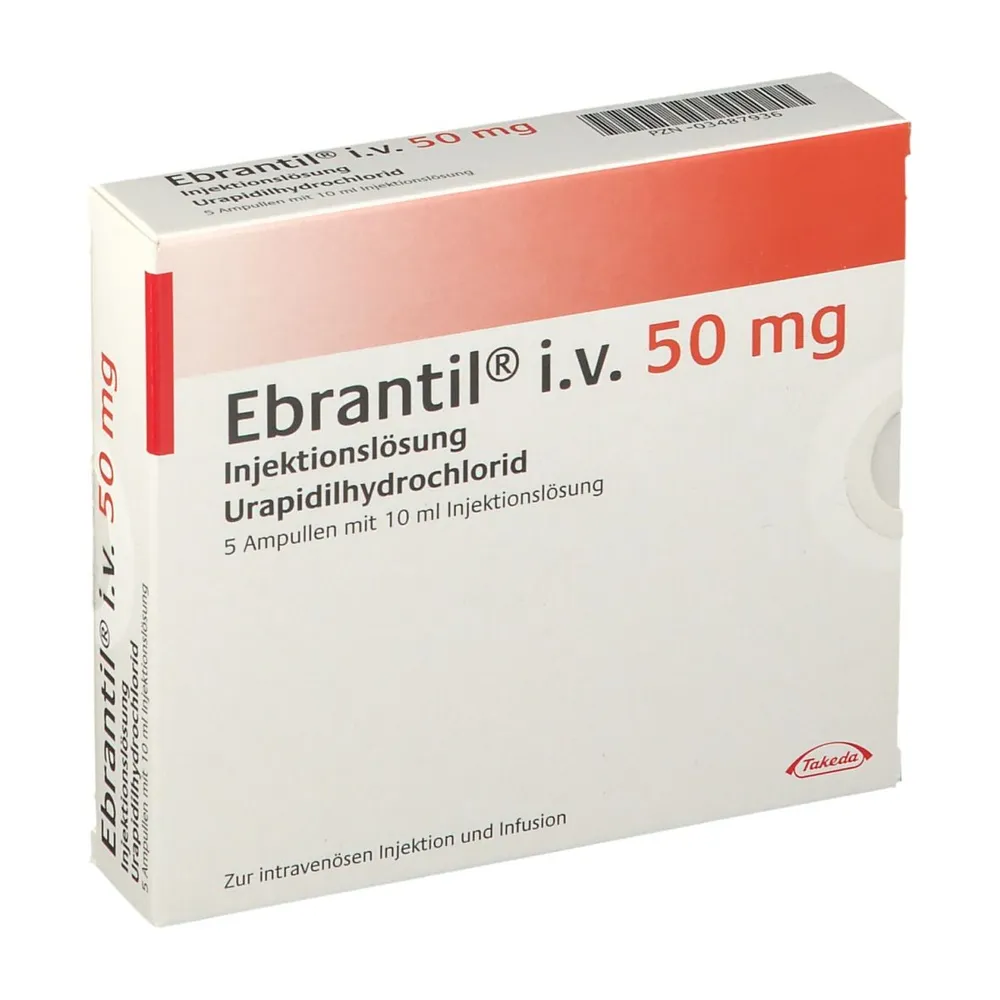
Table of Contents
- Package leaflet: Information for the patient
- EBRANTIL 50 mg/10 ml injectable solution for intravenous use and infusion
- 1. What EBRANTIL is and what it is used for
- 2. What you should know before being given EBRANTIL
- 3. How EBRANTIL will be administered to you
- 4. Possible side effects
- 5. How to store EBRANTIL
- 6. Package contents and other information
Package leaflet: Information for the patient
EBRANTIL 50 mg/10 ml injectable solution for intravenous use and infusion
Urapidil
Please read this leaflet carefully before this medicine is administered to you
because it contains important information for you.
- Keep this leaflet. You may need to read it again.
- If you have any questions, ask your doctor or nurse.
- If you get any side effects, talk to your doctor or nurse. This includes any side effects not listed in this leaflet. See section 4.
Contents of this leaflet:
- What EBRANTIL is and what it is used for
- What you need to know before EBRANTIL is administered to you
- How EBRANTIL will be administered to you
- Possible side effects
- How to store EBRANTIL
- Contents of the pack and other information
1. What EBRANTIL is and what it is used for
EBRANTIL is a medicine used to lower blood pressure and contains urapidil as its active substance. It is used in adults to treat hypertensive emergencies and urgent hypertensive conditions.
2. What you should know before being given EBRANTIL
You will not be given EBRANTIL
- if you are allergic to urapidil or to any of the other ingredients of this medicine (listed in section 6);
- if you are pregnant or breastfeeding (see section 2 “Pregnancy, breastfeeding and fertility”);
- if you have narrowing of the aorta, the largest artery in the body (isthmic aortic stenosis), or have an abnormal connection between an artery and a vein (arteriovenous shunt).
Warnings and precautions
Talk to your doctor or nurse before you are given EBRANTIL.
Inform your doctor if you have any of the following conditions:
- if you have previously been given another medicine to lower blood pressure and sufficient time has not passed for its effect to occur;
- if you have reduced heart function due to mechanical functional damage (e.g. aortic or mitral valve stenosis), if you have a blockage in the pulmonary artery, the vessel carrying blood from the heart to the lungs (pulmonary embolism), or a disease of the sac surrounding the heart (pericardium);
- if you have liver disease;
- if you have moderate to severe kidney disease;
- if you are elderly;
- if you are taking cimetidine, a medicine used to treat stomach ulcers (see section 2 “Other medicines and EBRANTIL”);
- if you have suffered a head injury (cranial trauma).
Children and adolescents
EBRANTIL should be administered with caution in children and adolescents.
Other medicines and EBRANTIL
Tell your doctor if you are taking, have recently taken, or might take any other
medicines, especially:
- medicines to lower high blood pressure (alpha-adrenergic receptor blockers, vasodilators, other antihypertensive medicines administered concurrently, ACE inhibitors);
- cimetidine, a medicine used to treat ulcers.
EBRANTIL and alcohol
Concurrent use with alcohol may enhance the antihypertensive effect of EBRANTIL.
Pregnancy, breastfeeding and fertility
If you are pregnant, think you might be pregnant, are planning a pregnancy, or are breastfeeding,
consult your doctor before being given this medicine.
EBRANTIL must not be administered during pregnancy or to women of childbearing potential who are not using contraceptive methods, as there is insufficient human experience.
EBRANTIL must not be administered during breastfeeding.
It is unknown whether EBRANTIL affects male or female fertility.
Driving and using machines
EBRANTIL may affect your ability to drive and operate machinery. This is particularly
relevant at the beginning of treatment, when switching products, or when taken in combination with alcohol (see section 2 “EBRANTIL and alcohol”).
EBRANTIL contains sodium and propylene glycol
This medicine contains less than 1 mmol (23 mg) of sodium per vial, i.e. it is essentially “sodium-free”.
This medicine contains 1,000 mg of propylene glycol per 10 ml vial, equivalent to 100 mg/ml.
If you are pregnant or breastfeeding, do not take this medicine unless otherwise
recommended by your doctor.
If you have liver or kidney disease, do not take this medicine unless otherwise
recommended by your doctor.
Propylene glycol in this medicine may produce effects similar to those of alcohol consumption and may increase the likelihood of side effects.
Do not use this medicine in children under 5 years of age.
Use this medicine only if recommended by your doctor. Your doctor may carry out additional monitoring during treatment.
3. How EBRANTIL will be administered to you
This medicine will be given to you intravenously (into a vein) under close medical supervision.
If you have any doubts, consult your doctor.
The dose for controlled reduction of blood pressure during and after surgical procedures will be determined by your doctor.
Treatment will last a maximum of 7 days. After this period, your doctor may prescribe oral medicines to lower your blood pressure.
Elderly patients
If you are elderly, your doctor will administer lower doses, at least at the beginning of treatment.
Patients with kidney and/or liver disease
If you have kidney and/or liver disease, your doctor may administer lower doses.
Use in children and adolescents
EBRANTIL is generally not given to children and adolescents. If administration is necessary, the dose for controlled reduction of blood pressure during and after surgical procedures will be determined by the doctor.
If you are given more EBRANTIL than you should
In case of accidental overdose of EBRANTIL, your doctor will initiate the most appropriate therapy.
If you are given high doses of EBRANTIL, you may experience:
- dizziness,
- low blood pressure upon standing,
- fainting,
- fatigue and reduced reaction speed.
If you stop treatment with EBRANTIL
If you have any doubts about using this medicine, consult your doctor or nurse.
4. Possible side effects
Like all medicines, this medicine can cause side effects, although not everybody gets them.
Many of the following side effects are due to a sudden drop in blood pressure, but in practice they usually disappear within a few minutes, even during rapid infusion. However, depending on the severity of the side effects, treatment discontinuation should be considered.
Common (may affect up to 1 in 10 people)
- nausea,
- dizziness,
- headache.
Uncommon (may affect up to 1 in 100 people)
- awareness of heart beat (palpitations),
- fast heartbeat (tachycardia),
- slow heartbeat (bradycardia),
- tightness or pain in the chest (symptoms similar to angina pectoris) and shortness of breath (dyspnoea),
- vomiting,
- tiredness, weakness (asthenia),
- irregular heartbeat,
- increased sweating,
- drop in blood pressure upon changing position, e.g. when standing up (orthostatic dysregulation).
Rare (may affect up to 1 in 1,000 people)
- prolonged and painful erection (priapism),
- stuffy nose (nasal congestion),
- allergic reactions such as itching, skin redness, skin rash with pustules, blisters and wheals (rash).
Very rare (may affect up to 1 in 10,000 people)
- decrease in the number of platelets in the blood,
- agitation,
- sleep disorders,
- increased need to urinate or worsening of inability to hold urine (urinary incontinence), nocturnal enuresis (loss of urine during sleep).
Frequency not known (cannot be estimated from the available data)
- swelling of the face, mouth, tongue, throat, or other mucous membranes (angioedema),
- itchy skin rash (urticaria).
Reporting of side effects
If you experience any side effect, including those not listed in this leaflet, talk to your doctor or nurse. You can also report side effects directly via the national reporting system at https://www.aifa.gov.it/content/segnalazioni-reazioni-avverse.
By reporting side effects, you can help provide more information on the safety of this medicine.
5. How to store EBRANTIL
Keep this medicine out of the sight and reach of children.
Do not use this medicine after the expiry date stated on the label after "Exp".
The expiry date refers to the last day of that month.
Do not store above 30°C.
Keep the vials in the outer packaging to protect the medicine from light.
Solutions for continuous intravenous infusion must be prepared immediately before use. Any unused
portion should not be reused.
Do not dispose of medicines via wastewater or household waste. Ask your pharmacist how to dispose of
medicines no longer in use. This will help protect the environment.
6. Package contents and other information
What EBRANTIL contains
- The active substance is urapidil. Each vial contains 50 mg of urapidil.
- The other components are propylene glycol, monosodium phosphate dihydrate, monosodium phosphate monohydrate, water for injections (see section 2 “EBRANTIL contains sodium and propylene glycol”).
Description of the appearance of EBRANTIL and package contents
EBRANTIL is a solution for injection for intravenous use and infusion.
It is available in packs of 5 vials of 10 ml each.
Marketing Authorisation Holder and Manufacturer
Marketing Authorisation Holder
CHEPLAPHARM Arzneimittel GmbH, Ziegelhof 24, 17489 Greifswald, Germany
Manufacturer
Takeda Austria GmbH St. Peter Strasse 25 - A-4020 Linz, Austria
The following information is intended exclusively for physicians or healthcare professionals:
Warnings and precautions
If another antihypertensive drug has already been administered previously, EBRANTIL must not be used until sufficient time has elapsed to allow the effect of the previously administered drug(s) to take place. The dosage of EBRANTIL should therefore be appropriately reduced.
An excessively rapid reduction in blood pressure may cause bradycardia or cardiac arrest.
For intravenous bolus injection, 10–50 mg of EBRANTIL may be administered. The hypotensive effect usually occurs within 5–10 minutes. EBRANTIL injection may be repeated according to blood pressure response, following the dosing regimen described in section “Dosage and method of administration”.
Preparation of diluted solution
For continuous intravenous infusion, 200–250 mg of EBRANTIL (4–5 vials of EBRANTIL 50 mg/10 ml solution for injection) should be diluted in 500 ml of a compatible infusion solution: physiological saline, 5% or 10% glucose solution, 5% fructose solution, dextran 40 with 0.9% sodium chloride. The maximum compatible concentration of EBRANTIL is 4 mg per ml.
The initial infusion rate must not exceed 2 mg/min. The maintenance dose (on average 9 mg/h) and duration of infusion (not more than 7 days) should be appropriately adjusted according to the blood pressure response.
The extent of blood pressure reduction is determined by the dose infused during the first 15 minutes. Subsequently, stabilization of blood pressure may be achieved with considerably lower doses.
The infusion solution used to maintain the blood pressure level achieved with bolus injection is prepared as follows: generally, 100–200 mg of EBRANTIL (2–4 vials of EBRANTIL 50 mg/10 ml solution for injection) are diluted in 500 ml of a compatible infusion solution, for example physiological saline, 5% or 10% glucose solution, 5% fructose solution, dextran 40 with 0.9% sodium chloride.
The maximum compatible concentration is 4 mg of EBRANTIL per ml of infusion solution.
When using a syringe pump to administer the maintenance dose, 20 ml of EBRANTIL (corresponding to 100 mg of active substance) are placed in a syringe and diluted to a final volume of 50 ml with a compatible infusion solution (see above).
EBRANTIL injection solution must not be mixed with other injectable products or alkaline infusion solutions, as cloudiness or flocculation may occur due to the acidic properties of the solution itself.
Dosage and method of administration
The recommended dose for controlled reduction of blood pressure in hypertensive patients during and after surgical procedures is:
A) Bolus administration
B) Stabilization of blood pressure by continuous infusion
Intravenous injection of 25 mg EBRANTIL
= 5 ml of injection solution
After 2 minutes
If no change in blood pressure
After 2 minutes
Intravenous injection of 25 mg EBRANTIL
= 5 ml of injection solution
After 2 minutes
If no change in blood pressure
After 2 minutes
Slow intravenous injection of 50 mg EBRANTIL
= 10 ml of injection solution
After 2 minutes
Initially up to 6 mg in 1–2 minutes, then reduce dose according to blood pressure response
Duration of treatment: not longer than 7 days.
EBRANTIL injection solution may be administered intravenously either as a bolus injection or by continuous infusion, with the patient lying down.
Unless otherwise prescribed by a physician, both single or repeated bolus administrations and continuous intravenous infusion are possible for the indications listed. Transition from acute parenteral therapy to maintenance therapy with oral antihypertensives is possible.
Elderly patients
Antihypertensive drugs should be used with caution in elderly patients and initially at lower doses, as sensitivity to drugs of this type is often altered in this population.
Patients with renal and/or hepatic impairment
Dosage reduction may be necessary in patients with impaired renal and/or hepatic function.
Overdose
Treatment
Excessive drop in blood pressure may be alleviated by elevating the patient’s legs while maintaining the supine position, or by restoring blood volume. If these measures are inadequate, a vasoconstrictor agent should be administered slowly by intravenous infusion, with continuous monitoring of blood pressure.
In very rare cases, intravenous injection of catecholamines (e.g. adrenaline 0.5–1.0 mg diluted to 10 ml with isotonic saline solution) may be required.