Dymista
Italy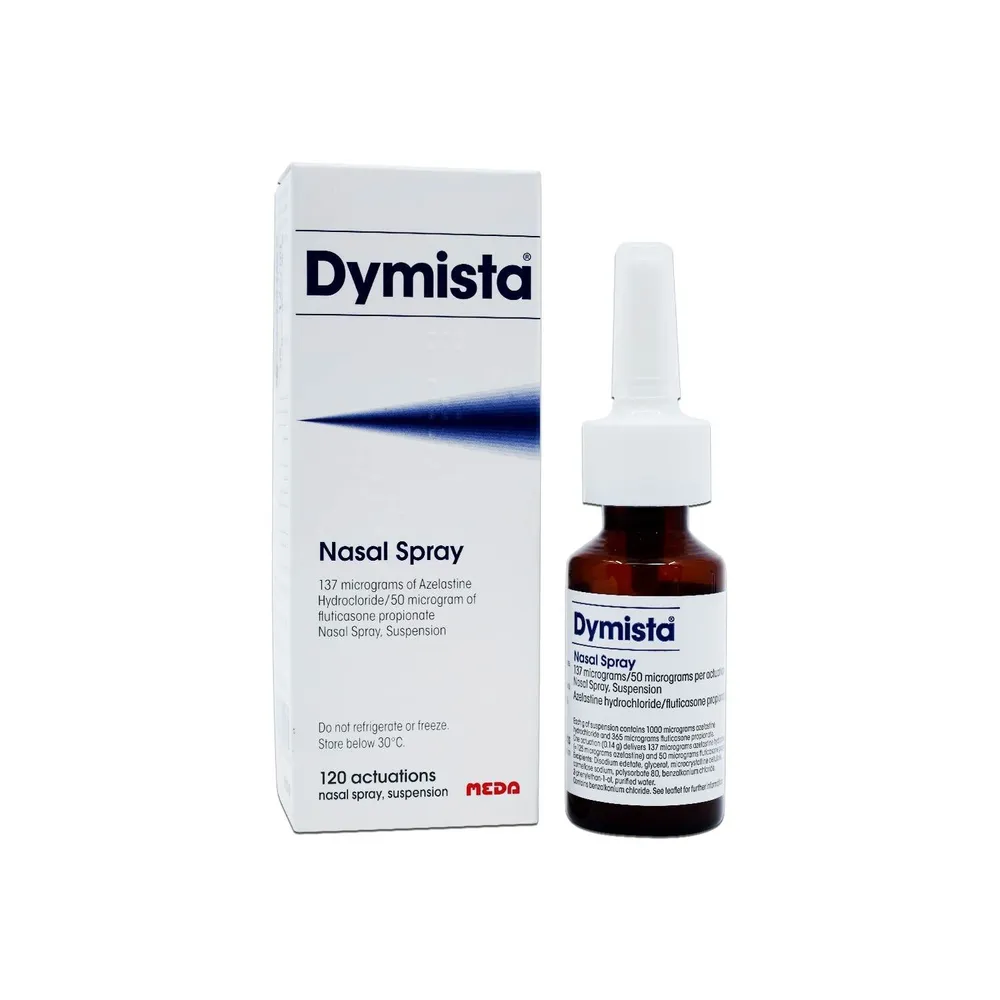
Table of Contents
Package leaflet: Information for the patient
Dymista
137 micrograms/50 micrograms per spray
Nasal spray, suspension
Azelastine hydrochloride / fluticasone propionate
Please read this leaflet carefully before using this medicine because it contains important information for you.
- Keep this leaflet. You may need to read it again.
- If you have any questions, ask your doctor or pharmacist.
- This medicine has been prescribed for you only. Do not give it to other people, even if their symptoms are the same as yours, as it may be harmful.
- If you experience any side effects, including those not listed in this leaflet, contact your doctor or pharmacist. See section 4.
Contents of this leaflet:
- What Dymista is and what it is used for
- What you need to know before using Dymista
- How to use Dymista
- Possible side effects
- How to store Dymista
- Contents of the pack and other information
1. What Dymista is and what it is used for
Dymista contains two active substances: azelastine hydrochloride and fluticasone propionate.
- Azelastine hydrochloride belongs to the pharmacotherapeutic class of antihistamines. Antihistamines work by blocking the effects of substances such as histamine, which the body produces during an allergic reaction, thereby reducing the symptoms of allergic rhinitis.
- Fluticasone propionato belongs to the pharmacotherapeutic class of corticosteroids, which reduce inflammation.
Dymista is used to relieve symptoms of moderate to severe seasonal and perennial allergic rhinitis
when treatment with either an antihistamine or an intranasal corticosteroid alone is considered
insufficient.
Seasonal and perennial allergic rhinitis are allergic reactions to substances such as pollen (hay fever), dust mites, moulds, dust, or pets.
Dymista relieves allergy symptoms such as excessive nasal mucus production, nasal discharge, sneezing, nasal itching, or nasal congestion.
2. What you need to know before using Dymista
Do not use Dymista:
- if you are allergic to azelastine hydrochloride or fluticasone propionate or to any of the other ingredients of this medicine (listed in section 6).
Warnings and precautions
Talk to your doctor or pharmacist before using Dymista:
- if you recently had nasal surgery
- if you have had a nasal infection. Nasal airway infections should be treated with an antibacterial or antifungal medicine. If you have been prescribed a medicine for a nasal infection, you may continue using Dymista for the treatment of your allergies
- if you have tuberculosis or an untreated infection
- if you have experienced vision problems or have a history of increased intraocular pressure, glaucoma, and/or cataracts. If any of these conditions apply to you, you will be closely monitored during treatment with Dymista
- if you have impaired adrenal function. Extreme caution is required when switching from systemic corticosteroid therapy to Dymista
- if you have severe liver disease. Your risk of experiencing systemic side effects is higher.
In these cases, your doctor will decide whether or not you can use Dymista.
It is important that you take your dose as indicated in section 3 below or as advised by your doctor. Treatment with inhaled corticosteroid doses higher than recommended may cause adrenal suppression, a condition that can lead to weight loss, fatigue, muscle weakness, low blood sugar levels, craving for salty foods, joint pain, depression, and darkening of the skin. If these symptoms occur, your doctor may recommend an alternative medicine during periods of stress or elective surgery.
To avoid adrenal suppression, your doctor will advise you to take the lowest dose that effectively controls your rhinitis symptoms.
Long-term use of inhaled corticosteroids (such as Dymista) may cause slowed growth in children and adolescents. Your doctor will regularly monitor your child's height and ensure they are taking the lowest effective dose.
Contact your doctor if you experience blurred vision or other visual disturbances.
If you are unsure whether any of the conditions listed above apply to you, discuss them with your doctor or pharmacist before using Dymista.
Children
The use of this medicine is not recommended in children under 12 years of age.
Other medicines and Dymista
Tell your doctor or pharmacist if you are taking, have recently taken, or might take any other medicines, including those obtained without a prescription.
- Some medicines may increase the effects of Dymista, and your doctor may wish to monitor you closely if you are taking these (including certain HIV treatments: ritonavir, cobicistat, and antifungal medicines: ketoconazole).
Pregnancy and breastfeeding
If you are pregnant, think you may be pregnant, planning to become pregnant, or are breastfeeding, consult your doctor or pharmacist before taking Dymista.
Driving and using machines
Dymista has negligible influence on the ability to drive or operate machinery.
Very rarely, fatigue or dizziness may occur, either due to the illness itself or due to the use of Dymista. In such cases, avoid driving or operating machinery. You should be aware that alcohol consumption may worsen these effects.
Dymista contains benzalkonium chloride
This medicine contains 14 micrograms of benzalkonium chloride per spray, equivalent to 0.014 mg/0.14 g. Benzalkonium chloride may cause irritation and swelling inside the nose, especially if used for prolonged periods. Consult your doctor or pharmacist if you experience discomfort while using the spray.
3. How to use Dymista
Use Dymista exactly as directed by your doctor. If you have any doubts, consult your doctor or pharmacist.
It is essential to use Dymista regularly to achieve the full therapeutic benefit.
Avoid contact with the eyes.
Adults and adolescents (from 12 years of age)
- The recommended dose is one spray into each nostril in the morning and evening.
Use in children under 12 years of age
- This medicine is not recommended for use in children under 12 years of age.
Use in patients with renal or hepatic impairment
- There are no data available in patients with renal or hepatic impairment.
Method of administration
For nasal inhalation use.
Read the information provided in this leaflet and follow the instructions carefully.
INSTRUCTIONS FOR USE
Preparing the spray
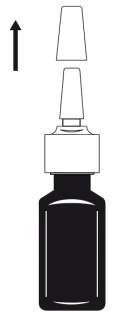
- Gently shake the bottle for 5 seconds, tilting it up and down, then remove the protective cap (see Figure 1).
Figure 1
- The first time you use the nasal spray, you must prime the pump by spraying the product into the air.
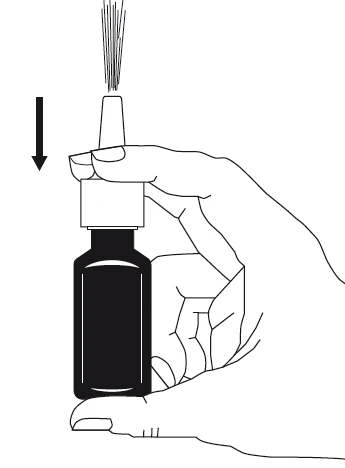
- To prime the pump, place two fingers on either side of the spray pump and place your thumb on the base of the bottle.
- Press down and release the pump 6 times until a fine mist appears (see Figure 2).
- The pump is now primed and ready for use.
Figure 2
- If the nasal spray has not been used for more than 7 days, you must re-prime the pump by pressing and releasing it once.
Using the spray
- Gently shake the bottle for about 5 seconds, tilting it up and down, then remove the protective cap (see Figure 1).
- Blow your nose to clear your nostrils.
- Keep your head tilted slightly forward (towards your feet). Do not tilt your head backward.
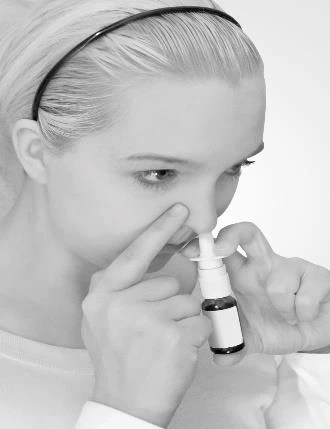
- Hold the bottle upright and gently insert the spray tip into one nostril.
- Close the other nostril with a finger, press down quickly once, and at the same time inhale gently (see Figure 3).
- Breathe out through your mouth.
Figure 3
- Repeat the same procedure for the other nostril.
- Breathe in gently without tilting your head back after administration. This will help prevent the medicine from running down your throat and causing an unpleasant taste (see Figure 4).
Figure 4
- After each use, wipe the spray tip with a tissue or clean cloth and replace the protective cap.
- Do not pierce the nozzle if the spray does not work. Clean the spray tip with water.
It is important that you take your dose as directed by your doctor. Use only the amount recommended by your doctor.
Duration of treatment
Dymista is intended for long-term use. The duration of treatment should correspond to the period during which allergy symptoms occur.
If you use more Dymista than you should
If you spray an excessive dose of this medicine into your nose, it is unlikely to cause problems. However, if you are concerned or have used higher than recommended doses for a prolonged period, contact your doctor. In case of accidental ingestion of Dymista, especially by a child, contact your doctor or the nearest hospital emergency department immediately.
If you forget to use Dymista
Use the nasal spray as soon as you remember, then take your next dose at the usual time. Do not use a double dose to make up for a forgotten dose.
If you stop using Dymista
Do not stop using Dymista without first consulting your doctor, as this may reduce the effectiveness of treatment.
If you have any questions about the use of this medicine, consult your doctor or pharmacist.
4. Possible side effects
Like all medicines, Dymista can cause side effects, although not everyone experiences them.
Very common side effects (may affect more than 1 in 10 patients):
- nosebleeds
Common side effects (may affect up to 1 in 10 patients):
- headache
- bitter taste in the mouth, especially if you tilt your head backwards when using the nasal spray. This should disappear quickly if you sip a non-alcoholic drink for a few minutes after using this medicine
- unpleasant odour
Uncommon side effects (may affect up to 1 in 100 patients):
- mild irritation inside the nose. This may cause mild burning, itching or sneezing
- dry nose, cough, dry throat or throat irritation
Rare side effects (may affect up to 1 in 1,000 patients):
- dry mouth
Very rare side effects (may affect up to 1 in 10,000 patients):
- dizziness or drowsiness
- cataract, glaucoma or increased eye pressure, leading to loss of vision and/or red, painful eyes. These side effects have been reported after prolonged treatment with fluticasone propionate nasal sprays.
- damage to the skin and mucous membrane of the nose
- nausea, malaise, fatigue or weakness
- skin rash, itching or redness of the skin, raised itchy rashes (hives)
- bronchospasm (narrowing of the airways in the lungs)
Side effects with unknown frequency (frequency cannot be estimated from the available data):
- blurred vision
- nasal ulcers
Seek immediate medical attention if you experience any of the following symptoms:
- swelling of the face, lips, tongue or throat, which may cause difficulty in swallowing or breathing, and sudden onset of skin rash. These could be signs of a severe allergic reaction. Note: This occurrence is very rare.
Systemic side effects (side effects affecting the whole body) may occur when this medicine is used at high doses over a long period. These effects may vary between individual patients and between different corticosteroid preparations (see section 2).
It is much less likely that such effects will occur with a corticosteroid nasal spray than with oral corticosteroids.
Nasal corticosteroids may affect the body's normal hormone production, particularly if high doses are used over a long period. In children and adolescents, this side effect may cause slowed growth.
In rare cases, reduced bone density (osteoporosis) has been observed following long-term use of inhaled corticosteroids.
Reporting of side effects
If you experience any side effect, including those not listed in this leaflet, please inform your doctor or pharmacist. You can also report side effects directly via the national reporting system at the following website:
http://www.agenziafarmaco.gov.it/content/segnalazioni-reazioni-avverse
By reporting side effects, you can help provide more information on the safety of this medicine.
5. How to store Dymista
Keep this medicine out of the sight and reach of children.
Do not use this medicine after the expiry date stated on the vial label and on the carton after "Exp.". The expiry date refers to the last day of that month.
Do not refrigerate or freeze.
Duration of use after first opening: Discard any unused medicine 6 months after first opening of the nasal spray.
Do not dispose of medicines via wastewater or household waste. Ask your pharmacist how to dispose of medicines you no longer use. This will help protect the environment.
6. Package contents and other information
What Dymista contains
The active substances are: azelastine hydrochloride and fluticasone propionate.
Each gram of suspension contains 1,000 micrograms of azelastine hydrochloride and 365
micrograms of fluticasone propionate.
Each spray (0.14 g) delivers 137 micrograms of azelastine hydrochloride (= 125
micrograms of azelastine) and 50 micrograms of fluticasone propionate.
The other components are: disodium edetate, glycerol, microcrystalline cellulose, sodium
carboxymethylcellulose, polysorbate 80, benzalkonium chloride solution, phenylethyl alcohol, and purified water.
Description of the appearance of Dymista and contents of the pack
Dymista is a white, homogeneous suspension.
Dymista is supplied in an amber glass bottle equipped with a spray pump, an applicator, and a protective cap.
The 10 ml bottle contains 6.4 g of nasal spray, suspension (at least 28 sprays). The 25 ml bottle contains 23 g of nasal spray, suspension (at least 120 sprays).
Dymista is available in:
packs containing 1 bottle with 6.4 g of nasal spray, suspension
packs containing 1 bottle with 23 g of nasal spray, suspension
multiple packs containing 10 bottles, each with 6.4 g of nasal spray, suspension
multiple packs containing 3 bottles, each with 23 g of nasal spray, suspension
Not all pack sizes may be marketed.
Marketing Authorisation Holder
Viatris Healthcare Limited,
Damastown Industrial Park,
Mulhuddart, Dublin 15,
DUBLIN, Ireland
Manufacturer
MEDA Pharma GmbH & Co. KG
Benzstraße 1,
D-61352 Bad Homburg,
Germany
Mylan Hungary Kft
H-2900 Komárom,
Mylan utca 1,
Hungary
Haupt Pharma Amareg GmbH
Donaustaufer Str. 378, 93055 Regensburg
Germany
This medicinal product is authorised in the European Economic Area Member States and in the United
Kingdom (Northern Ireland) under the following names:
| Austria | Dymista Nasal Spray | Latvia | Dymista 137 micrograms/50 micrograms per dose nasal aerosol, suspension |
| Bulgaria | Dymista | Liechtenstein | Dymista Nasal Spray |
| Cyprus | Dymista Nasal Spray | Lithuania | Dymista 137 micrograms/50 micrograms per dose nasal spray (suspension) |
| Czech Republic | Dymistin 137 micrograms / 50 micrograms, nasal spray, suspension | Luxembourg | Dymista Nasal Spray / Suspension for nasal spray / Nasenspray |
| spray, suspension | Nasenspray | ||
| Denmark | Dymista | Malta | Dymista Nasal Spray |
| Estonia | Dymista | Norway | Dymista nasal spray |
| Finland | Dymista nasal spray | Poland | Dymista |
| France | Dymistalin Suspension for nasal spray | Portugal | Dymista Nasal Spray |
| Germany | Dymista Nasal Spray 137 micrograms/50 micrograms per spray nasal spray, suspension | Romania | Dymista 137 micrograms / 50 micrograms / dose nasal spray suspension |
| Greece | Dymista Nasal Spray | Slovakia | Dymista nasal aerosol |
| Hungary | Dymista Suspension nasal spray | Slovenia | Dymista 137 micrograms / 50 micrograms per puff nasal spray, suspension |
| Iceland | Dymista Nasal Spray | Spain | Dymista nasal suspension spray |
| Ireland | Dymista Nasal Spray | Sweden | Dymista Nasal Spray, suspension (1 mg/g; 0.365 mg/g) |
| Italy | Dymista | United Kingdom (Northern Ireland) | Dymista Nasal Spray |