Duodopa
Italy
Table of Contents
- Package leaflet: Information for the patient
- Duodopa 240 mg/ml + 12 mg/ml infusion solution
- 1. What Duodopa 240 mg/ml + 12 mg/ml infusion solution is and what it is used for
- 2. What you should know before using Duodopa 240 mg/ml + 12 mg/ml solution for infusion
- 3. How to use Duodopa 240 mg/ml + 12 mg/ml solution for infusion
- 4. Possible side effects
- 5. How to store Duodopa 240 mg/ml + 12 mg/ml solution for infusion
- 6. Package contents and other information
- 7. Instructions for use of Duodopa 240 mg/ml + 12 mg/ml infusion solution with the
- 1. Organization
- 2. Preparation of the vial containing the solution
- 3. Preparation of the Duodopa 240 mg/ml + 12 mg/ml infusion solution
- 4. Selection and preparation of the infusion site
- 5. Starting the infusion of Duodopa 240 mg/ml + 12 mg/ml solution for infusion
- 6. After use
Package leaflet: Information for the patient
Duodopa 240 mg/ml + 12 mg/ml infusion solution
foslevodopa and foscarbidopa
Please read all of this leaflet carefully before using this medicine because it contains important information for you.
- Keep this leaflet. You may need to read it again.
- If you have any questions, ask your doctor, pharmacist, or nurse.
- This medicine has been prescribed for you only. Do not pass it on to other people, even if they have the same symptoms as yours, as it may be harmful to them.
- If you experience any side effects, including those not listed in this leaflet, tell your doctor, pharmacist, or nurse. See section 4.
Contents of this leaflet
- What Duodopa 240 mg/ml + 12 mg/ml infusion solution is and what it is used for
- What you need to know before using Duodopa 240 mg/ml + 12 mg/ml infusion solution
- How to use Duodopa 240 mg/ml + 12 mg/ml infusion solution
- Possible side effects
- How to store Duodopa 240 mg/ml + 12 mg/ml infusion solution
- Contents of the pack and other information
- Instructions for using Duodopa 240 mg/ml + 12 mg/ml infusion solution with the Vyafuser pump
1. What Duodopa 240 mg/ml + 12 mg/ml infusion solution is and what it is used for
Duodopa 240 mg/ml + 12 mg/ml infusion solution contains two active substances, foslevodopa and
foscarbidopa, and is used for the treatment of Parkinson's disease.
How Duodopa 240 mg/ml + 12 mg/ml infusion solution works
- In the body, foslevodopa is converted into a substance called "dopamine". This adds to the dopamine already present in the brain and spinal cord. Dopamine helps transmit signals between nerve cells.
- Too low levels of dopamine cause the symptoms of Parkinson's disease, such as tremor, feelings of stiffness, slowness of movement, and problems with balance.
- Treatment with foslevodopa increases the amount of dopamine in the body. This means it reduces these symptoms.
- Foscarbidopa enhances the effect of foslevodopa. In addition, it reduces the undesirable effects of foslevodopa.
2. What you should know before using Duodopa 240 mg/ml + 12 mg/ml solution for infusion
Do not use Duodopa 240 mg/ml + 12 mg/ml solution for infusion if
- you are allergic to foslevodopa, foscarbidopa, or any of the other components of this medicine (listed in section 6).
- you suffer from a condition of the eye called “closed-angle glaucoma”.
- you have severe heart problems.
- you have a serious irregular heartbeat (arrhythmia).
- you are experiencing an acute stroke.
- you are taking medicines called non-selective MAO inhibitors or selective MAO-A inhibitors such as moclobemide or phenelzine. These medicines must be discontinued at least two weeks before starting Duodopa 240 mg/ml + 12 mg/ml solution for infusion.
- you have a tumour of the adrenal gland (pheochromocytoma).
- you have hormonal disorders, such as excess cortisol (Cushing's syndrome) or excessively high levels of thyroid hormone (hyperthyroidism).
- you have had a skin tumour or have moles or unusual spots on your skin that have never been checked by a doctor.
Do not use Duodopa 240 mg/ml + 12 mg/ml solution for infusion if any of the conditions
listed above apply to you. If you have any doubts, consult your doctor before taking the medicine.
Warnings and precautions
Talk to your doctor, pharmacist, or nurse before and during treatment with Duodopa 240 mg/ml + 12
mg/ml solution for infusion if:
- you have had a heart attack, blocked blood vessels in the heart, or any other heart problems including an irregular heartbeat (arrhythmia).
- you suffer from a lung condition—such as asthma.
- you have had a hormonal disorder.
- you have suffered from depression with suicidal thoughts or any other psychiatric condition.
- you suffer from a condition of the eye called “open-angle glaucoma”.
- you have had a stomach ulcer.
- you have experienced seizures (fits).
- you suffer from kidney or liver disease.
- you are on a sodium-controlled diet (see “Duodopa 240 mg/ml + 12 mg/ml solution for infusion contains sodium”).
- you notice changes at the infusion site, such as redness, warmth, swelling, pain, or skin discolouration when pressing on the area.
- you experience progressive weakness, pain, numbness, or loss of sensation in your fingers or feet (polyneuropathy). Before starting treatment with Duodopa 240 mg/ml + 12 mg/ml solution for infusion, and periodically thereafter, your doctor will assess for these signs and symptoms. Inform your doctor if you have previously had neuropathy or a medical condition associated with neuropathy.
If any of the conditions listed above apply to you or if you have any doubts, consult your doctor before
taking Duodopa 240 mg/ml + 12 mg/ml solution for infusion.
Inform your doctor if you experience involuntary and uncontrollable movements of the legs, back, neck, or chin
(dyskinesia), or an increase in stiffness or slowness of movement. Your daily dose may need to be adjusted, or your infusion device may be blocked.
Malignant neuroleptic syndrome
Do not stop using Duodopa 240 mg/ml + 12 mg/ml solution for infusion unless instructed by your doctor. Abrupt discontinuation or rapid reduction of the dose of Duodopa 240 mg/ml + 12 mg/ml solution for infusion may cause a serious condition called “malignant neuroleptic syndrome”. Signs may include
- rapid heartbeat, changes in blood pressure, and sweating, followed by fever
- faster breathing, muscle rigidity, reduced level of consciousness, and coma
- elevated levels of a protein in the blood (an enzyme called “creatine phosphokinase”). These levels are measured by your doctor.
Impulse control disorders – changes in behaviour
Inform your doctor if you, a family member, or caregiver notice that you are developing urges or desires to behave in unusual ways, or if you cannot resist the impulse or temptation to carry out certain activities that could harm yourself or others.
These behaviours are called “impulse control disorders” and may include:
- gambling addiction
- excessive eating or spending.
- abnormal, excessive sexual desire or increased sexual thoughts or urges.
Your doctor may consider it necessary to review your treatment. He or she will decide together with you how to manage or reduce these symptoms (see also section 4 “Impulse control disorders – changes in behaviour”).
Dopaminergic dysregulation syndrome
Inform your doctor if you, a family member, or caregiver notice the development of symptoms resembling addiction, leading to a desire for high doses of Duodopa 240 mg/ml + 12 mg/ml solution for infusion and other medicines used to treat Parkinson’s disease.
Infections at the infusion site
Inform your doctor if you notice changes in the skin at the infusion site, such as redness, warmth, swelling, pain, or abnormal discolouration when pressure is applied to the area.
When using this medicine, you must always follow aseptic (sterile) techniques and change the infusion site regularly (at least every three days), using a new infusion set. Ensure that you select an infusion site located at least 2.5 cm away from the area used in the previous 12 days. You may need to change the infusion site more frequently than every third consecutive day if you notice any of the skin changes described above.
Duodopa 240 mg/ml + 12 mg/ml solution for infusion and tumours
In the body, foscarbidopa (an active substance in Duodopa 240 mg/ml + 12 mg/ml solution for infusion) is broken down into a substance called “hydrazine”. Hydrazine may damage genetic material, potentially leading to tumours. However, it is not known whether the amount of hydrazine produced when taking a normal dose of Duodopa 240 mg/ml + 12 mg/ml solution for infusion could cause tumours.
Children and adolescents
Duodopa 240 mg/ml + 12 mg/ml solution for infusion is not recommended for children and adolescents under 18 years of age, as the use of the medicine has not been studied in these age groups.
Other medicines and Duodopa 240 mg/ml + 12 mg/ml solution for infusion
Inform your doctor or pharmacist if you are taking, have recently taken, or might take any other medicines. This includes medicines without a prescription and herbal medicines.
Inform your doctor or pharmacist before starting Duodopa 240 mg/ml + 12 mg/ml solution for infusion if you are taking other medicines for:
- tuberculosis—such as isoniazid
- anxiety—such as benzodiazepines
- nausea or vomiting—such as metoclopramide
- high blood pressure—such as antihypertensives
- spasms in blood vessels—such as papaverine
- seizures (fits) or epilepsy—such as phenytoin
- psychiatric illness—such as antipsychotics including phenothiazines, butyrophenones, and risperidone
- Parkinson’s disease—such as tolcapone, entacapone, opicapone, and amantadine
- depression—such as tricyclic antidepressants including amoxapine and trimipramine.
Inform your doctor or pharmacist if you are taking a COMT inhibitor (catechol-O-methyltransferase inhibitor), as this medicine may increase the amount of levodopa in the blood. Your doctor may consider it necessary to adjust the dose of one of these medicines.
Inform your doctor or pharmacist if you are taking medicines called sympathomimetics, including but not limited to, salbutamol, phenylephrine, isoprenaline, dobutamine, used to treat low blood pressure. Sympathomimetic medicines and levodopa may increase the risk of high blood pressure (hypertension) or irregular heartbeat (arrhythmia).
Inform your doctor or pharmacist if you are taking medicines known to be eliminated by an enzyme called “CYP1A2”. Examples of these medicines include:
- caffeine (helps mental alertness)
- melatonin (aids sleep)
- fluvoxamine, duloxetine (antidepressants that improve mood)
- clozapine (controls schizophrenia)
- theophylline (helpful in asthma)
Some medicines you take (such as selegiline) may lower blood pressure, causing dizziness when standing up from a chair or bed (orthostatic hypotension). Duodopa 240 mg/ml + 12 mg/ml solution for infusion may worsen this dizziness. Moving slowly from lying down to standing may reduce dizziness.
Do not use Duodopa 240 mg/ml + 12 mg/ml solution for infusion if you are taking:
- medicines for depression called selective MAO-A inhibitors and non-selective MAO inhibitors such as moclobemide or phenelzine.
Pregnancy and breastfeeding
If you are pregnant, think you might be pregnant, planning a pregnancy, or breastfeeding, consult your doctor before using this medicine.
Duodopa 240 mg/ml + 12 mg/ml solution for infusion is not recommended during pregnancy and in women of childbearing potential who are not using contraception, unless the benefits to the mother outweigh the potential risks to the fetus.
It is not known whether Duodopa 240 mg/ml + 12 mg/ml solution for infusion is excreted in human breast milk. Breastfeeding must be discontinued during treatment with Duodopa 240 mg/ml + 12 mg/ml solution for infusion.
Driving and using machines
Do not drive or operate tools or machinery until you are certain how Duodopa 240 mg/ml + 12 mg/ml solution for infusion affects you.
- Duodopa 240 mg/ml + 12 mg/ml solution for infusion may make you very sleepy or, occasionally, cause you to fall asleep suddenly (sleep attacks).
- Duodopa 240 mg/ml + 12 mg/ml solution for infusion may lower your blood pressure, which may make you feel dizzy or lightheaded. Do not drive or use tools or machinery until you feel fully alert again or no longer feel dizzy or lightheaded.
Duodopa 240 mg/ml + 12 mg/ml solution for infusion contains sodium
Inform your doctor or pharmacist if you need to take a daily dose of Duodopa 240 mg/ml + 12 mg/ml solution for infusion equal to or greater than 9 ml for a prolonged period, especially if you have been advised to follow a low-salt (sodium) diet.
3. How to use Duodopa 240 mg/ml + 12 mg/ml solution for infusion
Use this medicine exactly as instructed by your doctor, nurse, or pharmacist. If you have any doubts, consult your doctor, nurse, or pharmacist.
How to use Duodopa 240 mg/ml + 12 mg/ml solution for infusion
- Before starting treatment, you or your caregiver will be trained on how to handle the product and the infusion pump.
- Duodopa 240 mg/ml + 12 mg/ml solution for infusion is a solution administered under the skin (called “subcutaneous infusion”) via an infusion pump, most often in the abdominal area. The use of the infusion pump should be avoided within a 5 cm circular area around the navel.
- Your doctor or nurse will set up the pump so that the dose meets your specific needs.
- The pump will deliver the medicine continuously over 24 hours. You may need to refill the pump using a new syringe within a 24-hour period to ensure a sufficient amount of medicine is delivered into the bloodstream to control your symptoms.
How much medicine to use
- Always use this medicine exactly as instructed by your doctor.
- Your doctor will determine how much Duodopa 240 mg/ml + 12 mg/ml solution for infusion you should use and for how long. Typically, a continuous maintenance dose is administered.
- As needed, you may take an additional dose (available as a feature on the pump) to manage sudden “Off” symptoms that occur during continuous infusion. This will be determined by your doctor.
- If treatment is interrupted for more than 3 hours, you may need to self-administer a loading dose (available as a feature on the pump) before resuming continuous infusion, in order to rapidly re-establish symptom control.
Read section 7 “Instructions for use of Duodopa 240 mg/ml + 12 mg/ml solution for infusion with the Vyafuser pump” before using Duodopa 240 mg/ml + 12 mg/ml solution for infusion.
If you use more Duodopa 240 mg/ml + 12 mg/ml solution for infusion than you should
If you have used more Duodopa 240 mg/ml + 12 mg/ml solution for infusion than intended, stop the infusion immediately and contact your doctor or go immediately to a hospital. Take the medicine packaging with you. The following effects may occur:
- unusually fast, slow, or irregular heartbeat (arrhythmia)
- low blood pressure (hypotension)
If you forget to take or interrupt the administration of Duodopa 240 mg/ml + 12 mg/ml solution for infusion
If you forget to take Duodopa 240 mg/ml + 12 mg/ml solution for infusion, restart the pump with the usual dose as soon as possible.
Duodopa 240 mg/ml + 12 mg/ml solution for infusion may be interrupted for short periods, for example, to take a shower. If the interruption lasts longer than 1 hour, replace the infusion set (tubing and cannula), selecting each time a different infusion site. If the interruption lasts longer than 3 hours, you may need to self-administer a loading dose to rapidly re-establish symptom control. The loading dose option is available on the infusion pump, according to settings established by your doctor or nurse.
For any questions about the use of this medicine, consult your doctor, pharmacist, or nurse.
4. Possible side effects
Like all medicines, this medicine can cause side effects, although not everyone gets them.
Stop using Duodopa 240 mg/ml + 12 mg/ml infusion solution and contact your doctor immediately if you experience any of the following serious side effects. You may require urgent medical treatment.
- Acute angle-closure glaucoma (severe eye pain, headache, blurred vision, nausea and vomiting).
- Swelling of the face, tongue or throat, which may cause difficulty swallowing or breathing, or hives. These may be signs of a severe allergic reaction (anaphylactic reaction). Frequency not known. The frequency cannot be estimated from the available data.
Your doctor will decide whether you can continue using Duodopa 240 mg/ml + 12 mg/ml infusion solution.
Other side effects
Contact your doctor, pharmacist or nurse if you notice any of the following side effects:
Very common: may affect more than 1 in 10 people
- Infection at infusion site (infusion site cellulitis) (see section 2)
- Anxiety
- Seeing, hearing or sensing things that are not there (hallucinations)
- Depression
- Reactions at infusion site (redness, nodule, swelling, pain)
- Falls
- Urinary tract infections
Common: may affect up to 1 in 10 people
- Reactions at infusion site (bruising, peeling of thin layers of skin, leakage of medication, bleeding, inflammation, irritation, mass, swelling, itching, erythema)
- Abscess at infusion site
- Decreased appetite
- Confusion
- False beliefs (delusions)
- Paranoia
- Thoughts of ending one's life (suicidal thoughts)
- Problems with thinking, learning and memory ability (cognitive disorder)
- Involuntary movements (dyskinesia)
- Uncontrollable muscle spasms of the eyes, head, neck and body (dystonia)
- Headache
- Reduced sense of touch, abnormal tactile sensitivity or numbness, tingling or prickling sensations in hands, arms, legs or feet (hypoesthesia, paresthesia)
- Progressive weakness or pain or numbness or loss of sensation in fingers or feet (polyneuropathy)
- Rapid or unexpected return of Parkinson’s disease symptoms, known as the “On-Off phenomenon”
- Sudden sleep attacks (falling asleep suddenly), feeling very sleepy, sleep disturbances
- High or low blood pressure
- Dizziness
- Dizziness when standing up or changing position (orthostatic hypotension, postural dizziness) – this is due to low blood pressure. Always change position slowly – do not stand up quickly
- Fainting
- Stomach (abdominal) pain
- Constipation
- Dry mouth
- Feeling unwell (nausea), diarrhoea or feeling unwell (vomiting)
- Inability to hold urine (incontinence)
- Difficulty urinating (urinary retention)
- Lack of energy, feeling weak (fatigue)
- Swelling in lower legs or hands due to fluid accumulation (peripheral oedema)
- Psychotic disorder
- Reduced levels of vitamin B6 in the body
- Reduced levels of vitamin B12 in the body
- Increased levels of amino acids, the small components that make up proteins in the body
- Increased levels of homocysteine in the blood, which helps form proteins in the body
- Sore throat
- Weight gain
- Weight loss
- Difficulty sleeping (insomnia)
- Skin rashes, itching, increased sweating
- Muscle spasms
- Feeling of difficulty breathing
- Feeling generally unwell
- Anaemia
- Abnormal dreams
- Restlessness
- Stomach swelling (abdominal distension), gas (flatulence), indigestion (dyspepsia)
- Pain
- Neck pain
- Difficulty swallowing or altered taste (bitter taste)
- Irregular heartbeat
Impulse control disorders – behavioural changes. These are common side effects, which may affect up to 1 in 10 people.
Some people are unable to resist the impulse to do things that could be harmful to themselves or others. This may include:
- A strong urge to gamble excessively, despite serious personal or family consequences
- Altered or increased sexual thoughts and behaviour causing significant concern to the patient or others. This may include increased sexual desire.
- Excessive and uncontrolled shopping or spending
- Uncontrolled eating – eating large amounts of food in a short time, or compulsive eating – eating more food than normal and more than the body needs
Inform your doctor if you, your family or your caregiver notice any of these behaviours. Your doctor may consider it necessary to review your treatment. He or she will decide together with you how to manage or reduce these symptoms.
Uncommon: may affect up to 1 in 100 people
- Desire to take higher doses of Duodopa 240 mg/ml + 12 mg/ml infusion solution than needed to control motor symptoms, known as dopamine dysregulation syndrome
- Dark urine
- Hoarse voice, chest pain
- Hair loss, skin redness, hives
- Producing more saliva than normal
- Change in walking pattern
- Attempting or completing suicide
- Low white blood cell count or changes in blood cell counts that may cause bleeding
- Euphoric mood, increased sexual interest, dementia, feeling of fear
- Difficulty controlling movements and making sudden, uncontrollable movements
- Problems opening the eyes, double vision, blurred vision, optic nerve damage (ischaemic optic neuropathy)
- Irregular heartbeat (palpitations)
- Confusion
- Nightmare
- Swelling of a vein
Rare: may affect up to 1 in 1,000 people
- Teeth grinding
- Prolonged painful erection
- Appearance or worsening of unusual spots or moles on the skin, or skin tumour (malignant melanoma)
- Dark saliva or sweat, burning sensation of the tongue, hiccups
- Unusual thoughts
- Unusual breathing
Reporting of side effects
If you experience any side effect, including those not listed in this leaflet, contact your doctor, pharmacist or nurse. You can also report side effects directly via the national reporting system at: https://www.aifa.gov.it/content/segnalazioni-reazioni-avverse . By reporting side effects, you can help provide more information on the safety of this medicine.
5. How to store Duodopa 240 mg/ml + 12 mg/ml solution for infusion
Keep this medicine out of the sight and reach of children.
Keep the vials in the outer packaging to protect them from breakage.
Do not use this medicine after the expiry date stated on the vial label and on the carton. The expiry date refers to the last day of that month.
- Do not freeze the medicine.
- Store and transport in a refrigerator (between 2 °C and 8 °C).
- The vials may be stored at room temperature, up to a maximum of 30 °C, for a continuous period not exceeding 28 days.
- The carton contains a space where you can record the date on which the medicine is removed from the refrigerator.
- Do not return the medicine to the refrigerator once it has been brought to room temperature.
- Discard the medicine if not used after storage at room temperature for 28 days.
- The entire content of the vial must be transferred at once into a syringe for administration.
- Do not reuse an opened vial; the product is for single use only.
- After opening: use the medicine immediately. Use Duodopa 240 mg/ml + 12 mg/ml solution for infusion within 24 hours after transferring from the vial to the syringe.
- Do not dispose of any medicine via wastewater or household waste. Ask your pharmacist how to dispose of medicines no longer in use. This will help protect the environment.
- Dispose of the vial after transferring the medicine into the syringe.
- Dispose of the syringe and any unused medicine remaining inside it within 24 hours.
6. Package contents and other information
What Duodopa 240 mg/ml + 12 mg/ml infusion solution contains
- The active substances are foslevodopa and foscarbidopa. 1 ml contains 240 mg of foslevodopa and 12 mg of foscarbidopa.
- 1 vial of 10 ml contains 2400 mg of foslevodopa and 120 mg of foscarbidopa.
- The other components are sodium hydroxide 10 N (for pH adjustment), concentrated hydrochloric acid (for pH adjustment), and water for injections.
Description of the appearance of Duodopa 240 mg/ml + 12 mg/ml infusion solution and contents of the package
Duodopa 240 mg/ml + 12 mg/ml infusion solution is a clear to slightly opalescent solution, free from particles, contained in a transparent, colourless glass vial closed with a grey rubber stopper and a turquoise plastic cap. The solution may vary in colour from colourless to yellow or brown, and may have a purple or red tint. Colour variations do not affect the quality of the medicinal product. The solution may become darker in colour after piercing the vial stopper or while in the syringe.
Each package contains 7 vials of 10 ml each.
Sterile, single-use components suitable for infusion (syringe, infusion set, and vial adapter) are supplied separately by the doctor or pharmacist. The Vyafuser pump is supplied separately.
Marketing Authorisation Holder
AbbVie S.r.l.
S.R.148 Pontina km 52 snc
04011 Campoverde di Aprilia (LT)
Italy
Manufacturer
AbbVie S.r.l.
S.R.148 Pontina km 52 snc
04011 Campoverde di Aprilia (LT)
Italy
Other sources of information
More detailed information on this medicinal product is available on the website of the Italian Medicines Agency (Agenzia Italiana del Farmaco), https://www.aifa.gov.it
7. Instructions for use of Duodopa 240 mg/ml + 12 mg/ml infusion solution with the
Vyafuser pump
Read the entire paragraph below before using Duodopa 240 mg/ml + 12 mg/ml infusion solution.
Important information
Read the following instructions carefully – these instructions explain how to prepare and use Duodopa 240 mg/ml + 12 mg/ml infusion solution.
- Duodopa 240 mg/ml + 12 mg/ml infusion solution is administered by subcutaneous infusion using the Vyafuser pump and its infusion components (syringe, infusion set, and vial adapter).
- You may receive the infusion set components from your doctor or pharmacist.
- You must carefully read all instructions before using Duodopa 240 mg/ml + 12 mg/ml infusion solution, as well as the instructions for use of the vial adapter, the instructions for use of the infusion set, and the patient instructions for use of the Vyafuser pump.
- Your doctor or nurse will set up the pump for you, ensuring you always receive the correct dose of medication.
- Your doctor or nurse will instruct you on how to take this medicine and how to manage the pump before starting treatment.
- If anything is unclear – ask your doctor or nurse.
How to prepare the medicine
- Do not dilute Duodopa 240 mg/ml + 12 mg/ml infusion solution, nor fill the syringe with other solutions.
- Before infusion, bring the medicine to room temperature. If the medicine has been refrigerated prior to use, remove the vial from the refrigerator and allow it to stand at room temperature, protected from direct sunlight, for 30 minutes. If the medicine has been refrigerated, do not heat the medicine (in the vial or in the syringe) in any way other than by leaving it at room temperature. For example, do not heat the medicine in a microwave or in warm water.
1. Organization
Follow these instructions every time you need to refill the pump with Duodopa 240 mg/ml +
12 mg/ml solution for infusion.
- Wash your hands with soap and water and dry them thoroughly.
- Make sure you have a clean, flat surface available. This will help prevent contamination during syringe preparation.
- Prepare the following items on a flat surface:
- Syringe (in its packaging)
- Vial of Duodopa 240 mg/ml + 12 mg/ml solution for infusion
- Vial adapter (in its packaging). A new vial adapter must be used with each new vial of Duodopa 240 mg/ml + 12 mg/ml solution for infusion.
- Alcohol swabs (not supplied with the medicine)
- Check the vial, vial adapter, and syringe for their expiration dates and inspect the packaging for any damage.
- Do not use the vial, vial adapter, or syringe if the sterile packaging is damaged.
- Do not use Duodopa 240 mg/ml + 12 mg/ml solution for infusion, the vial adapter, or the syringe after the expiration date.
- Do not use Duodopa 240 mg/ml + 12 mg/ml solution for infusion if it appears cloudy or contains flakes or particles.
2. Preparation of the vial containing the solution
- Prepare the vial containing the solution.
a. Remove the plastic cap from the
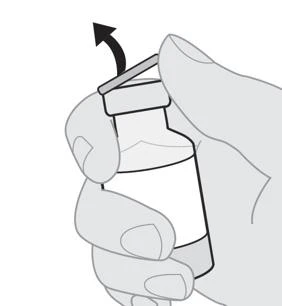
vial containing the solution.
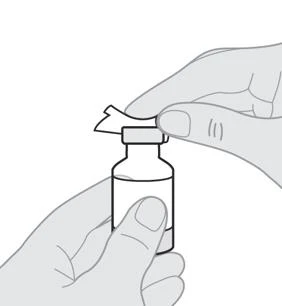
b. Wipe the top of the vial with an alcohol swab and allow it to dry.
2) Attach the vial adapter to the
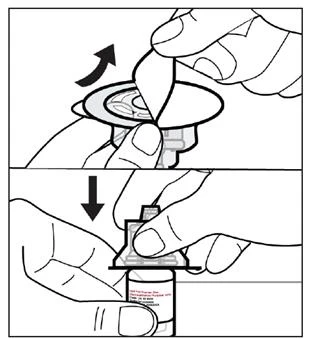
vial.
The vial adapter may look different from the one shown in this section.
a. Remove the paper protector from the vial adapter package.
Keep the adapter in the plastic packaging for Step 3.
b. Use the packaging to firmly push the vial adapter down onto the vial until it clicks into place.
c. Remove the vial adapter from its packaging.
For detailed instructions, refer to the Instructions for Use of the Vial Adapter.
3) While firmly holding the vial adapter, connect the syringe to the adapter
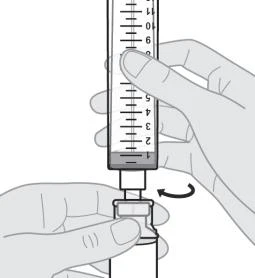
by pressing firmly and then rotating to secure it in place (clockwise). Do not overtighten.
4) Turn it upside down, positioning the syringe vertically
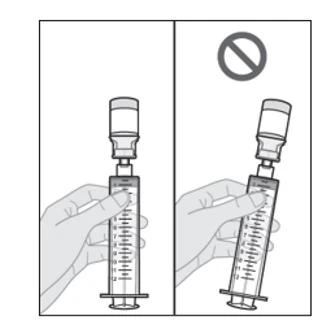
with the vial above the syringe.
OK
5) It is important to keep the syringe facing upwards.
6) Holding the syringe firmly with one hand, use the other hand to pull down the plunger rod
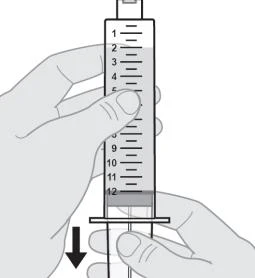
to draw all the contents of the vial into the syringe, approximately up to the 12 ml mark, or until you see air at the tip of the syringe.
a. Ensure that the entire contents of the vial are transferred into the syringe.
b. You will see air at the top of the syringe.
7) Check for the presence of air bubbles.
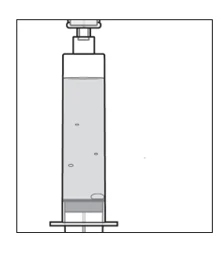
a. The presence of small air bubbles is
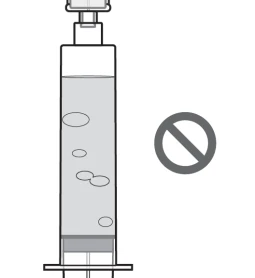
acceptable, and it is expected that some air will be present at the tip of the syringe. If you see small air bubbles or no bubbles at all, proceed to the next section and go to Step 9: Expel air from the syringe.
b. If large air bubbles are present, they must be removed. If you see large air bubbles, continue with the next section, Step 8: Manually remove air bubbles.
8) Manually remove air bubbles.
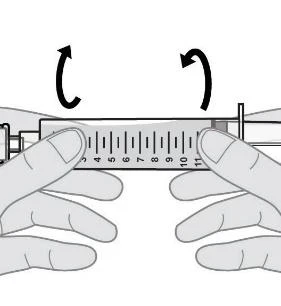
a. Slowly and gently rotate the syringe and tilt it back and forth. This will combine the bubbles into one larger bubble. Do not shake or tap the syringe to remove air bubbles.
b. If air bubbles are still present, consolidate them by gently rotating the syringe from side to side.
c. Once large air bubbles have been grouped into a single bubble, proceed to the next step.
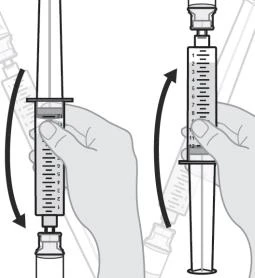
- Expel air from the syringe.
a. Without removing the solution vial, orient the syringe tip upward.
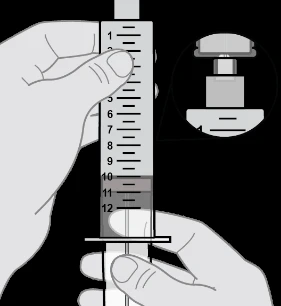
b. Slowly press the plunger to push the air out of the syringe and back into the vial. You may feel slight resistance as the air is pushed into the vial.
c. Continue pressing until all air has been expelled from the syringe into the vial and until you see the solution reach the tip of the syringe.
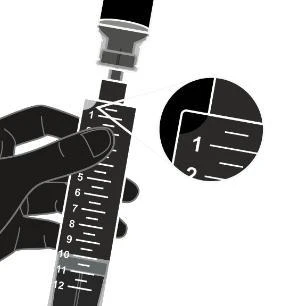
d. When tilting the syringe, you may see a small air bubble in the corner. This is acceptable.
10) Turn the syringe and vial upside down so that the vial
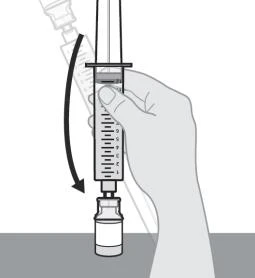
is facing upward on a flat surface.
11) Disconnect the syringe from the vial adapter.
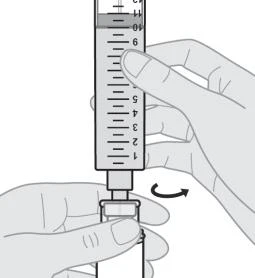
a. Firmly hold the vial adapter with one hand and the barrel of the syringe with the other.
b. Unscrew the syringe from the vial adapter. Do not press the plunger when disconnecting the syringe from the vial, to avoid loss of solution.
c. Place the syringe on a clean surface, taking care to prevent the tip of the syringe from touching any unclean surfaces.
12) The syringe is now ready for use.
3. Preparation of the Duodopa 240 mg/ml + 12 mg/ml infusion solution
- Attach the infusion set tubing to a new syringe.
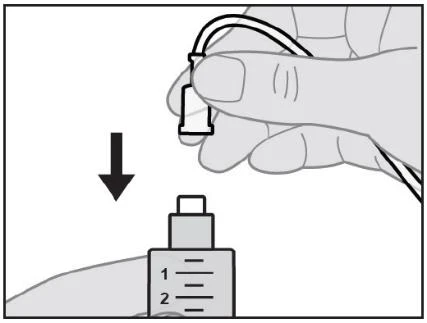
o Holding the syringe firmly, connect the infusion set tubing to the syringe and twist until securely fastened.
o For detailed instructions, refer to the Instructions for Use of the Infusion Set.
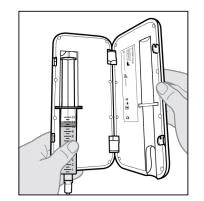
- Place the syringe into the pump.
o For detailed instructions, refer to the Patient Instructions for Using the Vyafuser Pump. - Prime the infusion set tubing. Priming means that the pump pushes the medicine from the syringe through the infusion set tubing to remove any air from the tubing.
o For detailed instructions, refer to the Patient Instructions for Using the Vyafuser Pump.
4. Selection and preparation of the infusion site
- Select an area shown (on the abdomen) at least 5 cm
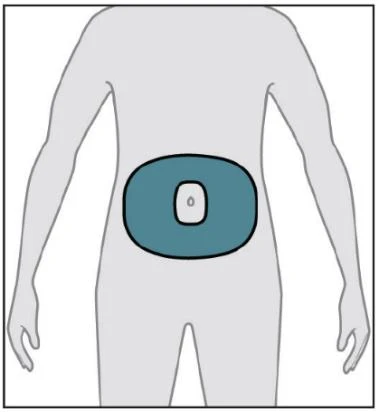
from the navel.
- Avoid skin with scars, hardened tissue, stretch marks, skin folds, natural body creases, or areas where clothing may cause irritation (e.g., near the waistline).
- Clean the selected infusion site with an alcohol swab and allow it to air dry for at least 1 minute. For detailed instructions, refer to the Instructions for Use of the Infusion Set and the Patient Instructions for Use of the Vyafuser Pump.
- Connect the cannula to the body and the infusion set to the cannula.
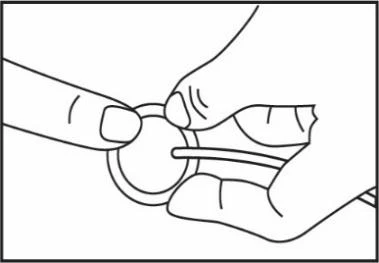
o Insert the cannula into the body.
o Connect the infusion tubing to the cannula.
o For detailed instructions, refer to the Instructions for Use of the Infusion Set.
5. Starting the infusion of Duodopa 240 mg/ml + 12 mg/ml solution for infusion
- Start the pump. For detailed instructions,
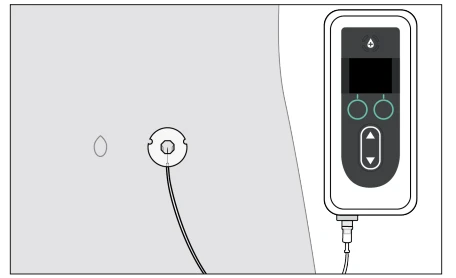
refer to the Patient Instructions
for using the Vyafuser pump.
- Pump delivery options
| Purpose | When Available | |
| Continuous Infusion | Main mode delivering a continuous dose of Duodopa 240 mg/ml + 12 mg/ml infusion solution throughout the day. | Always available, as prescribed. |
| Extra Dose | A small single-volume dose administered over a short period of time (bolus) to rapidly achieve the desired drug level in the body. The extra dose is available only if set by the doctor. | Available if needed, defined by a preset Extra Dose lockout time. |
| Loading Dose | A large single dose administered over a short period of time (bolus) that may be given to rapidly achieve the desired drug level in the body, available only after | After the medication has not been delivered for a prolonged period, defined by the Loading Dose lockout time |
| the pump has been turned off for an extended period and if it has been set by the doctor. | (minimum 3 hours). |
- The pump has alternative delivery options available that can be configured by the physician, if necessary.
6. After use
- Used vials and the vial adapter still attached must be disposed of in accordance with local regulations or as directed by your doctor, pharmacist, or nurse.