Duoclin
Italy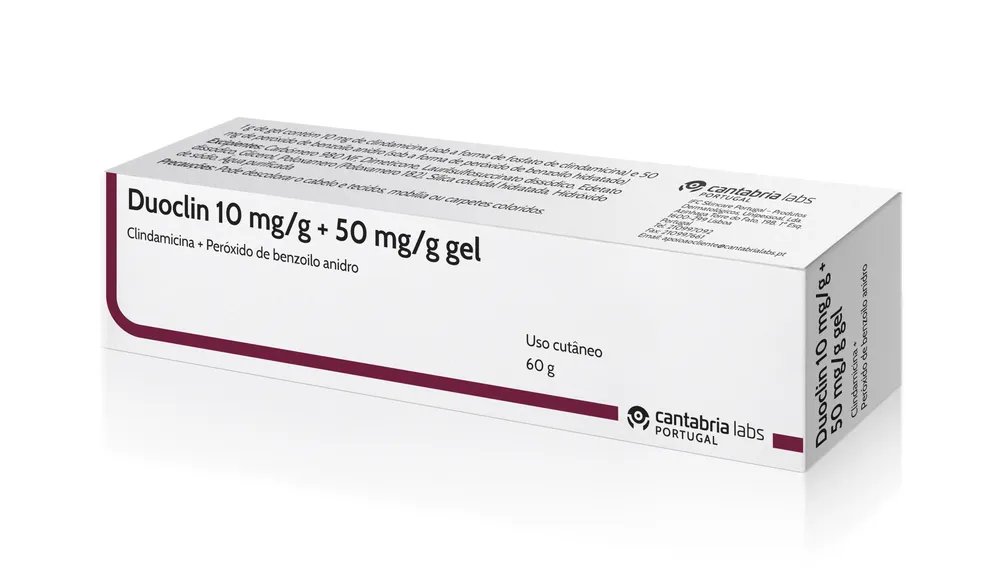
Table of Contents
Package leaflet: Information for the patient
Duoclin 10 mg/g + 30 mg/g gel
clindamycin + anhydrous benzoyl peroxide
equivalent medicine
Please read this leaflet carefully before using this medicine because it contains important information for you.
- Keep this leaflet. You may need to read it again.
- If you have any questions, ask your doctor or pharmacist.
- This medicine has been prescribed for you only. Do not give it to others, even if their symptoms are the same as yours, because it could be harmful.
- If any adverse reaction occurs, including those not listed in this leaflet, consult your doctor or pharmacist. See section 4.
Contents of this leaflet:
- What Duoclin is and what it is used for
- What you need to know before using Duoclin
- How to use Duoclin
- Possible side effects
- How to store Duoclin
- Contents of the pack and other information
1. What Duoclin is and what it is used for
Duoclin contains two medicines: clindamycin and benzoyl peroxide.
Duoclin belongs to a group of medicines known as "anti-acne preparations".
Duoclin is used to treat mild to moderate acne of the skin.
- Clindamycin is an antibiotic that prevents the growth of bacteria involved in acne.
- Benzoyl peroxide reduces blackheads and pimples. It also kills the bacteria involved in acne.
Their combined use in Duoclin works by:
- fighting the bacteria that cause acne
- treating existing blackheads, pimples, and pustules
- reducing the number of red, inflamed acne pustules
Duoclin is indicated for use in adults and adolescents aged 12 years and older.
2. What you need to know before using Duoclin
Do not use Duoclin
- if you are allergic to clindamycin, lincomycin, benzoyl peroxide, or any of the other ingredients of this medicine (listed in section 6)
Do not use Duoclin if any of the above situations apply to you. If you are unsure, speak with your doctor or pharmacist before starting
Duoclin.
Warnings and precautions
Talk to your doctor or pharmacist before using this medicine
- if you have ever had the following intestinal problems: "regional enteritis", "ulcerative colitis", or "antibiotic-associated colitis".
- If stomach cramps or diarrhoea occur that do not improve or worsen, stop using this medicine and contact your doctor immediately. Antibiotics can cause a condition leading to severe diarrhoea and stomach cramps. Although this is unlikely to occur with antibiotics applied to the skin.
- Use clindamycin + benzoyl peroxide gel only on the skin. Keep away from areas such as eyes, lips, mouth, or inside the nose.
- Do not use the gel on irritated areas of skin. For example, if there are cuts, abrasions, sunburns, or damaged skin.
- If this medicine accidentally gets into the eyes, mouth, or nose, rinse thoroughly with plenty of water.
- Do not apply too much clindamycin + benzoyl peroxide gel on sensitive areas of skin.
- Most patients experience some redness and peeling of the skin during the first few weeks of treatment. If skin irritation occurs, you may need to use an oil-free moisturiser, use this medicine less frequently, or stop using it temporarily to allow the skin to recover, then resume treatment.
- Stop treatment and consult your doctor if skin irritation is severe (severe redness, dryness, itching, stinging pain, or burning) or does not improve.
- Try to avoid contact between clindamycin + benzoyl peroxide gel and coloured fabrics, including clothing, towels, linen, furniture, or carpets. This medicine can bleach these materials.
- This medicine can bleach hair.
- This medicine may make your skin more sensitive to the harmful effects of sunlight. Avoid using sunbeds/lamps and minimize exposure to sunlight. Sunscreen protection and protective clothing should be used while using clindamycin + benzoyl peroxide gel.
Talk to your doctor or pharmacist before using this medicine if:
- You have recently used other medicines containing clindamycin or erythromycin, as there may be a higher chance that clindamycin + benzoyl peroxide gel will not work as well as it should.
- Inform your doctor or pharmacist if you have recently taken other medicines containing clindamycin or erythromycin.
Children
Do not give this medicine to children under twelve years of age. It is not known whether it is effective or safe for
them.
Other medicines and Duoclin
Inform your doctor or pharmacist if you are taking, have recently taken, or might take any other
medicine.
Inform your doctor or pharmacist if you are using any of the following:
- Any acne treatment containing antibiotics applied to the skin
- Medicated or "abrasive" soaps and cleansers
- Soaps or cosmetics that are excessively drying
- Products containing high amounts of alcohol or "astringent" substances.
- Because when used together with Duoclin, these may irritate the skin over time.
Duoclin may reduce the effectiveness of certain anti-acne medicines when used at the same time.
This includes:
- some topical anti-acne medicines containing tretinoin, isotretinoin, or tazarotene
➢ Inform your doctor or pharmacist if you are also using any of these medicines. You may need to use the two products at different times of the day (e.g., one in the morning and the other in the evening). Using other anti-acne medicines together with Duoclin may increase the risk of skin irritation.
➢ Stop treatment and consult your doctor if skin irritation becomes severe (severe
redness, dryness, itching, stinging pain, or burning).
Duoclin must not be used at the same time as medicines containing erythromycin.
Applying Duoclin simultaneously with medicines such as dapsone and sulfacetamide may cause a
temporary change in skin or facial hair colour (yellow/orange). This will not be
permanent.
One of the medicines in Duoclin may affect the action of certain medicines used during
general anaesthesia (so-called “neuromuscular blocking agents”).
➢ Inform your doctor or pharmacist if you are scheduled for surgery.
If you are unsure whether any of these conditions apply to you, talk to your
doctor or pharmacist before using Duoclin.
Pregnancy and breastfeeding
There is only limited information available on the safety of Duoclin in pregnant women.
If you are pregnant, think you may be pregnant, planning to become pregnant, or are breastfeeding, ask your doctor or pharmacist for advice before using this medicine.
Your doctor will assess the benefit to the mother and the risk to the unborn child of using Duoclin
during pregnancy.
It is not known whether the components of Duoclin pass into breast milk. One of the medicines contained in
Duoclin is clindamycin. When clindamycin is taken by mouth or by injection, it can pass into breast milk. If you are breastfeeding, you must consult your doctor before using Duoclin.
Do not apply Duoclin to the breast area if you are breastfeeding.
3. How to use Duoclin
Use this medicine exactly as directed by your doctor or pharmacist. If you have any doubts, consult your doctor or pharmacist.
- Use Duoclin once daily in the evening on the entire affected area.
- It may take 2 to 5 weeks before you see the effect of Duoclin.
- Do not use for more than 12 consecutive weeks. Your doctor will tell you how long your treatment should last.
If you experience excessive dryness or peeling, reduce the frequency of application or temporarily stop treatment.
How to apply Duoclin
- Completely remove any makeup from the skin area to be treated.
- Wash the affected area thoroughly. Then rinse with lukewarm water and gently pat dry with a towel.
- Apply a thin layer of gel to the entire affected skin area, using your fingertips.
- Apply to all acne-affected areas of skin, not just individual spots. If the gel does not absorb easily, this means too much has been applied.
- For the face only, use an amount of gel equal to the length from the tip of your finger to the first crease (first joint). This is referred to as a "fingertip unit".
- For both face and back, use a total of two and a half fingertip units.
- If you experience excessive dryness or peeling, you may use an oil-free, fragrance-free, hypoallergenic moisturizer, use Duoclin less frequently, or temporarily stop treatment to allow your skin to adjust. This medicine may not work properly if not applied daily.
- Wash your hands after applying the gel.
- Once the gel is dry, you may apply non-comedogenic makeup.
Always use this medicine exactly as described in this leaflet or as directed by your doctor or pharmacist. If you have any doubts, consult your doctor or pharmacist.
If you use more Duoclin than you should
- Be careful not to apply too much. Applying more gel or applying it more frequently will not clear acne faster and may cause skin irritation. If this occurs, use the gel less often or stop using it for a few days, then restart treatment.
If you accidentally swallow Duoclin
- If the gel is accidentally swallowed, consult a doctor. Symptoms may be similar to those experienced when taking oral antibiotics (such as stomach upset).
If you forget to use Duoclin
- Do not apply a double dose to make up for missed doses.
- Apply the next dose at your usual time.
If you stop treatment with Duoclin
Do not use the gel for longer than 12 weeks at a time without consulting your doctor. Use Duoclin for the duration recommended by your doctor. Do not stop unless advised by your doctor.
It is important to continue using the gel as prescribed by your doctor. If you stop too early, acne may return.
If you have any questions about using this medicine, speak to your doctor or pharmacist.
4. Possible side effects
Like all medicines, this medicine can cause side effects, although not everybody gets them.
Stop using Duoclin and consult a doctor immediately if you experience any of the following serious side effects – you may need urgent medical treatment:
- Signs of an allergic reaction (such as swelling of the face, eyes, lips or tongue, hives, breathing difficulties, collapse)
- Severe or prolonged diarrhoea, or abdominal cramps
- Severe burning, peeling or itching.
Other possible side effects
If you notice any of these side effects, try using Duoclin less frequently, or stop using Duoclin for one or two days and then resume.
Very common side effects
(may affect more than 1 in 10 people)
At the application site:
- Skin burning sensation, peeling, itching, dry skin
- Superficial redness of the skin with irritation (erythema), especially during the first weeks of use.
These side effects are usually mild in intensity.
Common side effects
(may affect up to 1 in 10 people)
- Headache
At the application site:
- Skin rash and redness (dermatitis)
- Light sensitivity, skin pain at the application site
Uncommon side effects
(may affect up to 1 in 100 people)
- Tingling (paresthesia), worsening of acne, skin redness, skin itching, rash (erythematous rash).
Other side effects
Other side effects with unknown frequency (frequency cannot be estimated from the available data) include:
- Allergic reactions
- Inflammation of the intestine, diarrhoea, including haemorrhagic diarrhoea, stomach ache
At the application site:
- Skin reactions, skin discoloration
- Itchy raised skin rash (urticaria)
- Reporting of side effects If you experience any side effect, including those not listed in this leaflet, talk to your doctor or pharmacist. You can also report side effects directly via the national reporting system at https://www.aifa.gov.it/content/segnalazioni-reazioni-avverse. Reporting side effects can help provide more information on the safety of this medicine.
5. How to store Duoclin
Keep this medicine out of the sight and reach of children.
Store in the refrigerator (2 °C-8 °C).
After the first opening of Duoclin, do not store above 25 °C and discard after 2 months.
Do not use this medicine after the expiry date stated on the packaging after “Exp”. The expiry date refers to the last day of that month.
Do not dispose of medicines via wastewater or household waste. Ask your pharmacist how to dispose of medicines you no longer use. This will help protect the environment.
6. Package contents and other information
What Duoclin contains
The active substances are: clindamycin and anhydrous benzoyl peroxide. 1 g of gel contains 10 mg of clindamycin
(as clindamycin phosphate) and 30 mg of anhydrous benzoyl peroxide (as hydrated benzoyl peroxide).
It is possible that not all pack sizes are marketed.
The other excipients are: carbomer 980, dimethicone, disodium lauryl sulfosuccinate, disodium edetate, glycerol,
poloxamer (poloxamer 182), silica, dental type, sodium hydroxide 2N solution and purified water.
Description of the appearance of Duoclin and contents of the pack
Homogeneous gel, white to slightly yellow, with visible fine particles.
30 g or 60 g of gel in an aluminium tube closed with a white plastic screw cap, packed in a cardboard carton.
Marketing Authorization Holder and Manufacturer
Difa Cooper S.p.A.
Via Milano 160
21042 Caronno P. (Va)
Italy
Manufacturer
JADRAN - Galenski laboratorij d.d.
Svilno 20
51000 Rijeka
Croatia
This medicinal product has been authorized in the Member States of the European Union under the following names: