Dostinex
Italy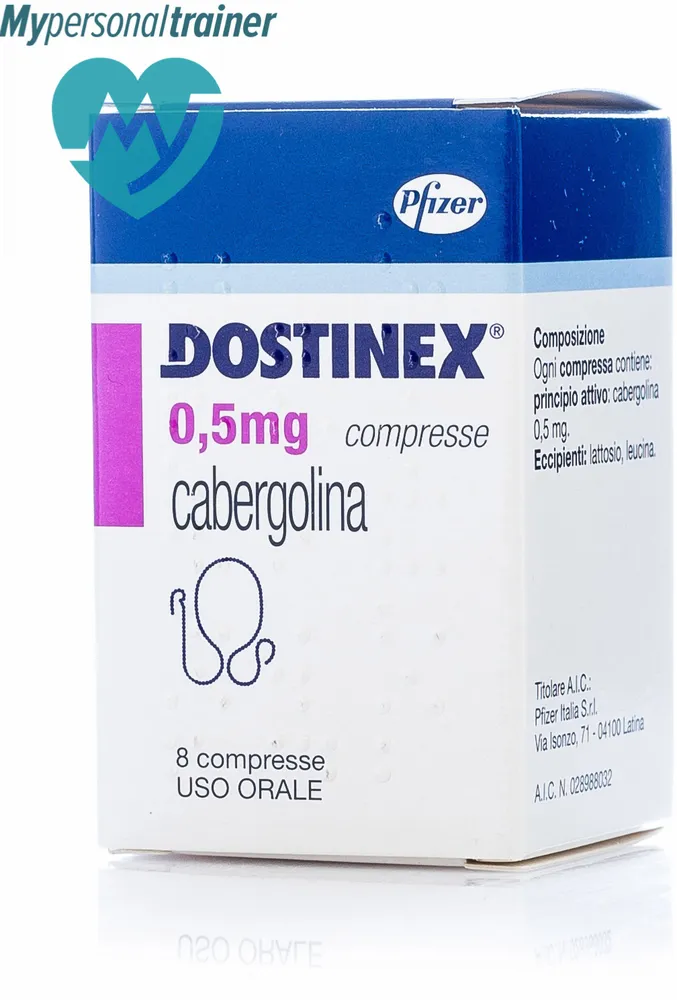
Table of Contents
Package leaflet: Information for the patient
DOSTINEX 0.5 mg tablets
Cabergoline
Please read all of this leaflet carefully before taking this medicine because it contains important information for you.
- Keep this leaflet. You may need to read it again.
- If you have any questions, ask your doctor or pharmacist.
- This medicine has been prescribed for you only. Do not give it to other people, even if their symptoms are the same as yours, as it may be harmful.
- If you experience any side effects, including those not listed in this leaflet, talk to your doctor or pharmacist. See section 4.
Contents of this leaflet:
- What Dostinex is and what it is used for
- What you need to know before taking Dostinex
- How to take Dostinex
- Possible side effects
- How to store Dostinex
- Contents of the pack and other information
1. What Dostinex is and what it is used for
Dostinex contains the active substance cabergoline, which belongs to a group of medicines called
prolactin inhibitors (prolactin is a hormone that stimulates milk production from the breasts). Cabergoline
works by reducing the production of prolactin in the blood.
- Dostinex is used immediately after childbirth to prevent the normal production and secretion of breast milk (lactation), or to stop an already established lactation:
- when breastfeeding is not desired;
- when breastfeeding is not recommended for health reasons concerning the mother or newborn;
- after the delivery of a stillborn fetus;
- after termination of pregnancy or spontaneous abortion.
- Dostinex may also be used to treat other conditions that may be caused by high levels of prolactin (hyperprolactinaemia), such as:
- absence or loss of menstruation (amenorrhoea);
- irregular menstrual cycles (oligomenorrhoea);
- interruption or cessation of ovulation (anovulation);
- persistent milk production from the breast after cessation of lactation (galactorrhoea). Elevated prolactin levels are caused by certain diseases of the pituitary gland (a gland located at the base of the skull) in both men and women.
2. What you should know before taking Dostinex
Do not take Dostinex
- If you are allergic to cabergoline, to other similar medicines called ergot alkaloids, or to any of the other ingredients of this medicine (listed in section 6).
- If you have ever had fibrotic reactions (formation of scar tissue) affecting the lungs, heart, or abdomen.
- For a prolonged period if you have ever had or currently have a heart valve disease, including cases of fibrotic reactions (formation of scar tissue) affecting the heart valves.
Warnings and precautions
Inform your doctor or pharmacist if you have or have ever had any of the following conditions:
- Severe diseases of the heart or blood vessels (veins and/or arteries);
- A condition causing cold hands and feet (Raynaud's syndrome);
- Stomach ulcer;
- Bleeding from the stomach or intestines;
- Severe mental illnesses, particularly psychotic disorders (severe disturbances of mental equilibrium);
- Severely impaired liver function (severe hepatic insufficiency), especially if you have been on long-term treatment with this medicine, as this may require a lower-than-expected dose of Dostinex;
- High blood pressure (arterial hypertension) and you are already taking other medicines to lower it. Particular caution is required when taking Dostinex together with other blood pressure-lowering medicines, because a drop in blood pressure may occur upon standing up from a sitting or lying position after taking Dostinex. Dostinex may also lower blood pressure if taken over a long period of time;
- Sudden onset of high blood pressure (arterial hypertension) during pregnancy or immediately after childbirth, as treatment with Dostinex may not be suitable for you. Your doctor will evaluate the risks and benefits of administering this medicine based on your condition.
If you have recently given birth, you may be at increased risk of developing certain conditions. These may include hypertension, heart attack, seizures, stroke, or psychiatric disorders. Therefore, your doctor should regularly monitor your blood pressure during treatment. Seek immediate medical advice if you develop hypertension, chest pain, or unusually severe or persistent headache (with or without visual disturbances).
Before administration of Dostinex, and at regular intervals during therapy, your doctor may wish to perform the following examinations:
- Medical examination to assess the condition of the heart and major blood vessels (arteries and veins);
- Echocardiogram (ultrasound of the heart) to detect possible heart valve disease (even if you have never had symptoms);
- Blood tests;
- A test to evaluate lung function;
- A chest X-ray or other radiological examinations;
- A test to evaluate kidney function;
- Tests to monitor pituitary gland function, to rule out diseases of this gland;
- Appropriate tests to exclude pregnancy. If you are being treated with Dostinex and wish to become pregnant, Dostinex should be discontinued one month before planned conception (see Pregnancy and Breastfeeding);
- Any other tests deemed necessary by your doctor.
Dostinex may promote the development of fibrotic reactions (formation of scar tissue) affecting various organs, which may initially go undiagnosed. Contact your doctor if, during prolonged treatment with Dostinex, you experience any of the following symptoms (see section 4 Possible side effects):
- Difficulty breathing (dyspnea), shortness of breath, persistent cough, chest pain, or development of fluid in the space between the lungs and the chest wall (pleuritis). These symptoms may indicate the onset of fibrotic reactions affecting the lungs or pleura (a membrane surrounding each lung).
- Flank pain/lower back pain, swollen ankles and/or legs (edema), abdominal pain, or formation of a mass within the abdomen. These symptoms may indicate the onset of fibrotic reactions affecting various abdominal organs.
- Generalized weakness and fatigue, palpitations, and other symptoms that may indicate the onset of fibrotic reactions affecting the heart and/or heart valves and/or pericardium (a thin membrane normally surrounding the heart). If fibrotic reactions affecting the heart occur, treatment with Dostinex must be discontinued.
Inform your doctor if, during treatment with Dostinex, you or your family members or caregivers notice any of the following symptoms (see section 4 Possible side effects):
- Drowsiness/sudden sleep attacks, especially if you have ever had or currently have Parkinson’s disease, which may occur without warning and without awareness. Your doctor may decide to reduce the dose or discontinue treatment (see section Driving and use of machines).
- Desire/need to behave differently than usual/inability to resist the impulse, desire, or temptation to carry out certain actions that could harm you or others. These problems are known as “impulse control disorders” and may include behaviors such as pathological gambling, binge eating or excessive spending, abnormally increased sexual desire, or increased sexual thoughts or urges. Your doctor may decide to adjust the dose or discontinue treatment.
If your doctor has prescribed Dostinex for the treatment of absence of menstruation (amenorrhea) caused by elevated levels of prolactin in the blood (hyperprolactinemia), your doctor may decide to perform a pregnancy test. Regular pregnancy testing is necessary to detect the possible onset of pregnancy, as Dostinex restores fertility in women before the return of menstruation. The pregnancy test should be performed:
- during absence of menstruation: at least once every 4 weeks;
- after resumption of menstruation: each time menstruation is delayed by more than 3 days. If pregnancy occurs during treatment with Dostinex, your doctor may decide, as a precaution, to perform tests to monitor the function of the gland producing prolactin (pituitary gland).
Other medicines and Dostinex
Inform your doctor or pharmacist if you are taking, have recently taken, or might take any other medicines.
The effectiveness of Dostinex may be reduced by certain medicines, including:
- medicines used to treat mental disorders (e.g. phenothiazines, butyrophenones, thioxanthenes);
- medicines used to treat nausea and vomiting (e.g. metoclopramide).
Side effects may be increased when Dostinex is used together with other medicines, including:
- erythromycin and other antibiotics belonging to the same class (macrolide antibiotics).
If your doctor has decided to treat you with Dostinex for a prolonged period, concomitant use of Dostinex with other medicines called ergot alkaloids is not recommended.
Dostinex may cause a drop in blood pressure upon standing up from a sitting or lying position. Therefore, caution is required when Dostinex is administered together with the following class of medicines:
- medicines that lower blood pressure (see section 2 Warnings and precautions)
Pregnancy, breastfeeding, and fertility
Inform your doctor before taking Dostinex if you are pregnant, suspect you may be pregnant, or are planning a pregnancy.
Pregnancy
While being treated with Dostinex, use effective contraceptive methods to avoid pregnancy.
Dostinex may be used during pregnancy only if strictly necessary and only after careful evaluation by your doctor of the potential benefits and risks of this medicine.
If conception occurs while you are taking Dostinex, treatment should be discontinued as soon as pregnancy is confirmed.
Breastfeeding
Since Dostinex stops milk production, you must not take it if you intend to breastfeed.
If you need to take Dostinex, you will need to use an alternative method to feed your baby.
As there is no information on the passage of Dostinex into breast milk, you must not breastfeed your baby with breast milk if Dostinex has not been effective in stopping lactation.
Fertility
If you are being treated with Dostinex and are planning a pregnancy, you should discontinue the medicine one month before the planned conception. Discontinuing Dostinex one month before conception does not reduce your fertility, as the effect of the medicine lasts for approximately 6 months after discontinuation.
Driving and use of machines
Dostinex may cause drowsiness and sudden episodes of sleep. If you experience these symptoms, do not drive and do not operate tools or machinery, nor perform any activity requiring a high degree of attention or coordination until these symptoms have completely resolved.
Dostinex contains lactose
Dostinex contains lactose, a type of sugar. If your doctor has diagnosed you with an intolerance to certain sugars, contact them before taking this medicine.
3. How to take Dostinex
Take this medicine exactly as instructed by your doctor. If you have any doubts, consult your doctor.
The recommended dose is:
- To prevent milk production (lactation): 2 tablets of Dostinex 0,5 mg taken only on the first day after childbirth.
- To stop milk production after starting breastfeeding: half a tablet of Dostinex 0,5 mg every 12 hours for two days.
- To reduce prolactin levels in other conditions (hyperprolactinaemia): initially, you should take one tablet of 0,5 mg, either as a single dose or divided into two doses over the course of one week (e.g. half a tablet on Monday and the other half on Thursday). Subsequently, your doctor may decide to gradually increase the dose to find the appropriate dose needed to control your symptoms, up to a maximum of 4,5 mg (9 tablets of 0,5 mg Dostinex) per week. You must not take more than 3 mg (6 tablets of 0,5 mg Dostinex) per day.
When and how to take Dostinex
Take Dostinex tablets by mouth, preferably after a meal to reduce unwanted effects.
Swallow the tablets with a little water.
Use in children and adolescents
The use of Dostinex is not recommended in individuals under 16 years of age.
Elderly patients
Experience in elderly patients is very limited. Currently, no specific risks are known.
If you take more Dostinex than you should
If you have accidentally taken too many tablets, symptoms such as nausea, vomiting, stomach discomfort, low blood pressure upon standing from a sitting or lying position, confusion, psychosis (e.g. altered perception of reality, disturbances in thinking, emotions, or behaviour), hallucinations may occur. In this case, contact your doctor immediately or go to the nearest hospital emergency department.
If you forget to take Dostinex
It is important not to miss a dose. If you forget to take the medicine at your usual time, take it as soon as you remember, then continue taking it as usual. Do not take a double dose to make up for the forgotten dose.
If you stop taking Dostinex
Your doctor will tell you how long to take Dostinex. Do not stop treatment unless instructed by your doctor. If you stop treatment with Dostinex before your doctor tells you to, your condition may worsen or return.
If you have any doubts about the use of this medicine, consult your doctor or pharmacist.
4. Possible side effects
Like all medicines, this medicine can cause side effects, although not everyone gets them.
Contact your doctor immediately if you experience any of the following symptoms, as they may be serious and treatment with Dostinex must be stopped (see Warnings and precautions):
- Very common side effects (may affect more than 1 in 10 people): heart valve disorders and related disorders, for example, inflammation of the pericardium (pericarditis) or fluid accumulation in the pericardium (pericardial effusion). These disorders may present with various symptoms including generalised weakness, fatigue and palpitations.
- Other side effects (frequency cannot be estimated from the available data): chest pain (angina pectoris).
The following side effects have been reported in patients treated with Dostinex:
Very common side effects (may affect more than 1 in 10 people):
- headache (cephalalgia)*;
- dizziness/vertigo*;
- nausea*;
- stomach pain, discomfort and bloating (dyspepsia);
- gastritis;
- abdominal pain*;
- weakness;
- fatigue.
The side effects marked with an asterisk (*) are very common in women treated with Dostinex to reduce abnormally high levels of prolactin (hyperprolactinaemia). They are instead common in women treated with Dostinex to prevent or stop the production of breast milk.
Weakness is very common in women treated with Dostinex to reduce abnormally high levels of prolactin (hyperprolactinaemia). It is instead uncommon in women treated with Dostinex to prevent or stop the production of breast milk.
Common side effects (may affect up to 1 in 10 people):
- drowsiness;
- depression;
- low blood pressure (hypotension), particularly during long-term Dostinex therapy;
- drop in blood pressure when moving from a sitting or lying position to a standing position (orthostatic hypotension);
- low blood pressure without noticeable symptoms;
- hot flushes**;
- constipation;
- vomiting**;
- breast pain.
The side effects marked with two asterisks (**) are common in women treated with Dostinex to reduce abnormally high levels of prolactin (hyperprolactinaemia). They are instead uncommon in women treated with Dostinex to prevent or stop the production of breast milk.
Uncommon side effects (may affect up to 1 in 100 people):
- palpitations;
- difficulty breathing (dyspnoea);
- fluid accumulation in the space between the lungs and the chest wall (pleural effusion);
- fibrotic reactions (formation of scar tissue), which may also affect the lungs;
- nosebleeds;
- allergic reactions;
- temporary loss of vision in one half of the visual field, in one or both eyes (transient hemianopia);
- sudden loss of consciousness;
- sensations of tingling or warmth;
- increased sexual desire;
- cold fingers and toes;
- fainting;
- fluid accumulation in various parts of the body (oedema);
- swollen ankles and/or legs;
- skin rash;
- patchy hair loss (alopecia);
- leg cramps;
- decrease in haemoglobin levels (a substance contained within red blood cells). This side effect occurred within the first months after resumption of menstruation in women who had previously experienced absence of menstruation (amenorrhoea).
Rare side effects (may affect up to 1 in 1,000 people):
- stomach ache.
Very rare side effects (may affect up to 1 in 10,000 people):
- fibrotic reactions (formation of scar tissue) of the pleura (a membrane surrounding the lungs).
Other side effects (frequency cannot be estimated from the available data): - breathing disorders;
- lung function abnormalities (respiratory failure);
- inflammation of the pleura (pleuritis);
- chest pain;
- sudden sleep onset;
- tremor;
- visual disturbances;
- aggression;
- delirium;
- pathological and obsessive urge to engage in sexual activity or persistent thoughts about sex;
- strong impulse to gamble excessively;
- psychosis (e.g. altered perception of reality, changes in thinking, emotional states, and behavioural abnormalities);
- hallucinations;
- liver function abnormalities;
- increased blood levels of a substance (called creatine phosphokinase) predominantly found within muscle tissue;
- abnormal liver function laboratory tests.
Pay special attention to the following side effects (see section 2 Warnings and precautions):
Impulse control disorders, a condition that may cause harm to you or others, and whose symptoms may include:
- strong impulse to gamble excessively;
- increased sexual desire, pathological and obsessive urge to engage in sexual activity or persistent thoughts about sex;
- voluntary but poorly controlled impulse to make excessive purchases;
- uncontrollable impulse to eat (consumption of an amount of food greater than normal and beyond the need to satisfy hunger).
Inform your doctor if any of these behaviours occur, so that he or she can decide how to manage or reduce the symptoms.
Reporting of side effects
If you experience any side effect, including those not listed in this leaflet, talk to your doctor or pharmacist. You can also report side effects directly via the Italian Medicines Agency (Agenzia Italiana del Farmaco) website: https://www.aifa.gov.it/content/segnalazioni-reazioni-avverse
By reporting side effects, you can help provide more information on the safety of this medicine.
5. How to store Dostinex
Keep this medicine out of the sight and reach of children.
Do not use this medicine after the expiry date which is stated on the pack after "Expiry". The expiry date refers to the last day of that month.
No special storage precautions are required.
Do not dispose of any medicine via wastewater or household waste. Ask your pharmacist how to dispose of medicines you no longer use. This will help protect the environment.
6. Package contents and other information
What Dostinex contains
The active substance is cabergoline.
Each 0.5 mg Dostinex tablet contains 0.5 mg of cabergoline.
The other components are: lactose (see section "Dostinex contains lactose"), leucine.
Description of the appearance of Dostinex and contents of the pack
The 0.5 mg Dostinex tablets are flat, oval, white tablets, marked with "PU" divided by a score line on one side, and marked with "700" with a slight indentation above and below the central "0" on the other side.
The tablets are contained in high-density polyethylene (HDPE) bottles with child-resistant cap, containing silica gel as desiccant. This desiccant must not be removed.
It is recommended to close the bottle carefully after use. Packs of 2, 4 or 8 tablets.
Not all pack sizes may be marketed.
Marketing Authorisation Holder and Manufacturer
Marketing Authorisation Holder
Pfizer Italia S.r.l. - Via Isonzo, 71 - 04100 Latina
Manufacturer
Pfizer Italia S.r.l. - Località Marino del Tronto - 63100 Ascoli Piceno (AP)