Dorsiflex
ItalyTable of Contents
Package leaflet: Information for the patient
Dorsiflex 70 mg medicated patch
For use in adults
Etofenamate
Please read all of this leaflet carefully before using this medicine because it contains
important information for you.
Always use this medicine exactly as described in this leaflet or as your doctor or
pharmacist has instructed you.
- Keep this leaflet. You may need to read it again.
- If you would like more information or advice, please consult your pharmacist.
- If you experience any side effects, including those not listed in this leaflet, consult your doctor or pharmacist. See section 4.
- Consult your doctor if you do not notice any improvement or if your symptoms worsen after 7 days.
Contents of this leaflet
- What Dorsiflex is and what it is used for
- What you need to know before using Dorsiflex
- How to use Dorsiflex
- Possible side effects
- How to store Dorsiflex
- Contents of the pack and other information
1. What Dorsiflex is and what it is used for
The active substance in this medicine – etofenamate – belongs to a class of drugs known as non-steroidal anti-inflammatory drugs (NSAIDs), which have analgesic and anti-inflammatory properties.
Dorsiflex is indicated for the short-term symptomatic treatment of local painful conditions associated with uncomplicated acute ankle sprain in adults.
Consult your doctor if you do not feel better or if you feel worse after 7 days.
2. What you need to know before using Dorsiflex
Do not use Dorsiflex:
- if you are allergic to etofenamate or to any of the other ingredients of this medicine (listed in section 6);
- if you are allergic to other non-steroidal anti-inflammatory drugs (NSAIDs, medicines used to treat pain and inflammation such as, for example, acetylsalicylic acid or ibuprofen) and have experienced asthma, breathing difficulties (bronchospasm), runny nose, swelling, or hives;
- if your skin is damaged (e.g. abrasions, cuts, burns, open wounds), infected or inflamed, or if you have exudative dermatitis or eczema;
- during the last three months of pregnancy (see section “Pregnancy, breastfeeding and fertility”);
- on eyes, lips or mucous membranes.
Warnings and precautions
If a skin rash occurs, remove the medicated patch immediately and stop treatment.
To minimize the occurrence of possible adverse effects, it is recommended to use the patch only for the shortest time necessary to relieve symptoms.
Do not use bandages to keep the medicated patch in place.
In patients who suffer or have previously suffered from bronchial asthma or allergies, breathing difficulties (bronchospasm) may occur.
During treatment and for 2 weeks after removal of the patch, avoid exposing the treated area to direct sunlight or solarium radiation to reduce the risk of photosensitivity.
The possibility of systemic adverse effects (adverse effects affecting entire organs, organ systems or the whole body) associated with the application of the medicated patch cannot be ruled out when the medicine is used over large skin areas (i.e. when applying more than one patch – see section 3) and for prolonged periods.
Although systemic effects (effects affecting entire organs, organ systems or the whole body) should be minimal, the medicated patch must be used with caution in patients with:
- kidney, heart or liver problems;
- active gastrointestinal ulcer or history of gastrointestinal ulcer, intestinal inflammation, or predisposition to bleeding.
Non-steroidal anti-inflammatory drugs (NSAIDs) should be used with caution if you are elderly, as you are more prone to developing adverse effects.
Do not use the patch concurrently with other medicines containing etofenamate or with any other non-steroidal anti-inflammatory drug (NSAID) administered topically (applied to the skin) or orally.
Children and adolescents
Dorsiflex must not be used in children and adolescents under 18 years of age, as the safety and efficacy of this medicine have not yet been established in this age group.
Other medicines and Dorsiflex
Inform your doctor or pharmacist if you are taking, have recently taken, or might take any other medicines.
When Dorsiflex is used correctly, only a small amount of etofenamate is absorbed into the body, and interactions with other medicines are unlikely.
Pregnancy, breastfeeding and fertility
If you are pregnant, think you might be pregnant, are planning to become pregnant, or are breastfeeding, consult your doctor or pharmacist before using this medicine.
This medicine must not be used by women during the third trimester of pregnancy.
During the first and second trimesters of pregnancy, use this medicine only on medical advice.
Small amounts of flufenamic acid, a degradation product of etofenamate, are excreted in breast milk. However, if your doctor considers it necessary, short-term use of Dorsiflex during breastfeeding may be possible. If used during breastfeeding, Dorsiflex must not be applied to the breast of nursing mothers, nor to extensive skin areas or for prolonged periods.
Driving and using machines
Dorsiflex does not affect, or affects negligibly, the ability to drive vehicles and use machinery.
3. How to use Dorsiflex
Use this medicine exactly as described in this leaflet or as directed by your doctor or pharmacist. If you have any doubts, consult your doctor or pharmacist.
Recommended dose
Adults and elderly:
Apply one (1) patch every 12 hours (for a total of 2 patches per day), for no more than 7 days.
Use only one patch at a time.
Do not exceed the recommended dose.
Method of administration
For topical use only.
Use the patch only on intact, non-infected skin.
How to apply the patch
The patch must be applied to dry skin without creating folds. The presence of sweat or excessive hair at the application site may interfere with adhesion.
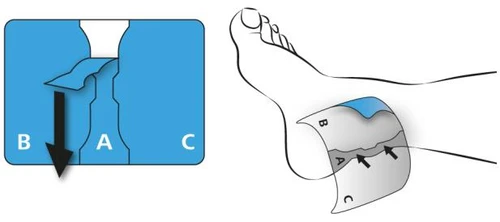
First, remove the protective film from the center of the patch (A) and press it directly onto the skin.
Do not touch the adhesive side of the patch with your fingers!
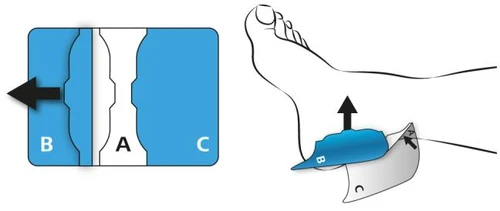
While pressing the center of the patch (A) with the other hand, remove part (B) of the protective film by folding the patch outward and pulling off the protective film (B) by the protruding tab (see arrow). While removing the protective film, press the patch directly onto the skin.
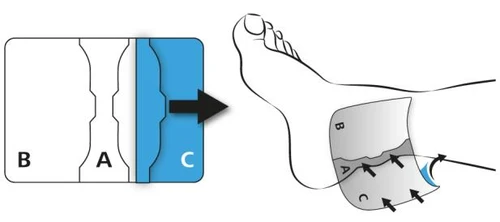
Remove part (C) of the protective film following the same procedure described for part (B). Press the patch directly onto the skin.
After application, press the patch firmly onto the skin for at least 30 seconds to ensure optimal adhesion.
After each application, make sure to carefully reseal the pouch using the built-in zipper.
Duration of treatment
For short-term use only.
Dorsiflex should be used for the shortest duration necessary to relieve symptoms.
The patch must not be used for longer than 7 days. If you notice no improvement after this period, or if symptoms worsen, consult your doctor.
Do not exceed the recommended duration of treatment.
If you use more Dorsiflex than you should
In case of overdose or accidental ingestion by a child, seek medical help immediately.
If you forget to use Dorsiflex
Do not apply a double dose to make up for the missed patch.
If you have any doubts about how to use this medicine, consult your doctor or pharmacist.
4. Possible side effects
Like all medicines, this medicine can cause side effects, although not everybody will experience them.
Stop using this medicine and contact your doctor immediately if you experience any of the following side effects:
- signs of an allergic reaction such as asthma, unexplained wheezing or shortness of breath, itching, runny nose, skin rashes.
- signs of hypersensitivity and skin reactions such as redness, swelling, peeling, blistering, desquamation or ulceration of the skin.
The following side effects may occur:
Uncommon (may affect up to 1 in 100 people):
Dermatitis, for example, skin redness, itching, burning, rash, sometimes accompanied by the formation of papules, pustules or wheals.
Rare (may affect up to 1 in 1,000 people):
Hypersensitivity reactions, local allergic reactions (contact dermatitis).
Very rare (may affect up to 1 in 10,000 people):
Skin swelling.
Not known (frequency cannot be estimated from the available data):
Sensitivity to light (photosensitisation).
The risk of side effects increases if the patch is used on large areas of skin (i.e. when applying more than one patch – see section 3) and for prolonged periods.
Reporting of suspected adverse reactions
If you experience any side effect, including those not listed in this leaflet, talk to your doctor or pharmacist. You can also report side effects directly via the national reporting system at https://www.aifa.gov.it/content/segnalazioni-reazioni-avverse. By reporting side effects, you can help provide more information on the safety of this medicine.
5. How to store Dorsiflex
Keep this medicine out of the sight and reach of children.
Do not use this medicine after the expiry date stated on the sachet and carton. The expiry date refers to the last day of that month.
Do not store above 30°C.
Used patches should be folded with the adhesive side turned inwards and safely disposed of.
Do not dispose of any medicine via wastewater or household waste. Ask your pharmacist how to dispose of medicines no longer required. This will help protect the environment.
6. Package contents and other information
What Dorsiflex contains
- The active substance is etofenamate. Each medicated patch contains 70 mg of etofenamate.
- The other components are the following:
Adhesive layer
Polycondensate of alpha-hydro-omega-hydroxypoly (dimethylsiloxane) trimethylsilylate with
dimethicone, macrogol 400 and refined olive oil
Backing layer
Bi-elastic polyester fabric
Protective film
Polyester film coated with fluoropolymer
Description of the appearance of Dorsiflex and contents of the pack
Each 10 cm x 14 cm patch consists of a white fabric with a colourless self-adhesive layer and a removable protective film.
Dorsiflex is available in a cardboard box containing a sealed pouch. Each pouch contains 2, 5 or 7 medicated patches. The pouch is equipped with a zipper closure allowing it to be resealed after individual patches have been removed.
Not all pack sizes may be marketed.
Marketing Authorisation Holder and Manufacturer
Marketing Authorisation Holder:
Drossapharm Arzneimittel Handelsgesellschaft mbH
Wallbrunnstrasse 24
79539 Lörrach
Germany
Manufacturer:
mikle-pharm GmbH
Sandgasse 17
76829 Landau
Germany
This medicinal product is authorised for marketing in the EEA Member States under the following names:
Austria/Germany: Lixim 70 mg wirkstoffhaltiges Pflaster
Belgium: Lixim 70 mg emplâtre médicamenteux / Lixim 70 mg wirkstoffhaltiges Pflaster / Lixim 70 mg pleister voor cutafan gebruik
Spain: Flogopatch 70 mg apósito adhesivo medicamentoso
Hungary: Lixim 70 mg gyógyszeres tapasz
Italy: Dorsiflex
Poland: Lixim
Portugal: Fixplast 70 mg emplastro medicamentoso