Doricum
Italy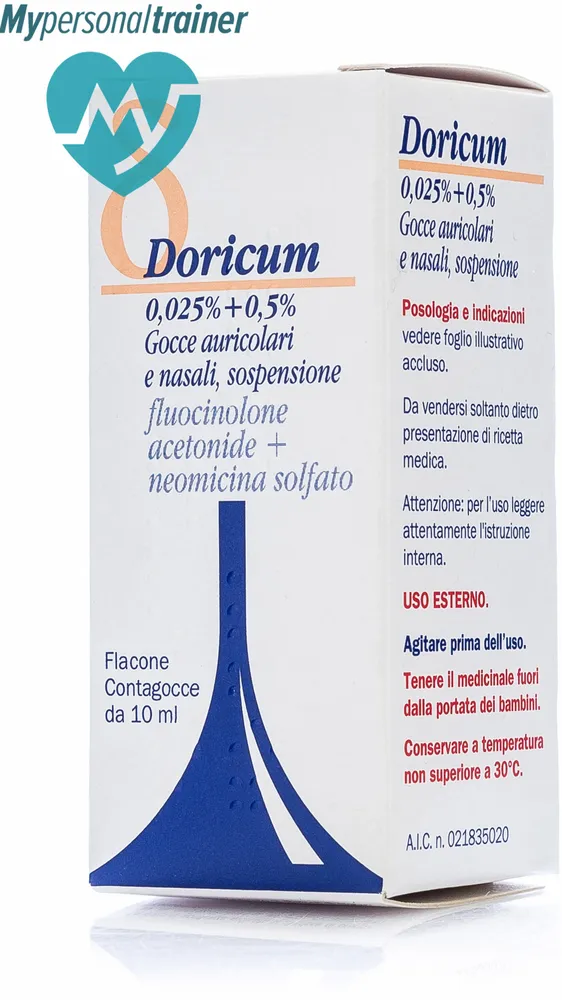
Table of Contents
- Package leaflet: Information for the patient
- DORICUM “0.25 mg/ml + 5 mg/ml ear and nasal drops, suspension”
- 1. What DORICUM is and what it is used for
- 2. What you need to know before using DORICUM
- 3. How to use DORICUM
- 4. Possible side effects
- 5. How to store DORICUM
- 6. Package contents and other information
- Patient Information Leaflet
- DORICUM “0.4 mg/ml + 5 mg/ml eye drops, suspension”
- 1. What DORICUM is and what it is used for
- 2. What you need to know before using DORICUM
- 3. How to use DORICUM
- 4. Possible side effects
- 5. How to store DORICUM
- 6. Package contents and other information
Package leaflet: Information for the patient
DORICUM “0.25 mg/ml + 5 mg/ml ear and nasal drops, suspension”
Fluocinolone acetonide + Neomycin sulfate
Please read this leaflet carefully before using this medicine because it contains important information for you.
- Keep this leaflet. You may need to read it again.
- If you have any questions, ask your doctor or pharmacist.
- This medicine has been prescribed for you only. Do not give it to others, even if their symptoms are the same as yours, as it may be harmful.
- If you experience any adverse reaction, including those not listed in this leaflet, contact your doctor or pharmacist. See section 4.
Contents of this leaflet:
- What DORICUM is and what it is used for
- What you need to know before using DORICUM
- How to use DORICUM
- Possible side effects
- How to store DORICUM
- Contents of the pack and other information
1. What DORICUM is and what it is used for
DORICUM contains fluocinolone acetonide and neomycin sulfate.
DORICUM is a preparation containing a corticosteroid with anti-inflammatory action, fluocinolone, and an antibiotic, neomycin.
DORICUM is indicated in patients for the treatment of:
- Nasal infections with evident inflammation caused by bacteria sensitive to neomycin.
- Skin disorders of the external auditory canal requiring corticosteroid therapy in the presence of infection with bacteria sensitive to neomycin.
- Infections of the external auditory canal with evident inflammation caused by bacteria sensitive to neomycin.
Consult your doctor if you do not feel better or if you feel worse.
2. What you need to know before using DORICUM
Do not use DORICUM
- if you are allergic to fluocinolone acetonide or neomycin sulfate or to any of the other ingredients of this medicine (listed in section 6);
- if you have fungal infections, tuberculosis-causing bacteria, or viral infections affecting mucous membranes and skin;
- if you have a perforated eardrum, the membrane inside the ear that transmits sound.
Warnings and precautions
Talk to your doctor or pharmacist before using DORICUM.
Use of this medicine may lead to microbial resistance and may mask symptoms of infection.
Prolonged use and high doses may result in potential effects including:
- Cushing's syndrome,
- Cushingoid appearance,
- reduced adrenal gland function,
- growth retardation in children and adolescents,
- reduced bone mineral density,
- lens opacification (cataract),
- increased intraocular pressure (glaucoma),
- psychological or behavioral effects including psychomotor hyperactivity, sleep disturbances, anxiety, depression, or aggression (particularly in children),
- ear damage (otonephrotoxicity). Regular monitoring of height is recommended in children receiving prolonged treatment with intranasal corticosteroids (see section "Possible side effects").
This product should be used with caution in cases of chronic otitis media (a middle ear infection) due to the ototoxicity of neomycin.
Contact your doctor if you experience blurred vision or other visual disturbances.
Other medicines and DORICUM
Inform your doctor or pharmacist if you are currently using, have recently used, or might use any other medicines.
Allergic reactions may occur between neomycin and the following antibiotics: kanamycin, streptomycin, paromomycin, and possibly gentamicin. There is an increasing number of people sensitive to neomycin.
Pregnancy and breastfeeding
If you are pregnant, think you may be pregnant, planning a pregnancy, or breastfeeding, consult your doctor or pharmacist before using this medicine.
In pregnant women and very young infants, this product should only be administered when strictly necessary and under direct medical supervision.
Driving and using machines
DORICUM does not affect the ability to drive or operate machinery.
DORICUM contains Benzalkonium chloride and Sodium metabisulfite
This medicine contains 0.0035 mg of benzalkonium chloride per drop, equivalent to 0.1 mg/mL.
Benzalkonium chloride, used as a preservative in DORICUM, may cause nasal irritation and swelling, especially when used for prolonged periods. If such a reaction is suspected (persistent nasal congestion), a nasal medicine without benzalkonium chloride should be used if possible. If nasal medicines without benzalkonium chloride are not available, another pharmaceutical form should be considered.
It may cause bronchospasm. Irritant, may cause local skin reactions.
DORICUM contains sodium metabisulfite. Rarely, this may cause severe hypersensitivity reactions (allergic) and bronchospasm (temporary narrowing of the bronchi, impairing airflow).
DORICUM contains polysorbate
Polysorbate may cause allergic reactions.
3. How to use DORICUM
Use this medicine exactly as instructed by your doctor or pharmacist. If
you have any doubts, consult your doctor or pharmacist.
Nasal use
The recommended dose is 1-3 drops to be applied in each nostril 3-5 times a day, according to
medical prescription.
Otic use
The recommended dose is 1-3 drops to be applied in the ear 3-5 times a day, according to
medical prescription.
If you use more DORICUM than you should
Cases of overdose have not been reported.
If you forget to use DORICUM
Do not use a double dose to make up for the missed dose.
If you stop using DORICUM
If you have any doubts about the use of this medicine, consult your doctor or pharmacist.
4. Possible side effects
Like all medicines, this medicine can cause side effects, although not everybody gets them. The following side effects have been observed:
- increased blood content in tissues (hyperemia)
- burning sensation
- itching
- weakness (asthenia)
- increased blood pressure (arterial hypertension)
- swelling (edema)
- decreased potassium levels in the blood (hypokalaemia)
- decreased levels of acids in the blood (metabolic alkalosis)
- irregular heartbeat (cardiac rhythm disturbances)
- severe physical weakness due to serious illness (adynamia)
- blurred vision (frequency not known)
Additional side effects in children and adolescents
General effects of intranasal corticosteroids, particularly when prescribed at high doses for prolonged periods, may include growth retardation in children and adolescents.
Reporting of side effects
If you experience any side effects, including those not listed in this leaflet, please inform your doctor or pharmacist. You may also report side effects directly via the website: http://www.aifa.gov.it/content/segnalazioni-reazioni-avverse.
By reporting side effects, you can help provide more information on the safety of this medicine.
5. How to store DORICUM
Do not store above 30°C.
Keep this medicine out of the sight and reach of children.
Do not use this medicine after the expiry date stated on the container after "Exp.".
The expiry date refers to the last day of that month.
The shelf life after first opening the bottle is 30 days.
Do not use this medicine if you notice any discolouration other than white.
Do not dispose of any medicine via wastewater or household waste. Ask your pharmacist how to
dispose of medicines no longer required. This will help protect the environment.
6. Package contents and other information
What DORICUM contains
- The active substances are fluocinolone acetonide and neomycin sulfate.
- The other components are disodium phosphate dodecahydrate, monobasic potassium phosphate, polysorbate 80, polysorbate 60, hypromellose, benzalkonium chloride, edetate disodium, sodium metabisulfite, sodium hydroxide (for pH adjustment), purified water (see section 2: DORICUM contains benzalkonium chloride and sodium metabisulfite).
Description of the appearance of DORICUM and contents of the pack
DORICUM is an odorless white suspension contained in a 10 ml dropper bottle.
Marketing Authorization Holder and Manufacturer
THEA FARMA S.p.A.
Via Tiziano, 32
20145 MILAN
Manufacturer
FARMILA-THEA FARMACEUTICI S.p.A.
Via Enrico Fermi, 50
20019 Settimo Milanese (MI)
Patient Information Leaflet
DORICUM “0.4 mg/ml + 5 mg/ml eye drops, suspension”
Fluocinolone acetonide + Neomycin sulfate
Please read this entire leaflet carefully before using this medicine, as it contains important information for you.
- Keep this leaflet. You may need to read it again.
- If you have any questions, ask your doctor or pharmacist.
- This medicine has been prescribed for you only. Do not give it to others, even if their symptoms are the same as yours, as it could be harmful.
- If you experience any side effect, including those not listed in this leaflet, contact your doctor or pharmacist. See section 4.
Contents of this leaflet:
- What DORICUM is and what it is used for
- What you need to know before using DORICUM
- How to use DORICUM
- Possible side effects
- How to store DORICUM
- Contents of the pack and other information
1. What DORICUM is and what it is used for
DORICUM contains fluocinolone acetonide and neomycin sulfate.
DORICUM is a preparation containing a corticosteroid with anti-inflammatory action, fluocinolone, and an antibiotic, neomycin.
DORICUM is indicated in patients for the treatment of inflammatory eye conditions, including those following surgical procedures (conjunctivitis, keratoconjunctivitis, dacryocystitis, blepharitis, blepharoconjunctivitis, episcleritis and scleritis, post-operative reactions).
Consult your doctor if you do not feel better or if you feel worse.
2. What you need to know before using DORICUM
Do not use DORICUM
- If you are allergic to fluocinolone acetonide or neomycin sulfate or to any of the other ingredients of this medicine (listed in section 6).
- If you have high pressure of the fluid inside the eye (ocular hypertension).
- If you have an eye infection caused by a virus.
- If you have an eye infection caused by a virus called Herpes Simplex, unless your doctor has specifically prescribed DORICUM together with a medication to treat this virus.
- If you have inflammation of the conjunctiva—the membrane covering the eye and the inner surface of the eyelids—associated with inflammation of the cornea, the transparent front part of the eye.
- If you have tuberculosis of the eye, an infection caused by a bacterium.
- If you have a fungal infection of the eye.
- If you have a pus-producing eye infection.
- If you have a stye (acute inflammation at the base of the eyelashes).
Warnings and precautions
Talk to your doctor or pharmacist before using DORICUM.
During prolonged treatment, your doctor will ask you to have frequent checks of the internal eye pressure.
Prolonged use may lead to complications; continuous use for more than one month is not recommended.
Contact your doctor if you experience blurred vision or other visual disturbances.
Prolonged use could cause:
- glaucoma (a condition characterized by increased pressure of the fluid inside the eye),
- damage to the optic nerves (the nerves that transmit visual information from the eye to the brain),
- visual disturbances,
- cataract formation (clouding of the lens of the eye, which is responsible for focusing images),
- increased risk of eye infections,
- increased risk of perforation in the presence of diseases that weaken the transparent front part of the eye,
- development of fungal infections of the cornea, the transparent front part of the eye,
- development of antibiotic-resistant bacteria; if this occurs or if no clinical improvement is observed within a reasonable time, stop using the product and consult your doctor to initiate appropriate therapy.
Other medicines and DORICUM
Inform your doctor or pharmacist if you are currently using, have recently used, or might use any other medicines.
Allergic reactions with neomycin may occur in patients taking certain antibiotics such as kanamycin, paromomycin, streptomycin, and possibly gentamicin.
Pregnancy and breastfeeding
If you are pregnant, think you may be pregnant, planning to become pregnant, or breastfeeding, consult your doctor or pharmacist before using this medicine.
If you are pregnant or breastfeeding, your doctor will decide whether or not to prescribe this medicine.
Driving and using machines
DORICUM does not affect the ability to drive vehicles or operate machinery.
DORICUM contains Benzalkonium chloride, Sodium metabisulfite, and phosphate buffer.
This medicine contains 0.0035 mg of benzalkonium chloride per drop, equivalent to 0.1 mg/mL.
Benzalkonium chloride may be absorbed by soft contact lenses and may cause discoloration. Remove your contact lenses before using this medicine and wait 15 minutes before reinserting them.
Benzalkonium chloride may also cause eye irritation, especially if you have dry eye or corneal disorders (the outermost transparent layer of the eye). If you experience unusual sensations, burning, or pain in the eye after using this medicine, speak with your doctor.
DORICUM contains sodium metabisulfite. Rarely, this may cause severe hypersensitivity reactions (allergic reactions) and bronchospasm (temporary narrowing of the bronchial tubes, impairing airflow).
This medicine contains 0.377 mg of phosphate buffer per drop, equivalent to 10.8 mg/mL.
If you have severe damage to the outermost transparent layer of the eye (the cornea), phosphates may very rarely cause opaque corneal deposits due to calcium accumulation during treatment.
3. How to use DORICUM
Use this medicine exactly as directed by your doctor or pharmacist. If
you have any doubts, consult your doctor or pharmacist.
The recommended dose is one or two drops applied into the eye 2-4 times a day, according to
medical prescription.
Prolonged use may cause adverse effects; continuous application for more than one month is not recommended (see section 2 - Warnings and Precautions).
If you use more DORICUM than you should
Cases of overdose have not been reported.
If you forget to use DORICUM
Do not use a double dose to make up for the missed dose.
If you stop using DORICUM
If you have any doubts about using this medicine, consult your doctor or pharmacist.
4. Possible side effects
Like all medicines, this medicine can cause side effects, although not everybody will experience them.
Effects affecting the skin
Neomycin is a substance that may cause skin allergies. An increase in the number of people allergic to neomycin has been reported. Allergic reactions to neomycin may occur, which could prevent the future use of the following antibiotics: kanamycin, paromomycin, streptomycin, and possibly gentamicin.
Blurred vision has been reported, with unknown frequency.
Reporting of side effects
If you experience any side effect, including those not listed in this leaflet, talk to your doctor or pharmacist. You may also report side effects directly via the website http://www.aifa.gov.it/content/segnalazioni-reazioni-avverse.
By reporting side effects, you can help provide more information on the safety of this medicine.
5. How to store DORICUM
This medicine does not require any special storage conditions.
The product must not be used more than 30 days after first opening the container.
Keep this medicine out of the sight and reach of children.
Do not use this medicine after the expiry date stated on the packaging after "Exp."
The expiry date refers to the last day of that month.
Do not use this medicine if you notice any discoloration different from white.
Do not dispose of medicines via wastewater or household waste. Ask your pharmacist how to
dispose of medicines you no longer use. This will help protect the environment.
6. Package contents and other information
What DORICUM contains
- The active substances are fluocinolone acetonide and neomycin sulfate.
- The other components are disodium phosphate dodecahydrate, monobasic potassium phosphate, polysorbate 80, polysorbate 60, hypromellose, benzalkonium chloride, disodium edetate, sodium metabisulfite, sodium chloride, purified water (see section 2: DORICUM contains benzalkonium chloride and sodium metabisulfite).
Description of the appearance of DORICUM and package contents
DORICUM is an odourless white suspension contained in a 5 ml dropper bottle.
Marketing Authorization Holder and Manufacturer
THEA FARMA S.p.A.
Via Tiziano, 32
20145 MILAN
Manufacturer
FARMILA-THEA FARMACEUTICI S.p.A.
Via Enrico Fermi, 50
20019 Settimo Milanese (MI)