Dopamine hydrochloride S.A.L.F.
Italy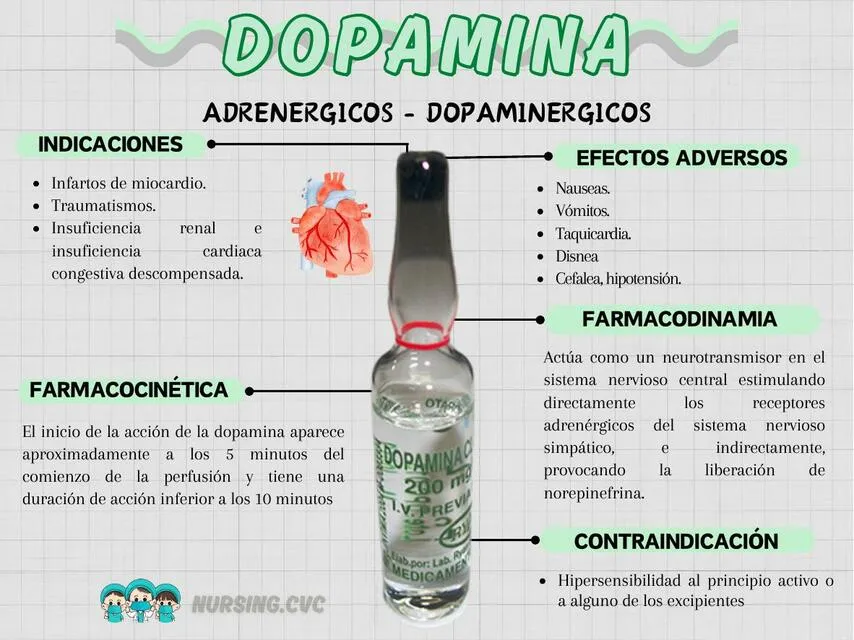
Table of Contents
- Package leaflet: Information for the user
- DOPAMINE HYDROCHLORIDE S.A.L.F. 10 mg/2 ml concentrate for solution for infusion, 50 mg/10 ml concentrate for solution for infusion, 200 mg/5 ml concentrate for solution for infusion, 400 mg/5 ml concentrate for solution for infusion
- 1. What DOPAMINA CLORIDRATO S.A.L.F. is and what it is used for
- 2. What you need to know before using DOPAMINE HYDROCHLORIDE S.A.L.F.
- 3. How to use DOPAMINE HYDROCHLORIDE S.A.L.F.
- 4. Possible side effects
- 5. How to store DOPAMINE HYDROCHLORIDE S.A.L.F.
- 6. Package contents and other information
Package leaflet: Information for the user
DOPAMINE HYDROCHLORIDE S.A.L.F. 10 mg/2 ml concentrate for solution for infusion, 50 mg/10 ml concentrate for solution for infusion, 200 mg/5 ml concentrate for solution for infusion, 400 mg/5 ml concentrate for solution for infusion
Dopamine
Equivalent medicine
Please read all of this leaflet carefully before using this medicine, because it contains important information for you.
- Keep this leaflet. You may need to read it again.
- If you have any questions, ask your doctor or nurse.
- This medicine has been prescribed for you only. Do not give it to other people, even if their symptoms are the same as yours, as it may be harmful.
- If you experience any side effects, including those not listed in this leaflet, tell your doctor or nurse. See section 4.
Contents of this leaflet:
- What DOPAMINE HYDROCHLORIDE S.A.L.F. is and what it is used for
- What you need to know before using DOPAMINE HYDROCHLORIDE S.A.L.F.
- How to use DOPAMINE HYDROCHLORIDE S.A.L.F.
- Possible side effects
- How to store DOPAMINE HYDROCHLORIDE S.A.L.F.
- Contents of the pack and other information
1. What DOPAMINA CLORIDRATO S.A.L.F. is and what it is used for
DOPAMINA CLORIDRATO S.A.L.F. contains the active substance dopamine, which belongs to a group of medicines called adrenergic and dopaminergic agents.
DOPAMINA CLORIDRATO S.A.L.F. is used to treat shock states of various origins:
- post-infarction cardiogenic shock, a shock state caused by a heart attack,
- surgical shock, caused by a surgical procedure,
- hypovolemic or hemorrhagic shock, caused by a reduced blood volume or hemorrhage,
- toxic-infectious shock, caused by a blood infection,
- anaphylactic shock, caused by a severe allergic reaction. This type of shock is characterized by a severe drop in blood pressure following a reduction in blood flow throughout the body.
Your doctor will take care to implement, in addition, other measures aimed at restoring blood volume and addressing the underlying cause of the shock.
2. What you need to know before using DOPAMINE HYDROCHLORIDE S.A.L.F.
Do not use DOPAMINE HYDROCHLORIDE S.A.L.F.
- if you are allergic to dopamine or to any of the other ingredients of this medicine (listed in section 6);
- if you have a tumour of the adrenal glands (phaeochromocytoma);
- if you have an overactive thyroid gland (hyperthyroidism);
- if you have a heart rhythm disorder (untreated tachyarrhythmias or ventricular fibrillation).
Dopamine must not be administered during anaesthesia with cyclopropane or halogenated hydrocarbon anaesthetics.
Warnings and precautions
Talk to your doctor or nurse before you are given DOPAMINE HYDROCHLORIDE S.A.L.F.
This medicine should be administered with caution in the following cases:
- if you have low blood volume (hypovolaemia);
- if you have a history of circulatory problems, vascular occlusive diseases (atherosclerosis, arterial embolism, Raynaud's disease, cold injuries, diabetic endarteritis, or Buerger's disease). In such cases, any changes in skin colour or temperature of the fingers should be carefully monitored;
- if you are being treated with monoamine oxidase inhibitors (MAOIs), medicines used to treat depression.
This medicine will be administered intravenously by a doctor or nurse. The infusion should preferably be given into large veins to avoid leakage of the medicine from the vein (extravasation) and to minimize the risk of tissue damage (tissue necrosis).
During dopamine administration, certain heart parameters (cardiac output and blood pressure) and kidney function (urine flow) must be continuously monitored.
For athletes, the use of this medicine without genuine therapeutic need constitutes doping and may lead to a positive anti-doping test.
Children
There are no data on the safety and efficacy of dopamine in children.
Other medicines and DOPAMINE HYDROCHLORIDE S.A.L.F.
Tell your doctor, pharmacist, or nurse if you are taking, have recently taken, or might take any other medicines.
In particular, inform your doctor if you are taking the following medicines:
- monoamine oxidase inhibitors (MAOIs), such as certain medicines used to treat depression;
- medicines used during anaesthesia, such as cyclopropane and halogenated hydrocarbon anaesthetics;
- alpha- and beta-blocking agents used to lower blood pressure, such as propranolol and metoprolol;
- phenytoin, a medicine used for epilepsy;
- medicines used to treat high blood pressure (diuretics, guanethidine, tricyclic antidepressants);
- certain medicines used to treat headache (ergot alkaloids).
Pregnancy and breastfeeding
If you are pregnant, think you might be pregnant, are planning to become pregnant, or are breastfeeding, ask your doctor or nurse for advice before this medicine is administered.
During pregnancy and breastfeeding, this medicine should be administered only if absolutely necessary and under direct medical supervision.
Driving and using machines
This medicine does not affect the ability to drive or operate machinery.
DOPAMINE HYDROCHLORIDE S.A.L.F. contains potassium metabisulphite and sodium
This medicine contains potassium metabisulphite, which may rarely cause severe hypersensitivity reactions and bronchospasm.
DOPAMINE HYDROCHLORIDE S.A.L.F. 10 mg/2 ml concentrate for solution for infusion contains less than 1 mmol (23 mg) of sodium per vial, i.e. it is practically sodium-free.
DOPAMINE HYDROCHLORIDE S.A.L.F. 50 mg/10 ml concentrate for solution for infusion contains 1.54 mmol (35.4 mg) of sodium per vial. This should be taken into consideration in patients with impaired renal function or those on a low-sodium diet.
DOPAMINE HYDROCHLORIDE S.A.L.F. 200 mg/5 ml concentrate for solution for infusion contains less than 1 mmol (23 mg) of sodium per vial, i.e. it is practically sodium-free.
DOPAMINE HYDROCHLORIDE S.A.L.F. 400 mg/5 ml concentrate for solution for infusion contains less than 1 mmol (23 mg) of sodium per vial, i.e. it is practically sodium-free.
3. How to use DOPAMINE HYDROCHLORIDE S.A.L.F.
This medicine will be administered to you by specialized healthcare personnel. If you have any doubts, consult your doctor or nurse.
This medicine is given by intravenous infusion (into a vein) after appropriate dilution.
The recommended dose is 5–15 micrograms per kg of body weight per minute, administered continuously by intravenous infusion. The flow rate and dosage will be adjusted according to your response to treatment.
If you use more DOPAMINE HYDROCHLORIDE S.A.L.F.
than you should
Since this medicine will be administered by specialized personnel, it is unlikely that you will receive an excessive dose.
In case of overdose, a marked increase in blood pressure may occur, which resolves by stopping or reducing the infusion.
The antidote is phentolamine mesylate.
If you think you have been given too much of this medicine, contact your doctor or nurse immediately.
If you have any doubts about how to use this medicine, consult your doctor or nurse.
4. Possible side effects
Like all medicines, this medicine can cause side effects, although not everybody will experience them.
The following side effects may occur:
- changes in heart rhythm (ectopic beats, tachycardia, aberrant conduction, QRS complex widening);
- awareness of heartbeats (palpitations);
- slow heartbeat (bradycardia);
- chest pain due to heart problems (angina);
- circulation problems caused by narrowing of blood vessels (vasoconstriction);
- increase or decrease in blood pressure (hypertension or hypotension);
- nausea and vomiting;
- headache;
- difficulty in breathing (dyspnea);
- goosebumps (piloerection);
- increased levels of nitrogen in the blood.
Reporting of side effects
If you experience any side effect, including those not listed in this leaflet, consult your doctor or pharmacist.
You can also report side effects directly via the national reporting system at www.agenziafarmaco.gov.it/content/come-segnalare-una-sospetta-reazione-avversa.
By reporting side effects, you can help provide further information on the safety of this medicine.
5. How to store DOPAMINE HYDROCHLORIDE S.A.L.F.
Keep this medicine out of the sight and reach of children.
Do not use this medicine after the expiry date stated on the carton after “Expiry”.
The expiry date refers to the last day of that month.
Store in the original packaging to protect the medicine from light. Do not freeze.
Dopamine hydrochloride S.A.L.F. 10 mg/2 ml concentrate for solution for infusion
Dopamine hydrochloride S.A.L.F. 50 mg/10 ml concentrate for solution for infusion
The solution must not be used if it is not colourless.
Dopamine hydrochloride S.A.L.F. 200 mg/5 ml concentrate for solution for infusion
Dopamine hydrochloride S.A.L.F. 400 mg/5 ml concentrate for solution for infusion
The solution should be clear and slightly yellowish or slightly brownish in colour.
Vials are for single use only: any unused solution must be discarded.
Do not dispose of medicines via wastewater or household waste. Ask your pharmacist how to dispose of medicines you no longer use. This will help protect the environment.
6. Package contents and other information
What DOPAMINA CLORIDRATO S.A.L.F. contains
DOPAMINA CLORIDRATO S.A.L.F. 10 mg/2 ml concentrate for solution for infusion.
- The active substance is dopamine hydrochloride. Each vial contains 10 mg of dopamine.
- The other components are: sodium chloride, potassium metabisulfite, water for injections.
DOPAMINA CLORIDRATO S.A.L.F. 50 mg/10 ml concentrate for solution for infusion.
- The active substance is dopamine hydrochloride. Each vial contains 50 mg of dopamine.
- The other components are: sodium chloride, potassium metabisulfite, water for injections.
DOPAMINA CLORIDRATO S.A.L.F. 200 mg/5 ml concentrate for solution for infusion.
- The active substance is dopamine hydrochloride. Each vial contains 200 mg of dopamine.
- The other components are: sodium chloride, potassium metabisulfite, water for injections.
DOPAMINA CLORIDRATO S.A.L.F. 400 mg/5 ml concentrate for solution for infusion.
- The active substance is dopamine hydrochloride. Each vial contains 400 mg of dopamine.
- The other components are: sodium chloride, potassium metabisulfite, water for injections.
Description of the appearance of DOPAMINA CLORIDRATO S.A.L.F. and package contents
Dopamina cloridrato S.A.L.F. 10 mg/2 ml concentrate for solution for infusion.
5 Glass vials of 2 ml.
Dopamina cloridrato S.A.L.F. 50 mg/10 ml concentrate for solution for infusion.
5 Glass vials of 10 ml.
Dopamina cloridrato S.A.L.F. 200 mg/5 ml concentrate for solution for infusion.
5 Glass vials of 5 ml.
Dopamina cloridrato S.A.L.F. 400 mg/5 ml concentrate for solution for infusion.
5 Glass vials of 5 ml.
Marketing Authorization Holder and Manufacturer
S.A.L.F. S.p.A. Laboratorio Farmacologico, via Marconi, 2 - 24069 Cenate Sotto (BG) - Tel. 035 - 940097

The following information is intended exclusively for physicians or healthcare professionals
CLINICAL INFORMATION
Dosage and method of administration
Dopamina cloridrato S.A.L.F. 10 mg/2 ml concentrate for solution for infusion
Dopamina cloridrato S.A.L.F. 50 mg/10 ml concentrate for solution for infusion
By diluting the Dopamina Cloridrato S.A.L.F. vial 5 times (diluting Dopamina Cloridrato S.A.L.F. 10 mg/2 ml
concentrate for solution for infusion to 10 ml, or Dopamina Cloridrato S.A.L.F. 50 mg/10 ml concentrate for
solution for infusion to 50 ml with 0.9% sodium chloride (physiological solution), 5% glucose, or Ringer's lactate),
a solution is obtained containing 1 mg (1000 micrograms) of dopamine per ml.
Since, using standard infusion sets, 1 ml corresponds to 20 drops, each drop will contain approximately 50 micrograms
of dopamine.
Typically, doses of 5–15 micrograms/kg/min are sufficient, but in some cases it may be necessary to reach 20 or more micrograms/kg/min.
Once a satisfactory increase in diuresis, blood pressure values, and improvement in general circulatory conditions has been achieved, the infusion should be continued at the effective dosage.
As a general guide, the table below shows the number of drops per minute of the solution diluted as described above for administration rates of 5 to 15 micrograms/kg/min.
| dose | 5 mcg/Kg/min | 10 mcg/Kg/min | 15 mcg/Kg/min | |||
| Weight (Kg) | mcg/min | drop rate/min | mcg/min | drop rate/min | mcg/min | drop rate/min |
| 40 | 200 | 4 | 400 | 8 | 600 | 12 |
| 50 | 250 | 5 | 500 | 10 | 750 | 15 |
| 60 | 300 | 6 | 600 | 12 | 900 | 18 |
| 70 | 350 | 7 | 700 | 14 | 1050 | 21 |
| 80 | 400 | 8 | 800 | 16 | 1200 | 24 |
| 90 | 450 | 9 | 900 | 18 | 1350 | 27 |
The medicinal product must always be administered by slow intravenous infusion.
The solution must not be used if it is not colourless.
Dopamine hydrochloride S.A.L.F. 200 mg/5 ml concentrate for solution for infusion
Dopamine hydrochloride S.A.L.F. 400 mg/5 ml concentrate for solution for infusion
By diluting the 200 mg vial to 250 ml or the 400 mg vial to 500 ml with sodium chloride 0.9% (physiological solution), glucose 5%, or Ringer's lactate, a solution is obtained containing 0.8 mg (800 micrograms) of dopamine per ml.
Since, using standard infusion sets, 1 ml corresponds to 20 drops, each drop will contain approximately 40 micrograms of dopamine.
Generally, doses of 5–15 micrograms/kg/min are sufficient; however, in some cases it may be necessary to reach 20 or more micrograms/kg/min.
Once a satisfactory increase in diuresis, blood pressure values, and improvement in general circulatory conditions has been achieved, the infusion should be continued at the dosage proven effective.
For guidance, the following table indicates the number of drops per minute of the diluted solution described above for administration rates of 5 to 15 micrograms/kg/min.
| Dosage | 5 mcg/Kg/min | 10 mcg/Kg/min | 15 mcg/Kg/min | |||
| Weight (Kg) | mcg/min | microdrops/min | mcg/min | microdrops/min | mcg/min | microdrops/min |
| 40 | 200 | 5 | 400 | 10 | 600 | 15 |
| 50 | 250 | 6 | 500 | 12 | 750 | 19 |
| 60 | 300 | 7 | 600 | 15 | 900 | 22 |
| 70 | 350 | 9 | 700 | 17 | 1050 | 26 |
| 80 | 400 | 10 | 800 | 20 | 1200 | 30 |
| 90 | 450 | 11 | 900 | 22 | 1350 | 34 |
The medicinal product must always be administered by slow intravenous infusion.
The solution should be clear and slightly yellow (Y6, Ph. Eur. reference scale, current revision) or
slightly brown (B6, Ph. Eur. reference scale, current revision).
Incompatibilities
Dopamine is inactivated in alkaline solutions such as 5% sodium bicarbonate and is incompatible with iron salts, oxidizing agents, and alkaline drugs such as furosemide and sodium thiopental.
Incompatibility has also been reported with insulin, ampicillin, amphotericin B, gentamicin sulfate, sodium cephalothin, and sodium oxacillin; therefore, mixtures with these drugs must be avoided.
Special warnings and precautions for use
Excessive administration of potassium-free solutions may cause significant hypokalemia. Intravenous administration of these solutions may lead to fluid and/or solute overload, resulting in dilution of serum electrolyte concentrations, hyperhydration, congestive states, or pulmonary edema.
Before treatment with hydrochloride dopamine, hypovolemia should be corrected with appropriate amounts of blood or plasma as indicated.
During therapy with hydrochloride dopamine, urinary flow, cardiac output, and blood pressure must be closely monitored.
If a disproportionate increase in diastolic pressure occurs (i.e., a marked decrease in pulse pressure), the infusion rate should be reduced and the patient carefully observed to prevent a predominant, undesirable vasoconstrictive effect.
Hydrochloride dopamine should be infused into the largest possible veins to minimize the risk of extravasation into surrounding tissues. Extravasation may cause necrosis and ulceration. Therefore, the regularity of the infusion must be carefully monitored. Ischemia is reversible by infiltrating the affected area with 10 ml to 15 ml of saline solution containing 5 mg to 10 mg of phentolamine mesylate. At the first sign of extravasation, a syringe with a small-gauge hypodermic needle should be used to allow free infiltration of phentolamine into the ischemic area.
Patients with a history of occlusive vascular diseases (atherosclerosis, arterial embolism, Raynaud's disease, cold injuries, diabetic endoarteritis, and Buerger's disease) should be closely observed for any changes in skin color or temperature of the extremities. If such changes occur and are considered to result from compromised circulation in the extremities, the benefits of continuing hydrochloride dopamine infusion should be weighed against the risks of possible necrosis.
This condition may be reversed either by reducing or stopping the infusion.
As an antidote to peripheral ischemia to prevent ulcers and necrosis, it is advisable to infiltrate as rapidly as possible 10 or 15 ml of physiological saline solution containing 5 or 10 mg of phentolamine.
Patients treated with monoamine oxidase inhibitors (MAOIs) require a substantial reduction in dosage (at least 1/10 of the normal dose).
Do not add alkaline solutions to dopamine.
Glucose solutions should be used with caution in patients with a history of subclinical or overt diabetes mellitus.
Since the effect of dopamine in patients with impaired renal or hepatic function is unknown, careful monitoring is required in these patients.
To avoid an undesirable state of hypotension, dopamine infusion should be gradually discontinued.
Overdose
In case of accidental overdose, manifested by excessive elevation of blood pressure, reduce the infusion rate or temporarily suspend administration until the patient's condition stabilizes.
Because the activity of hydrochloride dopamine is extremely short-lived, additional measures are usually not necessary.
If the measures taken are insufficient, a short-acting alpha-adrenergic receptor blocker such as phentolamine may be used.
For further information, consult the Summary of Product Characteristics.