Domperidone Teva
Italy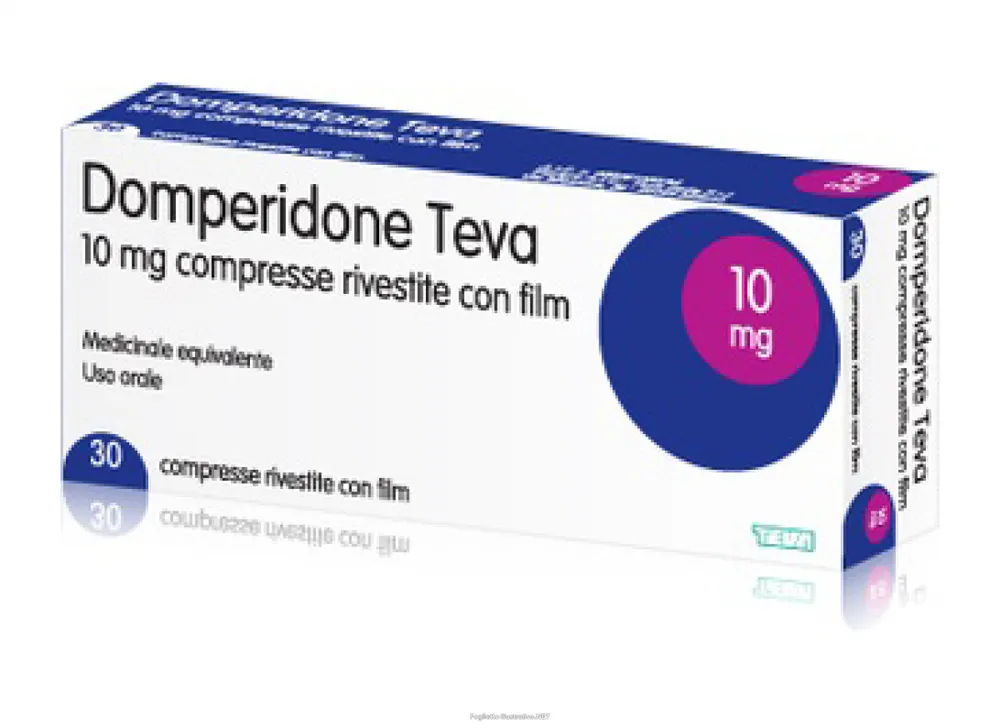
Table of Contents
- Package Leaflet: Information for the User
- Domperidone Teva 10 mg film-coated tablets
- 1. What Domperidone Teva is and what it is used for
- 2. What you need to know before taking Domperidone Teva
- 3. How to take Domperidone Teva
- 4. Possible side effects
- 5. How to store Domperidone Teva
- 6. Package contents and other information
Package Leaflet: Information for the User
Domperidone Teva 10 mg film-coated tablets
Equivalent medicine
▼Medicine subject to additional monitoring. This will allow rapid identification of new safety information. You can help by reporting any side effects you experience while taking this medicine. See the end of section 4 for information on how to report side effects.
Please read this leaflet carefully before taking this medicine because it contains important information for you.
- Keep this leaflet. You may need to read it again.
- If you have any questions, ask your doctor or pharmacist.
- This medicine has been prescribed for you only. Do not give it to others, even if their symptoms are the same as yours, as it could be harmful.
- If you experience any side effect, including those not listed in this leaflet, tell your doctor or pharmacist. See section 4.
Contents of this leaflet:
- What Domperidone Teva is and what it is used for
- What you need to know before taking Domperidone Teva
- How to take Domperidone Teva
- Possible side effects
- How to store Domperidone Teva
- Contents of the pack and other information
1. What Domperidone Teva is and what it is used for
This medicine is used to treat nausea and vomiting (feeling of discomfort) in adults and
adolescents (aged 12 years and older and weighing 35 kg or more).
2. What you need to know before taking Domperidone Teva
Do not take Domperidone Teva
If you are allergic to domperidone or to any of the ingredients of this medicine (listed in
section 6).
If you have stomach bleeding or regularly experience severe abdominal pain or persistent black stools.
If you have intestinal obstruction or perforation.
If you have a pituitary gland tumour (prolactinoma).
If you have moderate or severe liver disease.
If your ECG (electrocardiogram) shows a heart condition called “prolongation
of the QT interval”.
If you have or have had a condition in which your heart is unable to pump blood through the body properly (a condition known as heart failure).
If you have a condition causing low levels of potassium or magnesium, or high levels of potassium in your blood.
If you are taking certain medicines (see “Other medicines and Domperidone Teva”).
Warnings and precautions
Talk to your doctor before taking Domperidone Teva:
- if you have liver problems (hepatic impairment or liver failure) (see “Do not take Domperidone Teva”)
- if you have kidney problems (kidney damage or renal failure). Consult your doctor for advice if treatment is prolonged, as you may need to take a lower dose of this medicine or take it less frequently, and your doctor may wish to monitor you regularly. Domperidone may be associated with an increased risk of heart rhythm disorders and cardiac arrest. The risk may be higher in patients over 60 years of age or in those taking doses exceeding 30 mg per day. The risk is further increased when domperidone is taken together with other medicines. Inform your doctor or pharmacist if you are taking medicines for infections (fungal or bacterial infections) and/or if you have heart problems or AIDS/HIV (see section “Other medicines and Domperidone Teva”).
Domperidone should be used at the lowest effective dose in adults and children.
While taking domperidone, contact your doctor if you experience heart rhythm disturbances such as palpitations, difficulty breathing, or loss of consciousness. In such cases, treatment with domperidone must be stopped.
Children and adolescents
This medicine is not suitable for newborns, infants, children under 12 years of age, or adolescents weighing less than 35 kg. If Domperidone Teva is intended for a child, consult your doctor for a paediatric formulation.
Other medicines and Domperidone Teva
Tell your doctor or pharmacist if you are taking, have recently taken, or might take any other medicines.
Do not take Domperidone Teva if you are taking medicines for the treatment of:
- fungal infections, for example pentamidine or azole antifungals, particularly itraconazole, oral ketoconazole, fluconazole, posaconazole or voriconazole
- bacterial infections, particularly erythromycin, clarithromycin, telithromycin, levofloxacin, moxifloxacin, spiramycin (these medicines are antibiotics)
- heart problems or high blood pressure (e.g. amiodarone, dronedarone, ibutilide, disopyramide, dofetilide, sotalol, hydroquinidine, quinidine)
- psychosis (e.g. haloperidol, pimozide, sertindole)
- depression (e.g. citalopram, escitalopram)
- gastrointestinal disorders (e.g. cisapride, dolasetron, prucalopride)
- allergies (e.g. mequitazine, mizolastine)
- malaria (particularly halofantrine, lumefantrine)
- AIDS/HIV, such as ritonavir or saquinavir (these are protease inhibitors)
- hepatitis C (e.g. telaprevir)
- tumours (e.g. toremifene, vandetanib, vincamine)
Do not take Domperidone Teva if you are taking other medicines (e.g. bepridil, disopyramide, methadone).
Domperidone Teva and apomorphine
Before using Domperidone Teva and apomorphine together, your doctor will ensure that your body can tolerate taking both medicines simultaneously. Ask your doctor or specialist for personalised advice. Refer to the apomorphine package leaflet.
Inform your doctor or pharmacist if you are taking medicines for infections, heart conditions, AIDS/HIV, or Parkinson’s disease.
It is important to ask your doctor or pharmacist about the safety of Domperidone Teva when taking other medicines, including those available without a prescription.
Pregnancy and breastfeeding
If you are pregnant, think you might be pregnant, planning to become pregnant, or breastfeeding, consult your doctor or pharmacist before taking this medicine.
Pregnancy
It is not known whether the use of domperidone is harmful during pregnancy. If you are pregnant or think you may be pregnant, inform your doctor, who will decide whether you can take Domperidone Teva.
Breastfeeding
Small amounts of domperidone have been detected in breast milk. Domperidone may cause unwanted effects on the heart of a breastfed newborn. Domperidone Teva should only be used during breastfeeding if your doctor considers it strictly necessary. Consult your doctor before taking this medicine.
Driving and using machines
Some patients have reported dizziness or drowsiness after taking domperidone. Do not drive or operate machinery while taking Domperidone Teva until you know how this medicine affects you.
Domperidone Teva contains lactose
If your doctor has diagnosed you with an intolerance to certain sugars, contact them before taking this medicine.
3. How to take Domperidone Teva
Take this medicine exactly as instructed by your doctor or pharmacist. If you have
any doubts, consult your doctor or pharmacist.
Take Domperidone Teva before meals, as taking it after meals slightly reduces
the absorption of the medicine.
Duration of treatment:
Symptoms usually resolve within 3–4 days of taking this medicine. Do not take
Domperidone Teva for more than 7 days without consulting your doctor.
Adults and adolescents aged 12 years and older, and weighing 35 kg or more
The usual dose is one tablet taken three times a day, preferably before meals.
Take the tablet with some water or another liquid. Do not chew the tablet.
Do not take more than three tablets per day.
Patients with kidney problems
Your doctor may advise you to take a lower dose or to take the medicine less frequently.
Newborns, infants, children under 12 years of age, and adolescents weighing less than 35 kg
Domperidone Teva is not suitable for children under 12 years of age or adolescents weighing less than 35 kg.
If Domperidone Teva is intended for a child, ask your doctor for a formulation appropriate for children.
If you take more Domperidone Teva than you should
If you have taken an excessive amount of Domperidone Teva, contact your doctor, pharmacist,
or the nearest poison control center immediately, especially if the overdose was taken by a child. Signs
of an overdose may include restlessness, confusion, altered state of consciousness, seizures, abnormal
muscle movements, or tremors. In case of overdose, symptomatic treatment may be administered.
Electrocardiogram monitoring may be performed due to the possibility of a heart problem known as “QT interval prolongation”.
Information for the physician: careful patient observation is recommended, along with gastric lavage,
administration of activated charcoal, and general supportive measures. Anti-Parkinsonian anticholinergic drugs
may help counteract extrapyramidal disorders.
If you forget to take Domperidone Teva
Take the missed dose as soon as you remember. If it is almost time for your next dose, wait until then and continue your regular dosing schedule. Do not take a double dose to make up for a forgotten dose.
If you have any doubts about how to use this medicine, consult your doctor or pharmacist.
4. Possible side effects
Like all medicines, this medicine can cause side effects, although not everyone gets them.
Uncommon: may affect up to 1 in 100 people
- Involuntary movements of the face or arms and legs, excessive tremor, excessive muscle rigidity or muscle spasm.
Not known: (frequency cannot be estimated from the available data)
- Seizures.
- A type of reaction that may occur shortly after administration, characterised by skin rash, itching, shortness of breath and/or facial swelling.
- A severe hypersensitivity reaction that may occur shortly after administration, characterised by urticaria, itching, flushing, fainting, breathing difficulties and other possible symptoms.
- Cardiovascular disorders: disturbances in heart rhythm (fast or irregular heartbeat) have been reported; if this occurs, treatment must be stopped immediately. Domperidone may be associated with an increased risk of cardiac rhythm disturbances and cardiac arrest. This risk may be higher in people over 60 years of age or in those taking doses exceeding 30 mg per day. Domperidone should be used at the lowest effective dose in adults and children.
Stop treatment with Domperidone Teva and contact your doctor immediately if you experience any of the
above-mentioned side effects.
Other side effects:
Common: may affect up to 1 in 10 people
- Dry mouth.
Uncommon: may affect up to 1 in 100 people
- Anxiety.
- Restlessness.
- Nervousness.
- Loss of interest in sex or decreased interest in sex.
- Headache.
- Drowsiness.
- Diarrhoea.
- Rash.
- Itching.
- Urticaria.
- Breast pain or tenderness.
- Milk production from the breast.
- General feeling of malaise.
- Dizziness.
Not known: frequency cannot be estimated from the available data
- Upward movement of the eyes.
- Menstrual cycle blockage in women.
- Breast enlargement in men.
- Inability to urinate.
- Changes in certain laboratory test results.
- Worsening of restless legs syndrome (feeling of discomfort, with an irresistible urge to move the legs, and sometimes arms and other body parts) in patients with Parkinson's disease.
Some patients who have used domperidone for conditions and at dosages requiring medical supervision have experienced the following side effects:
Restlessness, swollen or enlarged breasts, unusual breast discharge, irregular menstrual cycles in women,
breastfeeding difficulties, depression, hypersensitivity.
Reporting of side effects
If you experience any side effect, including those not listed in this leaflet, please inform your doctor or pharmacist. You may also report side effects directly via the national reporting system at the following address: http://www.agenziafarmaco.gov.it/content/come-segnalare-una-sospetta-reazione-avversa
By reporting side effects, you can help provide more information on the safety of this medicine.
5. How to store Domperidone Teva
Keep this medicine out of the sight and reach of children.
Do not use this medicine after the expiry date stated on the carton or bottle following “EXP”.
The expiry date refers to the last day of that month.
Do not store above 25°C.
Do not dispose of any medicine via wastewater or household waste. Ask your pharmacist how to dispose of medicines you no longer use. This will help protect the environment.
6. Package contents and other information
What Domperidone Teva contains
- The active substance is domperidone maleate. Each Domperidone Teva tablet contains 12.73 mg of domperidone maleate (active substance), equivalent to 10 mg of domperidone.
- The other components are monohydrate lactose, maize starch, sodium lauryl sulfate, povidone (K30), microcrystalline cellulose, silica (anhydrous colloidal), magnesium stearate, hypromellose (5 mPa s), propylene glycol, talc, titanium dioxide (E171).
Description of the appearance of Domperidone Teva and pack sizes
Tablets in a polyethylene container with a press-and-turn cap or a screw cap made of polyethylene or polypropylene, containing
100 tablets.
Cardboard boxes containing 1, 2, 3, 4, 5, or 10 blisters (in PVC/Al) with 10 tablets each.
Cardboard boxes containing 20 blisters (in PVC/Al) with 20 tablets each.
Not all pack sizes may be marketed.
Marketing Authorisation Holder and Manufacturers
Marketing Authorisation Holder
Teva Italia S.r.l.
Piazzale Luigi Cadorna 4
20123 Milan
Italy
Manufacturers
Pharmachemie B.V.
P.O. Box 552 Swensweg 5-2003 RN Haarlem
The Netherlands
Teva Pharmaceutical Works Private Limited Company
Pallagi út 13
4042 Debrecen
Hungary