Distem
Italy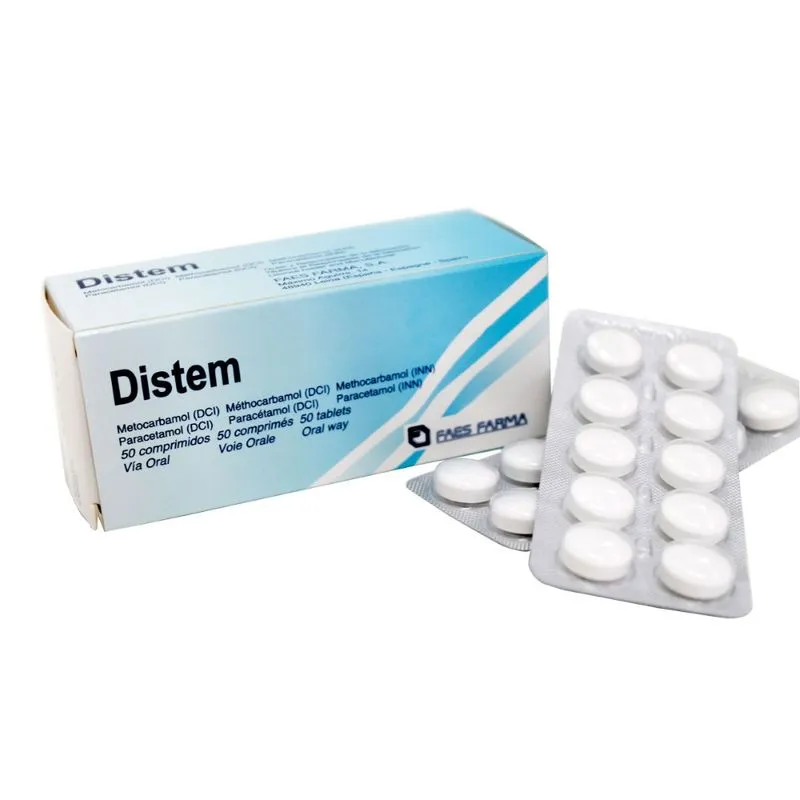
Table of Contents
Package leaflet: Information for the patient
Distem 380 mg/300 mg tablets
methocarbamol/paracetamol
Please read all of this leaflet carefully before you start taking this medicine because it contains important information for you.
- Keep this leaflet. You may need to read it again.
- If you have any questions, ask your doctor or pharmacist.
- This medicine has been prescribed for you only. Do not give it to others, even if they have the same symptoms as yours, because it could be harmful.
- If you experience any side effects, including those not listed in this leaflet, talk to your doctor or pharmacist. See section 4.
Contents of this leaflet
- What Distem is and what it is used for
- What you need to know before taking Distem
- How to take Distem
- Possible side effects
- How to store Distem
- Contents of the pack and other information
1. What Distem is and what it is used for
This medicinal product is a combination of an analgesic and antipyretic (to reduce pain and fever) and a muscle relaxant.
This medicinal product is an analgesic for pain and muscle stiffness and is used for the treatment of painful muscle spasms.
Treatment with metocarbamol should be as short as possible. When the pain subsides, your doctor will discontinue administration of this medicinal product. The duration of treatment depends on the symptoms but must not exceed 30 days.
2. What you need to know before taking Distem
Do not take Distem:
- if you are allergic or sensitive to metocarbamol and paracetamol or to any of the other ingredients of this medicine (listed in section 6).
- if you have any cerebral pathology.
- if you have suffered brain damage or have been in a coma.
- if you suffer from epilepsy or seizures.
- if you have muscle weakness (or a condition called myasthenia gravis).
Warnings and precautions
Do not exceed the recommended doses (see section 3 How to take Distem). Make sure you do not
take other medicines containing paracetamol at the same time (for example, cold remedies or other painkillers for fever).
Talk to your doctor or pharmacist before taking Distem:
-
if you regularly consume alcohol (more than three alcoholic drinks per day).
-
if you suffer from chronic alcoholism, as a precaution you should not ingest more than 2 g/day of paracetamol (maximum 6 tablets per day).
-
if you have liver or kidney disease, your doctor may adjust the dose, increase the interval between doses, and emphasize the importance of not prolonging treatment beyond what is necessary.
-
if you have heart or lung diseases or anemia.
-
if you are asthmatic and sensitive to aspirin.
-
if you are being treated with medicines for epilepsy. See below: Other medicines and Distem. When used concurrently, the effectiveness decreases and the hepatotoxicity of paracetamol increases, especially with high-dose paracetamol regimens.
During treatment with Distem, inform your doctor immediately if you develop serious conditions, including
severe renal impairment or sepsis (when bacteria and their toxins circulate in the blood causing
organ damage), malnutrition, chronic alcoholism, or if you are also taking flucloxacillin (an
antibiotic). In patients with these conditions, a serious condition called metabolic acidosis (an abnormality in blood and body fluids) has been reported when paracetamol is used regularly for prolonged periods or when paracetamol is taken in combination with flucloxacillin. Symptoms
of metabolic acidosis may include: severe breathing difficulties with rapid, deep breathing, drowsiness, nausea, and vomiting.
Analytical interferences
If you need to undergo any diagnostic tests, inform your doctor that you are taking this medicine,
as it may alter test results. Paracetamol may affect the analytical values of uric acid and glucose measurements.
Other medicines and Distem
Tell your doctor or pharmacist if you are taking, have recently taken, or might take any other medicines, including those without a prescription.
Metocarbamol may interact with the following medicines:
- Barbiturates (used for epilepsy or to promote sleep)
- Appetite suppressants (used to help lose weight)
- Anticholinergics (used to relieve spasms or contractions of the intestine and bladder, or motion sickness)
- Psychotropic medicines (used to treat anxiety, depression, or other mental disorders)
- Anaesthetics (if you are undergoing anaesthesia for any reason, inform your doctor or dentist that you are taking this medicine)
- Anticholinesterases (used for the treatment of myasthenia gravis).
Paracetamol may interact with the following medicines:
-
Oral anticoagulants (used to treat thromboembolic disorders)
-
Antiepileptic drugs (used to treat epileptic seizures)
-
Antibiotics (chloramphenicol)
-
Contraceptives
-
Diuretics (used to increase urine elimination)
-
Isoniazid (used to treat tuberculosis)
-
Metoclopramide and domperidone (used to treat vomiting)
-
Probenecid (used to treat gout)
-
Propranolol (used to treat hypertension and cardiac arrhythmias)
-
Rifampicin (used to treat tuberculosis)
-
Anticholinergics (used to relieve spasms or contractions of the intestine and bladder)
-
Zidovudine (used to treat HIV infections)
-
Colestipol (used to lower blood cholesterol levels)
Inform your doctor or pharmacist if you are taking flucloxacillin (an antibiotic), due to a serious
risk of blood and fluid abnormalities (called metabolic acidosis) that require urgent treatment (see section 2).
Do not use together with other analgesics (painkillers) without consulting your doctor.
This medicine contains less than 1 mmol (23 mg) of sodium per tablet, i.e. essentially ‘sodium-free’.
Distem with food, drinks and alcohol
You should avoid drinking alcohol while taking this medicine. Alcohol may enhance
the central nervous system depressant effect of metocarbamol. The use of paracetamol in
patients who regularly consume alcohol (three or more alcoholic drinks per day: beer, wine,
spirits...) may cause liver damage.
Pregnancy and breastfeeding
If you are pregnant, suspect you may be pregnant, planning a pregnancy, or breastfeeding, consult your doctor before taking this medicine.
Pregnancy
The use of this medicine during pregnancy is not recommended. If you discover you are pregnant
during treatment, consult your doctor immediately so that your treatment can be adjusted
accordingly.
Breastfeeding
Women who are breastfeeding should consult their doctor before taking this medicine. Your
doctor will discuss with you whether you should breastfeed your baby. Metocarbamol and/or its metabolites have been detected in dog milk; however, it is not known whether metocarbamol or its metabolites are excreted in human breast milk. Paracetamol is excreted in breast milk, but not in clinically significant amounts.
Driving and using machines
This medicine may cause drowsiness; therefore, it is not advisable to drive or operate machinery until you know how this medicine affects you. This is particularly important if you have consumed alcohol or are taking other medicines that may cause drowsiness.
3. How to take Distem
Take this medicine exactly as directed by your doctor. If you have any doubts, consult your doctor.
Recommended dose:
Adults
The recommended dose is 2 tablets, four to six times daily, depending on the severity of symptoms. You should not take more than 12 tablets in 24 hours, and the interval between doses must not be less than 4 hours.
Elderly patients
Elderly patients may require a lower dose to achieve the same relief from pain and muscle spasms. The recommended dose is 1 tablet, 4 times daily.
Patients with kidney or liver problems
A longer interval between doses may be required.
Carefully follow your doctor's recommendations (see section 2. What you need to know before taking Distem).
Depending on the severity of kidney impairment, your doctor will advise whether you should take 1 tablet every 6–8 hours.
If you suffer from severe liver disease, you must not take more than 6 tablets in 24 hours.
Use in children and adolescents
Use is not recommended in children or adolescents under 18 years of age due to lack of data on safety and efficacy in this population.
This medicine is administered orally.
The score line on the tablet is intended to facilitate breaking the tablet in case you have difficulty swallowing it whole.
Swallow the tablets without chewing, with a sufficient amount of liquid.
Treatment with this medicine should be as short as possible. Your doctor will determine the duration of treatment, which will depend on the presence of painful symptoms or muscle contractions. When symptoms disappear, your doctor will discontinue the medicine.
Remember to take your medicine as prescribed. Do not exceed the recommended dose.
If you feel that the effect of Distem is too strong or too weak, inform your doctor or pharmacist.
If you take more Distem than you should
If you take more Distem than you should, contact your doctor, pharmacist, or hospital emergency department immediately. Bring the Distem packaging with you.
If you forget to take Distem
Do not take a double dose to make up for a missed dose. If you are sure you have forgotten to take a tablet on time, take it as soon as possible, then continue with your regular dosing schedule. Always allow at least 4 hours to pass before taking another tablet. If in doubt, consult your doctor or pharmacist.
If you stop taking Distem
If you have any further questions about the use of this medicine, ask your doctor or pharmacist.
4. Possible side effects
Like all medicines, this medicine can cause side effects, although not everybody gets them.
If you experience any of the following reactions, stop treatment immediately and inform your doctor straight away:
- allergic reactions ranging from simple skin rash or urticaria to more severe reactions such as anaphylactic reaction or angioedema (skin rash, itching, swelling of the extremities, face, lips, mouth or throat which may cause difficulty in swallowing or breathing) or severe skin reactions;
- jaundice (yellowing of the skin and whites of the eyes), indicating a liver problem;
- if you develop an infection with symptoms such as fever and pain, contact your doctor immediately, as this may indicate changes in white blood cells or platelets in the blood, reducing resistance to infections;
- seizures or fainting (syncope).
The following adverse reaction may occur rarely (may affect up to 1 in 1,000 people):
- headache, dizziness or vertigo;
- conjunctivitis with nasal congestion;
- decrease in arterial blood pressure, metallic taste, increased liver transaminases;
- fever, malaise.
The following adverse reactions may occur very rarely (may affect up to 1 in 10,000 people):
- nausea, vomiting;
- nervousness, anxiety, confusion, tremor, somnolence, blurred vision, nystagmus (rapid, involuntary eye movements);
- low blood sugar levels, decreased heart rate, skin flushing;
- renal toxicity (dark urine);
- difficulty breathing.
The following adverse reactions have been reported, but their frequency cannot be estimated from the available data:
- mild muscle incoordination, memory loss, dizziness, insomnia, double vision;
- heartburn, dry mouth, fatigue, diarrhoea;
- severe condition that may make the blood more acidic (called metabolic acidosis) in patients with a serious underlying illness who are using paracetamol (see section 2).
Reporting of side effects
If you experience any side effect, including those not listed in this leaflet, talk to your doctor or pharmacist. You can also report side effects directly via the national reporting system at www.aifa.gov.it/content/segnalazioni-reazioni-avverse.
By reporting side effects, you can help provide more information on the safety of this medicine.
5. How to store Distem
Keep this medicine out of the sight and reach of children.
Do not use this medicine after the expiry date stated on the carton and blister after
Exp. The expiry date refers to the last day of that month.
This medicine does not require any special storage conditions. Store in the
original packaging.
Do not use this medicine if you notice any visible signs of deterioration.
Do not dispose of medicines via wastewater or household waste. Ask your pharmacist how to
dispose of medicines you no longer use. This will help protect the environment.
6. Package contents and other information
What Distem 380 mg/300 mg tablets contain
- The active substances are methocarbamol and paracetamol. Each tablet contains 380 mg of methocarbamol and 300 mg of paracetamol.
- The other components are: stearic acid, pregelatinized corn starch, croscarmellose sodium, magnesium stearate, anhydrous colloidal silicon dioxide, povidone K-30, glycerol distearate type I, sodium starch glycolate type A and talc.
Description of the appearance of Distem and contents of the pack
Distem 380 mg/300 mg tablets are round, biconvex, white tablets, 14 mm in diameter and 7 mm in height, with a score line on one side. They are supplied in PVC-aluminum blisters, in packs containing 20, 30 or 50 tablets.
Marketing Authorization Holder
Bruno Farmaceutici S.p.A.
Via delle Ande, 15
00144 ROMA
Manufacturer
Faes Farma, S.A.
Maximo Agirre Kalea, 14
48940 Leioa (Bizkaia)
Spain
Or
Faes Farma, S.A.
Parque Científico y Tecnológico de Bizkaia
Ibaizabal Bidea, Edificio 901
48160 Derio (Bizkaia)
Spain