Disipal
Italy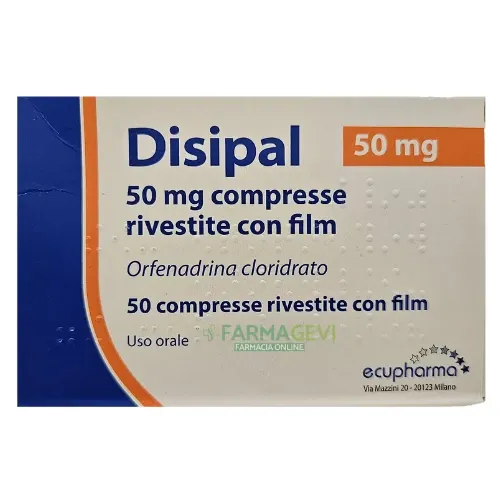
Table of Contents
Package leaflet: Information for the patient
Disipal 50 mg film-coated tablets
Orphenadrine hydrochloride
Please read this leaflet carefully before taking this medicine because it contains
important information for you.
- Keep this leaflet. You may need to read it again.
- If you have any questions, ask your doctor or pharmacist.
- This medicine has been prescribed for you only. Do not give it to other people, even if their symptoms are the same as yours, as it may be harmful.
- If you experience any side effects, including those not listed in this leaflet, contact your doctor or pharmacist. See section 4.
Contents of this leaflet:
- What Disipal is and what it is used for
- What you need to know before taking Disipal
- How to take Disipal
- Possible side effects
- How to store Disipal
- Contents of the pack and other information
1. What Disipal is and what it is used for
Disipal contains orphenadrine hydrochloride.
Disipal is indicated in adults for the treatment of:
- Parkinson’s disease, a central nervous system disorder that may cause tremors, slowed movement, and difficulty maintaining balance;
- movement disorders associated with the use of medications used to treat mental disorders;
- dizziness;
- muscle spasms causing pain.
2. What you should know before taking Disipal
Do not take Disipal
- if you are allergic to orphenadrine hydrochloride or to any of the other ingredients of this medicine (listed in section 6);
- if you have a disease of the eye characterized by increased pressure of the fluid inside the eye (glaucoma);
- if you have an enlarged prostate, the gland in men that produces seminal fluid (prostatic hypertrophy);
- if you have a blockage of the stomach or intestines;
- if you are unable to urinate;
- if you have a stomach lesion that makes emptying difficult (stenosing peptic ulcer);
- if you have a disease of the esophagus causing irregular passage of food (cardiospasm);
- if you suffer from a serious muscle disorder that may lead to paralysis (myasthenia gravis);
- if you have had an allergic reaction to the drug;
- if you have movement disorders and have previously taken medicines to treat mental illnesses (tardive dyskinesia);
- if you suffer from a blood disorder (porphyria).
Warnings and precautions
Talk to your doctor or pharmacist before taking Disipal:
- if you have difficulty urinating;
- if you are pregnant or breastfeeding;
- if you have a heart disease;
- if you have a liver or kidney disease;
- if you are elderly.
Other medicines and Disipal
Inform your doctor or pharmacist if you are taking, have recently taken, or might take any other medicine, especially:
- psychotropic drugs (medicines for the treatment of mental disorders): your doctor will monitor you closely during treatment;
- dextropropoxyphene (a medicine for the treatment of pain): in this case, your doctor will reduce your dose or discontinue treatment with one of the two medicines;
- antimuscarinics (medicines similar to Disipal).
Pregnancy and breastfeeding
If you are pregnant, suspect you may be pregnant, planning a pregnancy, or are breastfeeding, ask your doctor or pharmacist for advice before taking this medicine.
Take Disipal during pregnancy or breastfeeding only if instructed by your doctor.
Driving and using machines
During treatment with Disipal, exercise particular caution when driving or operating machinery, as you may experience drowsiness or slowed reaction times.
Disipal contains sucrose
If your doctor has diagnosed you with an intolerance to certain sugars, consult him before taking this medicine.
Disipal contains Sunset Yellow FCF (E110) and Tartrazine (E102)
These may cause allergic reactions.
Sodium content
This medicine contains less than 1 mmol of sodium (23 mg per film-coated tablet), i.e. it is essentially "sodium-free".
3. How to take Disipal
Take this medicine exactly as directed by your doctor or pharmacist.
If you have any doubts, consult your doctor or pharmacist.
Parkinson's disease
The recommended starting dose is 2-3 film-coated tablets per day, to be increased gradually (1 film-coated tablet every 3 days) until the optimal effect is achieved. Your doctor will determine the optimal dose for you. When switching from other medications to Disipal, replace the previous preparation gradually with Disipal (1 film-coated tablet at a time every 3 days). In this case too, your doctor will determine the optimal dose for you.
Movement disorders associated with taking medicines used to treat mental disorders
The recommended dose is 2 to 6 film-coated tablets per day. Your doctor will determine the optimal dose for you.
Vertigo
The recommended starting dose is 1 film-coated tablet per day, which may be increased up to 3 film-coated tablets per day. Your doctor will determine the optimal dose for you.
Muscle cramps causing pain
The recommended dose is 3 film-coated tablets per day. Your doctor will determine the optimal dose for you.
Swallow the film-coated tablet with a glass of water.
If you take more Disipal than you should
In case of accidental overdose, immediately contact your doctor or go to the nearest hospital.
If you forget to take Disipal
Do not take a double dose to make up for the missed tablet.
If you stop taking Disipal
Do not stop treatment with Disipal abruptly.
If you have any questions about the use of this medicine, consult your doctor or pharmacist.
4. Possible side effects
Like all medicines, this medicine can cause side effects, although not everyone gets them.
The possible side effects, which in some cases have been observed at high doses or in elderly patients and which may disappear with dose reduction, are listed below according to their frequency:
Common (may affect up to 1 in 10 people)
- feeling of instability
- difficulty focusing images (accommodation disorders)
- dry mouth
- stomach and intestinal disturbances
Uncommon (may affect up to 1 in 100 people)
- allergy
- confusion
- nervousness
- perception of things that do not exist in reality (hallucination)
- insomnia
- euphoria
- sedation
- uncontrolled body movements (convulsions)
- rapid heartbeat (tachycardia)
- inability to urinate
Rare (may affect up to 1 in 1,000 people)
- memory disorders
Not known (frequency cannot be estimated from the available data)
- drowsiness
- dizziness
- headache
- vertigo
- tremors
- mental confusion and disorientation
- increased pressure of the fluid inside the eye (increased intraocular pressure)
- nausea
- vomiting
- constipation
- itching
- weakness
Reporting of side effects
If you experience any side effect, including those not listed in this leaflet, please contact your doctor. You can also report side effects directly via the national reporting system at www.aifa.gov.it/content/segnalazioni-reazioni-avverse.
By reporting side effects, you can help provide more information on the safety of this medicine.
5. How to store Disipal
Keep this medicine out of the sight and reach of children.
This medicine does not require any special storage temperature.
Keep the blister in the outer packaging to protect the medicine from light.
Do not use this medicine after the expiry date stated on the carton and blister after Exp.
The expiry date refers to the last day of that month.
Do not dispose of medicines via wastewater or household waste. Ask your pharmacist how to
dispose of medicines you no longer use. This will help protect the environment.
6. Package contents and other information
What Disipal contains
- The active substance is orphenadrine hydrochloride 50 mg, equivalent to 44.039 mg of orphenadrine.
- The other components are microcrystalline cellulose, pregelatinized corn starch, stearic acid, magnesium stearate, anhydrous colloidal silica. The excipients forming the tablet film coating are: talc, hypromellose, sucrose, titanium dioxide, calcium carbonate, yellow iron oxide, sunset yellow FCF (E110), tartrazine (E102), carnauba wax, water and shellac. Description of the appearance of Disipal and package contents Disipal is presented as film-coated tablets, yellow in colour and round in shape. It is available in cardboard boxes containing 50 film-coated tablets, packed in PVC/PVDC/Al blisters.
Marketing Authorization Holder and Manufacturer
Marketing Authorization Holder:
Ecupharma S.r.l.
Via Mazzini, 20
20123 Milano (MI)
Italy
Manufacturer:
Laboratorio Farmacologico Milanese S.r.l.
Via Monterosso 273
21042 - Caronno Pertusella (VA)