Dicloreum anti-inflammatory local
Italy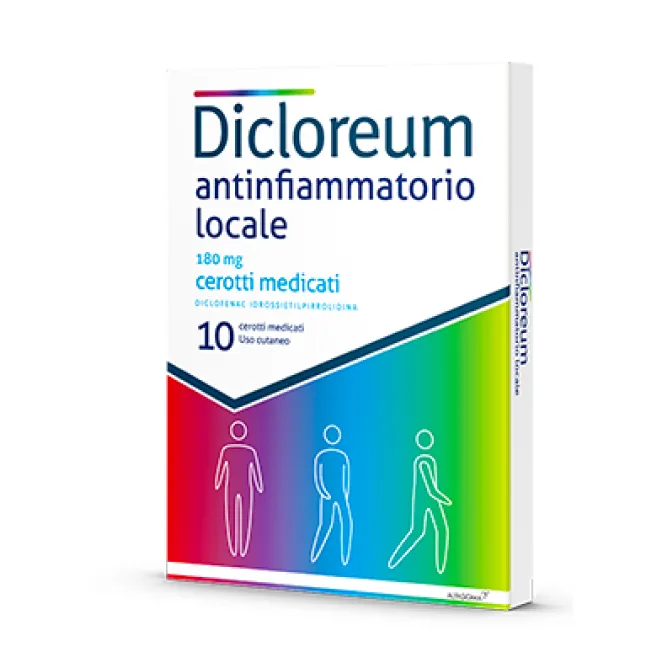
Table of Contents
- Patient Information Leaflet: Information for the User
- Dicloreum Anti-inflammatory 180 mg medicated patches
- 1. What Dicloreum Anti-inflammatory Local is and what it is used for
- 2. What you need to know before using Dicloreum Antinfiammatorio Locale
- 3. How to use Dicloreum Antinfiammatorio Locale
- 4. Possible side effects
- 5. How to store Dicloreum Antinfiammatorio Locale
- 6. Package contents and other information
- Package leaflet: information for the user
- Dicloreum Anti-inflammatory Topical 3% Cutaneous Foam, Pressurized Container
- 1. What Dicloreum Antinfiammatorio Locale is and what it is used for
- 2. What you need to know before using Dicloreum Anti-inflammatory Local
- 3. How to use Dicloreum Antinfiammatorio Locale
- 4. Possible side effects
- 5. How to store Dicloreum Anti-inflammatory Local Use
- 6. Package contents and other information
Patient Information Leaflet: Information for the User
Dicloreum Anti-inflammatory 180 mg medicated patches
Diclofenac hydroxyethylpyrrolidone
Please read this leaflet carefully before using this medicine because it contains important information for you.
Use this medicine exactly as described in this leaflet or as your doctor or pharmacist has instructed.
- Keep this leaflet. You may need to read it again.
- If you need more information or advice, consult your pharmacist.
- If you experience any side effects, including those not listed in this leaflet, consult your doctor or pharmacist. See section 4.
- Consult your doctor if you do not notice improvement or if you experience worsening of symptoms after the recommended treatment period (7 days in adolescents, 14 days in adults).
Contents of this leaflet:
- What Dicloreum Anti-inflammatory is and what it is used for
- What you need to know before using Dicloreum Anti-inflammatory
- How to use Dicloreum Anti-inflammatory
- Possible side effects
- How to store Dicloreum Anti-inflammatory
- Contents of the pack and other information
1. What Dicloreum Anti-inflammatory Local is and what it is used for
Dicloreum Anti-inflammatory Local is a medicated patch for application on the skin, containing the active substance diclofenac hydroxyethylpyrrolidine, which belongs to a class of medicines called non-steroidal anti-inflammatory drugs (NSAIDs).
Dicloreum Anti-inflammatory Local is indicated for the local treatment of pain and inflammation affecting joints, muscles, tendons, and ligaments due to rheumatic diseases or trauma.
2. What you need to know before using Dicloreum Antinfiammatorio Locale
Do not use Dicloreum Antinfiammatorio Locale
- if you are allergic to diclofenac or to any of the other ingredients of this medicine (listed in section 6).
- if you are allergic to medicines containing acetylsalicylic acid (e.g. aspirin) or other non-steroidal anti-inflammatory drugs (NSAIDs), or to a disinfectant called isopropanol.
- if you have previously experienced asthma attacks, skin rash (urticaria), or cold-like symptoms (acute rhinitis) after taking medicines containing acetylsalicylic acid (e.g. aspirin) or other non-steroidal anti-inflammatory drugs (NSAIDs).
- if you have damaged skin, regardless of the type of lesion: allergic reactions (exudative dermatitis, eczema), infected lesions, burns, or wounds.
- if you are in the last 3 months of pregnancy or during breastfeeding (see section “Pregnancy, breastfeeding and fertility”).
- if you suffer from gastrointestinal disorders (active peptic ulcer).
- in children and adolescents under 16 years of age.
Warnings and precautions
The use, especially if prolonged and over large skin areas, of topical anti-inflammatory medicines
may lead to undesirable systemic effects.
The medicated patch must be applied only on intact, healthy skin, without wounds or open lesions.
Take care to avoid contact of the patches with eyes or mucous membranes.
The medicated patch must not be covered with an airtight bandage, and should not be worn while bathing or showering.
Undesirable effects can be minimized by using the lowest effective dose for the shortest duration necessary to control symptoms.
Use Dicloreum Antinfiammatorio Locale with particular caution:
- if you suffer from kidney, heart, or liver disease, if you have previously had gastrointestinal disorders (peptic ulcer), inflammatory bowel disease, or a tendency to bleeding (haemorrhagic diathesis).
- if you are elderly, as you may be more susceptible to adverse effects.
Use Dicloreum Antinfiammatorio Locale only after consulting your doctor:
- if you have had or currently have allergic reactions, such as asthma attacks, skin rashes (urticaria), or acute allergic rhinitis, after taking non-steroidal anti-inflammatory drugs (NSAIDs).
- in case of damaged skin, regardless of the type of lesion: allergic reactions (exudative dermatitis, eczema), infected lesions, burns, or wounds.
- if you currently suffer or have previously suffered from peptic ulcer.
Stop treatment immediately and consult your doctor or pharmacist:
- if a skin rash (rash) appears after applying the medicated patch.
Avoid excessive exposure to sunlight during and for approximately one day after removal of the medicated patch to reduce the risk of possible photosensitivity reactions.
Other medicines and Dicloreum Antinfiammatorio Locale
Inform your doctor or pharmacist if you are currently taking, have recently taken, or might take any other medicines.
Do not use another diclofenac-containing medicine or other non-steroidal anti-inflammatory drugs (NSAIDs), either topically or systemically, at the same time.
Since this medicine acts locally on the skin, absorption of the active ingredient into the body is very low, making interactions with other medicines or food unlikely.
Pregnancy, breastfeeding and fertility
If you are pregnant, think you may be pregnant, planning a pregnancy, or breastfeeding, consult your doctor or pharmacist before using this medicine.
Pregnancy
Do not use Dicloreum Antinfiammatorio Locale during the last 3 months of pregnancy (see section “Do not use Dicloreum Antinfiammatorio Locale”) because non-steroidal anti-inflammatory drugs (NSAIDs) may cause:
- heart, lung, and kidney damage in the fetus
- prolonged bleeding time in both mother and newborn
- inhibition of uterine contractions in the mother, leading to delayed or prolonged labour.
Do not use Dicloreum Antinfiammatorio Locale during the first 6 months of pregnancy unless strictly necessary and under medical advice. If treatment is required during this period, the lowest possible dose for the shortest possible duration should be used.
Oral forms (e.g. tablets) of diclofenac may cause adverse effects in the newborn. It is not known whether the same risk applies with Dicloreum Antinfiammatorio Locale when applied to the skin.
Breastfeeding
As with other non-steroidal anti-inflammatory drugs, diclofenac contained in this medicine is excreted in breast milk.
At the recommended doses of Dicloreum Antinfiammatorio Locale, effects on the breastfed infant are not expected. However, due to the lack of adequate studies, breastfeeding women should use this medicine only under the advice of a doctor or pharmacist. In such cases, avoid applying the medicine on the breast, or over large skin areas and for prolonged periods (see section “Warnings and precautions”).
Driving and using machines
Dicloreum Antinfiammatorio Locale does not impair the ability to drive or operate machinery.
Dicloreum Antinfiammatorio Locale contains methyl parahydroxybenzoate (E218), propyl parahydroxybenzoate (E216), propylene glycol, and fragrance.
Methyl parahydroxybenzoate (E218) and propyl parahydroxybenzoate (E216) may cause allergic reactions (including delayed reactions).
This medicine contains 420 mg of propylene glycol per patch, which may cause skin irritation.
This medicine contains a fragrance which itself contains allergens (amyl cinnamal, cinnamyl alcohol, benzyl alcohol, benzyl benzoate, benzyl salicylate, cinnamal, cinnamyl alcohol, citronellol, d-Limonene, eugenol, farnesol, geraniol, alpha-hexyl cinnamaldehyde, hydroxycitronellal, isoeugenol, linalool, methyl heptine carbonate) that may cause allergic reactions.
3. How to use Dicloreum Antinfiammatorio Locale
Use this medicine exactly as stated in this leaflet or as directed by your doctor or pharmacist. If you have any doubts, consult your doctor or pharmacist.
Instructions for use:
- Apply one patch at a time
- For external use only
- Do not exceed the recommended doses
Use in adults
The usual dose is 1 or 2 patches per day (one application every 12 or 24 hours) for up to 14 days.
If no improvement is observed after the recommended treatment period, you should consult a doctor.
Use in adolescents aged 16 years and older
In adolescents aged 16 years and older, if the product is required for a treatment period longer than 7 days for pain relief, or if symptoms worsen, the patient or the adolescent's caregivers should consult a doctor.
Use in children and adolescents under 16 years of age
Dicloreum Antinfiammatorio Locale must not be used in children and adolescents under 16 years of age, as there are insufficient data available to evaluate the safety and efficacy of the medicine in this age group.
Use in elderly patients
This medicine should be used with caution in elderly patients, who are more predisposed to adverse effects (see "Warnings and precautions").
Use in patients with hepatic or renal impairment
For use of diclofenac medicated patches in patients with hepatic or renal impairment, refer to the section "Warnings and precautions".
The diclofenac medicated patch should be used for the shortest duration possible according to the indication.
How to apply the Dicloreum Antinfiammatorio Locale medicated patch
- Apply only to intact, healthy skin and not during bathing or showering.
- Cut open the pouch containing the medicated patch as indicated.
- Remove one medicated patch, peel off the plastic film protecting the adhesive surface, and apply the patch to the affected joint or painful area.
- If necessary, the patch may be secured in place with an elastic bandage.
- Reseal the pouch carefully by pressing together the edges at the closure strip.
- The patch must be used whole.
If you use more Dicloreum Antinfiammatorio Locale than you should
Inform your doctor immediately or go to the nearest hospital if you have used excessive doses or accidentally ingested Dicloreum Antinfiammatorio Locale orally.
Cases of overdose with diclofenac medicated patches have not been reported.
However, if systemic adverse effects occur due to incorrect use or accidental overdose (e.g., in children), seek immediate medical advice. The doctor will implement general supportive measures appropriate for intoxication with non-steroidal anti-inflammatory drugs.
4. Possible side effects
Like all medicines, this medicine can cause side effects, although not everyone gets them.
Stop using Dicloreum Antinfiammatorio Locale and contact your doctor or pharmacist immediately if you notice any of the following side effects:
Common side effects (may affect up to 1 in 10 people):
- skin rash
- severe skin redness (erythema) and appearance of blisters (eczema)
- inflammatory or allergic skin reactions (allergic dermatitis and contact dermatitis), itching
- reactions at the application site
Rare side effects (may affect up to 1 in 1,000 people):
- skin inflammation with blistering (bullous dermatitis)
- dry skin
Very rare side effects (may affect up to 1 in 10,000 people):
- allergic reactions, including skin rash (urticaria)
- severe allergic reaction (anaphylactoid reaction) with symptoms such as restlessness, low blood pressure, nausea, etc.
- widespread swelling of the skin (angioneurotic edema)
- skin rash with raised skin lesions (pustules)
- absence of or difficulty in breathing (asthma)
- skin reactions to sunlight (photosensitivity)
Reporting of side effects
If you experience any side effect, including those not listed in this leaflet, please consult your doctor or pharmacist. You may also report side effects directly via the national reporting system at https://www.aifa.gov.it/content/segnalazioni-reazioni-avverse.
By reporting side effects, you can help provide more information on the safety of this medicine.
5. How to store Dicloreum Antinfiammatorio Locale
Keep this medicine out of the sight and reach of children.
Do not use this medicine after the expiry date stated on the packaging.
Store this medicine in its original packaging at a temperature not exceeding 30 °C.
After first opening, the product is valid for 3 months provided that the sachet containing the medicated patches is
properly resealed.
Do not dispose of any medicine via wastewater or household waste. Ask your pharmacist how to dispose of medicines you no longer use. This will help protect the environment.
6. Package contents and other information
What Dicloreum Anti-inflammatory Local contains
- The active substance is diclofenac hydroxyethylpyrrolidine. One medicated patch contains 180 mg of diclofenac hydroxyethylpyrrolidine (equivalent to 140 mg of sodium diclofenac).
- The other components of the medicinal product are: gelatin, povidone, d-sorbitol 70% solution, kaolin, titanium dioxide, propylene glycol, methyl parahydroxybenzoate (E218), propyl parahydroxybenzoate (E216), disodium edetate, tartaric acid, dihydroxyaluminium aminoacetate, sodium carmellose, sodium polyacrylate, 1,3-butylene glycol, polysorbate 80, fragrance, purified water, synthetic felt, plastic film.
Description of the appearance of Dicloreum Anti-inflammatory Local and contents of the pack
Dicloreum Anti-inflammatory Local is available as a medicated patch.
Pack contents: 5, 8 or 10 medicated patches.
It is possible that not all pack sizes are marketed.
Marketing Authorization Holder and Manufacturer
Marketing Authorization Holder:
Alfasigma S.p.A. – Via Ragazzi del ‘99, n. 5 - 40133 Bologna (BO)
Manufacturer:
Altergon Italia S.r.l. – Morra De Sanctis (AV), Italy.
Package leaflet: information for the user
Dicloreum Anti-inflammatory Topical 3% Cutaneous Foam, Pressurized Container
Diclofenac
Please read this leaflet carefully before using this medicine as it contains important information for you.
Always use this medicine exactly as described in this leaflet or as your doctor or pharmacist has instructed.
- Keep this leaflet. You may need to read it again.
- If you need more information or advice, consult your pharmacist.
- If you experience any side effects, including those not listed in this leaflet, consult your doctor or pharmacist. See section 4.
- Consult your doctor if you do not notice any improvement, or if your symptoms worsen after 7 days.
Contents of this leaflet:
- What Dicloreum Anti-inflammatory Topical is and what it is used for
- What you need to know before using Dicloreum Anti-inflammatory Topical
- How to use Dicloreum Anti-inflammatory Topical
- Possible side effects
- How to store Dicloreum Anti-inflammatory Topical
- Contents of the pack and other information
1. What Dicloreum Antinfiammatorio Locale is and what it is used for
Dicloreum Antinfiammatorio Locale is a topical foam containing the active substance diclofenac, which belongs to a group of medicines called non-steroidal anti-inflammatory drugs (NSAIDs).
Dicloreum Antinfiammatorio Locale is indicated for the local treatment of pain and inflammation affecting joints, muscles, tendons, and ligaments due to rheumatic diseases or trauma.
2. What you need to know before using Dicloreum Anti-inflammatory Local
Do not use Dicloreum Anti-inflammatory Local
- if you are allergic to diclofenac or to any of the other ingredients of this medicine (listed in section 6).
- if you are allergic to medicines containing acetylsalicylic acid (e.g. aspirin) and other non-steroidal anti-inflammatory drugs (NSAIDs), or to a disinfectant called isopropanol.
- if you have previously experienced asthma attacks, skin rash (urticaria), or rhinitis after taking medicines containing acetylsalicylic acid (e.g. aspirin), other non-steroidal anti-inflammatory drugs, or isopropanol.
- during the last 3 months of pregnancy, as it may cause heart, lung, and kidney damage to the fetus (see section “Pregnancy, breastfeeding and fertility”).
- in children and adolescents under 14 years of age, as there is no safety and efficacy data available for this age group.
Warnings and precautions
The use, especially prolonged and over large areas of skin, of topical anti-inflammatory medicines may cause systemic adverse effects.
Use Dicloreum Anti-inflammatory Local:
- only on intact, healthy skin without wounds or open lesions.
- only with breathable dressings, not with tight bandages.
Take care to avoid contact of the foam with the eyes, and avoid swallowing it.
Use Dicloreum Anti-inflammatory Local with particular caution:
- if you have previously had allergic reactions, such as asthma attacks, skin rashes, or acute allergic rhinitis, after taking non-steroidal anti-inflammatory drugs or painkillers.
- if you suffer from asthma, chronic obstructive bronchial disease, allergic rhinitis, or inflammation of the nasal mucosa (nasal polyps), as you may be more likely than other patients to experience asthma attacks, local skin or mucosal inflammation (Quincke's edema), or skin rash (urticaria).
- if you are elderly or have stomach problems, because you should avoid taking other anti-inflammatory medicines by mouth, suppository, or injection at the same time as this medicine.
Stop treatment and consult your doctor or pharmacist:
- if a skin rash appears after applying the medicine.
- if allergic reactions occur after application, especially if prolonged, of other topical medicines.
Avoid excessive exposure to sunlight during treatment with Dicloreum Anti-inflammatory Local to prevent possible photosensitivity reactions.
Other medicines and Dicloreum Anti-inflammatory Local
Inform your doctor or pharmacist if you are currently taking, have recently taken, or might take any other medicines.
Since this medicine acts locally on the skin, absorption of the active ingredient into the body is very low, and interactions with other medicines or food are unlikely.
However, if you use this medicine at high doses or for long periods, you should consult your doctor or pharmacist.
Pregnancy, breastfeeding and fertility
If you are pregnant, think you might be pregnant, planning to become pregnant, or breastfeeding, consult your doctor or pharmacist before using this medicine.
Pregnancy
Do not use Dicloreum Anti-inflammatory Local during the last 3 months of pregnancy (see section “Do not use Dicloreum Anti-inflammatory Local”), as non-steroidal anti-inflammatory drugs may cause:
- heart, lung, and kidney damage in the fetus
- prolonged bleeding time in both mother and newborn
- inhibition of uterine contractions in the mother, leading to delayed or prolonged labor.
Do not use Dicloreum Anti-inflammatory Local during the first 6 months of pregnancy unless strictly necessary and under medical advice. If treatment is required during this period, the lowest effective dose for the shortest possible duration should be used.
Oral forms (e.g. tablets) of diclofenac may cause adverse effects in the newborn. It is not known whether the same risk applies with Dicloreum Anti-inflammatory Local when applied to the skin.
Breastfeeding
Like other non-steroidal anti-inflammatory drugs, diclofenac contained in this medicine is excreted in breast milk.
At the recommended doses of Dicloreum Anti-inflammatory Local, effects on the breastfed infant are not expected. However, due to the lack of adequate studies, breastfeeding women should use this medicine only under the advice of a doctor or pharmacist. In such cases, remember not to apply the medicine on the breast or on large areas of skin for prolonged periods (see section “Warnings and precautions”).
Driving and using machines
Dicloreum Anti-inflammatory Local does not impair the ability to drive or operate machinery.
Dicloreum Anti-inflammatory Local contains potassium sorbate, benzyl alcohol, and a mint/eucalyptus fragrance
Potassium sorbate may cause local skin reactions (e.g. contact dermatitis).
This medicine contains 7.5 mg of benzyl alcohol per dose. Benzyl alcohol may cause allergic reactions and may cause mild local irritation.
This medicine contains a mint/eucalyptus fragrance, which contains geraniol, limonene, and linalool, substances that may cause allergic reactions.
3. How to use Dicloreum Antinfiammatorio Locale
Use this medicine exactly as described in this leaflet or as directed by your doctor or pharmacist. If you are unsure, consult your doctor or pharmacist.
Instructions for use:
- Shake the can well before use. With the can upside down, press the dispenser to release the foam. For each application, spray a circular amount of foam measuring 3–5 cm in diameter onto the palm of your hand, then apply it to the area to be treated. Gently massage the area until the medicine is completely absorbed into the skin.
- Remember to always wash your hands after each application to avoid unintentional exposure of the hands to the medicinal foam.
Dicloreum Antinfiammatorio Locale may be used in combination with ultrasound therapy. For iontophoresis treatment, the product must be applied at the negative pole.
Use in adults
Apply the medicine 1 to 3 times daily, or as prescribed by your doctor.
Caution: Use only for short-term treatment.
Consult your doctor if symptoms recur or if you notice any recent changes in their characteristics.
Use in adolescents aged 14 to 18 years
Apply the topical foam 1 to 3 times daily, or as prescribed by a doctor.
If this medicine is required for more than 7 days to relieve pain or if symptoms worsen, consult your doctor.
Use in children and adolescents under 14 years of age
Do not use in children and adolescents under 14 years of age, as there are insufficient data available to assess the safety and efficacy of the medicine in this age group.
Use in the elderly
The usual adult dosage may be used.
If you use more Dicloreum Antinfiammatorio Locale than you should
Immediately inform your doctor or go to the nearest hospital if excessive doses have been used or if Dicloreum Antinfiammatorio Locale has been accidentally ingested orally.
Since this medicine acts locally on the skin, absorption of the active ingredient into the body is very low, and overdose is unlikely. However, the use of excessive doses or accidental oral ingestion may cause adverse effects.
4. Possible side effects
Like all medicines, this medicine can cause side effects, although not everybody will experience them.
Common side effects (may affect up to 1 in 10 people):
- skin rash
- severe redness of the skin and appearance of blisters (eczema, erythema)
- inflammatory skin reactions (dermatitis, including contact dermatitis)
- itching
Rare side effects (may affect up to 1 in 1,000 people):
- skin inflammation with blistering (bullous dermatitis)
Very rare side effects (may affect up to 1 in 10,000 people):
- allergic reactions, including skin rash (urticaria)
- rapid swelling of the skin (angioneurotic oedema)
- skin eruption with pustules
- asthma
- skin reactions to sunlight (photosensitivity)
Dicloreum in combination with other medicines containing diclofenac may cause the following
side effects:
- photosensitivity,
- skin rash with blister formation,
- eczema,
- erythema,
- severe skin reactions (Stevens-Johnson syndrome, Lyell syndrome).
Reporting of side effects
If you experience any side effect, including those not listed in this leaflet, talk to your doctor or pharmacist.
You can also report side effects directly via the national reporting system at https://www.aifa.gov.it/content/segnalazioni-reazioni-avverse.
By reporting side effects, you can help provide more information on the safety of this medicine.
5. How to store Dicloreum Anti-inflammatory Local Use
Keep this medicine out of the sight and reach of children.
Do not use this medicine after the expiry date stated on the packaging. The expiry date refers to the last day of that month.
Store this medicine in its original packaging at a temperature not exceeding 30 °C.
This medicine contains a flammable propellant.
Pressurised container: may burst if heated; do not pierce or burn, even after use.
Keep away from heat sources, sparks, open flames, and hot surfaces. Do not smoke.
Protect from sunlight and do not expose to temperatures above 50°C. Do not spray onto an open flame or other source of ignition.
Do not use this medicine if the packaging has been opened or damaged.
Do not dispose of any medicine via wastewater or household waste. Ask your pharmacist how to dispose of medicines no longer in use. This will help protect the environment.
6. Package contents and other information
What Dicloreum Antinfiammatorio Locale contains
- The active substance is diclofenac. 100 g of cutaneous foam contain 3 g of diclofenac.
- The other components of the medicinal product are: potassium sorbate, sodium hydroxide, macroglycerides caprylocaprate, phospholipon 80 H, polysorbate 80, benzyl alcohol, disodium phosphate dodecahydrate, tocopheryl acetate, menthol/eucalyptus flavour, purified water.
Description of the appearance of Dicloreum Antinfiammatorio Locale and contents of the pack
Dicloreum Antinfiammatorio Locale is available as a cutaneous foam. Each pack contains one
aluminium pressurised can fitted with a sealed valve and dispenser with cap.
Each pressurised can contains:
- 47.5 grams of solution and 2.5 grams of propellant (isobutane, n-butane, propane).
Marketing Authorisation Holder and Manufacturer
Marketing Authorisation Holder:
Alfasigma S.p.A. – Via Ragazzi del ‘99, n. 5 - 40133 Bologna (BO)
Manufacturer:
Farmol Health Care S.r.l. - Via del Maglio n. 6 - Valmadrera (LC)
IGS Aerosols GmbH, Im Hemmet 1 und 2, Wehr, Baden - Wuerttemberg, Germany