Diclofenac Teva
Italy
Table of Contents
- PACKAGE LEAFLET: Information for the user
- Diclofenac Teva 140 mg medicated patches
- 1. What Diclofenac Teva is and what it is used for
- 2. What you need to know before using Diclofenac Teva
- 3. How to use Diclofenac Teva
- 4. Possible side effects
- 5. How to store Diclofenac Teva
- 6. Package contents and other information
PACKAGE LEAFLET: Information for the user
Diclofenac Teva 140 mg medicated patches
For use in adolescents from 16 years of age and adults.
sodium diclofenac
Please read all of this leaflet carefully before using this medicine because it contains important information for you.
Use this medicine exactly as described in this leaflet or as your doctor or pharmacist has instructed you.
- Keep this leaflet. You may need to read it again.
- If you need more information or advice, consult your pharmacist.
- If you experience any side effects, including those not listed in this leaflet, contact your doctor or pharmacist. See section 4.
- Contact your doctor if you do not notice improvement or if you notice worsening of symptoms after 3 days.
Contents of this leaflet:
- What Diclofenac Teva is and what it is used for
- What you need to know before using Diclofenac Teva
- How to use Diclofenac Teva
- Possible side effects
- How to store Diclofenac Teva
- Contents of the pack and other information
1. What Diclofenac Teva is and what it is used for
Diclofenac Teva is a medicine that reduces pain. It belongs to a group of medicines known as
non-steroidal anti-inflammatory drugs (NSAIDs).
Diclofenac Teva is used for the local, symptomatic, short-term treatment of acute pain associated
with muscle strains, sprains or bruises of the arms and legs resulting from injuries, for example sports
injuries in adolescents aged 16 years and older and in adults.
2. What you need to know before using Diclofenac Teva
Do not use Diclofenac Teva
- If you are allergic to diclofenac, propylene glycol, butylated hydroxytoluene, or to any of the excipients of this medicine (listed in section 6).
- If you are allergic to any other non-steroidal anti-inflammatory drug (NSAID), for example, acetylsalicylic acid or ibuprofen.
- If you have previously experienced asthma, urticaria, skin and mucosal swelling, or swelling and irritation inside the nose after taking acetylsalicylic acid or any other NSAID.
- If you currently have active gastric or duodenal ulcer.
- If you are in the last three months of pregnancy.
- In children or adolescents under 16 years of age.
- On damaged skin (e.g., abrasions, cuts, burns), infected skin, or skin affected by exudative dermatitis or eczema.
Warnings and precautions
Talk to your doctor or pharmacist before using Diclofenac Teva
- If you suffer from or have previously suffered from bronchial asthma or allergies, as you may experience bronchospasm (airway spasms), which can make breathing difficult.
- If you develop a skin rash after applying the medicated patch. If this occurs, remove the medicated patch immediately and discontinue treatment.
- If you have renal, cardiac, or hepatic impairment, or if you suffer or have previously suffered from gastric or intestinal ulcers, intestinal inflammation, or a tendency to bleeding.
Undesirable effects can be minimized by using the lowest effective dose for the shortest duration necessary.
Important precautions:
- Do not apply the medicated patch to the eyes or mucous membranes, and avoid contact with these areas.
- Avoid exposing the treated area to direct sunlight or sunlamps after removing the medicated patch, to reduce the risk of photosensitivity reactions.
- Do not use other medicines containing diclofenac or other NSAIDs simultaneously, either topically or systemically.
Elderly
Elderly patients should use Diclofenac Teva with caution, as they are more susceptible to adverse effects.
Children and adolescents
Diclofenac Teva must not be used in children and adolescents under 16 years of age, as adequate experience in this age group is not available.
Other medicines and Diclofenac Teva
Inform your doctor or pharmacist if you are taking, have recently taken, or might take any other medicines.
When used correctly, only a small amount of diclofenac is absorbed into the body; therefore, interactions described for oral diclofenac formulations are unlikely.
Pregnancy, breastfeeding, and fertility
If you are pregnant, suspect you may be pregnant, planning to become pregnant, or breastfeeding, consult your doctor or pharmacist before using this medicine.
Pregnancy
Do not use Diclofenac Teva during the last three months of pregnancy. Do not use Diclofenac Teva during the first six months of pregnancy unless strictly necessary and under medical advice. If treatment is required during this period, the lowest dose for the shortest possible time should be used.
Oral formulations (e.g., tablets) of diclofenac may cause adverse effects in the unborn child. It is not known whether the same risk applies with Diclofenac Teva when applied to the skin.
Breastfeeding
Consult your doctor or pharmacist before using Diclofenac Teva.
Minimal amounts of diclofenac are excreted in breast milk. Since adverse effects in the infant are not known, breastfeeding generally does not need to be interrupted during short-term use of Diclofenac Teva. However, this medicine must not be applied directly to the area around the breast.
Fertility
Diclofenac Teva should not be used by women who are trying to become pregnant, who have difficulty conceiving, or who are undergoing fertility investigations.
Driving and using machines
Diclofenac Teva has no or negligible influence on the ability to drive and use machinery.
Diclofenac Teva contains Propylene Glycol and Butylated Hydroxytoluene
This medicine contains 1400 mg of propylene glycol per patch. Propylene glycol may cause skin irritation.
Butylated hydroxytoluene may cause localized skin reactions (e.g., contact dermatitis) or irritation of the eyes and mucous membranes.
3. How to use Diclofenac Teva
Use this medicine exactly as described in this leaflet or as instructed by your doctor or pharmacist. If you have any doubts, consult your doctor or pharmacist.
The recommended dose is one medicated patch applied twice daily.
Apply one medicated patch to the painful area twice daily, in the morning and in the evening.
The maximum daily dose is 2 medicated patches, even if more than one area needs treatment. However, only one painful area should be treated at a time.
Use in children and adolescents
Diclofenac Teva must not be used in children and adolescents under 16 years of age. Safety and efficacy data available are insufficient for children and adolescents under 16 years of age.
Method of administration
For topical use only (cutaneous application).
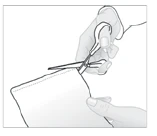
- Cut the pouch containing the medicated patch along the dotted line.
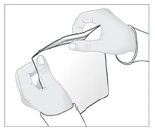
- Remove one patch and carefully reseal the pouch by pressing along the closure strip.
- Remove the protective liner from the adhesive surface of the medicated patch.
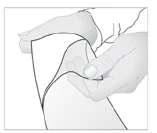
- Apply the medicated patch to the painful area.
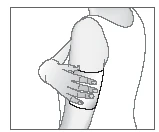
Use the medicated patch only on intact, healthy skin.
If necessary, the medicated patch may be secured in place using an elastic woven mesh bandage.
Do not use the medicated patch with an airtight (occlusive) dressing.
Do not wear during bathing or showering.
The medicated patch must not be cut or divided.
Used patches should be folded in half with the adhesive side turned inwards.
Duration of use
Do not use Diclofenac Teva for more than 7 days.
If symptoms worsen or persist for longer than 3 days, consult your doctor.
If you feel that the effect of Diclofenac Teva is too strong or too weak, talk to your doctor or pharmacist.
If you use more Diclofenac Teva than you should
Inform your doctor if significant adverse effects occur following incorrect use of this medicine or accidental overdose (e.g. in children). Your doctor will advise you on the appropriate actions to take.
If you forget to use Diclofenac Teva
Do not apply a double dose to make up for a forgotten dose.
If you have any questions about how to use this medicine, consult your doctor or pharmacist.
4. Possible side effects
Like all medicines, this medicine can cause side effects, although not everybody gets them.
If any of the following symptoms occur, inform your doctor immediately and stop using the
patch:
sudden itchy rash (urticaria); swelling of the hands, feet, ankles, face, lips, mouth or throat; difficulty breathing; drop in blood pressure or weakness.
The following side effects may occur:
Common (may affect up to 1 in 10 people): local skin reactions (including allergic dermatitis and contact dermatitis) such as redness and burning sensation of the skin, itching, skin redness, skin rash sometimes with pustules or wheals.
Rare (may affect up to 1 in 1,000 people): bullous dermatitis, dry skin.
Very rare (may affect less than 1 in 10,000 people): hypersensitivity reactions (including urticaria), angioedema, anaphylactic-type reactions, asthma, photosensitivity.
In patients using active substances belonging to the same class of diclofenac medicines topically, isolated cases of generalized skin rash, hypersensitivity reactions such as skin and mucosal swelling, anaphylactic-type reactions with acute disturbances in circulatory regulation, and photosensitivity have been reported.
The absorption of diclofenac into the body through the skin is very low compared to the blood concentration of active substance measured after oral administration of diclofenac. Therefore, the likelihood of systemic side effects (such as gastrointestinal, hepatic or renal disorders or breathing difficulties) is very low.
However, particularly when the medicated patch is used over large skin areas and for prolonged periods, systemic side effects may occur.
Reporting of side effects
If you experience any side effect, including those not listed in this leaflet, talk to your doctor or pharmacist. You can also report side effects directly via the national reporting system at www.aifa.gov.it/content/segnalazioni-reazioni-avverse.
By reporting side effects, you can help provide more information on the safety of this medicine.
5. How to store Diclofenac Teva
Keep this medicine out of the sight and reach of children.
Do not use this medicine after the expiry date stated on the outer packaging and on the sachet,
following the abbreviation EXP. The expiry date refers to the last day of that month.
Do not store above 25°C.
Store in the original packaging to protect the medicine from drying out and from light.
Keep the sachet tightly closed to protect the medicine from drying out.
After first opening of the sachet, the medicine can be stored for 4 months.
Do not dispose of any medicine via wastewater or household waste. Ask your pharmacist how to
dispose of medicines no longer in use. This will help protect the environment.
6. Package contents and other information
What Diclofenac Teva contains
The active substance is sodium diclofenac. Each medicated patch contains 140 mg of sodium diclofenac.
The other components are: glycerol; propylene glycol (E1520); diisopropyl adipate; liquid sorbitol
(crystallizing) (E420); sodium carmellose; sodium polyacrylate; methacrylic acid copolymer butylated
base; disodium edetate; sodium sulfite (E221); butylated hydroxytoluene (E321); aluminum-potassium-bis
(sulfate); anhydrous colloidal silica; light kaolin (natural); macrogol lauryl ether (9 EO units);
levomenthol; tartaric acid; purified water; polyester non-woven fabric backing; polypropylene protective
film.
Description of the appearance of Diclofenac Teva and pack contents
Diclofenac Teva is a medicated patch measuring 10 x 14 cm, consisting of a matrix ranging in colour from white to light brown, evenly distributed on a non-woven fabric backing, with a removable protective film.
Diclofenac Teva is available in packs of 5 or 10 medicated patches, in resealable pouches each containing 5 medicated patches. Not all pack sizes may be marketed.
Marketing Authorization Holder and Manufacturer
Marketing Authorization Holder:
Teva B.V.
Swensweg 5,
2031 GA Haarlem
The Netherlands
Manufacturer:
Merckle GmbH
Ludwig-Merckle-Straße 3
89143 Blaubeuren, Germany
This medicinal product is authorized in the Member States of the European Economic Area under the
following names:
Germany: Diclo-mepha Schmerzpflaster
Italy: Diclofenac Teva
Spain: ALGIPATCH