Dexdor
Italy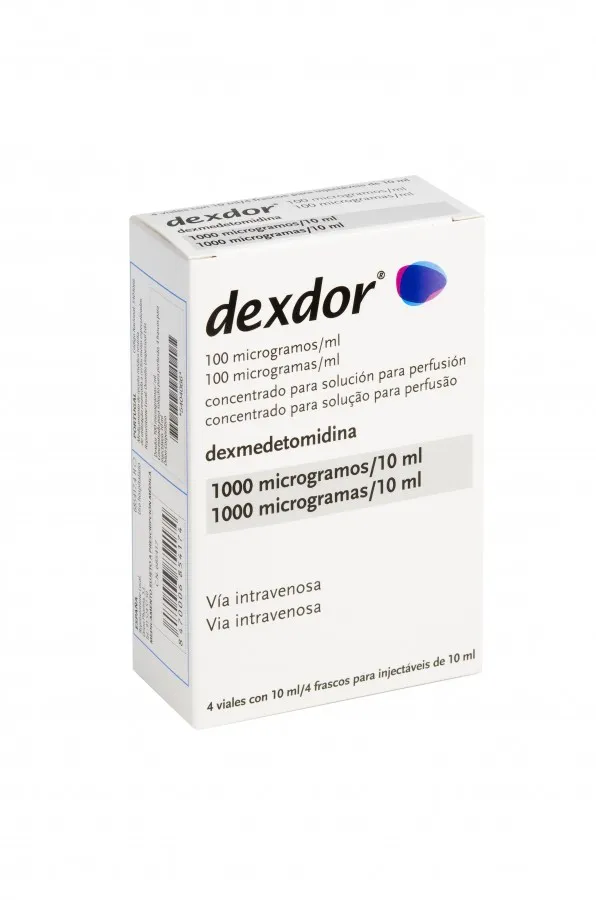
Table of Contents
- Package leaflet: Information for the user
- Dexdor 100 micrograms/ml concentrate for solution for infusion
- 1. What Dexdor is and what it is used for
- 2. What you should know before being given Dexdor
- 3. How to use Dexdor
- 4. Possible side effects
- 5. How to store Dexdor
- 6. Package contents and other information
- The following information is intended exclusively for healthcare professionals:
Package leaflet: Information for the user
Dexdor 100 micrograms/ml concentrate for solution for infusion
dexmedetomidine
Please read this leaflet carefully before you are given this medicine because it
contains important information for you.
- Keep this leaflet. You may need to read it again.
- If you have any questions, ask your doctor or nurse.
- If you get any side effects, including those not listed in this leaflet, tell your doctor. See section 4.
Contents of this leaflet:
- What Dexdor is and what it is used for
- What you need to know before Dexdor is administered to you
- How to use Dexdor
- Possible side effects
- How to store Dexdor
- Contents of the pack and other information
1. What Dexdor is and what it is used for
Dexdor contains an active substance called dexmedetomidine, which belongs to a group of
medicines called sedatives. It is used to induce sedation (a state of calm, drowsiness, or
sleep) in adult patients admitted to hospital intensive care units or conscious sedation during
various diagnostic or surgical procedures.
2. What you should know before being given Dexdor
Dexdor must not be administered to you
- if you are allergic to dexmedetomidine or to any of the other ingredients of this medicine (listed in section 6)
- if you have certain heart rhythm disorders (second- or third-degree atrioventricular block)
- if you have very low blood pressure that does not respond to treatment
- if you have recently had a stroke or another serious condition involving reduced blood flow to the brain.
Warnings and precautions
Before being treated with this medicine, inform your doctor or nurse if any of the following apply to you, as Dexdor must be used with caution:
- if you have a slower than normal heart rate (due either to disease or to high levels of physical fitness), as this may increase the risk of cardiac arrest
- if you have low blood pressure
- if you have low blood volume, for example after bleeding
- if you suffer from heart disorders
- if you are elderly
- if you suffer from a neurological disorder (e.g. head injury, spinal cord injury, or stroke)
- if you have severe liver problems
- if you have ever developed a high fever after taking certain medicines, particularly anaesthetics.
This medicine may cause excessive urine production and excessive thirst. Contact a doctor if these side effects occur. See section 4 for further information.
An increased risk of mortality has been observed in patients aged 65 years or younger during use of this medicine, particularly in patients admitted to intensive care units for reasons other than surgery, who have a more severe illness at admission and are younger in age. Your doctor will decide whether this medicine remains appropriate for you. Your doctor will consider the benefits and risks of this medicine for you compared to treatment with other sedatives.
Other medicines and Dexdor
Inform your doctor or nurse if you are taking, have recently taken, or might take any other medicines.
The following medicines may increase the effect of Dexdor:
- medicines that help you sleep or cause sedation (e.g. midazolam, propofol)
- strong painkillers (e.g. opioids such as morphine, codeine)
- anaesthetic medicines (e.g. sevoflurane, isoflurane).
If you are taking medicines that lower blood pressure and heart rate, concomitant administration of Dexdor may increase this effect. Dexdor must not be used with other medicines that cause temporary paralysis.
Pregnancy and breastfeeding
Dexdor must not be used during pregnancy or breastfeeding unless strictly necessary.
Ask your doctor for advice before using this medicine.
Driving and using machines
Dexdor has a major impact on the ability to drive and use machines. After receiving Dexdor, do not drive, operate machinery, or work in hazardous situations until the effects have completely worn off. Ask your doctor when you can resume these activities and return to such work.
Excipients
Dexdor contains less than 1 mmol of sodium (23 mg) per ml and is therefore essentially "sodium-free".
3. How to use Dexdor
Hospital intensive care
Dexdor is administered to you by a doctor or nurse in a hospital intensive care setting.
Procedural sedation/conscious sedation
Dexdor is administered to you by a doctor or nurse before and/or during diagnostic or surgical procedures requiring sedation, i.e. procedural/conscious sedation.
The doctor will decide the appropriate dose for you. The amount of Dexdor depends on your age, weight, general health, required level of sedation, and how you respond to the medicine. The doctor may adjust the dose if necessary and will monitor your heart and blood pressure during treatment.
Dexdor is diluted and administered to you as an intravenous infusion (drip).
After sedation/recovery
- The doctor will continue to monitor you medically for several hours after sedation to ensure you feel well.
- You must not go home unaccompanied.
- Medicines that help you sleep, cause sedation, or strong painkillers may not be appropriate for a certain period of time after you have been given Dexdor. Talk to your doctor about the use of these medicines and about alcohol consumption. If you are given more Dexdor than you should
If you are given too much Dexdor, your blood pressure may increase or decrease, your heart rate may slow down, you may breathe more slowly, and you may feel more drowsy. The doctor will know how to treat you based on your condition.
If you have further questions about the use of this medicine, consult your doctor.
4. Possible side effects
Like all medicines, this medicine can cause side effects, although not everybody gets them.
Very common ( may affect more than 1 in 10 people ):
- Slowing of the heart rate
- Low or high blood pressure
- Changes in breathing pattern or respiratory arrest
Common ( may affect up to 1 in 10 people ):
- Chest pain or heart attack
- Fast heart rate
- Low or high blood sugar (amount of sugar in the blood)
- Nausea, vomiting or dry mouth
- Agitation
- High temperature
- Symptoms due to stopping the medicine
Uncommon ( may affect up to 1 in 100 people ):
- Reduced heart function, cardiac arrest
- Swollen stomach
- Thirst
- A condition where there is too much acid in the body
- Low level of albumin in the blood
- Shortness of breath
- Hallucinations
- The medicine not being effective enough
Not known ( frequency cannot be estimated from the available data ):
- Passing large amounts of urine and excessive thirst – these may be symptoms of a hormonal disorder called diabetes insipidus. Consult a doctor if these occur.
Reporting of side effects
If you get any side effects, including those not listed in this leaflet, talk to your doctor or nurse.
You can also report side effects directly via the national reporting system listed in Annex V.
By reporting side effects, you can help provide more information on the safety of this medicine.
5. How to store Dexdor
Keep this medicine out of the sight and reach of children.
Do not use this medicine after the expiry date stated on the label and the carton after EXP.
This medicine does not require any special storage temperature. Keep the vials or ampoules in the outer packaging to protect the medicine from light.
6. Package contents and other information
What Dexdor contains
- The active substance is dexmedetomidine. Each ml of concentrate contains dexmedetomidine hydrochloride equivalent to 100 micrograms of dexmedetomidine.
- The excipients are sodium chloride and water for injections.
Each 2 ml vial contains 200 micrograms of dexmedetomidine (as hydrochloride).
Each 2 ml vial contains 200 micrograms of dexmedetomidine (as hydrochloride).
Each 4 ml vial contains 400 micrograms of dexmedetomidine (as hydrochloride).
Each 10 ml vial contains 1000 micrograms of dexmedetomidine (as hydrochloride).
The final concentration of the solution after dilution must be 4 micrograms/ml or
8 micrograms/ml.
Description of the appearance of Dexdor and contents of the pack
Concentrate for solution for infusion (sterile concentrate).
The concentrate is a clear, colourless solution.
Containers
2 ml glass vials
2 ml, 5 ml or 10 ml glass vials
Packs
5 vials of 2 ml
25 vials of 2 ml
5 vials of 2 ml
4 vials of 4 ml
4 vials of 10 ml
Not all pack sizes may be marketed.
Marketing Authorization Holder
Orion Corporation
Orionintie 1
FI-02200 Espoo
Finland
Manufacturer
Orion Corporation
Orion Pharma
Orionintie 1
FI-02200 Espoo
Finland
For further information about this medicinal product, please contact the local representative of the Marketing Authorization Holder:
België/Belgique/Belgien
Luxembourg/Luxemburg
Orion Pharma BVBA/SPRL
Tél/Tel: +32 (0)15 64 10 20
Nederland Danmark
Orion Pharma BVBA/SPRL Orion Pharma A/S
Tel: +32 (0)15 64 10 20 Tlf: +45 8614 00 00
Česká republika Eesti
Orion Pharma s.r.o. Orion Pharma Eesti Oü
Tel: +420 234 703 305 Tel: +372 6 644 550
Deutschland España
Österreich Orion Pharma S.L.
Orion Pharma GmbH Tel: + 34 91 599 86 01
Tel: + 49 40 899 6890
Ελλάδα Ireland
Orion Pharma Hellas M.E.Π.E Orion Pharma (Ireland) Ltd.
Τηλ: + 30 210 980 3355 Tel: + 353 1 428 7777
France Italia
Orion Pharma Orion Pharma S.r.l.
Tél: +33 (0) 1 85 18 00 00 Tel: + 39 02 67876111
Ísland Latvija
Vistor hf. Orion Corporation
Simi: +354 535 7000 Orion Pharma pārstāvniecība
Tel: +371 20028332
Κύπρος Magyarország
Lifepharma (ZAM) Ltd Orion Pharma Kft.
Τηλ.: +357 22056300 Tel.: +36 1 239 9095
Lietuva Polska
UAB Orion Pharma Orion Pharma Poland Sp. z.o.o.
Tel: +370 5 276 9499 Tel.: + 48 22 8 333 177
Norge Slovenija
Orion Pharma AS Orion Pharma d.o.o.
Tlf: + 47 4000 4210 Tel: +386 (0) 1 600 8015
Portugal Suomi/Finland
Orionfin Unipessoal Lda Orion Corporation Puh/Tel: + 358 104261
Tel: + 351 21 924 9910/17
България Hrvatska
Orion Pharma Poland Sp. z.o.o. PHOENIX Farmacija d.o.o.
Тел.: + 48 22 8 333 177 Tel: +385 1 6370450
Malta România
Orion Corporation Orion Corporation
Tel: + 358 10 4261 Tel: + 358 10 4261
Slovenská republika United Kingdom (Northern Ireland)
Orion Pharma s.r.o. Orion Pharma (Ireland) Ltd.
Tel: +420 234 703 305 Tel: +353 1 428 7777
Sverige
Orion Pharma AB
Tel: + 46 8 623 6440
More detailed information on this medicinal product is available on the European Medicines Agency website: http://www.ema.europa.eu
The following information is intended exclusively for healthcare professionals:
Dexdor 100 micrograms/ml concentrate for solution for infusion
Route of administration
Dexdor must be administered by healthcare professionals experienced in managing patients requiring intensive care or in managing anaesthetized patients in the operating theatre. It must only be given as a diluted intravenous infusion using a controlled infusion device.
Preparation of the solution
Dexdor may be diluted with glucose 50 mg/ml (5%), Ringer's solution, mannitol or sodium chloride 9 mg/ml (0.9%) injection solutions to obtain the required concentration of 4 micrograms/ml or 8 micrograms/ml prior to administration. See the table below for the volumes required to prepare the infusion.
When the required concentration is 4 micrograms/ml
| Volume of Dexdor 100 micrograms/ml concentrate for solution for infusion | Volume of diluent | Total volume of infusion |
| 2 ml | 48 ml | 50 ml |
| 4 ml | 96 ml | 100 ml |
| 10 ml | 240 ml | 250 ml |
| 20 ml | 480 ml | 500 ml |
In the case where the required concentration is 8 micrograms/ml
| Volume of Dexdor 100 micrograms/ml concentrate for infusion solution | Volume of diluent | Total infusion volume |
| 4 ml | 46 ml | 50 ml |
| 8 ml | 92 ml | 100 ml |
| 20 ml | 230 ml | 250 ml |
| 40 ml | 460 ml | 500 ml |
The solution should be gently shaken to ensure proper mixing.
Dexdor should be inspected visually for the presence of particles and any changes in colour before administration.
Dexdor is compatible when administered with the following intravenous fluids and the following medicinal products:
Ringer's lactate, 5% glucose solution, sodium chloride 9 mg/mL (0.9%) injectable solution, mannitol 200 mg/mL (20%),
sodium thiopental, etomidate, vecuronium bromide, pancuronium bromide, succinylcholine, atracurium besylate,
mivacurium chloride, rocuronium bromide, glycopyrronium bromide, phenylephrine hydrochloride, atropine sulfate,
dopamine, noradrenaline, dobutamine, midazolam, morphine sulfate, fentanyl citrate, and plasma substitutes.
Compatibility studies have shown potential adsorption of dexmedetomidine by certain types of natural rubber.
Although dexmedetomidine is dosed to achieve the desired effect, it is recommended to use synthetic components or coated natural rubber stoppers.
Shelf life
Chemical and physical in-use stability has been demonstrated for 24 hours at 25 °C.
From a microbiological standpoint, the product should be used immediately.
If not used immediately, the storage duration and conditions prior to use are the responsibility of the user and should normally not exceed 24 hours at 2–8 °C, unless dilution has been carried out under controlled and validated aseptic conditions.