Debrum
Italy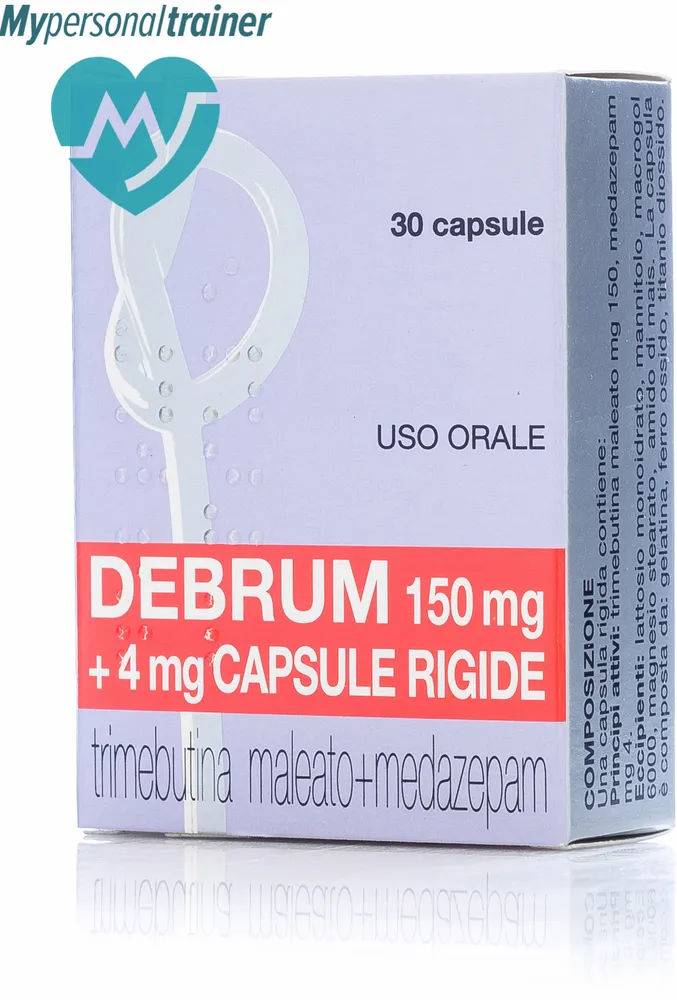
Table of Contents
Package leaflet: information for the patient
Debrum 150 mg + 4 mg hard capsules
trimebutine maleate + medazepam
Please read this leaflet carefully before taking this medicine because it contains important information for you.
- Keep this leaflet. You may need to read it again.
- If you have any questions, ask your doctor or pharmacist.
- This medicine has been prescribed for you only. Do not give it to others, even if their symptoms are the same as yours, as it could be harmful.
- If you experience any side effect, including those not listed in this leaflet, tell your doctor or pharmacist. See section 4.
Contents of this leaflet:
- What Debrum is and what it is used for
- What you need to know before taking Debrum
- How to take Debrum
- Possible side effects
- How to store Debrum
- Contents of the pack and other information
1. What Debrum is and what it is used for
Debrum contains the active substances trimebutine maleate and medazepam. Trimebutine maleate is a substance
that acts against muscle spasms and selectively affects gastrointestinal motility. Medazepam is a substance with anxiolytic activity.
Debrum is indicated in patients suffering from symptoms characterized by painful contractions (spastic-painful symptoms) of the gastrointestinal tract associated with anxiety.
2. What you should know before taking Debrum
Do not take Debrum
- if you are allergic to trimebutine maleate, medazepam, or any of the other ingredients of this medicine (listed in section 6)
- if you are in the first three months of pregnancy (see section “Pregnancy and breastfeeding”)
- if you have a nerve and muscle disease causing muscle weakness (myasthenia gravis)
- if you have serious lung problems (severe respiratory insufficiency)
- if you have severe liver failure
- if you suffer from breathing disorders during sleep (sleep apnoea syndrome)
Warnings and precautions
Talk to your doctor or pharmacist before taking Debrum.
If you take Debrum at high doses and for long periods of time, your doctor will arrange periodic checks of your blood pressure, blood composition, and liver function.
If you are elderly, your doctor may prescribe a lower dose of Debrum (see section 3).
Inform your doctor before taking Debrum:
- if you have chronic breathing problems, as your doctor will prescribe a lower dose due to the risk that breathing problems may worsen
- if you have abused drugs or alcohol, as benzodiazepines must be used with extreme caution in such cases
- if you suffer from thought disorders (psychotic illness), as the use of benzodiazepines is not recommended in such cases
- if you suffer from depression or anxiety associated with depression, as the use of benzodiazepines is not recommended in these cases, due to the possible emergence of marked suicidal tendencies.
Inform your doctor if, during treatment with Debrum:
- you notice a recurrence or worsening of your condition, as Debrum may become less effective if used repeatedly for several weeks.
- you experience reactions such as restlessness, agitation, irritability, aggression, delusions, anger, nightmares, hallucinations, or behavioural changes, as your doctor will assess whether treatment should be discontinued. These reactions are more frequent in children and the elderly.
- you experience episodes of short-term memory loss (anterograde amnesia), which mainly occur several hours after taking this medicine. To reduce this problem, you should have uninterrupted sleep for at least 7–8 hours.
Inform your doctor if, after stopping treatment with Debrum:
- you notice a worsening of your condition or the appearance of withdrawal symptoms (see section: “If you stop taking Debrum”), as Debrum can cause dependence. This risk increases with higher doses and longer duration of treatment, and if you have previously abused drugs or alcohol.
Children and adolescents
Your doctor will carefully evaluate the need for treatment before prescribing Debrum to children and adolescents. If treatment is necessary, the duration should be as short as possible.
Other medicines and Debrum
Inform your doctor or pharmacist if you are currently using, have recently used, or might use any other medicines, including those not requiring a prescription.
Inform your doctor if you are using or need to use one or more of the following medicines:
- antipsychotics (neuroleptics)
- hypnotics (medicines that induce sleep) or anxiolytics/sedatives (medicines that reduce anxiety)
- antidepressants (medicines for depression)
- narcotic analgesics (medicines used to relieve pain). When used concomitantly with Debrum, euphoria may increase, thereby increasing the risk of psychological dependence
- antiepileptics (medicines for epilepsy)
- anaesthetics (medicines for anaesthesia)
- sedative antihistamines (medicines for allergies that cause drowsiness)
Concomitant use of Debrum and opioids (strong painkillers, drugs for substitution therapy, and some cough medicines) increases the risk of drowsiness, breathing difficulties, coma, and may be life-threatening. For this reason, concomitant use of Debrum and opioids should only be considered when no other treatment options are possible.
However, if your doctor prescribes Debrum together with opioids, the dose and duration of concomitant therapy must be determined by your doctor. Therefore, inform your doctor about all opioid medicines you are taking and follow your doctor’s instructions regarding dosage carefully. It may be helpful to inform friends or family members so they can recognize the signs and symptoms listed above. Contact your doctor if these symptoms occur.
Debrum and alcohol
Do not consume alcohol with Debrum, as alcohol enhances its sedative effect. Drinking alcohol with Debrum also impairs your ability to drive and operate machinery.
Pregnancy, breastfeeding, and fertility
If you are pregnant, suspect you may be pregnant, are planning a pregnancy, or are breastfeeding, consult your doctor or pharmacist before taking this medicine.
Pregnancy
If you are a woman of childbearing age, you should use an effective contraceptive method during treatment. Consult your doctor if you suspect or are planning a pregnancy, so that discontinuation of Debrum treatment can be evaluated together.
Do not take Debrum during the first three months of pregnancy.
If Debrum has been administered for serious medical reasons during the last trimester of pregnancy or during labour at high doses, effects on the newborn may occur, such as low body temperature, reduced muscle tone, moderate respiratory depression, and withdrawal symptoms in the period after birth.
Breastfeeding
Benzodiazepines are excreted in breast milk; therefore, do not take Debrum if you are breastfeeding.
Fertility
No clinical studies on fertility have been conducted.
Driving and using machines
Debrum may cause symptoms such as sedation, amnesia, impaired concentration, and muscle function, which may negatively affect your ability to drive and operate machinery. If your sleep duration has been insufficient, the likelihood of impaired alertness increases.
Do not consume alcohol with Debrum, as alcohol enhances its sedative effect. Drinking alcohol with Debrum also impairs your ability to drive and operate machinery.
Debrum contains lactose (a milk sugar)
Debrum contains lactose. If your doctor has diagnosed you with an intolerance to certain sugars, contact them before taking this medicine.
3. How to take Debrum
Take this medicine exactly as directed by your doctor or pharmacist. If you have
any doubts, consult your doctor or pharmacist.
The recommended dose is 2 to 4 capsules per day.
Use in elderly patients
If you are elderly, your doctor may prescribe a lower dose of Debrum and will tell you exactly how much
Debrum you should take.
Use in patients with respiratory problems
Your doctor will prescribe a lower dose due to the risk of respiratory depression.
Use in children and adolescents
Your doctor will carefully evaluate the need for treatment before prescribing Debrum to children and
adolescents. If treatment is necessary, the duration should be as short as possible.
If you take more Debrum than you should
In case of accidental overdose, contact your doctor immediately or go to the nearest hospital.
If you forget to take Debrum
Do not take a double dose to make up for the missed dose.
If you stop taking Debrum
Do not stop treatment with Debrum abruptly.
Debrum can cause dependence. If this occurs, when you stop taking Debrum, symptoms of the illness may
return in a more severe form or withdrawal symptoms may occur, such as:
- headache
- muscle pain
- severe anxiety
- tension
- restlessness
- confusion
- irritability
In more severe cases, the following may also occur:
- distorted perception of the external world (derealization)
- distorted perception of self (depersonalization)
- excessive sensitivity and intolerance to sounds and noise
- excessive sensitivity to light and physical touch
- numbness and tingling in the extremities
- hallucinations
- epileptic seizures.
If you have any questions about the use of this medicine, consult your doctor or pharmacist.
4. Possible side effects
Like all medicines, this medicine can cause side effects, although not everybody gets them.
Side effects with unknown frequency (frequency cannot be estimated from the available data)
- Movement disorders (loss of motor coordination/difficulty performing certain voluntary movements)
- Headache
- Drowsiness
- Constipation
- Diarrhea
- Dry mouth
- Indigestion
- Nausea
- Vomiting
- Itching
- Fatigue
Other side effects reported in some patients, especially elderly or debilitated individuals:
- Drowsiness
- Low blood pressure
- Confusion
- Movement disorders (extrapyramidal symptoms)
- Skin rashes
- Fluid retention with swelling (edema)
- Visual disturbances
- Decrease in bone marrow cells, particularly granulocytes (agranulocytosis), usually reversible
- Liver function abnormalities
Medazepam (one of the components of Debrum), like other benzodiazepines, may cause the following
effects:
- Drowsiness, inability to feel emotions (emotional blunting), reduced alertness, confusion, fatigue, muscle weakness, loss of motor coordination, double vision, headache, dizziness. These phenomena usually occur at the beginning of treatment and typically disappear with continued administration. Occasionally, gastrointestinal disturbances, changes in sexual desire, and skin reactions have also been reported.
- Amnesia: Short-term memory loss (anterograde amnesia), behavioral changes.
- Depression: Pre-existing depression may become unmasked during benzodiazepine use, and restlessness, agitation, irritability, aggression, delusions, anger, nightmares, hallucinations, psychosis, and behavioral changes may occur.
- Dependence: The use of benzodiazepines (even at therapeutic doses) may lead to physical dependence: discontinuation of treatment may result in rebound or withdrawal symptoms (see section "Warnings and precautions"). Psychological dependence may also occur. Abuse of benzodiazepines has been reported.
Reporting of side effects
If you experience any side effect, including those not listed in this leaflet, talk to your doctor or pharmacist. You can also report side effects directly via the national reporting system at https://www.aifa.gov.it/content/segnalazioni-reazioni-avverse. By reporting side effects, you can help provide more information on the safety of this medicine.
5. How to store Debrum
Keep this medicine out of the sight and reach of children.
Do not use this medicine after the expiry date stated on the packaging after Exp. The expiry date refers to the last day of that month.
Do not dispose of any medicine via wastewater or household waste. Ask your pharmacist how to dispose of medicines no longer required. This will help protect the environment.
6. Package contents and other information
What Debrum contains
- The active substances are trimebutine maleate and medazepam. Each hard capsule contains 150 mg of trimebutine maleate and 4 mg of medazepam.
- The other components are monohydrate lactose, mannitol, macrogol 6000, magnesium stearate, maize starch.
- The hard capsule shell is composed of gelatin, iron oxide, titanium dioxide.
Description of the appearance of Debrum and contents of the pack
Each pack contains 30 hard capsules in blisters.
Marketing Authorization Holder
Alfasigma S.p.A. - Via Ragazzi del '99, n. 5 - 40133 Bologna (BO)
Manufacturer
Alfasigma S.p.A. - Via Pontina km. 30,400 - 00071 Pomezia (RM)