Dantrium
Italy
Table of Contents
- Package leaflet: Information for the user
- DANTRIUM 20 mg powder for solution for infusion
- 1. What Dantrium is and what it is used for
- 2. What you need to know before receiving Dantrium
- 3. How to administer Dantrium
- 4. Possible side effects
- 5. How to store Dantrium
- 6. Package contents and other information
- THE FOLLOWING INFORMATION IS INTENDED EXCLUSIVELY FOR HEALTHCARE PROFESSIONALS:
Package leaflet: Information for the user
DANTRIUM 20 mg powder for solution for infusion
Sodium dantrolene
Please read this leaflet carefully before receiving this medicine because it contains important information for you.
- Keep this leaflet. You may need to read it again.
- If you have any questions, ask your doctor or nurse.
- If you experience any side effects, including those not listed in this leaflet, tell your doctor or nurse. See section 4.
Contents of this leaflet:
- What Dantrium is and what it is used for
- What you must know before receiving Dantrium
- How Dantrium is administered
- Possible side effects
- How to store Dantrium
- Contents of the pack and other information
1. What Dantrium is and what it is used for
Dantrium contains the active substance dantrolene sodium, which belongs to a group of medicines called muscle relaxants, used to reduce muscle contraction.
This medicine, used in conjunction with other emergency measures, is specifically indicated for the treatment of increased oxygen demand (fulminant hypermetabolism) by skeletal muscles occurring during episodes of malignant hyperthermia, a serious reaction triggered by anaesthetics—medicines used to induce anaesthesia before a surgical procedure—and neuroleptics, medicines used to treat certain mental disorders.
Dantrium must be administered as soon as a malignant hyperthermia crisis is diagnosed, which presents with the following symptoms: increased heart rate (tachycardia) and respiratory rate (tachypnea), reduced oxygen levels in the blood (central venous desaturation), increased carbon dioxide levels in the blood (hypercapnia), increased blood acidity (metabolic acidosis), skeletal muscle rigidity, bluish discoloration of the skin (cyanosis) and mottled skin, and in many cases fever.
2. What you need to know before receiving Dantrium
Dantrium must not be administered:
- if you are allergic to sodium dantrolene or to any of the other ingredients of this medicine (listed in section 6).
Warnings and precautions
The administration of Dantrium does not replace the other emergency measures required in the treatment of malignant hyperthermia, which include:
- discontinuing the administration of agents that may have triggered the crisis;
- meeting the increased oxygen demand;
- correcting blood acidity (rebalancing metabolic acidosis);
- cooling the patient, if necessary;
- monitoring urine output (diuresis);
- correcting disturbances in fluid and electrolyte levels in the body (electrolyte imbalance).
Due to the characteristics of the formulation (high pH), this medicine must be administered with caution to avoid leakage from the vein (extravasation) and infiltration into surrounding tissues.
Dantrium contains 3000 mg of mannitol. Your doctor must take this into account if you are already receiving mannitol for the prevention or treatment of kidney problems related to malignant hyperthermia.
Other medicines and Dantrium
Inform your doctor if you are taking, have recently taken, or might take any other medicines.
Dantrium must not be administered together with calcium channel blockers such as verapamil, medicines used to treat high blood pressure, as serious adverse effects on the heart may occur.
Inform your doctor if you are taking any of the following medicines, as it may be necessary to adjust the dose of Dantrium:
- warfarin, a medicine used to thin the blood;
- clofibrate, a medicine used to reduce cholesterol levels in the blood;
- tolbutamide, a medicine used to reduce blood sugar levels.
Pregnancy, breastfeeding and fertility
If you are pregnant or breastfeeding, this medicine will be administered only after careful evaluation and in cases of absolute necessity, and only if the expected benefit outweighs the risks.
Dantrium contains sodium
This medicine contains less than 1 mmol (23 mg) of sodium per vial, i.e. it is practically sodium-free.
3. How to administer Dantrium
This medicine will be administered to you in a hospital or other specialized center by a doctor or nurse.
As soon as a crisis is diagnosed, this medicine will be given immediately through rapid, continuous intravenous injection (intravenous infusion).
The recommended initial dose is 1 mg per kg of body weight, both in adults and children.
If symptoms persist or recur, your doctor will repeat the administration up to a total maximum dose of 10 mg per kg of body weight.
On average, a dose of 2.5 mg per kg of body weight is required to achieve symptom resolution.
If you receive more Dantrium than you should
This medicine will be administered by specialized medical staff, so an overdose is unlikely. However, in the event of an overdose, the doctor will provide appropriate treatment.
If you have any doubts or further questions about the use of this medicine, consult your doctor or nurse.
4. Possible side effects
Like all medicines, this medicine can cause side effects, although not everybody gets them.
With this medicine, considering the short duration of treatment, the following side effects may occur:
The following side effects have sometimes been reported, but their frequency is unknown because it cannot be estimated from the available data: fluid accumulation in the lungs (pulmonary edema), inflammation of the veins (phlebitis), skin inflammation (urticaria), skin irritation (erythema), dizziness, drowsiness, convulsions, speech disorder, heart function problems (heart failure), reduced heart rate (bradycardia), increased heart rate (tachycardia), excess fluid in the lungs (pleural effusion), breathing difficulties (respiratory failure, respiratory depression), abdominal pain, nausea (feeling unwell), vomiting (being sick), gastrointestinal bleeding, jaundice, hepatitis, excessive sweating (hyperhidrosis), presence of crystals in the urine (crystalluria).
Reporting of side effects
If you experience any side effect, including those not listed in this leaflet, talk to your doctor or nurse. You can also report side effects directly via the national reporting system at http://www.agenziafarmaco.gov.it/content/come-segnalare-una-sospetta-reazione-avversa. By reporting side effects, you can help provide more information on the safety of this medicine.
5. How to store Dantrium
Medical personnel are aware of the correct way to store this medicine.
Keep this medicine out of the sight and reach of children.
Do not use this medicine after the expiry date stated on the carton and label following "Exp.". The expiry date refers to the last day of that month.
Do not store above 25°C.
After preparation, protect the solution from direct light.
Do not store the solution at temperatures below 15°C or above 25°C.
The prepared solution must be used within 6 hours of preparation.
Do not dispose of any medicine via wastewater. Ask your pharmacist how to dispose of medicines no longer required. This will help protect the environment.
6. Package contents and other information
What Dantrium contains
- The active substance is dantrolene sodium. Each vial contains 20 mg of dantrolene sodium.
- The other components are: mannitol, sodium hydroxide.
Description of the appearance of Dantrium and contents of the pack
Pack sizes of 12 or 36 vials. Each vial is supplied with a single-use filtration device.
Marketing Authorisation Holder
Norgine Italia S.r.l. – Via Fabio Filzi 25 – 20124 Milano – Italy
Manufacturer
Norgine B.V. – Hogehilweg 7 – 1101 CA Amsterdam ZO – The Netherlands
THE FOLLOWING INFORMATION IS INTENDED EXCLUSIVELY FOR HEALTHCARE PROFESSIONALS:
DOSAGE AND ADMINISTRATION
Administer Dantrium immediately by continuous rapid intravenous infusion at an initial dose of 1 mg/kg in both adults and children as soon as malignant hyperthermia is diagnosed.
Repeat administration up to a maximum cumulative dose of 10 mg/kg if physiological and metabolic abnormalities persist or recur.
Based on clinical experience, a mean cumulative dose of 2.5 mg/kg of Dantrium 20 mg powder for infusion solution is sufficient to resolve the manifestations of malignant hyperthermia.
Reconstitution method
Reconstitute the vial with 60 ml of water for injections and shake until the powder is completely dissolved.
Draw the reconstituted solution into a syringe, filtering it through the single-use filtration device supplied. The reconstituted solution must be used within 6 hours and filtered immediately before use. Remove the filtration device from the syringe before attaching an intravenous cannula or other administration system.
Dispose of the filtration device and the vial in appropriate containers for the disposal of needles and sharp objects.
Use a new filtration device for each vial of Dantrium.
Unused medicinal product and waste material must be disposed of in accordance with local regulations.
Use only the filtration device supplied.
The vial contents must be protected from direct light and used within 6 hours after preparation. The solution must not be exposed to temperatures below 15°C or above 25°C.
SPECIAL WARNINGS AND PRECAUTIONS FOR USE
The use of Dantrium 20 mg powder for infusion solution in the treatment of malignant hyperthermia does not replace standard supportive therapy.
In addition to discontinuing suspected triggering agents, it is usually necessary to meet increased oxygen demand, correct metabolic acidosis, cool the patient when required, monitor urine output, and correct electrolyte imbalances.
When reconstituted with 60 ml of water for injections, the Dantrium solution reaches an approximate pH of 9.5. Due to the high pH of the formulation, the solution must be infused carefully to avoid extravasation into surrounding tissues.
Furthermore, the use of the filtration device is always required when drawing up the solution, due to the possible presence of crystals/undissolved particles in the reconstituted product, and the consequent potential risk of increased injection site reactions/tissue necrosis caused by crystals present in affected vials.
When mannitol is used for the prevention or treatment of renal complications associated with malignant hyperthermia, the 3000 mg of mannitol contained in the Dantrium formulation must be taken into account.
Incompatibilities
Solutions of 0.9% dextrose, sodium chloride, and other acidic solutions are not compatible with Dantrium 20 mg powder for infusion solution.
For further information, please refer to the Summary of Product Characteristics.
Information on reconstitution and filtration of Dantrium
1)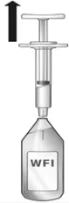 | 1) Insert a sterile needle into the syringe and fill it with 60 ml of water for injections. |
2)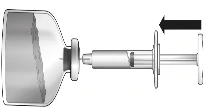 | 2) Take a vial of Dantrium and reconstitute it with the water in the syringe. Gently shake until the powder dissolves completely. Discard the needle. |
3)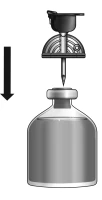 | 3) Remove the safety cap and insert the tip of the single-use filtration device into the vial. |
4)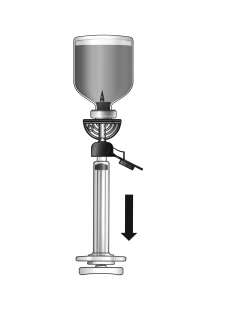 | 4) Attach the syringe and withdraw all 60 ml of reconstituted solution from the vial into the syringe, then discard the filtration device. |
5)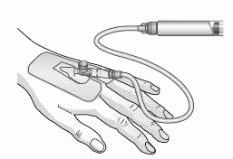 | 5) Connect the syringe containing the reconstituted and filtered solution directly to the intravenous cannula or to another patient administration system. The product may be administered immediately by manual infusion or using an infusion pump, depending on clinical requirements. For maximum dosage, refer to section 3. |
6)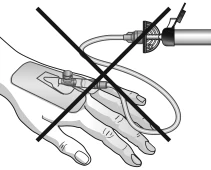 | 6) Do not use the filtration device to transfer the filtered solution from the syringe to the cannula or administration system. |