Dalacin T
Italy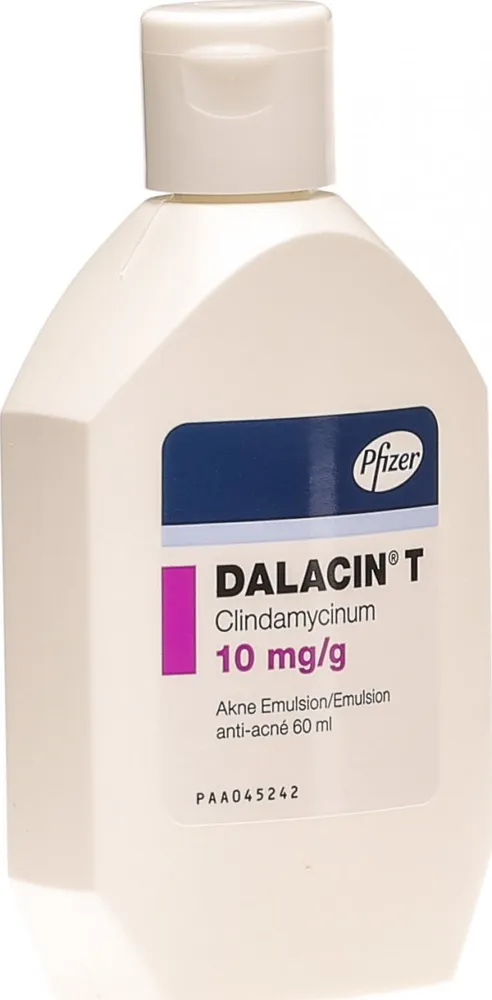
Table of Contents
Package leaflet: Information for the patient
DALACIN T 1% cutaneous emulsion, gel
Clindamycin
Please read this leaflet carefully before using this medicine because it contains important information for you.
- Keep this leaflet. You may need to read it again.
- If you have any questions, consult your doctor or pharmacist.
- This medicine has been prescribed for you only. Do not give it to other people, even if they have the same symptoms as yours, because it could be harmful.
- If you experience any side effects, including those not listed in this leaflet, consult your doctor or pharmacist. See section 4.
Contents of this leaflet:
- What Dalacin T is and what it is used for
- What you need to know before using Dalacin T
- How to use Dalacin T
- Possible side effects
- How to store Dalacin T
- Contents of the pack and other information
1. What Dalacin T is and what it is used for
Dalacin T contains the active substance clindamycin (an antibiotic belonging to a group of medicines called lincosamides) and is used in the treatment of acne. Clindamycin acts against bacteria that penetrate the skin pores and cause the typical red, pus-filled pimples associated with acne.
2. What you need to know before using Dalacin T
Do not use Dalacin T
- if you are allergic to clindamycin, to other similar active substances such as lincomycin, or to any of the other ingredients of this medicine (listed in section 6);
- if you have previously had inflammation of the colon (colitis) following the use of antibiotics.
Warnings and precautions
Talk to your doctor or pharmacist before using Dalacin T.
Inform your doctor if any of the following conditions occur or worsen during treatment with Dalacin T (see also section 4 “Possible side effects”):
- onset of diarrhea. If you experience abdominal cramps and severe, persistent diarrhea with blood and mucus in the stool, stop treatment with this medicine and consult your doctor immediately. These may be symptoms of intestinal inflammation (pseudomembranous colitis) caused by the use of antibiotics. Inform your doctor immediately if you experience these symptoms even several weeks after stopping treatment with Dalacin T, as the condition may worsen if ignored (see also section 4 “Possible side effects”);
- allergic reactions. In this case, discontinue treatment with this medicine and consult your doctor (see section 2 “What you need to know before using Dalacin T”).
Avoid contact with eyes, mucous membranes, and open wounds, as this medicine contains an alcohol base that may cause burning and irritation. In case of contact, wash the area thoroughly with plenty of fresh water.
Be careful when applying the medicine around the mouth, as it has an unpleasant taste.
Prolonged or repeated use of topical products may lead to sensitization reactions. If this occurs, discontinue use and consult your doctor to initiate appropriate therapy.
Children
This medicine should be used in very young infants only if strictly necessary and under direct medical supervision.
Other medicines and Dalacin T
Inform your doctor or pharmacist if you are taking, have recently taken, or might take any other medicines.
The following medicines affect the efficacy of Dalacin T, or Dalacin T affects the efficacy of these medicines:
- antibiotics such as metronidazole, gentamicin, and lincomycin;
- neuromuscular blocking agents such as ether, tubocurarine, pancuronium, when clindamycin is used systemically.
When clindamycin is used systemically, it may enhance the effect of neuromuscular blocking agents (such as ether, tubocurarine, pancuronio).
Pregnancy and breastfeeding
If you are pregnant, suspect you may be pregnant, planning to become pregnant, or breastfeeding, consult your doctor before using this medicine.
The active ingredient in Dalacin T, when used topically, may pass into human breast milk and may cause adverse effects in breastfed infants, such as diarrhea, blood in the stool, or skin rashes.
If you are pregnant or breastfeeding, your doctor will prescribe Dalacin T only if strictly necessary.
Driving and operating machinery
Dalacin T does not affect or affects negligibly the ability to drive vehicles or operate machinery.
Dalacin T 1% cutaneous emulsion contains:
- cetostearyl alcohol. May cause local skin reactions (e.g., contact dermatitis).
- methyl 4-hydroxybenzoate. May cause allergic reactions (including delayed reactions).
Dalacin T 1% gel contains propylene glycol (E1520) and methyl p-hydroxybenzoate (E218).
This medicine contains 50 mg of propylene glycol and 3 mg of methyl p-hydroxybenzoate per gram of gel.
Methyl p-hydroxybenzoate may cause allergic reactions (including delayed reactions).
3. How to use Dalacin T
Use this medicine exactly as instructed by your doctor. If you have any doubts, consult your doctor or pharmacist.
Apply a thin layer of Dalacin T to the affected area of skin twice daily. It is not necessary to massage the skin.
Wash your hands after each application.
If you use more Dalacin T than you should
If you have used more Dalacin T than recommended, contact your doctor, as you may experience adverse effects.
If you have any doubts about the use of this medicine, consult your doctor or pharmacist.
4. Possible side effects
Like all medicines, this medicine can cause side effects, although not everybody will experience them.
Stop using this medicine immediately and contact your doctor if you experience:
- severe, persistent diarrhoea, or diarrhoea with blood or mucus in the stool (which may be associated with stomach pain or fever). These may be symptoms of a serious intestinal inflammation (pseudomembranous colitis) (see section 2 "Warnings and precautions").
Contact your doctor if you experience the following side effects after using Dalacin T topical emulsion:
Very common (may affect more than 1 in 10 people):
- skin irritation
- urticaria
- dry skin
Common (may affect up to 1 in 10 people):
- increased sebum production on the skin (seborrhoea)
Frequency not known (frequency cannot be estimated from the available data):
- infection of hair follicles (folliculitis)
- eye pain
- abdominal pain
- stomach and intestinal disorders
- pseudomembranous colitis
- skin redness with blistering and scaling (contact dermatitis)
Contact your doctor if you experience the following side effects after using Dalacin T gel:
Very common (may affect more than 1 in 10 people):
- skin irritation
- increased sebum production on the skin (seborrhoea)
- dry skin
Common (may affect up to 1 in 10 people):
- urticaria
Uncommon (may affect up to 1 in 100 people):
- stomach and intestinal disorders
Frequency not known (frequency cannot be estimated from the available data):
- infection of hair follicles (folliculitis)
- eye pain
- abdominal pain
- pseudomembranous colitis
- skin redness with blistering and scaling (contact dermatitis)
Reporting of side effects
If you experience any side effect, including those not listed in this leaflet, please inform your doctor or pharmacist. You can also report side effects directly via the national reporting system at https://www.aifa.gov.it/content/segnalazioni-reazioni-avverse.
By reporting side effects, you can help provide more information on the safety of this medicine.
5. How to store Dalacin T
Keep this medicine out of the sight and reach of children.
Do not use this medicine after the expiry date stated on the carton, bottle, and tube after "Expiry". The expiry date refers to the last day of that month.
Dalacin T gel
Do not store above 25°C.
Do not dispose of any medicine via wastewater or household waste. Ask your pharmacist how to dispose of medicines no longer in use. This will help protect the environment.
6. Package contents and other information
What Dalacin T contains
The active substance is clindamycin (as clindamycin phosphate).
Dalacin T 1% cutaneous emulsion
100 g of emulsion contain 1.188 g of clindamycin phosphate (equivalent to 1 g of clindamycin base).
The other components are: glycerin, isostearyl alcohol, cetostearyl alcohol, methyl para-hydroxybenzoate
(see section 2 “Dalacin T 1% cutaneous emulsion contains”), stearic acid, glyceryl monostearate,
sodium lauryl sarcosinate and purified water.
Dalacin T 1% gel
100 ml of gel contain 1.188 g of clindamycin phosphate (equivalent to 1 g of clindamycin base).
The other components are: allantoin, methyl p-hydroxybenzoate (E218), propylene glycol (E1520) (see
section 2 “Dalacin T 1% gel contains propylene glycol (E1520) and methyl p-hydroxybenzoate (E218)” ),
polyethylene glycol 400, carbomer 934P and purified water.
Description of the appearance of Dalacin T and contents of the pack
Dalacin T 1% cutaneous emulsion is available in packs containing one 30 ml polyethylene bottle with a polypropylene cap.
Dalacin T 1% gel is available in packs containing one 30 g tube.
It is possible that not all pack sizes are marketed.
Marketing Authorization Holder and Manufacturer
Marketing Authorization Holder
Pfizer Italia S.r.l.
via Isonzo, 71
04100 Latina
Italy
Manufacturer
Pfizer Service Company BVBA
Hoge Wei
1930 Zaventem
Belgium