Daivonex
Italy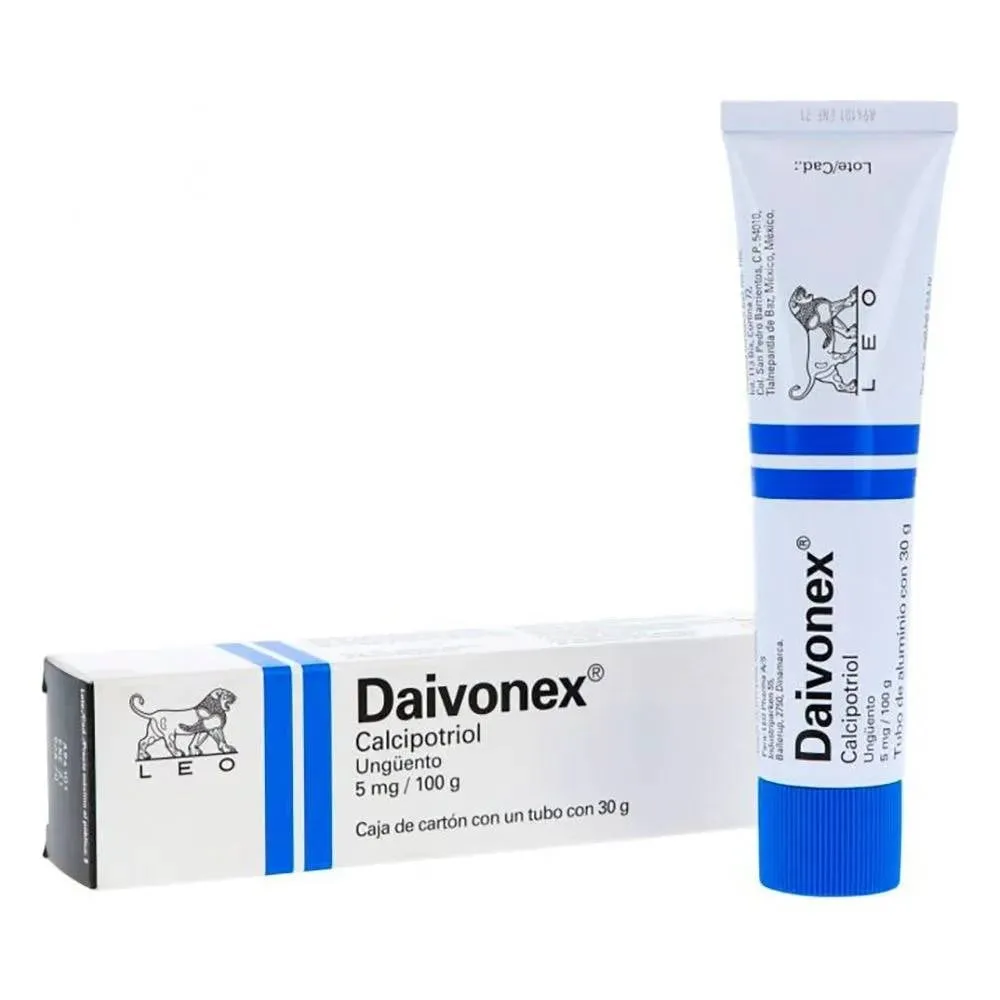
Table of Contents
- Patient Information Leaflet
- Daivonex 0.005% cream
- 1. What Daivonex is and what it is used for
- 2. What you need to know before using Daivonex
- 3. How to use Daivonex
- 4. Possible side effects
- 5. How to store Daivonex
- 6. Package contents and other information
- Patient information leaflet
- Daivonex 0.005% ointment
- 1. What Daivonex is and what it is used for
- 2. What you need to know before using Daivonex
- 3. How to use Daivonex
- 4. Possible side effects
- 5. How to store Daivonex
- 6. Package contents and other information
Patient Information Leaflet
Daivonex 0.005% cream
Calcipotriol
Please read this leaflet carefully before using this medicine because it contains important information for you.
- Keep this leaflet. You may need to read it again.
- If you have any questions, ask your doctor or pharmacist.
- This medicine has been prescribed for you only. Do not give it to others, even if their symptoms are the same as yours, as it could be harmful.
- If you experience any side effect, including those not listed in this leaflet, tell your doctor or pharmacist. See section 4.
Contents of this leaflet:
- What Daivonex is and what it is used for
- What you need to know before using Daivonex
- How to use Daivonex
- Possible side effects
- How to store Daivonex
- Contents of the pack and other information
1. What Daivonex is and what it is used for
Daivonex belongs to a group of medicines called anti-psoriatics. It contains the active substance
calcipotriol, a synthetic derivative of vitamin D. Vitamin D controls the growth of skin cells.
If your skin cells grow too quickly, you may develop psoriasis. Psoriasis is a condition in which the skin develops thick red patches and silvery-scaled plaques. These scaly patches consist of dead skin cells that normally shed from the skin without people noticing.
Daivonex works by reducing the number of skin cells produced. This means that skin symptoms also decrease.
Daivonex is used to treat psoriasis vulgaris, the most common type of psoriasis.
Consult your doctor if you do not feel better or if you feel worse during treatment.
2. What you need to know before using Daivonex
Do not use Daivonex
- If you are allergic to calcipotriol or to any of the other ingredients of this medicine (listed in section 6)
- if your doctor has informed you that you have high or low levels of a substance called calcium in your body (calcium metabolism disorders)
- if you suffer from other forms of psoriasis (guttate, erythrodermic, exfoliative, or pustular psoriasis), as this may increase the risk of elevated calcium levels in the blood
- if you have severe kidney problems
- if you have severe liver problems.
Warnings and precautions
Talk to your doctor or pharmacist before using Daivonex.
In particular, consult your doctor if you think any of the following conditions apply to you:
- you have high levels of vitamin D in your blood
- you have high levels of calcium in your blood (hypercalcemia)
- you have high levels of calcium in your urine (hypercalciuria)
- you have previously had kidney stones, because the use of calcipotriol may increase the risk of developing kidney stones.
Exposure to ultraviolet (UV) radiation
Talk to your doctor if you are undergoing UV radiation therapy, as you should discuss with your doctor whether undergoing UV radiation while using Daivonex is appropriate. Your doctor will advise you to limit exposure to sunlight or artificial light while using this medicine.
Children and adolescents
Avoid using Daivonex in children and adolescents (0–18 years of age), as the efficacy and safety of this medicine in this age group have not been established.
Other medicines and Daivonex
Inform your doctor or pharmacist if you are taking, have recently taken, or might take any other medicines.
Pregnancy, breastfeeding and fertility
If you are pregnant, think you may be pregnant, are planning to become pregnant, or are breastfeeding, consult your doctor or pharmacist before using this medicine.
Pregnancy
Avoid using Daivonex during pregnancy unless your doctor has specifically determined that this medicine is clearly needed.
Breastfeeding
Do not apply Daivonex to the breast area if you are breastfeeding.
Fertility
Daivonex has no effect on fertility.
Driving and using machines
Daivonex has no effect or a negligible effect on the ability to drive or operate machinery.
Daivonex cream contains cetyl stearyl alcohol, diazolidinyl urea, and 2,4-dichlorobenzyl alcohol
Daivonex contains cetyl stearyl alcohol: it may cause local skin reactions (e.g. contact dermatitis).
Daivonex cream contains diazolidinyl urea, an excipient that releases formaldehyde: it may cause local skin reactions (e.g. contact dermatitis).
Daivonex cream contains 1 mg/g of 2,4-dichlorobenzyl alcohol: it may cause allergic reactions and mild local irritation.
3. How to use Daivonex
Use this medicine exactly as described in this leaflet or as directed by your doctor or pharmacist. If you have any doubts, consult your doctor or pharmacist.
The recommended dose is 1 application twice daily.
The maximum recommended dose is 100 grams of this medicine per week (one 100-gram tube).
Do not exceed the recommended dose, as this may cause an increase in calcium levels in the blood (see section 4 “Possible side effects”), which however resolves upon discontinuation of treatment.
Inform your doctor or pharmacist if you are using another medicine containing calcipotriol (the same active substance contained in Daivonex) together with Daivonex.
How to use Daivonex
Wash and dry the area to be treated thoroughly.
Apply the cream to the affected lesions.
Do not use Daivonex on the face, as this may cause itching and skin irritation.
If you accidentally apply Daivonex to the eyes, you may experience conjunctival swelling (swelling of the inner membrane of the eye).
Therefore, wash your hands thoroughly after each application.
Avoid applying Daivonex to skin folds, as the risk of experiencing side effects is higher (see section 4 “Possible side effects”).
Duration of treatment
Continue treatment until the lesions have disappeared. However, normally the treatment duration should not exceed 22 weeks.
If you use more Daivonex than you should
Do not exceed the recommended dose, as this may cause an increase in calcium levels in the blood (hypercalcemia). Symptoms you may experience include:
- excessive production and excretion of urine
- constipation
- muscle weakness
- confusion
- coma
These symptoms however resolve upon discontinuation of treatment. In addition, if you use more Daivonex than recommended, you may also develop increased calcium levels in the urine. In case of accidental ingestion/overdose of Daivonex, contact your doctor immediately or go to the nearest hospital.
If you forget to use Daivonex
If you forget to apply Daivonex, do not apply a double amount to the lesions. Instead, consult your doctor or pharmacist.
If you stop using Daivonex
If you have any doubts about using this medicine, consult your doctor or pharmacist.
4. Possible side effects
Like all medicines, this medicine can cause side effects, although not everyone experiences them.
The following side effects have been reported during the use of this medicine:
Very common (may affect more than 1 in 10 people)
- skin irritation
Common (may affect up to 1 in 10 people) - worsening of psoriasis
- skin inflammation (dermatitis)
- redness of the skin (erythema)
- skin rash (rash: various types of rashes have been reported, such as erythematous rash, maculopapular rash, morbilliform rash, papular rash and pustular rash)
- skin peeling
- burning sensation of the skin
- itching
- pain at the application site
Uncommon (may affect up to 1 in 100 people) - allergy
- increased sensitivity to light
- skin swelling
- skin inflammation characterized by redness and scaling, particularly on the scalp, face and chest (seborrheic dermatitis)
- dry skin
- increased calcium levels in the blood (hypercalcaemia)
- increased calcium levels in urine (hypercalciuria)
Rare (may affect up to 1 in 1,000 people) - skin redness accompanied by itching
- change in skin colour at the application site
Reporting of side effects
If you experience any side effect, including those not listed in this leaflet, talk to your doctor. You can also report side effects directly via the national reporting system at www.agenziafarmaco.gov.it/it/responsabili. By reporting side effects, you can help provide more information on the safety of this medicine.
5. How to store Daivonex
Keep this medicine out of the sight and reach of children.
Do not use this medicine after the expiry date stated on the carton after Exp.
The expiry date refers to the last day of that month.
Do not store above 25°C. Do not freeze.
Validity after first opening: 6 months. Write the date of first opening of the tube in the designated space on the
carton.
Do not dispose of any medicine via wastewater or household waste. Ask your pharmacist how to dispose of
medicines no longer required. This will help protect the environment.
6. Package contents and other information
What Daivonex contains
100 grams of cream contain:
- The active substance is calcipotriol 5 milligrams
- The other components are macrogol cetostearyl ether, edetate sodium, disodium phosphate dihydrate, liquid paraffin, cetostearyl alcohol, glycerol 85%, diazolidinyl urea (contains formaldehyde), 2,4-dichlorobenzyl alcohol, sodium hydroxide, white soft paraffin, purified water, all-rac-α-tocopherol.
Description of the appearance of Daivonex and contents of the pack
Daivonex is available as a cream in tubes of 30 grams or 100 grams.
Not all pack sizes may be marketed.
Other available presentations:
Daivonex 0.005% ointment and Daivonex 0.005% cutaneous solution.
Marketing Authorization Holder
Leo Pharma A/S, Industriparken 55, 2750 – Ballerup (DK)
Licensee in Italy: LEO Pharma S.p.A., Via Elio Vittorini, 129 – 00144 Rome
Manufacturer
LEO Laboratories Limited, 285 Cashel Road, Dublin 12, Ireland.
Patient information leaflet
Daivonex 0.005% ointment
Calcipotriol
Please read this entire leaflet carefully before using this medicine, as it contains important information for you.
- Keep this leaflet. You may need to read it again.
- If you have any questions, consult your doctor or pharmacist.
- This medicine has been prescribed for you personally. Do not give it to others, even if their symptoms are the same as yours, as it could be harmful.
- If you experience any adverse reactions, including those not listed in this leaflet, contact your doctor or pharmacist. See section 4.
Contents of this leaflet:
- What Daivonex is and what it is used for
- What you need to know before using Daivonex
- How to use Daivonex
- Possible side effects
- How to store Daivonex
- Contents of the pack and other information
1. What Daivonex is and what it is used for
Daivonex belongs to a group of medicines called anti-psoriatics. It contains the active substance calcipotriol, a synthetic derivative of vitamin D. Vitamin D controls the growth of skin cells.
If your skin cells grow too quickly, you may develop psoriasis. Psoriasis is a condition in which the skin develops thick red patches and scaly silver-coloured plaques. These scaly patches consist of dead skin cells that normally shed from the skin without people noticing.
Daivonex works by reducing the number of skin cells produced. This means that skin symptoms also decrease.
Daivonex is used to treat psoriasis vulgaris, the most common type of psoriasis.
If you do not feel better or feel worse during treatment, consult your doctor.
2. What you need to know before using Daivonex
Do not use Daivonex
- If you are allergic to calcipotriol or to any of the other ingredients of this medicine (listed in section 6)
- if your doctor has informed you that you have high or low levels of a substance called calcium in your body (calcium metabolism disorders)
- if you suffer from other forms of psoriasis (guttate, erythrodermic, exfoliative, or pustular psoriasis), as this may increase the risk of elevated calcium levels in the blood
- if you have severe kidney problems
- if you have severe liver problems.
Warnings and precautions
Talk to your doctor or pharmacist before using Daivonex.
In particular, consult your doctor if you think any of the following conditions apply to you:
- you have high levels of vitamin D in the blood
- you have high levels of calcium in the blood (hypercalcemia)
- you have high levels of calcium in the urine (hypercalciuria)
- you have previously suffered from kidney stones
because the use of calcipotriol may increase the likelihood of kidney stone formation.
Exposure to ultraviolet (UV) radiation
Talk to your doctor if you are undergoing UV radiation treatment, as you should discuss the possibility of receiving UV radiation while using Daivonex.
Your doctor will advise you to limit exposure to sunlight or artificial light while using this medicine.
Children and adolescents
Avoid using Daivonex in children and adolescents (0–18 years of age), as the efficacy and safety of this medicine have not been established in this age group.
Other medicines and Daivonex
Inform your doctor or pharmacist if you are taking, have recently taken, or might take any other medicines.
Pregnancy, breastfeeding and fertility
If you are pregnant, think you might be pregnant, are planning a pregnancy, or are breastfeeding, consult your doctor or pharmacist before using this medicine.
Pregnancy
Avoid using Daivonex during pregnancy unless your doctor has assessed that treatment with this medicine is clearly necessary.
Breastfeeding
Do not apply Daivonex to the breast area if you are breastfeeding.
Fertility
Daivonex has no effect on fertility.
Driving and using machines
Daivonex has no effect, or has a negligible effect, on the ability to drive vehicles or operate machinery.
Daivonex contains propylene glycol
Daivonex contains propylene glycol: it may cause skin irritation.
3. How to use Daivonex
Use this medicine exactly as described in this leaflet or as directed by your doctor or pharmacist. If you are unsure, consult your doctor or pharmacist.
The recommended dose is one application twice daily.
The maximum recommended dose is 100 grams of this medicine per week (slightly more than three 30-gram tubes).
Do not exceed the recommended dose, as this may cause an increase in blood calcium levels (see section 4 "Possible side effects"), which however resolves upon discontinuation of treatment.
Inform your doctor or pharmacist if you are using another medicine containing calcipotriol (the same active substance contained in Daivonex) together with Daivonex.
How to use Daivonex
Wash and dry the affected area thoroughly.
Apply the ointment to the lesions.
Do not use Daivonex on the face, as this may cause itching and skin irritation.
If you accidentally apply Daivonex to the eyes, you may experience conjunctival swelling (swelling of the inner membrane of the eye).
Therefore, wash your hands thoroughly after each application.
Avoid applying Daivonex to skin folds, as the risk of experiencing side effects is higher (see section 4 "Possible side effects").
Duration of treatment
Continue treatment until the lesions have disappeared. However, normally the treatment duration should not exceed 22 weeks.
If you use more Daivonex than you should
Do not exceed the recommended dose, as this may cause an increase in blood calcium levels (hypercalcemia). Symptoms you may experience include:
- excessive urine production and excretion
- constipation
- muscle weakness
- confusion
- coma
These symptoms resolve upon discontinuation of treatment. Additionally, if you use more Daivonex than recommended, you may also experience increased calcium levels in the urine. In case of accidental ingestion/overdose of Daivonex, contact your doctor immediately or go to the nearest hospital.
If you forget to use Daivonex
If you forget to apply Daivonex, do not apply a double dose to the lesions. Instead, consult your doctor or pharmacist.
If you stop using Daivonex
If you have any questions about the use of this medicine, consult your doctor or pharmacist.
4. Possible side effects
Like all medicines, this medicine can cause side effects, although not everybody gets them.
The following side effects have been reported during the use of this medicine:
Common (may affect up to 1 in 10 people)
- worsening of psoriasis
- skin inflammation (dermatitis)
- skin redness (erythema)
- skin irritation
- skin peeling
- burning sensation of the skin
- itching
Uncommon (may affect up to 1 in 100 people)
- superficial infection of the hair follicle, the structure surrounding the hair root (folliculitis)
- skin rash (rash: various types of rash have been reported, such as erythematous rash, morbilliform rash, papular rash, pruritic rash and pustular rash)
- change in skin colour at the application site
- dry skin
Rare (may affect up to 1 in 1,000 people)
- allergy
- increased calcium in the blood (hypercalcaemia)
- increased calcium in the urine (hypercalciuria)
- increased sensitivity to light
- skin swelling
- skin inflammation characterized by redness and scaling, particularly on the scalp, face and chest (seborrhoeic dermatitis)
- skin redness accompanied by itching
Reporting of side effects
If you experience any side effect, including those not listed in this leaflet, consult your doctor.
You may also report side effects directly through the national reporting system at www.agenziafarmaco.gov.it/it/responsabili.
By reporting side effects, you can help provide more information on the safety of this medicine.
5. How to store Daivonex
Keep this medicine out of the sight and reach of children.
Do not use this medicine after the expiry date stated on the carton after Exp.
The expiry date refers to the last day of that month.
Do not store above 25°C.
Do not dispose of medicines via wastewater or household waste. Ask your pharmacist how to dispose of medicines no longer required. This will help protect the environment.
6. Package contents and other information
What Daivonex contains
100 grams of ointment contain:
- The active substance is calcipotriol 5 milligrams (equivalent to 0.005%).
- The other components are edetate disodium, disodium hydrogen phosphate dihydrate, alpha-tocopherol, liquid paraffin, stearyl alcohol (2) POE, propylene glycol, white soft paraffin, purified water.
Description of the appearance of Daivonex and contents of the pack
Daivonex is available as an ointment in a 30 g tube.
Other pack sizes are also available:
Daivonex 0.005% cream and Daivonex 0.005% cutaneous solution.
Marketing Authorisation Holder
Leo Pharma A/S, Industriparken 55, 2750 – Ballerup (DK)
Licence Holder in Italy: LEO Pharma S.p.A., Via Amsterdam 125 – 00144 Roma
Manufacturer
LEO Laboratories Limited, 285 Cashel Road, Dublin 12, Ireland.