Cytotec
Italy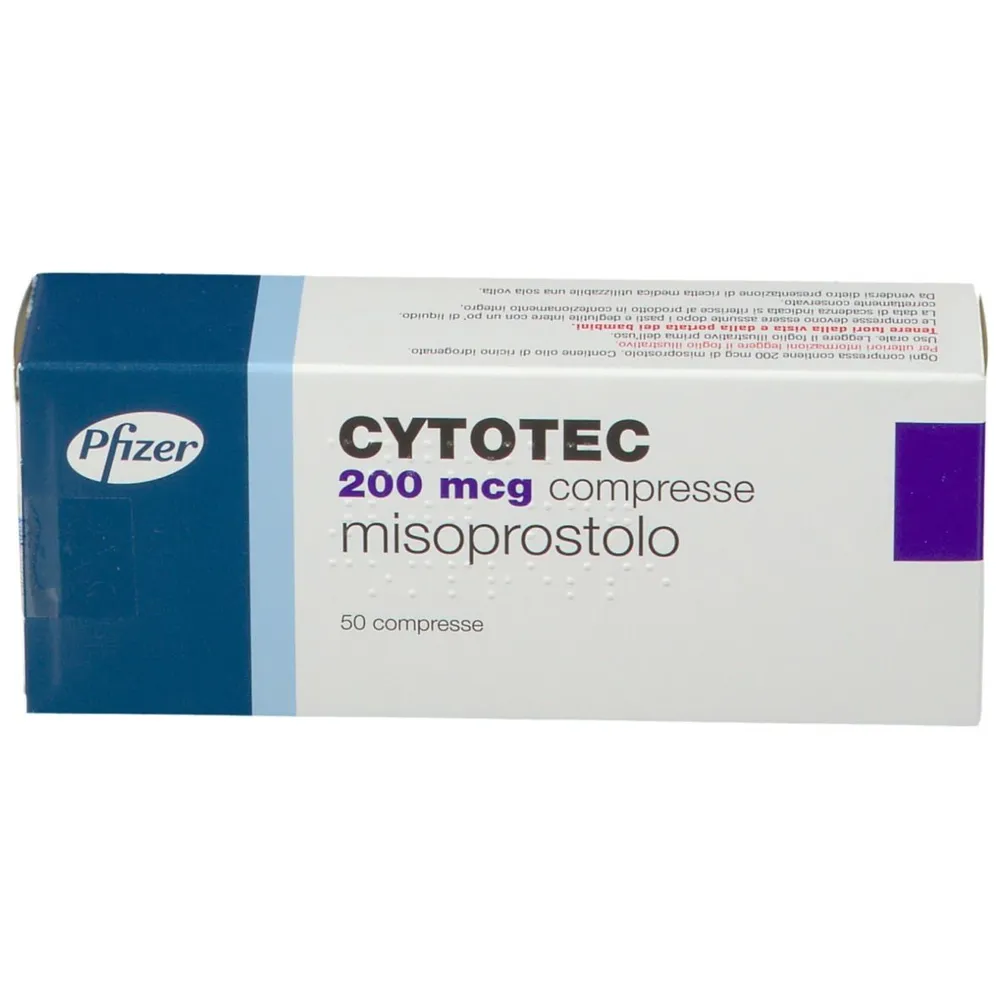
Table of Contents
Package leaflet: Information for the patient
Cytotec 200 mcg tablets
Misoprostol
Please read this leaflet carefully before taking this medicine because it contains important information for you.
- Keep this leaflet. You may need to read it again.
- If you have any questions, ask your doctor or pharmacist.
- This medicine has been prescribed for you only. Do not give it to other people, even if their symptoms are the same as yours, as it may be harmful.
- If you experience any side effect, including those not listed in this leaflet, please tell your doctor or pharmacist. See section 4.
Contents of this leaflet:- What Cytotec is and what it is used for
- What you need to know before taking Cytotec
- How to take Cytotec
- Possible side effects
- How to store Cytotec
- Contents of the pack and other information
1. What Cytotec is and what it is used for
Cytotec contains the active substance misoprostol, which belongs to a group of medicines called prostaglandin E1 analogues. This medicine protects the mucosa of the stomach and intestine from substances that may cause injury.
Cytotec is indicated:
- to prevent injury to the stomach and intestine ( gastroduodenal ulcers ) caused by medicines used to relieve symptoms of inflammation (non-steroidal anti-inflammatory drugs - NSAIDs);
- to treat injury to the stomach and intestine ( gastroduodenal ulcers ), including those induced by NSAID treatment in people with severe joint disorders (arthritic patients at risk) who need to continue therapy with these medicines.
2. What you need to know before taking Cytotec
Do not take Cytotec
- if you are allergic to misoprostol, to medicines similar to it (other prostaglandins), or to any of the other ingredients of this medicine (listed in section 6);
- if you are a woman of childbearing age and you are not using an effective contraceptive method to prevent pregnancy (see section “Pregnancy and breastfeeding”);
- if you are or think you may be pregnant, if you are planning a pregnancy, or if you do not have a negative pregnancy test, as it may cause miscarriage (see section “Pregnancy and breastfeeding”).
Warnings and precautions
Talk to your doctor or pharmacist before taking Cytotec if:
- you are pregnant or intend to become pregnant (see subsection “Pregnancy” below). Because of the risk to the fetus, your treatment with Cytotec must be stopped immediately.
- you are a woman of childbearing age (see subsection “Pregnancy” below). Because of the risk to the fetus, it is important to use an effective contraceptive method during treatment with Cytotec.
- you suffer from conditions that may cause diarrhea, such as inflammatory bowel disease. To reduce the risk of diarrhea, Cytotec should be taken with food and should not be taken together with antacids containing magnesium, used to treat certain stomach disorders (see sections “Other medicines and Cytotec” and “How to take Cytotec”);
- you have conditions that could be worsened by fluid loss ( dehydration ). In this case, your doctor will monitor your health condition closely;
- you suffer from severe circulatory disorders, especially affecting the heart and brain (cerebrovascular disease, coronary heart disease, or severe peripheral vascular disease), or from high blood pressure ( hypertension ), as this medicine may cause a sudden drop in blood pressure (hypotension), worsening symptoms of these diseases.
During treatment with Cytotec, bleeding, ulcers, or perforations of the stomach and intestine may occur, especially when Cytotec is taken together with other medicines used to relieve inflammation symptoms (non-steroidal anti-inflammatory drugs - NSAIDs) (see section “Other medicines and Cytotec”). Your doctor will carry out frequent check-ups.
Laboratory tests
Before starting treatment with Cytotec, your doctor will perform specific tests (endoscopy, biopsy) to rule out that stomach or intestinal lesions are caused by a tumor (neoplastic lesions), as this medicine may mask tumor symptoms and delay diagnosis.
These investigations, and others deemed necessary by your doctor, may be repeated at regular intervals to further assess your health status.
Other medicines and Cytotec
Tell your doctor or pharmacist if you are taking, have recently taken, or might take any other medicine.
Inform your doctor or pharmacist if you are taking non-steroidal anti-inflammatory drugs (NSAIDs) (medicines that relieve pain and reduce inflammation). When taken together with Cytotec, these medicines may alter the results of certain laboratory tests (elevated transaminases) and may cause swelling due to fluid retention, especially in the legs and ankles (peripheral edema).
Avoid taking Cytotec together with antacids containing magnesium (medicines used for stomach disorders), as they increase the risk of diarrhea caused by this medicine.
Pregnancy and breastfeeding
If you are pregnant, suspect you may be pregnant, are planning a pregnancy, or are breastfeeding, consult your doctor or pharmacist before taking this medicine.
Pregnancy
• Do not take Cytotec if you are pregnant, think you may be pregnant, or are planning a pregnancy. Your doctor will inform you about the risks during pregnancy, as Cytotec may cause miscarriage, premature birth, or congenital malformations (serious harm to your baby), including fetal death. Exposure to misoprostol during the first trimester of pregnancy has been associated with approximately a threefold increased risk of congenital malformations, particularly facial palsy, limb defects, and brain and cranial abnormalities. If you are exposed to Cytotec during pregnancy, consult your doctor. If you decide to continue the pregnancy, careful prenatal monitoring and repeated ultrasound examinations, with particular attention to limbs and head, should be performed.
• If you are a woman of childbearing age, perform a pregnancy test before starting treatment with Cytotec to ensure you are not pregnant. Begin treatment with this medicine on the second or third day of your normal menstrual cycle and use an effective contraceptive method to prevent pregnancy during treatment.
• If you become pregnant accidentally, you must stop treatment with this medicine immediately (see section “Do not take Cytotec”).
Breastfeeding
This medicine passes into breast milk. If you are breastfeeding, do not take Cytotec, as it may cause diarrhea in the infant.
Driving and operating machinery
This medicine may cause dizziness. Therefore, avoid driving or operating machinery if you experience this symptom.
Cytotec contains castor oil
This medicine contains castor oil. It may cause gastrointestinal disturbances and diarrhea.
Cytotec contains sodium
This medicine contains less than 1 mmol (23 mg) of sodium per tablet, i.e., essentially “sodium-free”.
3. How to take Cytotec
Take this medicine exactly as prescribed by your doctor or pharmacist. If you have
any doubts, consult your doctor or pharmacist.
Take Cytotec preferably with meals.
Take the last dose of the medicine in the evening before going to bed.
Avoid taking Cytotec together with magnesium-containing antacids (see sections “Warnings and
precautions” and “Other medicines and Cytotec”).
Prevention of stomach and intestinal damage (gastroduodenal ulcers) caused by the use of
non-steroidal anti-inflammatory drugs – NSAIDs
The recommended dose is 200 mcg, taken 2–4 times daily. Your doctor will determine the most suitable dose and duration of treatment for you, depending on your health condition.
Treatment of stomach and intestinal damage (gastroduodenal ulcers) caused by the use of
non-steroidal anti-inflammatory drugs – NSAIDs
The recommended dose is 800 mcg daily, divided into 2 or 4 doses per day.
You should continue treatment for at least 4 weeks, even if symptoms improve more rapidly. If necessary, your doctor may advise you to continue treatment for up to 8 weeks.
If symptoms of stomach or intestinal damage recur, your doctor may prescribe another course of treatment with Cytotec.
If you are elderly
Dose adjustments are not required in elderly patients.
If you have kidney problems
If you have kidney problems, a dose reduction may be necessary.
If you take more Cytotec than you should
It is important not to exceed the prescribed dose. If you accidentally take very high doses of this medicine, you may experience: sedation, tremors, seizures, breathing difficulties (dyspnea), abdominal pain, uterine muscle contractions (uterine contractions), diarrhea, fever, increased awareness of heartbeat (palpitations), low blood pressure (hypotension), or reduced heart rate (bradycardia).
If you have any questions about the use of this medicine, consult your doctor or pharmacist.
4. Possible side effects
Like all medicines, this medicine can cause side effects, although not everybody gets them.
Contact your doctor immediately if you experience any of the following side effects because they may be serious:
Common side effects (may affect up to 1 in 10 people)
- Congenital malformations (fetal malformations). If you become pregnant during treatment, stop taking Cytotec immediately and consult your doctor.
Rare side effects (may affect up to 1 in 1,000 people)
- Uterine rupture (tearing of the uterus) after administration of prostaglandins during the second or third trimester of pregnancy, primarily in women who have had previous deliveries or a previous caesarean section. Seek urgent medical advice.
Side effects with unknown frequency (frequency cannot be estimated from the available data):
- severe allergic reactions (anaphylactic reactions)
- passage of amniotic fluid into the maternal circulation causing severe harm to both mother and fetus (amniotic fluid embolism)
- abnormalities in uterine contractions
- fetal death during pregnancy
- incomplete expulsion of the fetus and/or placenta (incomplete abortion)
- delivery of the newborn before the normal end of pregnancy (premature birth)
- failure of the placenta to be expelled after childbirth (retained placenta)
- uterine perforation
- uterine haemorrhage
Inform your doctor if you experience any of the following side effects:
Very common side effects (may affect more than 1 in 10 people)
- diarrhoea, which may in rare cases be severe and accompanied by serious dehydration;
- skin irritations (rash).
Common side effects (may affect up to 1 in 10 people)
- dizziness
- headache (cephalalgia)
- abdominal pain
- constipation (stipsis)
- stomach discomfort and fullness (dyspepsia)
- flatulence
- nausea
- vomiting
Uncommon side effects (may affect up to 1 in 100 people)
- vaginal bleeding (vaginal haemorrhage, including post-menopausal bleeding)
- vaginal bleeding between menstrual periods (intermenstrual bleeding)
- menstrual cycle disturbances
- uterine muscle cramps (uterine cramps)
- fever (pyrexia)
Rare side effects (may affect up to 1 in 1,000 people)
- heavy vaginal bleeding (menorrhagia)
- severe pain during menstruation (dysmenorrhoea)
Side effects with unknown frequency (frequency cannot be estimated from the available data)
- chills
Reporting of side effects
If you get any side effects, including those not listed in this leaflet, talk to your doctor or pharmacist. You can also report side effects directly via the national reporting system at www.aifa.gov.it/content/segnalazioni-reazioni-avverse. By reporting side effects, you can help provide more information on the safety of this medicine.
5. How to store Cytotec
Keep this medicine out of the sight and reach of children.
Do not use this medicine after the expiry date stated on the carton and blister after "Exp.". The expiry date refers to the last day of that month.
Store the medicine in a dry place.
Do not dispose of any medicine via wastewater or household waste. Ask your pharmacist how to dispose of medicines you no longer use. This will help protect the environment.
6. Package contents and other information
What Cytotec contains
The active substance is misoprostol.
Each tablet contains 200 micrograms of misoprostol.
The other components are: hypromellose, microcrystalline cellulose, sodium starch glycolate, castor oil, hydrogenated.
Description of the appearance of Cytotec and pack contents
Cytotec tablets are available in aluminum/polyvinyl chloride blisters, in packages containing 50 tablets.
Marketing Authorisation Holder and Manufacturer
Marketing Authorisation Holder
Pfizer S.r.l.
Via Isonzo, 71
04100 Latina, Italy
Manufacturer
Piramal Pharma Solutions (Dutch) B.V.
Level, 7th floor
Bargelaan 200
2333 CW
Leiden
The Netherlands