Cystagon
Italy
Table of Contents
Package leaflet: Information for the user
Cystagon 50 mg Hard Capsules, 150 mg Hard Capsules
cysteamine bitartrate (mercaptamine bitartrate)
Please read this leaflet carefully before using this medicine because it contains important information for you.
- Keep this leaflet. You may need to read it again.
- If you have any questions, ask your doctor or pharmacist.
- This medicine has been prescribed for you only. Do not give it to others, even if their symptoms are the same as yours, because it could be harmful.
- If you experience any side effect, including those not listed in this leaflet, contact your doctor or pharmacist. See section 4.
Contents of this leaflet
- What CYSTAGON is and what it is used for
- What you need to know before taking CYSTAGON
- How to take CYSTAGON
- Possible side effects
- How to store CYSTAGON
- Contents of the pack and other information
1. What CYSTAGON is and what it is used for
Cystinosis is a metabolic disease known as “nephropathic cystinosis”, characterized by an abnormal accumulation of the amino acid cystine in various organs of the body, such as the kidneys, eyes, muscles, pancreas, and brain. The accumulation of cystine damages the kidneys and causes excessive excretion of glucose, proteins, and electrolytes. Different organs are affected at different ages.
CYSTAGON is prescribed for the treatment of this rare inherited disorder. CYSTAGON is a medicine that reacts with cystine to reduce its levels within cells.
2. What you should know before taking CYSTAGON
Do not take CYSTAGON
- if you – or the child – are allergic to cysteamine bitartrate or penicillamine, or to any of the other ingredients of this medicine (listed in section 6).
- if you are pregnant, especially during the first trimester.
- if you are breastfeeding.
Warnings and precautions
- If cystinosis has been confirmed by measuring cystine levels in white blood cells, treatment with CYSTAGON should be started as soon as possible.
- Cases of skin lesions on the elbow, in the form of small hard masses, have been reported in children treated with high doses of various cysteamine-containing preparations. These lesions were associated with skin striae and bone abnormalities, such as fractures or bone deformities, and joint laxity. Your doctor may recommend periodic medical examinations and X-rays of the skin and bones to monitor the effects of the medicine. Regular self-examination of the skin is also recommended, both for you and the child. If any skin or bone abnormalities appear, inform your doctor immediately.
- Your doctor may periodically monitor your blood cell counts.
- It has not been demonstrated that CYSTAGON prevents the accumulation of cystine crystals in the eye. If you are using a topical ophthalmic solution containing cysteamine for this purpose, continue its use.
- Unlike phosphocysteamine, another active substance similar to cysteamine bitartrate, CYSTAGON does not contain phosphate. You may already be taking phosphate supplements, and their dosage may need adjustment when CYSTAGON replaces phosphocysteamine.
- To avoid the risk of pulmonary aspiration, capsules must not be administered to children under approximately 6 years of age.
- Do not ingest the desiccant container placed inside the bottle.
Other medicines and CYSTAGON
Tell your doctor or pharmacist if you are taking, have recently taken, or might take any other
medicines.
CYSTAGON with food and drinks
For children under approximately six years of age, the hard capsule may be opened and its contents
mixed with food (e.g. milk, potatoes, or starchy foods) or infant formula. Do not mix it with acidic drinks such as orange juice. Consult your doctor for specific instructions.
Pregnancy
Do not take CYSTAGON if you are pregnant. Consult your doctor if you are planning to have a child.
Breastfeeding
CYSTAGON must not be used during breastfeeding.
Driving and using machines
CYSTAGON may cause drowsiness. At the beginning of treatment, you or your child should avoid potentially hazardous activities until the effects of the medicine are fully known.
3. How to use CYSTAGON
Use this medicine exactly as prescribed by your doctor or paediatrician. If you
have any doubts, consult your doctor.
The dose of CYSTAGON prescribed for you or your child will depend on age and body weight.
For children up to 12 years of age, the dose is based on body surface area; the usual dose is
1.30 g/m² of body surface area per day.
For patients over 12 years of age and weighing more than 50 kg, the usual dose is 2 g/day.
In any case, the usual dose must not exceed 1.95 g/m²/day.
CYSTAGON must be taken or administered only orally and exactly as directed by the doctor or paediatrician. To ensure CYSTAGON works properly, follow the instructions below:
- Strictly adhere to your doctor's instructions. Do not increase or decrease the amount of medicine without your doctor's approval.
- Hard capsules must not be administered to children under approximately six years of age, as they may be unable to swallow them and could therefore choke. For children under approximately six years of age, the hard capsule may be opened and its contents sprinkled onto food (e.g. milk, potatoes, or starchy foods) or mixed into formula. Do not add it to acidic drinks such as orange juice. Consult your doctor for precise instructions.
- Your or your child's treatment may include, in addition to CYSTAGON, one or more supplements to replace important electrolytes lost through the kidneys. It is important to take these supplements exactly as directed. Consult your doctor if several doses of these supplements have been missed, or if weakness or drowsiness occurs.
- Regular blood tests to measure the amount of cystine within leukocytes help determine the correct dosage of CYSTAGON. Your doctor or paediatrician will arrange the necessary
blood tests. Regular blood and urine tests to monitor levels of important body electrolytes also help your doctor properly adjust the doses of supplements.
CYSTAGON must be taken 4 times daily, every 6 hours, preferably immediately after eating or during meals. It is important to take the doses as close as possible to 6-hour intervals.
Treatment with CYSTAGON is indefinite, as determined by the doctor.
To open and close the Cystagon bottle easily, follow the instructions below.
Instructions for opening and closing the container
OPEN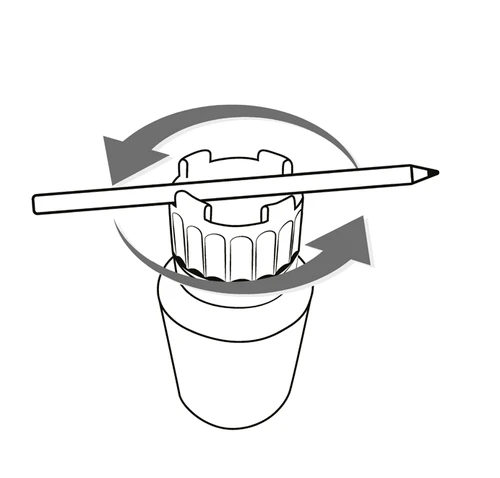 | CLOSE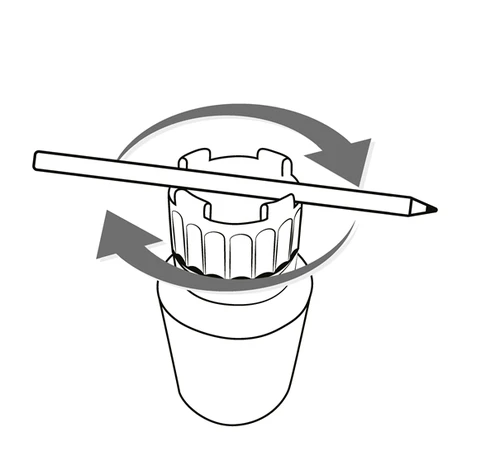 |
| To open, insert a pen or similar object between the raised sections of the protective cover and rotate in the direction shown (counterclockwise) | To close, insert a pen or similar object between the raised sections of the protective cover and rotate in the direction shown (clockwise) |
If you use more CYSTAGON than you should
Contact your doctor, paediatrician, or hospital emergency department immediately if the medicine has been taken in higher doses than prescribed, especially if drowsiness occurs.
If you forget to take CYSTAGON
If you forget to take a dose of the medicine, take it as soon as possible. However, if less than two hours remain before the next scheduled dose, skip the missed dose and resume your regular dosing schedule. Do not take a double dose to make up for the forgotten dose.
4. Possible side effects
Like all medicines, this medicine can cause side effects, although not everyone experiences them.
CYSTAGON may cause drowsiness or reduced alertness in some people. Before carrying out any activity that could be dangerous if adequate attention is not paid, make sure you know how you or your child react to this medicine.
The following side effects have been reported with the following frequency: very common (occur in at least 1 in 10 people), common (occur in at least 1 in 100 people), uncommon (occur in at least 1 in 1,000 people), rare (occur in at least 1 in 10,000 people), very rare (occur in at least 1 in 100,000 people).
- Very common: vomiting, nausea, diarrhoea, loss of appetite, fever, and drowsiness.
- Common: abdominal pain or discomfort, bad breath and altered body odour, skin rash, gastroenteritis, fatigue, headache, encephalopathy (brain disorder), and abnormal liver function tests.
- Uncommon: skin striae, skin lesions (small hard lumps on elbows), joint laxity, leg pain, bone fractures, scoliosis (spinal curvature), bone deformities and fragility, hair discoloration, severe allergic reactions, drowsiness, epileptic seizures, nervousness, hallucinations, decreased white blood cells, gastrointestinal ulceration presenting with gastrointestinal bleeding, and kidney effects presenting with swelling of extremities and weight gain. Some of the above side effects are serious. Therefore, we encourage you to consult your doctor or paediatrician for a more detailed explanation of the related symptoms.
Reporting of side effects
If you experience any side effect, including those not listed in this leaflet, please inform your doctor or pharmacist. You can also report side effects directly through the national reporting system detailed in Annex V. By reporting side effects, you can help provide more information on the safety of this medicine.
5. How to store CYSTAGON
Keep this medicine out of the sight and reach of children.
Do not use this medicine after the expiry date which is stated on the label after Exp. The expiry date refers to the last day of that month.
Do not store above 25°C and keep the container tightly closed, protected from light and moisture.
Do not dispose of any medicine via wastewater or household waste. Ask your pharmacist how to dispose of medicines no longer required. This will help protect the environment.
6. Package contents and other information
What CYSTAGON contains
- The active substance is cysteamine bitartrate (mercaptamine bitartrate). Each CYSTAGON 50 mg hard capsule contains 50 mg of cysteamine (as mercaptamine bitartrate). Each CYSTAGON 150 mg hard capsule contains 150 mg of cysteamine (as mercaptamine bitartrate).
- The excipients are: microcrystalline cellulose, pregelatinized starch, magnesium stearate/sodium lauryl sulfate, colloidal silicon dioxide, cross-linked sodium carboxymethylcellulose, capsule shell: gelatin, titanium dioxide, black ink on hard capsules (E 172).
Description of the appearance of CYSTAGON and contents of the pack
Hard capsules
- Cystagon 50 mg: opaque white hard capsules, imprinted with "CYSTA 50" on the body of the capsule and "RECORDATI RARE DISEASES" on the cap. Bottles containing 100 or 500 hard capsules. Not all pack sizes may be marketed.
- Cystagon 150 mg: opaque white hard capsules, imprinted with "CYSTAGON 150" on the body of the capsule and "RECORDATI RARE DISEASES" on the cap. Bottles containing 100 or 500 hard capsules. Not all pack sizes may be marketed.
Marketing Authorization Holder
Recordati Rare Diseases
Tour Hekla
52, Avenue du Général de Gaulle
F-92800 Puteaux
France
Manufacturer
Recordati Rare Diseases
Tour Hekla
52, Avenue du Général de Gaulle
F-92800 Puteaux
France
or
Recordati Rare Diseases
Eco River Parc
30, rue des Peupliers
F-92000 Nanterre
France
For further information about CYSTAGON, please contact the local representative of the Marketing Authorization Holder:
Belgique/België/Belgien Lietuva
Recordati Recordati AB.
Tél/Tel: +32 2 46101 36 Tel: + 46 8 545 80 230
Švedija
България Luxembourg/Luxemburg
Recordati Rare Diseases Recordati
Teл.: +33 (0)1 47 73 64 58 Tél/Tel: +32 2 46101 36
Франция Belgique/Belgien
Česká republika Magyarország
Recordati Rare Diseases Recordati Rare Diseases
Tel: +33 (0)1 47 73 64 58 Tel: +33 (0)1 47 73 64 58
Francie Franciaország
Danmark Malta
Recordati AB. Recordati Rare Diseases
Tlf. : +46 8 545 80 230 Tel: +33 1 47 73 64 58
Sverige Franza
Deutschland Nederland
Recordati Rare Diseases Germany GmbH Recordati
Tel: +49 731 140 554 0 Tel: +32 2 46101 36
België
Eesti Norge
Recordati AB. Recordati AB.
Tel: + 46 8 545 80 230 Tlf : +46 8 545 80 230
Rootsi Sverige
Ελλάδα Österreich
Recordati Rare Diseases Recordati Rare Diseases Germany GmbH
Τηλ: +33 1 47 73 64 58 Tel: +49 731 140 554 0
Γαλλία Deutschland
España Polska
Recordati Rare Diseases Spain S.L.U. Recordati Rare Diseases
Tel: + 34 91 659 28 90 Tel: +33 (0)1 47 73 64 58
Francja
France Portugal
Recordati Rare Diseases Recordati Rare Diseases SARL
Tél: +33 (0)1 47 73 64 58 Tel: +351 21 432 95 00
Hrvatska România
Recordati Rare Diseases Recordati Rare Diseases
Tél: +33 (0)1 47 73 64 58 Tel: +33 (0)1 47 73 64 58
Francuska Franţa
Ireland Slovenija
Recordati Rare Diseases Recordati Rare Diseases
Tel: +33 (0)1 47 73 64 58 Tel: +33 (0)1 47 73 64 58
France Francija
Ísland Slovenská republika
Recordati AB. Recordati Rare Diseases
Simi:+46 8 545 80 230 Tel: +33 (0)1 47 73 64 58
Svíþjóð Francúzsko
Italia Suomi/Finland
Recordati Rare Diseases Italy Srl Recordati AB.
Tel: +39 02 487 87 173 Puh/Tel : +46 8 545 80 230
Sverige
Κύπρος Sverige
Recordati Rare Diseases Recordati AB.
Τηλ : +33 1 47 73 64 58 Tel : +46 8 545 80 230
Γαλλία
Latvija
Recordati AB.
Tel: + 46 8 545 80 230
Zviedrija
This leaflet was last updated
More detailed information on this medicinal product is available on the website of the European Medicines Agency, https://www.ema.europa.eu
In addition, links to other websites on rare diseases and their treatments are provided.