Cystadrops
Italy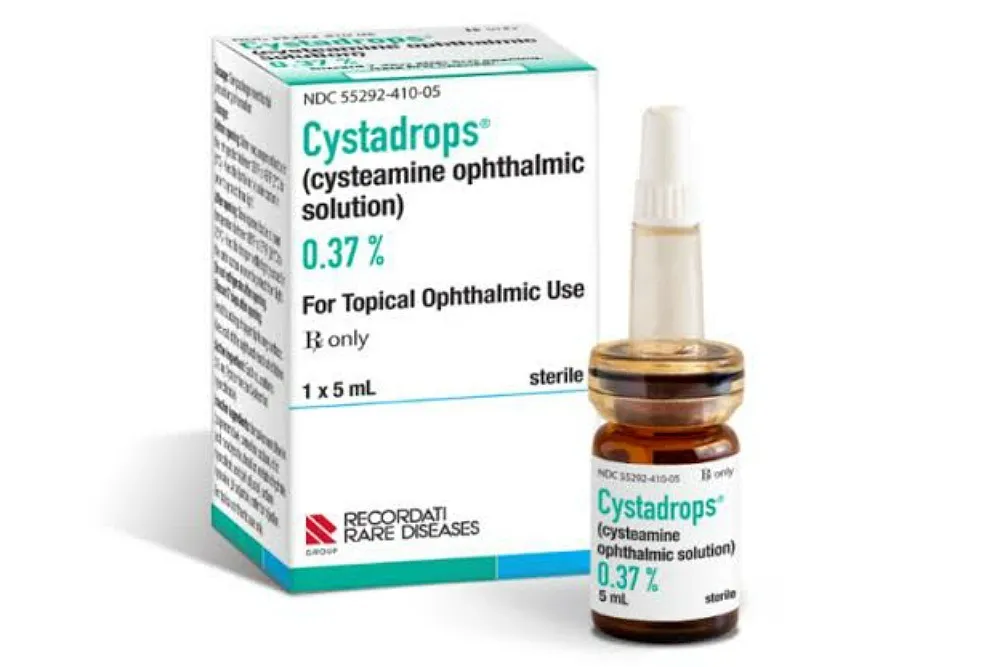
Table of Contents
Patient Information Leaflet
Cystadrops 3.8 mg/mL eye drops, solution
cysteamine (mercaptamine)
Please read all of this leaflet carefully before you start using this medicine, as it contains important information for you.
- Keep this leaflet. You may need to read it again.
- If you have any questions, ask your doctor or pharmacist.
- This medicine has been prescribed for you only. Do not pass it on to other people, even if their symptoms are the same as yours, as it may be harmful.
- If you experience any side effects, including those not listed in this leaflet, tell your doctor or pharmacist. See section 4.
Contents of this leaflet:
- What Cystadrops is and what it is used for
- What you need to know before using Cystadrops
- How to use Cystadrops
- Possible side effects
- How to store Cystadrops
- Contents of the pack and other information
1. What Cystadrops is and what it is used for
What Cystadrops is
Cystadrops is an eye solution containing the active substance cysteamine (also known as
mercaptamine).
What it is used for
It is used to reduce the amount of cystine crystals on the ocular surface (cornea) in adults and
children from 6 months of age with cystinosis.
What cystinosis is
Cystinosis is a rare inherited disease in which the body is unable to remove excess cystine (an amino acid), leading to the accumulation of cystine crystals in various organs (such as the kidneys and eyes). The buildup of crystals in the eye can cause increased sensitivity to light (photophobia), corneal deterioration (keratopathy), and vision loss.
2. What you need to know before using Cystadrops
Do not use Cystadrops
If you are allergic to cysteamine or to any of the other ingredients of this medicine (listed in section 6).
Warnings and precautions
Talk to your doctor or pharmacist before using Cystadrops.
Other medicines and Cystadrops
Tell your doctor or pharmacist if you are currently using, have recently used, or might use any other medicines.
Pregnancy and breastfeeding
Even though the level of Cystadrops in the blood is negligible, precautions should be taken.
If you are pregnant, suspect you may be pregnant, planning a pregnancy, or breastfeeding, consult your doctor or pharmacist before using this medicine.
Driving and using machines
Immediately after using Cystadrops, your vision may become blurred for a few minutes. Do not drive or operate machinery until your vision returns to normal.
Cystadrops contains benzalkonium chloride
This medicine contains 5 micrograms of benzalkonium chloride per drop, equivalent to 0.1 mg/mL.
Benzalkonium chloride may be absorbed by soft contact lenses and may cause discoloration. You must remove contact lenses before using this medicine and wait at least 15 minutes before reinserting them.
In addition, benzalkonium chloride may cause eye irritation, particularly if you suffer from dry eyes or corneal disorders (the transparent layer at the front of the eye). If, after using this medicine, you experience any unusual sensation in the eyes, eye twinges, or eye pain, consult your doctor.
3. How to use Cystadrops
Use this medicine exactly as directed by your doctor or pharmacist. If you have any doubts, consult your doctor or pharmacist.
Recommended dose
- The recommended dose is 1 drop in each eye, 4 times a day during waking hours.
- The recommended interval between applications is 4 hours (for example, you may administer the eye drops at 8 a.m., 12 p.m., 4 p.m., and 8 p.m.).
- To avoid having your eyelids "stuck" upon waking, it is recommended to administer the last drop of the day at least 30 minutes before going to bed.
- Based on the results of your ophthalmological examination, your doctor may decide to gradually reduce the dose (down to a minimum daily dosage of 1 drop in each eye).
This medicine must be used only as an eye drop (ophthalmic use).
When using the eye drops, you must carefully follow the instructions below. These instructions are also available in the form of an animated video at www.cystadrops.net ‘QR code to be included’
Step 1: Before using a bottle for the first time
- Cystadrops must be brought to room temperature before the first administration. This will facilitate the use of the drops.
- Immediately before first use, write down the date of opening in the designated space on the box.
- Wash your hands thoroughly to avoid contaminating the bottle's contents with bacteria.
- Remove the green protective cap (figure 1).
- Remove the metal seal (figure 2).
- Remove the grey cap (figure 3) from the bottle.
- Do not touch the opening of the bottle after removing the grey cap.
remove
remove
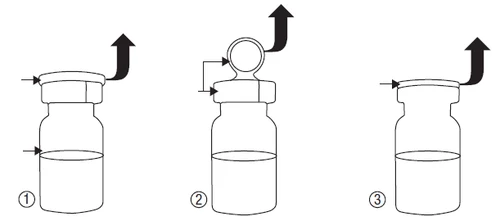
remove
green protective cap
grey cap
metal seal
bottle
- Remove the dropper from its pouch without touching the end that will be inserted into the bottle, and insert it into the bottle (figure 4). Do not remove the dropper from the bottle.
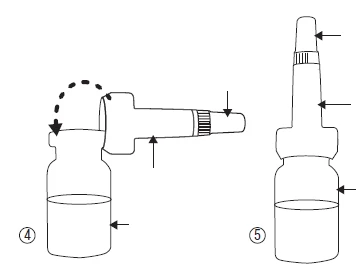
white cap
rotate and
white cap
press
dropper
to
the
dropper
bottle
bottle
- Make sure not to lose the white cap (figure 5) that covers the dropper tip.
Step 2: Before using the eye drops
- Check the opening date written on the box. Cystadrops can be used up to 7 days after opening.
- Take the dropper bottle and a mirror.
- Wash your hands.
Step 3: Using the eye drops
- Hold the dropper bottle upside down between your thumb and other fingers. Shake the dropper bottle firmly to facilitate filling the dropper.
- Unscrew the white cap from the dropper.
- Tilt your head backward. Gently pull down your lower eyelid with a clean finger to form a pouch between your eyelid and eye. The drop should be instilled into this pouch (figure 6).
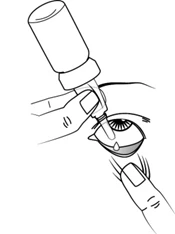
- Bring the tip of the dropper close to your eye. Use a mirror if it helps.
- Do not touch the eye, eyelid, surrounding areas, or any other surfaces with the dropper tip to avoid infecting the remaining drops in the bottle.
- Gently press the dropper to release one drop of Cystadrops at a time. Take particular care not to touch the dropper tip with your fingers.
- After administering Cystadrops, press gently with a finger on the inner corner of the eye near the nose (figure 7), and gently massage the upper eyelid to spread the eye drops over the eye.
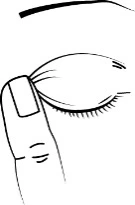
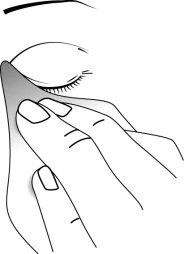
- To avoid possible irritation, wipe away excess medicine around the eye with a damp tissue (figure 8).
- Repeat step 3 for the other eye.
- Immediately after use, replace the white cap on the dropper.
Step 4: How to store the eye drops after use
- Place the dropper bottle back into the box.
- Store Cystadrops at room temperature (this will facilitate the use of the dropper).
- Discard 7 days after opening.
If a drop does not enter the eye
Try again.
If you use Cystadrops with another topical ophthalmic medicine
Wait at least 10 minutes between instilling Cystadrops and the other medicine. Ophthalmic ointment should be used last.
If you wear soft contact lenses
Do not use the eye drops while wearing your lenses. After using the eye drops, wait 15 minutes before reinserting your lenses.
If you use more Cystadrops than you should
If you instill too many drops, rinse your eyes, preferably with saline solution (or, if not possible, with lukewarm water). Do not instill further drops until the time of your next scheduled dose.
If you forget to use Cystadrops
Wait until your next scheduled dose and then continue with your regular dosing schedule. Do not use a double dose to make up for a missed dose.
If you stop using Cystadrops
Cystadrops must be used every day for the medicine to be effective. If you stop using Cystadrops, cystine crystal accumulation in the eye (cornea) may increase, leading to increased sensitivity to light (photophobia), corneal degeneration (keratopathy), and vision loss. Talk to your doctor before stopping treatment.
If you have any questions about the use of this medicine, consult your doctor or pharmacist.
4. Possible side effects
Like all medicines, this medicine can cause side effects, although not everyone gets them.
You may continue to use the eye drops normally unless the side effects are severe. If you have any
doubts, consult your doctor or pharmacist. Do not stop treatment with Cystadrops without first
talking to your doctor.
The following side effects have been reported:
Very common side effects (may affect more than 1 in 10 people)
- eye pain
- eye redness, eye itching, eye irritation (burning)
- watery eyes
- blurred vision
- discomfort at the application site (mainly "sticky" eyelids and eyelashes), deposit of medicine on the eyelashes and in the periocular area
Common side effects (may affect up to 1 in 10 people)
- abnormal sensation in the eyes, sensation of foreign body in the eye
- dry eyes
- eyelid swelling
- eyelid irritation
- visual disturbance
- pain at the application site
- chalazion
Reporting of side effects
If you experience any side effect, including those not listed in this leaflet, talk to your doctor or
pharmacist. You can also report side effects directly via the national reporting system listed in
Annex V. By reporting side effects, you can help provide more information on the safety of this
medicine.
5. How to store Cystadrops
Keep this medicine out of the sight and reach of children.
Do not use this medicine after the expiry date stated on the bottle label and on the
box after Exp.
Before opening:
- Store in the refrigerator (2°C - 8°C).
- Keep the bottle in the outer packaging to protect it from light.
After first opening:
- Write the date of opening of the dropper bottle in the designated space on the box.
- Cystadrops may be used for up to 7 days from the date of opening.
- Keep the dropper bottle tightly closed and store it in the outer packaging to protect it from light.
- Store at a temperature below 25°C.
- Do not refrigerate.
- The dropper bottle must be discarded 7 days after first opening, even if it is not empty. Use a new bottle.
Do not dispose of any medicine via wastewater or household waste. Ask your pharmacist how to
dispose of medicines you no longer use. This will help protect the environment.
6. Contents of the pack and other information
What Cystadrops contains
- The active substance is cysteamine (mercaptamine) as hydrochloride. Each mL of solution contains 3.8 mg of cysteamine.
- The other components are: benzalkonium chloride (see section 2 "Cystadrops contains benzalkonium chloride"), disodium edetate, sodium carmellose, citric acid monohydrate, sodium hydroxide, hydrochloric acid and water for injections.
Description of the appearance of Cystadrops and contents of the pack
Cystadrops is a clear, viscous solution.
Each pack contains:
- 1 amber glass bottle containing 5 mL of eye drops, solution,
- 1 dropper dispenser.
Cystadrops is available in a pack containing 1 box or in a multipack containing 4 boxes.
It is possible that not all pack sizes are marketed in your country.
Marketing Authorisation Holder
Recordati Rare Diseases
Tour Hekla
52, Avenue du Général de Gaulle
92800 Puteaux
France
Manufacturer
Recordati Rare Diseases
Tour Hekla
52, Avenue du Général de Gaulle
92800 Puteaux
France
or
Recordati Rare Diseases
Eco River Parc
30, rue des Peupliers
F-92000 Nanterre
France
For further information about this medicinal product, please contact the local representative of the Marketing Authorisation Holder:
Belgique/België/Belgien Lietuva
Recordati Recordati AB.
Tél/Tel: +32 2 46101 36 Tel: + 46 8 545 80 230
Švedija
България Luxembourg/Luxemburg
Recordati Rare Diseases Recordati
Tél: +33 (0)1 47 73 64 58 Tél/Tel: +32 2 46101 36
France Belgique/Belgien
Česká republika Magyarország
Recordati Rare Diseases Recordati Rare Diseases
Tél: +33 (0)1 47 73 64 58 Tél: +33 (0)1 47 73 64 58
France Hungary
Danmark Malta
Recordati AB. Recordati Rare Diseases
Tlf: +46 8 545 80 230 Tel: +33 1 47 73 64 58
Sweden Malta
Deutschland Nederland
Recordati Rare Diseases Germany GmbH Recordati
Tel: +49 731 140 554 0 Tel: +32 2 46101 36
Germany Belgium
Eesti Norge
Recordati AB. Recordati AB.
Tel: + 46 8 545 80 230 Tlf: +46 8 545 80 230
Estonia Norway
Ελλάδα Österreich
Recordati Rare Diseases Recordati Rare Diseases Germany GmbH
Τηλ: +33 1 47 73 64 58 Tel: +49 731 140 554 0
Greece Germany
España Polska
Recordati Rare Diseases Spain S.L.U. Recordati Rare Diseases
Tel: + 34 91 659 28 90 Tél: +33 (0)1 47 73 64 58
Spain Poland
France Portugal
Recordati Rare Diseases Recordati Rare Diseases SARL
Tél: +33 (0)1 47 73 64 58 Tel: +351 21 432 95 00
France Portugal
Hrvatska România
Recordati Rare Diseases Recordati Rare Diseases
Tél: +33 (0)1 47 73 64 58 Tél: +33 (0)1 47 73 64 58
Croatia Romania
Ireland Slovenija
Recordati Rare Diseases Recordati Rare Diseases
Tel: +33 (0)1 47 73 64 58 Tél: +33 (0)1 47 73 64 58
France Slovenia
Ísland Slovenská republika
Recordati AB. Recordati Rare Diseases
Simi:+46 8 545 80 230 Tél: +33 (0)1 47 73 64 58
Iceland Slovakia
Italia Suomi/Finland
Recordati Rare Diseases Italy Srl Recordati AB.
Tel: +39 02 487 87 173 Puh/Tel: +46 8 545 80 230
Italy Finland
Κύπρος Sverige
Recordati Rare Diseases Recordati AB.
Τηλ: +33 1 47 73 64 58 Tel: +46 8 545 80 230
Cyprus Sweden
Latvija
Recordati AB.
Tel: + 46 8 545 80 230
Latvia
Further sources of information
More detailed information on this medicinal product is available on the website of the European Medicines Agency: https://www.ema.europa.eu. Links to other websites on rare diseases and their treatments are also provided.