Cufence
Italy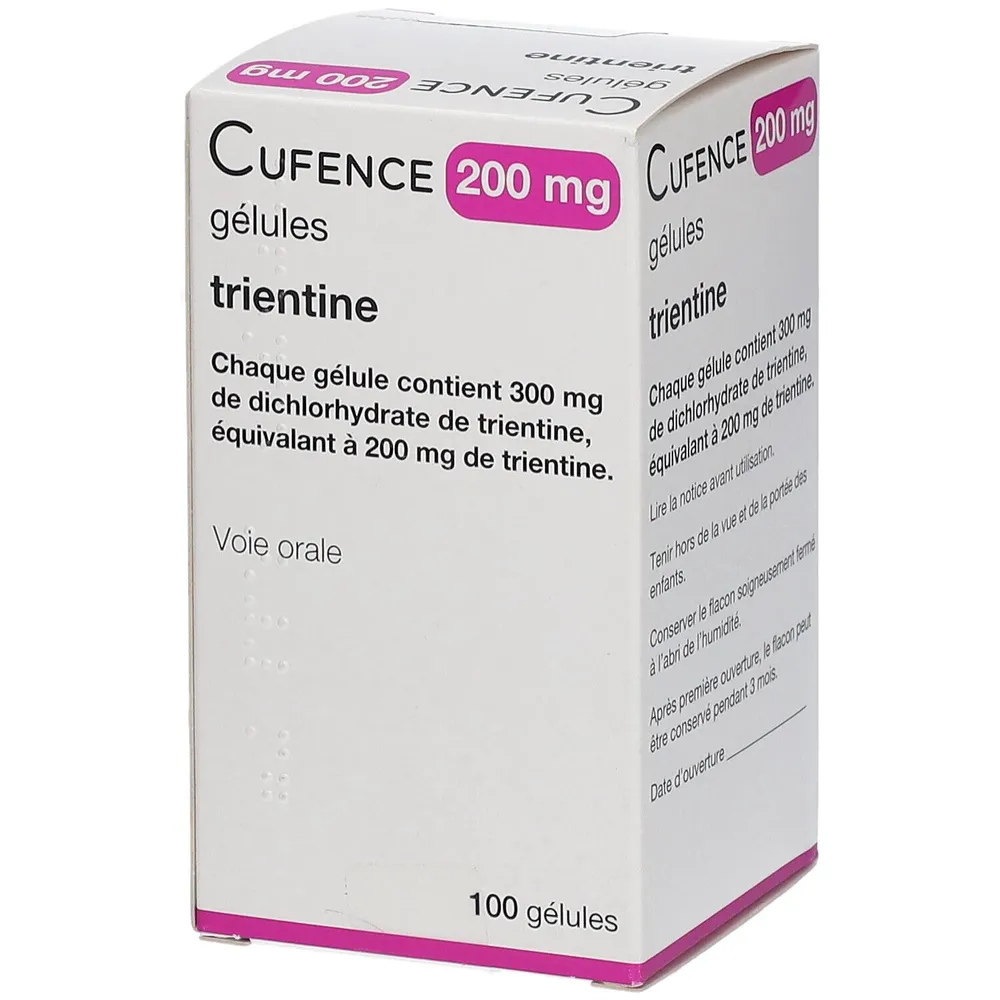
Table of Contents
Package leaflet: Information for the patient
Cufence 100 mg hard capsules, 200 mg hard capsules
trientina
Please read this leaflet carefully before taking this medicine because it contains important information for you.
- Keep this leaflet. You may need to read it again.
- If you have any questions, ask your doctor, pharmacist or nurse.
- This medicine has been prescribed for you only. Do not give it to other people, even if their symptoms are the same as yours, as it may be harmful.
- If you experience any adverse reaction, including those not listed in this leaflet, contact your doctor, pharmacist or nurse. See section 4.
Contents of this leaflet
- What Cufence is and what it is used for
- What you need to know before taking Cufence
- How to take Cufence
- Possible side effects
- How to store Cufence
- Contents of the pack and other information
1. What Cufence is and what it is used for
Cufence is a medicine used to treat Wilson's disease in adults, adolescents, and children aged 5 years and older. It is intended for patients who cannot take another medicine, D-penicillamine, due to its side effects.
Cufence contains the active substance trientine, a copper chelating agent used to remove excess copper from the body. Cufence binds to copper, which is then eliminated from the body.
2. What you should know before taking Cufence
Do not take Cufence
- if you are allergic to trientine or to any of the other ingredients of this medicine (listed in section 6).
Signs of an allergic reaction may include skin rash, itching, facial swelling, fainting,
and breathing difficulties.
Warnings and precautions
Your doctor will need to regularly monitor your disease symptoms as well as copper levels in your blood and urine. Regular monitoring is particularly important at the beginning of treatment or when the dose is changed, in growing children, and in pregnant women, to ensure that copper levels are maintained at appropriate levels. Your doctor may need to increase or decrease your dose of Cufence.
Problems affecting the nervous system (such as tremors, lack of coordination, speech disorders, muscle rigidity, and worsening of muscle spasms) may occur, especially in patients just starting treatment with Cufence. If you notice any of these symptoms during treatment with Cufence, inform your doctor immediately.
In some patients switched from penicillamine to trientine, lupus-like reactions have been reported (symptoms may include persistent skin rashes, fever, joint pain, and fatigue). However, it has not been possible to determine whether these reactions were due to trientine or to previous treatment with penicillamine.
Other medicines and Cufence
Inform your doctor or pharmacist if you are taking, have recently taken, or might take any other medicines.
If you are taking iron tablets or medications that neutralize stomach acid, take them at least 2 hours before or after taking Cufence, as they may reduce the effectiveness of Cufence.
It is recommended to take trientine at least one hour apart from any other medication.
Cufence with food and drink
Take this medicine only with water. Do not take it with other beverages, milk, or food, as they may reduce the medicine's effectiveness. Avoid eating or drinking (except water) for 2 hours before and 1 hour after taking Cufence.
Pregnancy and breastfeeding
If you are pregnant, think you may be pregnant, planning to become pregnant, or breastfeeding, consult your doctor or pharmacist before taking this medicine. It is very important to continue treatment to maintain normal copper levels during pregnancy. You and your doctor should carefully discuss the potential benefits of treatment, while also considering any possible risks. Your doctor will advise you on the most appropriate treatment and dosage for your situation. If you become pregnant while taking Cufence, speak to your doctor.
If you are pregnant and taking Cufence, you will be monitored throughout your pregnancy for any effects on the baby or changes in your copper levels.
Limited available data suggest that Cufence does not pass into breast milk, but it is not certain whether there are risks to the newborn. It is important that you inform your doctor if you are breastfeeding or intend to breastfeed. Your doctor will help you decide whether to stop breastfeeding or stop taking Cufence, taking into account the benefits of breastfeeding for the child and the benefits of Cufence for the mother. Your doctor will determine the most appropriate treatment and dosage for your situation.
Driving and using machines
It is unlikely that trientine will affect your ability to drive or operate machinery.
3. How to take Cufence
Take this medicine exactly as directed by your doctor or pharmacist. If you
have any doubts, consult your doctor or pharmacist.
Adults (including the elderly)
The recommended dose ranges from 800 to 1,600 mg daily, taken orally.
Use in children and adolescents (from 5 to 17 years of age)
In children and adolescents, the dose depends on age and body weight and will be adjusted by the
doctor. At the beginning of treatment, the dose may range from 400 to 1,000 mg daily.
Method of administration
Your doctor will determine the correct dose for you.
The total daily dose may be divided into 2–4 smaller doses, as indicated by your doctor.
Swallow the capsules whole with a glass of water on an empty stomach, at least 1 hour before or 2 hours
after food.
Patients who have difficulty swallowing should contact their doctor.
If you take more Cufence than you should
If you take an excessive amount of this medicine, you may experience nausea, vomiting, and dizziness. In this
case, contact your doctor or another healthcare professional immediately.
If you forget to take Cufence
If you forget to take a dose, take the next dose at the usual scheduled time.
Do not take a double dose to make up for the forgotten dose.
If you stop taking Cufence
This medicine is intended for long-term use, as Wilson's disease is a lifelong condition. Do not stop or
change your treatment without talking to your doctor, even if you feel well.
If you have any questions about how to use this medicine, consult your doctor or pharmacist.
4. Possible side effects
Like all medicines, this medicine can cause side effects, although not everybody will experience them.
Rarely (frequency unknown, cannot be estimated from available data), treatment with this medicine may cause inflammation of the small intestine or colon. If you experience any of the following side effects, contact your doctor immediately:
- Severe stomach pain
- Persistent diarrhoea
- Nervous system problems (for example tremors, lack of coordination, speech disorders, muscle rigidity, worsening of muscle spasms)
Other possible side effects may include:
Common side effects (may affect up to 1 in 10 people):
- Nausea (particularly at the beginning of treatment)
Uncommon side effects (may affect up to 1 in 100 people):
- Skin rashes
- Anaemia (you may feel unusually tired)
Reporting of side effects
If you get any side effects, including those not listed in this leaflet, talk to your doctor, pharmacist or nurse. You can also report side effects directly through the national reporting system detailed in Annex V. By reporting side effects, you can help provide more information on the safety of this medicine.
5. How to store Cufence
Keep this medicine out of the sight and reach of children.
Do not use this medicine after the expiry date stated on the bottle and outer carton after 'Exp.'. The expiry date refers to the last day of that month.
Use within 3 months after first opening the bottle. Keep the bottle tightly closed to protect the medicine from moisture. Do not use if the capsules become sticky or moist.
Do not dispose of any medicine via wastewater or household waste. Ask your pharmacist how to dispose of medicines no longer in use. This will help protect the environment.
6. Package contents and other information
What Cufence contains
The active substance is trientine.
- Each Cufence 100 mg hard capsule contains 150 mg of trientine dihydrochloride, equivalent to 100 mg of trientine.
- Each Cufence 200 mg hard capsule contains 300 mg of trientine dihydrochloride, equivalent to 200 mg of trientine.
The other ingredients are:
- Capsule contents: magnesium stearate, anhydrous colloidal silica
- Capsule shell: gelatin, titanium dioxide (E171)
- Printing ink: shellac, propylene glycol (E1520), titanium dioxide (E171), black iron oxide (E172), yellow iron oxide (E172)
Description of the appearance of Cufence and package contents
Cufence 100 mg hard capsules
White opaque HDPE bottle with child-resistant HDPE screw cap and induction seal, containing a silica gel desiccant packet. Each hard capsule is white, oval-shaped, size 3 (15.8 mm x 5.85 mm), printed with “Cufence 100” in grey ink.
Pack size: 1 bottle containing 200 hard capsules.
Cufence 200 mg hard capsules
Amber glass bottle with polypropylene cap and induction seal, containing a silica gel desiccant packet. Each hard capsule is white, oval-shaped, size 0 (21.8 mm x 7.66 mm), printed with “Cufence” in grey ink.
Pack size: 1 bottle containing 100 hard capsules.
Not all pack sizes may be marketed.
Marketing Authorization Holder
Univar Solutions BV
Schouwburgplein 30
3012 CL Rotterdam
The Netherlands
Manufacturer
Aesica Pharmaceuticals GmbH
Alfred-Nobel Strasse 10
40789 Monheim
Germany
Other sources of information
More detailed information on this medicinal product is available on the website of the European Medicines Agency: https://www.ema.europa.eu. Links to other websites on rare diseases and their therapeutic treatments are also provided.