Crinone
Italy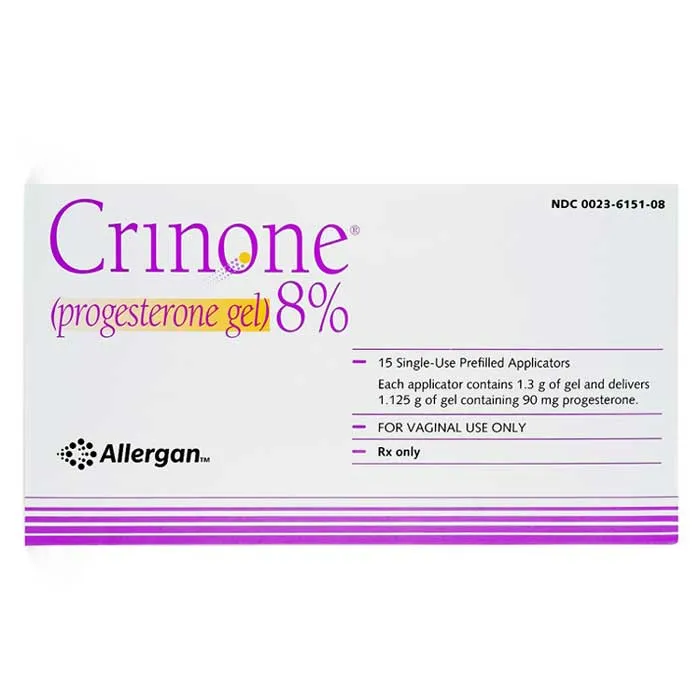
Table of Contents
Package leaflet: Information for the user
CRINONE 80 mg/g vaginal gel
progesterone
Please read all of this leaflet carefully before using this medicine because it contains important information for you.
- Keep this leaflet. You may need to read it again.
- If you have any questions, ask your doctor or pharmacist.
- This medicine has been prescribed for you. Do not give it to others, even if their symptoms are the same as yours, as it may be harmful.
- If any adverse reaction occurs, including those not listed in this leaflet, contact your doctor or pharmacist. See section 4.
Contents of this leaflet:
- What Crinone is and what it is used for
- What you need to know before using Crinone
- How to use Crinone
- Possible side effects
- How to store Crinone
- Contents of the pack and other information
1. What Crinone is and what it is used for
Crinone contains a hormone called progesterone and belongs to a group of medicines known as sex hormones (progestogens).
Crinone is indicated in adult women for:
- infertility due to inadequate luteal phase (when progesterone action or production during the second half of the menstrual cycle is insufficient)
- use during assisted reproduction (in-vitro fertilisation), when infertility is mainly due to problems with the fallopian tubes or endometrium or to unknown causes, in women with normal ovulatory cycles.
2. What you need to know before using Crinone
Do not use Crinone
- if you are allergic to progesterone or to any of the other ingredients of this medicine (listed in section 6)
- if you have unexplained vaginal bleeding
- if you have suspected or confirmed cancer of the ovary, uterus, or breast
- if you have blood clots in the veins (thrombophlebitis), blocked blood vessels (thromboembolic disorders), cerebral haemorrhage, or if you have risk factors for these conditions
- if you have an incomplete or missed abortion
- if you have severe liver failure
- if you have porphyria (an inherited disorder causing inability to break down certain substances in the blood called porphyrins).
Warnings and precautions
Talk to your doctor before using Crinone.
Before starting treatment, a thorough examination of the breasts and pelvic organs should be performed.
Talk to your doctor before using Crinone if you are in any of the following situations, as the medicine should be used with caution:
- if you have endocrine disorders (hormonal disorders)
- if you have liver problems (hepatic insufficiency)
- if you have kidney problems (renal insufficiency)
- if you have heart problems (cardiac insufficiency)
- if you suffer from asthma
- if you suffer from epilepsy
If you experience unexpected vaginal bleeding, inform your doctor so that the cause can be investigated.
If visual disturbances or symptoms related to possible thrombotic disorders occur during treatment, treatment must be discontinued and appropriate investigations carried out.
In diabetics, progestogens may cause or worsen fluid retention and reduce glucose tolerance.
Children and adolescents
Crinone is not indicated for use in children and adolescents.
Other medicines and Crinone
Crinone must not be used concomitantly with other medicines intended for vaginal use.
Inform your doctor or pharmacist if you are taking, have recently taken, or might take any other medicines.
Pregnancy and breastfeeding
Crinone may be used during the first trimester of pregnancy in cases of confirmed luteal phase deficiency.
Crinone must not be used during breastfeeding because traces of progesterone may pass into breast milk.
Driving and using machines
Crinone does not affect the ability to drive or operate machinery.
Crinone contains sorbic acid (E200)
The sorbic acid contained in the vaginal gel may cause localized skin reactions (e.g. contact dermatitis).
3. How to use Crinone
Use this medicine exactly as your doctor has told you. If you are unsure, consult your doctor or pharmacist.
For the treatment of infertility, the recommended dose is as follows:
one dose of Crinone (i.e. one applicator containing 90 mg of progesterone) daily, starting after your doctor has confirmed that ovulation has occurred, or on day 18–21 of the cycle.
For use in in vitro fertilisation (IVF), daily administration of Crinone should continue until placental autonomy is established, in case of confirmed pregnancy.
Instructions for use
Crinone must be applied directly into the vagina using the sealed, single-use applicator provided. Wash your hands.
Remove the applicator from its sealed packaging, but do not yet pull off the tab.
- Hold the applicator firmly by the thicker end (A).
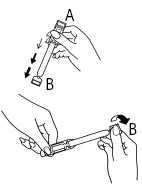
Shake downwards like a thermometer so that
the contents move towards the narrow end (B).
- Hold the applicator by the flat part of the thick end and
rotate the tab at the narrow end (B) until it detaches, then discard it. Be careful not to press the reservoir at the thick end at this stage, to avoid premature leakage of the gel before use.
- For insertion, assume a sitting or lying position on your back
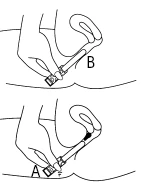
with knees bent. Gently insert the narrow end (B) of the applicator deeply into the vagina.
- Firmly press the reservoir at the thicker end (A) of the applicator
to release the gel into the vagina. Remove the applicator and dispose of it in a suitable container.
Special instructions for use at altitudes above 770 metres
Wash your hands. Remove the applicator from its sealed packaging, but do not yet pull off the tab.
- Hold the applicator firmly at the level of the reservoir
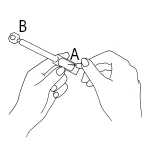
on the thicker end (A). Using a sterile needle, make a small hole in the flat surface of the reservoir. This will help balance the pressure difference due to altitude and ensure the correct amount of gel is delivered. Close the hole with your finger and shake downwards like a thermometer so that the contents move towards the narrow end (B).
Proceed with steps 2 and 3 as described above.
- Keep the hole in the reservoir closed with your finger and firmly press
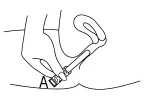
the reservoir at the thicker end (A) of the applicator to release the gel into the vagina. Remove the applicator and dispose of it in a suitable container.
Crinone coats the vaginal mucosa and provides prolonged release of
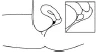
progesterone.
Each applicator contains slightly more gel than is actually released, since some of the product remains adherent to the inner walls of the applicator. Therefore, any residual gel remaining inside the applicator is considered normal.
If you use more Crinone than you should
Overdose is unlikely, as Crinone is administered via a single-dose applicator. However, if overdose occurs, discontinue treatment with Crinone.
If you accidentally ingest an excessive amount of Crinone, contact your doctor immediately or go to the nearest hospital.
If you forget to use Crinone
Do not take a double dose to make up for the missed dose.
If you forget to use Crinone for one day, continue with your regular dosing schedule the next day.
4. Possible adverse reactions
Like all medicines, this medicine may cause adverse reactions, although not everyone experiences them.
Following the instructions contained in this leaflet reduces the risk of adverse reactions.
Most of the adverse reactions observed in clinical studies cannot be distinguished from common symptoms of early pregnancy. The following adverse reactions have been reported in clinical studies, listed in order of frequency:
Common (may affect up to 1 in 10 people):
- breast tenderness,
- dizziness.
Not known (frequency cannot be estimated from the available data):
- intermenstrual bleeding (spotting),
- vaginal irritation and other mild reactions at the application site, as well as hypersensitivity reactions which generally manifest as skin rash.
Reporting of adverse reactions
If you experience any adverse reaction, including those not listed in this leaflet, please contact your doctor or pharmacist. You can also report adverse reactions directly via the national reporting system at https://www.aifa.gov.it/content/segnalazioni-reazioni-avverse.
By reporting adverse reactions, you can help provide more information on the safety of this medicine.
5. How to store Crinone
Keep this medicine out of the sight and reach of children.
Do not use this medicine after the expiry date stated on the packaging after "Exp".
The expiry date refers to the last day of that month.
Do not store above 25°C. Do not freeze.
Do not use this medicine if you notice any obvious signs of deterioration in the packaging.
Do not dispose of containers in the environment after use.
Do not throw any medicines into wastewater or household waste. Ask your pharmacist how to dispose of
medicines you no longer use. This will help protect the environment.
6. Package contents and other information
What Crinone contains
- The active substance is progesterone. Each single-dose applicator contains 90 mg of progesterone (equivalent to 8% w/w).
- The other components are: glycerol, liquid light paraffin, hydrogenated palm oil glycerides, carbomer 974P, sorbic acid (E200), polycarbophil, sodium hydroxide, purified water.
Description of the appearance of Crinone and contents of the pack
Crinone is a vaginal gel. Crinone is supplied in packs of 6 and 15 pre-filled single-dose applicators, each individually sealed.
Each Crinone applicator contains 1.45 g of gel and delivers 1.125 g of gel.
Not all pack sizes may be marketed.
Marketing Authorisation Holder and Manufacturer
Marketing Authorisation Holder
Merck Serono S.p.A.
Via Casilina 125
00176 Rome, Italy
Manufacturer
Central Pharma (Contract Packaging) LTD.
Caxton Road, Bedford – United Kingdom
Millmount Healthcare Limited,
block-7, City North Business Campus
Stamullen, Co. Meath, K32 YD60
Ireland