Corvert
Italy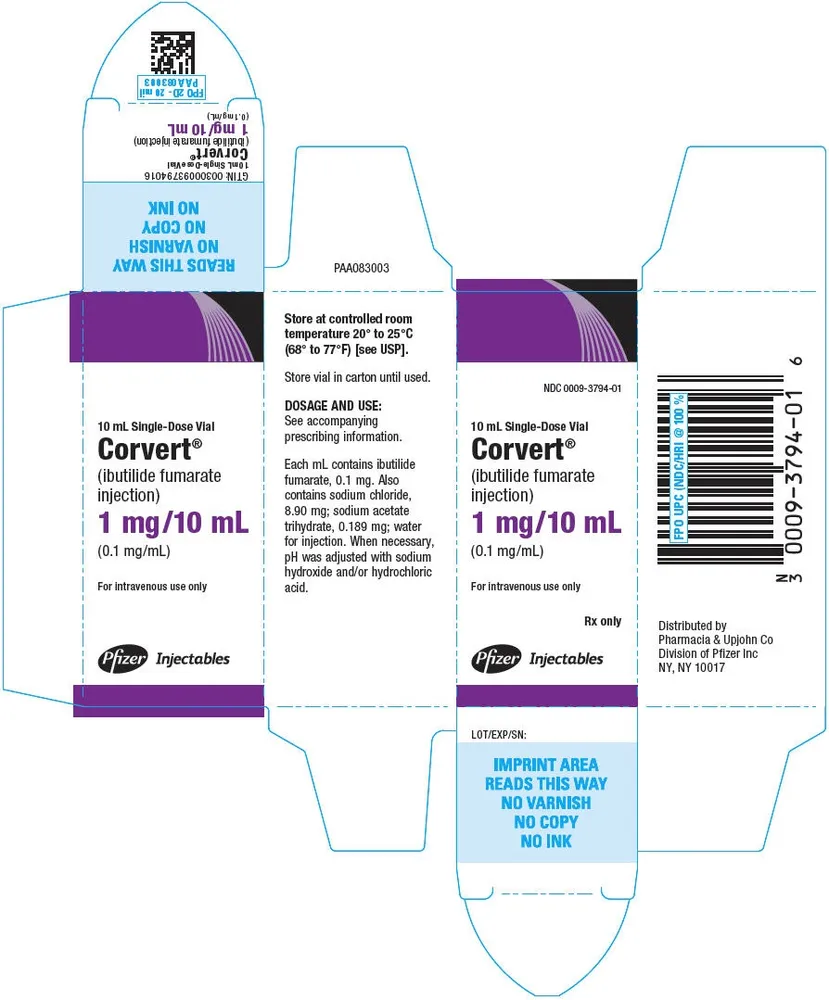
Table of Contents
PACKAGE LEAFLET: INFORMATION FOR THE USER
CORVERT 87 micrograms/ml solution for infusion
(ibutilide)
Read this leaflet carefully before you start taking this medicine
- Keep this leaflet. You may need to read it again.
- If you have any questions, ask your doctor or pharmacist.
- If any of the side effects worsens, or if you notice any side effects not listed in this leaflet, inform your doctor or pharmacist.
- This medicine has been prescribed for you personally. Never give it to others. This medicine could be dangerous for other people, even if their symptoms are the same as yours.
Contents of this leaflet:
- What Corvert is and what it is used for
- Before you take Corvert
- How to take Corvert
- Possible side effects
- How to store Corvert
- Further information
1. WHAT CORVERT IS AND WHAT IT IS USED FOR
Corvert belongs to a class of medicines called antiarrhythmics, which are used to treat disorders of heart rhythm. These medicines prevent the heart from beating irregularly. Corvert is used to restore the heart to its normal rhythm.
2. BEFORE TAKING CORVERT
Your doctor will ask you several questions before prescribing this medicine to ensure it is suitable for you. If you have difficulty understanding any of the questions, please ask your doctor for clarification.
Do not take Corvert
- If you are allergic (hypersensitive) to ibutilide fumarate or to any of the excipients of Corvert
- If you suffer from certain types of heart rhythm disorders such as increased heart rate (e.g. torsades de pointes), sick sinus syndrome, AV block, QT interval prolongation, or if you have had a heart attack within the last month, or if you have symptoms of heart failure, or if your blood potassium or magnesium levels are low
- If you are already taking other medicines for heart rhythm disorders
- If you have liver problems
- 1 -
Take special care with Corvert
Inform your doctor or pharmacist if you currently suffer or have previously suffered from any of the following conditions:
Left ventricular dysfunction resulting in reduced blood output from the heart (low left ventricular ejection fraction)
Heart failure
Your doctor will monitor your heart rhythm during treatment with Corvert for at least 4 hours after the start of treatment. If you have previously experienced specific heart rhythm disturbances known as ventricular arrhythmias, monitoring must continue for at least 24 hours after Corvert treatment.
Taking other medicines
Always inform your doctor or pharmacist if you are taking or have recently taken any other medicines, including those without a prescription:
It is particularly important to inform your doctor if you are taking the following medicines:
- Certain medicines that control heart rhythm. These medicines must not be taken with Corvert or within 4 hours after Corvert treatment.
- Certain medicines acting on the nervous system (thioridazine, chlorpromazine, levomepromazine, sulpiride, sultopride, amisulpride, tiapride, pimozide, haloperidol, droperidol, medicines used for depression)
- Certain antibiotics (erythromycin, pentamidine, fluoroquinolones)
- Certain medicines used to treat allergies (terfenadine, astemizole, mizolastine)
- Certain medicines used for heart conditions (digoxin, bepridil)
- Cisapride (used for stomach disorders)
- Halofantrine (used to treat malaria)
Pregnancy and breastfeeding
Corvert should be used during pregnancy only if strictly necessary. If you are pregnant, consult your doctor or pharmacist before taking any medicine.
Breastfeeding is not recommended during treatment with Corvert. If you are breastfeeding, consult your doctor or pharmacist before taking any medicine.
Driving and using machines
The effects on the ability to drive and use machines have not been studied. This medicine will be administered in a hospital setting; therefore, it is unlikely that you will drive or operate machinery immediately after treatment.
3. HOW TO TAKE CORVERT
Corvert is administered by infusion by specialized personnel. Your doctor will determine the appropriate
amount of Corvert to administer. If your body weight is equal to or greater than 60 kg, the usual dose
is 1 mg of ibutilide fumarate (1 vial), administered over at least 10 minutes. If your body weight
is less than 60 kg, the dose will need to be adjusted.
- 2 -
If the heart rhythm has not returned to normal within 10 minutes after completion of the initial infusion,
a second dose may be administered.
Corvert is not recommended for patients under 18 years of age.
If you have recently undergone heart surgery, your doctor may decide to administer a lower dose.
If you take more CORVERT than you should
If you have received a dose of Corvert greater than recommended, your doctor will provide appropriate
supportive therapy.
4. POSSIBLE ADVERSE REACTIONS
Like all medicines, Corvert may cause adverse reactions, although not everyone experiences them.
Cardiac rhythm disturbances are the most common and serious adverse reactions.
Patients with a history of heart failure or left ventricular dysfunction of the heart, resulting in reduced blood output from the heart (reduced left ventricular ejection fraction), have a higher risk of developing serious cardiac rhythm disturbances.
Common (more than 1 in 100 patients, less than 1 in 10 patients): various types of cardiac
rhythm disturbances with increased or decreased heart rate, decreased arterial pressure,
ECG changes.
Uncommon (more than 1 in 1,000 patients, less than 1 in 100 patients): constricting
chest pain (angina pectoris), ventricular fibrillation, atrial fibrillation, vasodilation, increased
arterial pressure, acute renal failure.
5. HOW TO STORE CORVERT
Keep out of the reach and sight of children.
Do not use Corvert after the expiry date stated on the label. The expiry date refers to the last day of the month.
Closed package: Do not store above 25°C; do not refrigerate or freeze.
Store in the original packaging.
Opened package: The single-dose vial of Corvert must be administered as a single dose; from a chemical and physical standpoint, the reconstituted solution is stable for 24 hours at 25°C.
From a microbiological standpoint, the product should be administered immediately; otherwise, healthcare personnel are responsible for the duration and conditions of storage prior to use, which must not exceed 24 hours at 2°C - 8°C, unless the dilution is carried out under controlled and validated aseptic conditions.
- 3 -
6. OTHER INFORMATION
What Corvert contains
- The active substance is ibutilide 87 micrograms/ml, as ibutilide fumarate 100 micrograms/ml.
- The excipients are: sodium acetate (granular trihydrate) 0.189 mg, sodium chloride 8.9 mg, sodium hydroxide solution 10%, hydrochloric acid solution 10%, water for injections.
Description of the appearance of Corvert and contents of the pack
Type I glass vial with rubber stopper and aluminium cap, pack size: 10 ml
Marketing Authorization Holder and Manufacturer
Marketing Authorization Holder:
Pfizer Italia S.r.l.
Via Isonzo, 71 – 04100 Latina
Manufacturer:
Pfizer Manufacturing Belgium NV
Rijksweg 12
2870 Puurs, Belgium
This leaflet was last approved in: 05/2012
The following information is intended exclusively for medical and healthcare professionals:
CORVERT may be administered as supplied or after dilution. The 10 ml vial may be
diluted with 50 ml of infusion solution.
In patients undergoing cardiac surgery, 5 ml may be diluted with 50 ml of infusion solution.
The following diluents are compatible with Corvert:
glucose 50 mg/ml (5%) injection solution;
sodium chloride 9 mg/ml (0.9%) injection solution.
The solution mixtures are compatible with polyvinylchloride (PVC) bags and polyolefin bags.
Bring the solution to room temperature before infusion.
Any unused product or waste material should be disposed of in accordance with local regulations.
- 4 -