Corlopam
Italy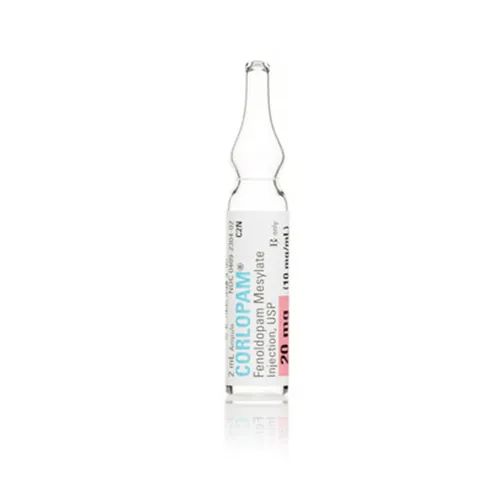
Table of Contents
- Package leaflet: Information for the patient
- Corlopam 20 mg/2 ml injectable solution for intravenous use
- 1. What Corlopam is and what it is used for
- 2. What you need to know before using Corlopam
- 3. How to use Corlopam
- 4. Possible side effects
- 5. How to store Corlopam
- 6. Package contents and other information
Package leaflet: Information for the patient
Corlopam 20 mg/2 ml injectable solution for intravenous use
fenoldopam mesilate
Please read all of this leaflet carefully before you start using this medicine because it contains important information for you.
- Keep this leaflet. You may need to read it again.
- If you have any questions, ask your doctor or nurse.
- This medicine has been prescribed for you only. Do not give it to other people, even if their symptoms are the same as yours, because it may be harmful.
- If you experience any side effects, including those not listed in this leaflet, tell your doctor or nurse. See section 4.
Contents of this leaflet:
- What Corlopam is and what it is used for
- What you need to know before using Corlopam
- How to use Corlopam
- Possible side effects
- How to store Corlopam
- Contents of the pack and other information
1. What Corlopam is and what it is used for
Corlopam contains the active substance fenoldopam, a compound used in acute episodes of severe hypertension (high blood pressure) requiring urgent intravenous treatment. It is, in fact, a vasodilating agent that relaxes the walls of blood vessels, increasing their diameter and thereby reducing blood pressure.
2. What you need to know before using Corlopam
Do not use Corlopam
- if you are allergic to the active substance or to any of the other ingredients of this medicine listed in section 6.
- in children.
Warnings and precautions
Talk to your doctor or nurse before using Corlopam.
Children
Corlopam must not be used in children, as its effects are unknown.
Other medicines and Corlopam
Inform your doctor or nurse if you are taking, have recently taken, or might take any other medicines.
Tell your doctor if you are taking medicines called monoamine oxidase inhibitors (MAO-), which are mainly used to treat mood disorders, as fenoldopam may interfere with their action.
Pregnancy and breastfeeding
If you are pregnant, suspect you may be pregnant, planning a pregnancy, or breastfeeding, consult your doctor before using this medicine.
Pregnancy
Corlopam is contraindicated during the first trimester of pregnancy. It should also be avoided during later months unless the potential benefits of treatment outweigh the risks to the fetus.
Breastfeeding
Corlopam should be used with caution during breastfeeding, as it is unknown whether fenoldopam passes into breast milk.
Driving and operating machinery
Corlopam may impair your ability to drive or operate machinery, as it causes a reduction in blood pressure (hypotension).
Corlopam contains:
Sodium metabisulfite
Rarely may cause severe hypersensitivity reactions and bronchospasm.
Sodium
This medicine contains less than 1 mmol (23 mg) of sodium per vial, i.e. essentially "sodium-free".
Propylene glycol
This medicine contains 1036 mg of propylene glycol per vial. If you suffer from liver or kidney disease, do not take this medicine unless otherwise recommended by your doctor. Your doctor may perform additional monitoring during treatment.
If you are pregnant or breastfeeding, do not take this medicine unless otherwise recommended by your doctor. Your doctor may perform additional monitoring during treatment.
For individuals engaged in sports: using this medicinal product without therapeutic need constitutes doping and may lead to a positive anti-doping test.
3. How to use Corlopam
Administration must be performed only by qualified healthcare personnel.
Corlopam will be administered directly into a vein via intravenous infusion (continuous intravenous infusion) by a doctor or nurse.
The recommended starting dose is 0.1 mcg/kg/min, increasing by 0.1 mcg increments until the desired reduction in blood pressure is achieved. The dosage may be increased every ten minutes, depending on the patient's clinical condition and severity of the disease. Blood pressure control is usually achieved within the range of 0.1–0.39 mcg/kg/min. In 20% of cases, the therapeutically effective range was 0.4–0.69 mcg/kg/min.
Once the desired blood pressure level is reached, the dosage may be reduced or the infusion may be stopped.
The doctor may decide to prescribe additional oral antihypertensive medications before or after the infusion.
If you use more Corlopam than you should
Since this medicine is administered by qualified healthcare personnel, it is highly unlikely that you would receive an excessive dose.
However, if more Corlopam is administered than required, an excessive lowering of blood pressure may occur, which may require appropriate treatment.
If you have any doubts about the use of this medicine, consult your doctor or nurse.
4. Possible side effects
Like all medicines, this medicine can cause side effects, although not everybody gets them.
Common side effects (may affect up to 1 in 10 people):
- skin redness (erythema);
- headache (cephalalgia);
- low blood pressure (hypotension);
- abnormalities in electrocardiogram results (T-wave inversion);
- heart rhythm disturbances (ventricular extrasystoles);
- sensation of heart pounding (palpitations);
- rapid heartbeat (tachycardia);
- nausea;
- vomiting;
- decreased potassium levels in the blood (hypokalaemia);
- dizziness;
- cramps in the lower limbs;
- nasal mucosa congestion.
Other side effects observed in less than 1% of treated patients include:
- feeling of fainting (presyncope);
- heart disorders (conduction disorder);
- chest pain;
- fatigue;
- fever;
- visual impairment;
- decreased levels of bicarbonate in the blood;
- inability to empty the bladder (urinary retention);
- presence of glucose in the urine (glycosuria);
- excessive sweating (hyperhidrosis);
- decreased white blood cells or blood platelets (lymphopenia and thrombocytopenia).
Reporting of side effects
If you experience any side effect, including those not listed in this leaflet, talk to your doctor or pharmacist.
You can also report side effects directly via the national reporting system at: //www.aifa.gov.it/content/segnalazioni-reazioni-avverse.
By reporting side effects, you can help provide more information on the safety of this medicine.
5. How to store Corlopam
Store below 25°C.
Keep in the original packaging to protect the medicine from light.
Keep this medicine out of the sight and reach of children.
Do not use this medicine after the expiry date stated on the carton after "Exp.".
The expiry date refers to the last day of that month.
6. Package contents and other information
What Corlopam contains
- The active substance is fenoldopam. One 2 ml vial contains 20 mg of fenoldopam (equivalent to 26.28 mg of fenoldopam mesilate);
- The other components are: propylene glycol, citric acid, sodium citrate, sodium metabisulfite, water for injections.
Description of the appearance of Corlopam and contents of the pack
Corlopam for injection is supplied in a carton containing 1 vial of 2 ml.
Marketing Authorization Holder and Manufacturer
Marketing Authorization Holder
Teva Italia S.r.l. - Piazzale Luigi Cadorna, 4 - 20123 Milan, Italy
Manufacturer
Corlopam 20 mg/2 ml solution for injection for intravenous use:
Haupt Pharma Livron - 1, Rue Comte de Sinard - 26250 Livron-sur-Drome - France
The following information is intended exclusively for physicians or healthcare professionals:
Preparation of the solution
Before administration, the Corlopam vial must be diluted with 0.9% sodium chloride solution or 5% dextrose solution. The diluted solution is colourless or slightly yellowish.
Stability of the solution
Once diluted in sodium chloride or dextrose, Corlopam is light-stable for at least 24 hours.
Administration
Corlopam must be administered by continuous intravenous infusion. The initial dose is 0.1 mcg/kg/min, increasing by increments of 0.1 mcg until the desired reduction in arterial pressure is achieved. The dosage may be increased at intervals of no less than ten minutes, depending on the patient's clinical condition and severity of the disease. Typically, blood pressure control is achieved within the range of 0.1–0.39 mcg/kg/min. In 20% of cases, the therapeutically effective range was 0.4–0.69 mcg/kg/min.
When the desired blood pressure response is achieved, the dose of Corlopam may be gradually reduced or the infusion discontinued. Oral antihypertensive agents may be administered during or after the infusion, if necessary.
Any unused portion of the solution must be discarded.
Compatible solutions
Fenoldopam is physically and chemically stable when diluted in 0.9% sodium chloride solution or 5% dextrose solution, or a combination of both. It is physically compatible with heparin, dopamine, adrenaline, gentamicin, lidocaine, cefazolin, and sodium nitroprusside. Chemical compatibility with these substances has not been verified.
Incompatible solutions
Fenoldopam is physically incompatible with furosemide injections.
Special warnings
As with all vasodilators, caution is required when reducing very high blood pressure, since excessively rapid lowering may result in acute hypoperfusion of the cerebral, myocardial, or optic nerve tissues, angina, and ischemic electrocardiographic changes. In elderly patients and in patients with impaired renal or hepatic function, dosage adjustment is generally not required with fenoldopam. No drug accumulation phenomena have been observed with this medicinal product.