Contrathion
Italy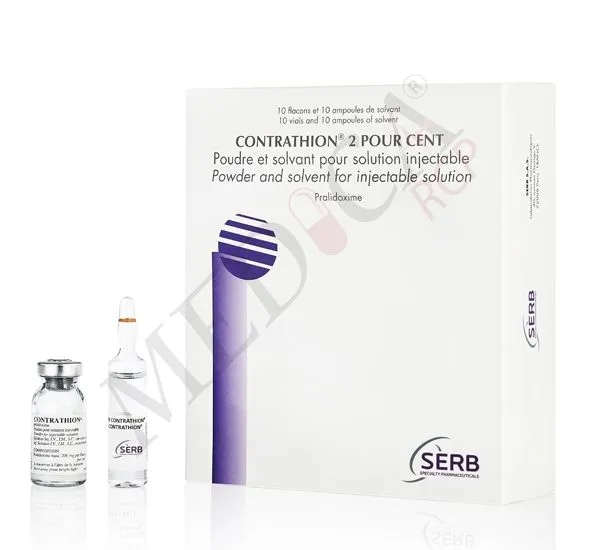
Table of Contents
Patient Information Leaflet
Contrathion 200 mg/10 ml
powder and solvent for solution for infusion
pralidoxime methylsulfate
Please read this leaflet carefully before taking this medicine because it contains important information for you.
- Keep this leaflet. You may need to read it again.
- If you have any questions, consult your doctor, pharmacist, or nurse.
- This medicine has been prescribed for you only. Do not give it to other people, even if they have the same symptoms as you, because it could be harmful.
- If you experience any side effects, including those not listed in this leaflet, talk to your doctor or pharmacist. See section 4.
Contents of this leaflet:
- What Contrathion is and what it is used for
- What you need to know before taking Contrathion
- How to take Contrathion
- Possible side effects
- How to store Contrathion
- Contents of the pack and other information
1. What Contrathion is and what it is used for
Contrathion contains pralidoxime methylsulfate, which belongs to a class of medicines called
"antidotes".
Contrathion is indicated for the treatment of moderate or severe poisonings caused by products mainly used
against parasites, known as "organophosphorus ester antiparasitics".
2. What you should know before taking Contrathion
Do not take Contrathion
- if you are allergic to pralidoxime methylsulfate or to any of the other ingredients of this medicine (listed in section 6).
Warnings and precautions
Talk to your doctor, pharmacist, or nurse before taking Contrathion.
Contrathion must be used under medical supervision.
Some of the organophosphorus pesticides, for which Contrathion is the antidote, most commonly used are listed below:
parathion, methylparathion, dimethoate, diazinon, trichlorfon, fenothion, TEPP, mevinphos, propham,
azinphos-methyl, phosphamidon, fenthion, fenitrothion, malathion, etc.
These are pesticides that act through skin or mucosal contact or by ingestion, easily penetrating through the skin and acting as poisons on the nervous system.
Contrathion is not effective in treating poisoning caused by phosphorus, inorganic phosphates, and organophosphorus compounds that have characteristics different from those listed above.
Use of Contrathion is not recommended for treating intoxications caused by pesticides belonging to the class of substances known as "carbamates".
Inform your doctor before being administered Contrathion if:
- you have kidney problems (reduced renal function); your doctor may reduce the dose,
- you suffer from severe muscle weakness (myasthenia), as your condition could worsen.
Other medicines and Contrathion
Inform your doctor or pharmacist if you are taking, have recently taken, or might take any other medicines.
The effects of Contrathion may be influenced by, or may influence, the following medicines:
- atropine, when used in combination with Contrathion,
- thiamine (or vitamin B1),
- barbiturates (used to treat seizures).
The following medicines must not be used at the same time as Contrathion:
- morphine (used to treat moderate to severe pain),
- theophylline and aminophylline (used in the treatment of asthma),
- succinylcholine (used in general anesthesia and to relax muscles),
- reserpine (used to treat high blood pressure and as a tranquilizer),
- tranquilizers known as "phenothiazines". See also section 4 “Possible side effects”.
Pregnancy and breastfeeding
If you are pregnant, think you might be pregnant, planning to become pregnant, or breastfeeding, consult your doctor or pharmacist before taking this medicine.
Pregnancy
Use of Contrathion is not recommended during pregnancy: in case of absolute necessity, Contrathion may be administered only after consulting a doctor.
Breastfeeding
Your doctor will prescribe Contrathion only if strictly necessary.
Your doctor will decide whether breastfeeding should be discontinued or whether administration of Contrathion should be avoided.
Driving and using machines
Contrathion is an emergency medicine. Its use is therefore associated with conditions that do not allow operating machinery or driving vehicles.
Contrathion contains sodium
This medicine contains 35.44 mg of sodium (the main component of table salt) per vial. This corresponds to 1.77% of the maximum recommended daily dietary intake of sodium for an adult.
3. How to take Contrathion
Take this medicine exactly as prescribed by your doctor or pharmacist. If you have
any doubts, consult your doctor or pharmacist.
Contrathion will be administered by healthcare professionals.
The administration of pralidoxime, the active substance in Contrathion, is usually preceded by
a substance called "atropine", given at the dose required according to the specialist's instructions.
As with all antidote treatments, therapy with Contrathion must be tailored to the individual needs of each patient.
Adults
The recommended dose is: a single dose administered intravenously (slow intravenous infusion)
ranging from 1000–2000 mg, depending on the severity of poisoning and the patient's body weight,
followed by a maintenance dose of 500 mg/hour, maintained as long as necessary and according to
the specialist's prescription.
Use in children
The recommended dose is: a single dose of 20–40 mg/kg (up to a maximum of 1 gram), administered
intravenously (slow intravenous infusion), followed by a maintenance dose of 10 mg/kg/hour,
maintained as long as necessary and according to the specialist's prescription.
Use in patients with kidney disease
If you have impaired kidney function, your doctor will reduce your dose.
Duration of treatment
In confirmed cases of poisoning, treatment with Contrathion may last from a minimum of 48 hours to
several days.
Contrathion will be administered slowly intravenously or by infusion to avoid unwanted effects due to
excessive administration speed.
The doses and methods of administration will be indicated by the specialist and must be followed
carefully.
If you take more Contrathion than you should
Pralidoxime, at very high doses, could worsen the blockade of muscle activity (neuromuscular blockade)
caused by toxic substances (organophosphorus compounds).
When using Contrathion, it may be difficult to distinguish side effects due to the medicine from those caused by
the toxic substances.
Poisoning due to overdose of the medicine is characterized by the following symptoms:
- Mild forms:
- transient malaise with nausea,
- dizziness,
- reduced heart rate (bradycardia),
- headache (cephalalgia),
- mild gastrointestinal disturbances.
- Severe forms:
- rapid onset of coma (loss of consciousness) with constriction of the pupils of the eyes (miosis),
- increased salivation,
- increased blood pressure (hypertension),
- inability to coordinate movements and muscle twitching (muscle fibrillation),
- breathing difficulties and fluid in the lungs (dyspnea with pulmonary edema),
- seizures preceding death.
In case of accidental ingestion/overdose of Contrathion, contact your doctor immediately or go to the nearest hospital.
If you have any doubts about the use of Contrathion, consult your doctor, pharmacist, or nurse.
4. Possible side effects
Like all medicines, this medicine can cause side effects, although not everybody gets them.
The following side effects have been reported after administration of Contrathion:
- dizziness,
- blurred vision,
- double vision (diplopia),
- eye focusing disturbances (accommodation),
- headache,
- drowsiness,
- nausea,
- changes in heart rhythm (arrhythmias),
- increased heart rate (tachycardia),
- rapid breathing (hyperventilation),
- reduced muscle strength (asthenia).
In addition, following rapid administration, the following have been reported: muscle rigidity and possible blockage of muscle activity (neuromuscular blockade).
Reporting of side effects
If you experience any side effect, including those not listed in this leaflet, talk to your doctor or pharmacist.
You can also report side effects directly via the national reporting system at the website
https://www.aifa.gov.it/content/segnalazioni-reazioni-avverse
By reporting side effects, you can help provide more information on the safety of this medicine.
5. How to store Contrathion
Keep this medicine out of the sight and reach of children.
Do not use this medicine after the expiry date which is stated on the carton after “Exp.”. The expiry date refers to the last day of that month.
To protect the medicine from light, keep the vial and ampoule in the outer packaging.
Do not dispose of any medicine via wastewater or household waste. Ask your pharmacist how to dispose of medicines you no longer use. This will help protect the environment.
6. Package contents and other information
What Contrathion contains
Vial of powder
The active substance is: pralidoxime methylsulfate. One vial of powder contains 361.95 mg of
pralidoxime methylsulfate, equivalent to 200 mg of pralidoxime.
Ampoule of solvent
The other components are: sodium chloride, water for injections.
Description of the appearance of Contrathion and contents of the pack
Contrathion is presented as a powder and solvent for solution for infusion:
- Carton containing 1 vial of powder + 1 ampoule of 10 ml solvent
- Carton containing 10 vials of powder + 10 ampoules of 10 ml solvent
Marketing Authorization Holder
SERB SAS - 32 rue de Monceau - 75008 Paris - France
Manufacturer
SERB - 32 rue de Monceau - 75008 Paris - France
The following information is intended exclusively for physicians or healthcare professionals:
Warnings and precautions
Pralidoxime has been very well tolerated in most cases, but it should be remembered that the extremely severe general condition of patients poisoned by organophosphorus compounds may mask minor signs and symptoms related to the use of the drug, especially if administered too rapidly or for prolonged periods.
Pralidoxime administered intravenously must be injected slowly or, preferably, by infusion, since adverse effects such as tachycardia, laryngospasm, and muscular rigidity have occasionally been attributed to too rapid administration.
Since pralidoxime is excreted in the urine, reduced renal function leads to higher blood levels of the drug; consequently, dosage must be reduced in patients with renal impairment.
Pralidoxime must be used with great caution in cases of overdose of organophosphorus compounds in patients suffering from myasthenia gravis, as it may trigger a myasthenic crisis.
Although not directly related to the use of pralidoxime, the following precautions should be observed in the treatment of poisoning by anticholinesterase agents: since barbiturates are potentiated by anticholinesterase agents, they should be used with great caution in treating possible convulsive episodes; furthermore, the use of morphine, theophylline, aminophylline, succinylcholine, reserpine, and phenothiazine tranquilizers should be avoided.
Pralidoxime must be used under medical supervision. Pralidoxime is not effective in the treatment of poisoning by phosphorus, inorganic phosphates, or organophosphorus compounds lacking anticholinesterase activity.
Until further data are available, the use of pralidoxime in carbamate insecticide poisoning is not recommended.
Note – Among the most commonly used organophosphorus insecticides are: parathion,
methylparathion, dimethoate, diazinon, trichlorfon, fenothion, TEPP, mevinphos, propoxur, azinphos-methyl,
phosphamidon, fenthion, fenitrothion, malathion, etc.
These are contact or ingestion insecticides, highly fat-soluble, which easily penetrate through the skin and act as poisons on the nervous system by inhibiting cholinesterase.
Contrathion contains sodium
This medicinal product contains 35.44 mg of sodium per ampoule, equivalent to 1.77% of the maximum daily intake recommended by the WHO, corresponding to 2 g of sodium for an adult.
Preparation and handling of the product
Initial intervention and decontamination
Ensure basic vital functions.
In cases of skin contamination, remove the patient's clothing soaked with the toxic substance and wash the patient thoroughly with large amounts of water and soap.
In cases of ingestion, perform gastric lavage and administer a suspension of activated charcoal at the end of the procedure.
Administration of pralidoxime is normally preceded by atropine at the dose required to control muscarinic cholinergic symptoms, as directed by the specialist.
Dosage
As with all antidotal treatments, pralidoxime therapy must be tailored to the specific needs of each individual case.
Adults
Slow intravenous infusion (1 ml/min for freshly prepared solution, or over 30 minutes if the freshly prepared solution is diluted in physiological saline) of a bolus dose between 1000–2000 mg, depending on the severity of intoxication and the patient's body weight, followed by a maintenance dose of 500 mg/hour, maintained as long as necessary and according to the specialist's prescription.
Children
Slow intravenous administration (0.5 ml/min for the freshly prepared solution, or infusion over 30 minutes if the solution is diluted in physiological saline) of a bolus dose of 20–40 mg/kg (up to a maximum of 1 gram), followed by a maintenance dose of 10 mg/kg/hour, maintained as long as necessary and according to the specialist's prescription.
Patients with impaired renal function
In these patients, the recommended doses should be reduced proportionally according to residual renal function.
Method of administration
The pralidoxime solution should be prepared immediately before use by adding 10 ml of solvent to the vial containing the powder.
The resulting solution may be administered directly or after dilution in physiological saline.
Careful attention must be paid to the infusion rate of the pralidoxime bolus dose, since adverse reactions occur almost exclusively with too rapid intravenous infusion of the bolus dose (when plasma concentration is highest and infusion rate is greatest). The first dose should therefore be administered over 30 minutes if diluted, or at a rate not exceeding 1 ml/minute for the freshly prepared solution.
Duration of treatment
In confirmed cases of poisoning, antidotal treatment should last from a minimum of 48 hours to several days.
Overdose
Pralidoxime, at very high doses, could worsen the neuromuscular blockade caused by organophosphorus compounds.
In clinical use, it is difficult to distinguish adverse effects due to the drug from those due to the toxic substances. Experimental and human poisoning by organophosphorus esters manifests in two phases, which are not always distinguishable:
- Muscarinic phase – vagal hyperstimulation phenomena: excessive salivary, tracheobronchial, sweat, and lacrimal secretion; nausea, vomiting, diarrhea, dyspnea due to bronchospasm, pulmonary edema, marked bradycardia.
- Nicotinic phase – neuromuscular disturbances: incoordination of movements, muscle fibrillation and twitching; followed by tonic-clonic convulsions and neuromuscular paralysis preceding death.
Clinical forms of poisoning may include:
- Mild forms: characterized by transient malaise with nausea, dizziness, bradycardia, headache, and mild gastrointestinal disturbances.
- Acute forms: sudden onset of coma with miosis, salivation, hypertension, muscle fibrillation, dyspnea with pulmonary edema, convulsions preceding death.