Combistill
Italy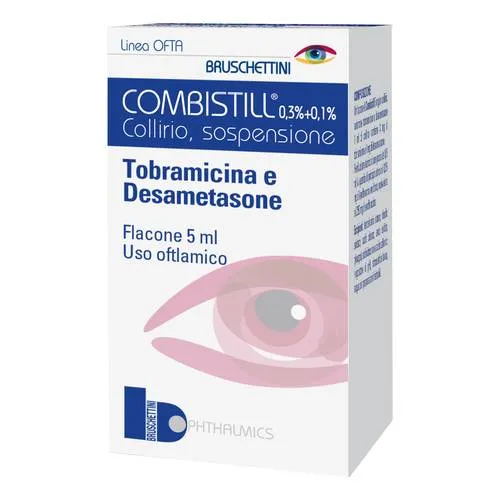
Table of Contents
- Package leaflet: Information for the user
- COMBISTILL 3 mg/ml + 1 mg/ml eye drops, suspension
- 1. What COMBISTILL is and what it is used for
- 2. What you need to know before using COMBISTILL
- 3. How to use COMBISTILL
- 4. Possible side effects
- 5. How to store COMBISTILL
- 6. Package contents and other information
Package leaflet: Information for the user
COMBISTILL 3 mg/ml + 1 mg/ml eye drops, suspension
tobramycin and dexamethasone
Equivalent medicine
Please read this leaflet carefully before using this medicine because it contains important information for you.
- Keep this leaflet. You may need to read it again.
- If you have any questions, ask your doctor or pharmacist.
- This medicine has been prescribed for you only. Do not give it to others, even if their symptoms are the same as yours, as it may be harmful.
- If you experience any adverse reactions, including those not listed in this leaflet, contact your doctor or pharmacist. See section 4.
Contents of this leaflet:
- What COMBISTILL is and what it is used for
- What you need to know before using COMBISTILL
- How to use COMBISTILL
- Possible side effects
- How to store COMBISTILL
- Contents of the pack and other information
1. What COMBISTILL is and what it is used for
COMBISTILL contains a combination of two medicines: dexamethasone, which belongs to the class of corticosteroids and has an anti-inflammatory effect, and tobramycin, which belongs to the class of aminoglycoside antibiotics and acts against various bacteria that can cause eye infections.
Combistill eye drops are indicated in adults and children from two years of age onwards for the treatment of eye inflammations when a corticosteroid is required and when there is either an existing eye infection or a risk of eye infection.
2. What you need to know before using COMBISTILL
Do not use COMBISTILL
- if you are allergic (hypersensitive) to tobramycin, dexamethasone, or any of the other ingredients of this medicine (listed in section 6); if you have:
- inflammation of the cornea (the transparent membrane covering the colored part of the eye) caused by the Herpes simplex virus (Herpes simplex keratitis)
- vaccinia, chickenpox, or other viral infections of the cornea and conjunctiva (the transparent membrane covering the white part of the eye and the inner eyelids)
- conjunctivitis with ulcerative keratitis, even in the early stage (fluorescein test +).
- fungal infections of the eye (ocular mycosis) or untreated parasitic eye infections
- mycobacterial infections of the eye (e.g. ocular tuberculosis)
- high pressure in the eye
- eye inflammations with pus formation (acute purulent ophthalmia, purulent conjunctivitis, purulent and herpetic blepharitis), which may be masked or worsened by corticosteroids
- styes.
Warnings and precautions
Talk to your doctor or pharmacist before using COMBISTILL.
- In some patients, sensitization (allergic reaction) to aminoglycoside antibiotics such as tobramycin administered in the eyes may occur. This allergic reaction may range from localized itching or redness of the skin to severe generalized allergic reactions (anaphylactic reactions) or serious skin reactions. If you experience these symptoms while using Combistill, stop treatment and consult your doctor. Also note that this allergic sensitivity may also occur with other antibiotics belonging to the aminoglycoside class, whether administered in the eyes or systemically (by injection).
- Consult your doctor if you have or have ever had conditions such as severe myasthenia gravis or Parkinson’s disease. This type of antibiotic may worsen muscle weakness.
- In patients who have received aminoglycoside antibiotics such as tobramycin systemically (by injection), serious toxic effects on the nervous system, ears, and kidneys have occurred. Be cautious and consult your doctor if you are using Combistill together with aminoglycoside antibiotics administered systemically (by injection).
- Long-term use of corticosteroids in the eyes may lead to increased eye pressure (including a condition called glaucoma, with damage to the optic nerve), vision problems, and cataract formation (clouding of the lens inside the eye, known as the crystalline lens). If you use Combistill for a prolonged period, you must regularly and frequently monitor your eye pressure. This is particularly important in children, as the risk of corticosteroid-induced increased eye pressure may be higher in children under six years of age and may appear earlier than in adults. Consult your doctor, especially if you need to use Combistill in children. The risk of corticosteroid-induced increased eye pressure and/or cataract formation is increased in predisposed patients (e.g. in diabetic patients).
- Consult your doctor if you experience swelling and weight gain around the trunk and face, as these are usually the first signs of a condition called Cushing's syndrome. Suppression of adrenal gland function may develop after discontinuation of prolonged or intensive treatment with Combistill. Consult your doctor before stopping treatment on your own. These risks are particularly important in children and in patients treated with a medicine called ritonavir or cobicistat.
- With the use of Combistill, you may become more susceptible to eye infections caused by bacteria, viruses, fungi, or parasites: if your symptoms worsen or suddenly reappear, consult your doctor.
- If you have a corneal ulcer that does not heal, stop treatment and consult your doctor.
- Consult your doctor before using this medicine if you have conditions causing thinning of eye tissues, as administration of corticosteroids into the eyes may lead to perforation.
- Corticosteroids applied to the eyes may slow the healing of corneal wounds. It is also known that NSAIDs (Non-Steroidal Anti-Inflammatory Drugs) applied to the eyes may slow or delay healing. Concomitant use of NSAIDs and corticosteroids in the eyes may potentially increase problems with eye wound healing (see section “Other medicines and Combistill”).
- Do not wear contact lenses during treatment for eye inflammation or infection. Also read the section “Combistill contains benzalkonium chloride”.
- Use Combistill under direct medical supervision.
- Use Combistill only for ocular application.
- Contact your doctor if blurred vision or other visual disturbances occur.
For athletes: using the medicine at doses or for indications different from those
authorized constitutes doping and may result in a positive anti-doping test
Other medicines and COMBISTILL
Tell your doctor or pharmacist if you are taking, have recently taken, or might take any other medicines.
Inform your doctor especially if you are using other eye medications containing drugs belonging to the NSAID class (Non-Steroidal Anti-Inflammatory Drugs). Concomitant use of NSAIDs and corticosteroids in the eyes may potentially increase problems with corneal wound healing.
Consult your doctor if you are using ritonavir or cobicistat, as they may increase blood levels of dexamethasone.
Incompatibilities
The component tyloxapol, contained in Combistill, is incompatible with tetracycline.
Do not use Combistill together with other eye products containing tetracycline.
Pregnancy, breastfeeding, and fertility
If you are pregnant, think you may be pregnant, planning pregnancy, or breastfeeding, consult your doctor or pharmacist before using this medicine.
Pregnancy
Data on the use of tobramycin and dexamethasone in the eyes during human pregnancy are lacking or limited. Animal studies have shown reproductive toxicity following systemic (oral or injectable) administration of dexamethasone and tobramycin.
Combistill should be used during pregnancy only if strictly necessary. Consult your doctor, who will decide whether you should use Combistill during pregnancy.
Breastfeeding
It is not known whether tobramycin or dexamethasone are excreted in breast milk after ocular administration. Tobramycin is excreted in breast milk after systemic administration (by injection). No data are available on the passage of dexamethasone into human breast milk. Risk to infants cannot be ruled out. Consult your doctor, who will decide whether you should discontinue breastfeeding or discontinue treatment with Combistill.
Fertility
No studies have been conducted to evaluate the effect of topical ocular administration of tobramycin on human fertility.
Clinical data to evaluate the effect of ocular administration of dexamethasone on male or female fertility are limited.
Driving and use of machines
For a certain period after instillation of Combistill, blurred vision or other visual disturbances may occur, which could impair your ability to drive vehicles or operate machinery. If you experience these effects, wait until your vision clears before driving or using machinery.
COMBISTILL contains benzalkonium chloride
This medicine contains 0.10 mg of benzalkonium chloride per ml, equivalent to approximately 0.0038 mg of benzalkonium chloride per drop.
Benzalkonium chloride may be absorbed by soft contact lenses and may cause discoloration. Remove contact lenses before using this medicine and wait 15 minutes before reinserting them.
Benzalkonium chloride may also cause eye irritation, especially if you have dry eye or corneal disorders (the outermost transparent layer of the eye). If you experience an unusual sensation, burning, or pain in the eye after using this medicine, speak with your doctor.
3. How to use COMBISTILL
Use this medicine exactly as instructed by your doctor or pharmacist.
If you have any doubts, consult your doctor or pharmacist.
COMBISTILL must be applied only in the eyes (ocular use).
This medicine is a solution for ophthalmic use and must not be injected.
The recommended dose is 1 or 2 drops, 4–5 times a day, as directed by your doctor. Use the medicine for the duration prescribed by your doctor.
The following procedure helps reduce the amount of medicine that passes into the bloodstream after application in the eye:
keep the eye closed and, at the same time, apply gentle pressure with a finger to the inner corner of the eye near the nose for at least 2 minutes.
If you are using other eye drops, wait at least 5 minutes between the instillation of each medicine.
Use in children
Do not use Combistill in children under two years of age, as safety and efficacy have not been established in this population and no data are available.
Combistill may be used in children from the age of two years onwards at the same doses as those recommended for adults.
How to apply Combistill
For correct use of the medicine, carefully read the following instructions:
- always wash your hands before using the eye drops;
- shake the bottle before use;
- open the bottle by unscrewing the cap;
- tilt your head backwards and gently pull down the lower eyelid of the eye to form a pouch;
- turn the bottle upside down and apply gentle pressure to the body of the container;
- instill 1 or 2 drops into the eye, as prescribed by your doctor;
- keep the eye closed for 1 minute, pressing with your finger on the corner of the eye near the nose;
- repeat the procedure in the other eye if prescribed by your doctor;
- after use, close the bottle by screwing the cap back on until it fits tightly on the container. Do not overtighten.
Avoid letting the tip of the dropper touch the eye, the area around the eye, or any other surface. This precaution is important to prevent contamination of the medicine with bacteria that may cause serious eye damage and could even lead to loss of vision.
The dropper tip delivers a drop of predefined volume. Therefore, do not attempt to enlarge the dropper orifice. After completing treatment, some medicine may remain in the bottle. Do not attempt to remove the excess COMBISTILL from the bottle.
If you use more COMBISTILL than you should
Since the medicine is applied to the eyes, overdose is unlikely. However, if this should occur, thoroughly rinse the eye with running water.
Do not use the medicine again until the next scheduled dose.
If you forget to use COMBISTILL
If you forget to use Combistill, do not worry—apply it as soon as you remember. However, if it is almost time for the next dose, skip the missed dose and return to your regular dosing schedule.
Do not use a double dose to make up for the forgotten dose.
If you have any doubts about the use of this medicine, consult your doctor or pharmacist.
4. Possible side effects
Like all medicines, this medicine can cause side effects, although not everybody experiences them.
The following side effects have been reported with the use of eye drops containing tobramycin 3 mg/ml and dexamethasone 1 mg/ml.
Uncommon (may affect up to 1 in 100 people)
- Increased pressure in the eye(s), eye pain, eye itching, eye discomfort, eye irritation
Rare (may affect up to 1 in 1,000 people)
- Inflammation of the eye surface (keratitis), eye allergy, blurred vision, dry eye, eye redness, unpleasant taste
Not known (frequency cannot be estimated from the available data)
- Swelling of the eyelids, redness of the eyelids, increased pupil size, increased tear production, blurred vision, increased body hair growth (especially in women), muscle weakness and atrophy, purple stretch marks on the skin, increased blood pressure, irregular or missed menstrual cycle, changes in protein and calcium levels in the body, delayed growth in children and adolescents, and swelling and weight gain affecting the body and face (called “Cushing's syndrome”) (see section 2, “Warnings and precautions”); severe allergic reactions (hypersensitivity), dizziness, headache, nausea, abdominal discomfort, skin rash, severe skin reactions (erythema multiforme), facial swelling, itching
Reporting of side effects
If you experience any side effect, including those not listed in this leaflet, talk to your doctor or pharmacist.
You can also report side effects directly via the national reporting system at: https://www.aifa.gov.it/content/segnalazioni-reazioni-avverse.
By reporting side effects, you can help provide more information on the safety of this medicine.
5. How to store COMBISTILL
Keep this medicine out of the sight and reach of children.
Store the medicine at a temperature not exceeding 25°C. Do not refrigerate or freeze. Do not use the
medicine more than 28 days after first opening the container.
Do not use this medicine after the expiry date stated on the outer packaging and
label after “Exp.”.
The expiry date refers to the last day of that month.
The expiry date refers to the product in its original, undamaged packaging and stored correctly.
Store in the original packaging, protected from light.
Do not dispose of any medicine via wastewater or household waste. Ask your pharmacist how to
dispose of medicines no longer in use. This will help protect the environment.
6. Package contents and other information
What COMBISTILL contains
- The active substances are: tobramycin and dexamethasone. 1 ml of eye drops contains 3 mg of tobramycin and 1 mg of dexamethasone.
- The other components are: benzalkonium chloride, disodium edetate, sodium chloride, sodium sulphate, tyloxapol, sodium hydroxide or sulfuric acid (pH regulator), hydroxyethylcellulose, water for injections.
Description of the appearance of COMBISTILL and contents of the pack
5 ml dropper bottle made of low-density polyethylene (LDPE).
Marketing Authorization Holder
Bruschettini S.r.l. - Via Isonzo, 6 – 16147 Genoa – Italy
Manufacturer
Rafarm Hellas S.A. Pharmaceutical Company - Thesi Pousi- Xatzi Agiou Louka, 19002, Paiania –
Attica – Greece