Colpogyn
Italy
Table of Contents
- Package leaflet: Information for the patient
- COLPOGYN 0.5 mg vaginal tablet, 1 mg vaginal tablet
- 1. What COLPOGYN is and what it is used for
- 2. What you need to know before using COLPOGYN
- 3. How to use COLPOGYN
- 4. Possible side effects
- 5. How to store COLPOGYN
- 6. Package contents and other information
Package leaflet: Information for the patient
COLPOGYN 0.5 mg vaginal tablet, 1 mg vaginal tablet
Estriol
Please read this leaflet carefully before using this medicine because it contains important information for you.
- Keep this leaflet. You may need to read it again.
- If you have any questions, ask your doctor or pharmacist.
- This medicine has been prescribed for you only. Do not give it to others, even if their symptoms are the same as yours, as it could be harmful.
- If you experience any side effects, including those not listed in this leaflet, contact your doctor or pharmacist. See section 4.
Contents of this leaflet:
- What COLPOGYN is and what it is used for
- What you need to know before using COLPOGYN
- How to use COLPOGYN
- Possible side effects
- How to store COLPOGYN
- Contents of the pack and other information
1. What COLPOGYN is and what it is used for
COLPOGYN is a vaginal medicinal product containing estriol, a sex hormone belonging to the oestrogen family and naturally produced by the female body. Estriol helps maintain the cells lining the vagina (mucosa) elastic and more resistant to mechanical stimuli, thereby reducing the risk of developing an infection.
COLPOGYN is used for:
- the treatment of disorders of the female genital tract (both internal and external) caused by oestrogen deficiency, such as senile vaginitis or vulvo-vaginitis, and vulval pruritus;
- treatment before and after surgery on the vagina or performed via the vaginal route, carried out shortly before or after the onset of menopause (climacteric);
- the prevention of inflammation of the cervix (the lowest part of the uterus) of unknown cause (erosive endocervicitis).
Consult your doctor if you do not feel better or if you feel worse after a short period of treatment.
2. What you need to know before using COLPOGYN
Do not use COLPOGYN if:
- you are allergic to the active substance or to any of the other ingredients of this medicine (listed in section 6);
- you have severe liver function impairment;
- you have or have had, or suspect you may have, breast cancer, unless specifically indicated by your doctor;
- you have or have had blood clots in blood vessels (thrombi or emboli), for example in the legs (thrombophlebitis), in the eye (retinal thrombosis), in the heart vessels (coronary thrombosis), in the brain (cerebral thrombosis), or in the lungs (pulmonary embolism);
- you have vaginal bleeding of unknown cause;
- you are pregnant or think you might be pregnant.
Warnings and precautions
Talk to your doctor or pharmacist before using COLPOGYN
Before prescribing COLPOGYN, your doctor will perform a general and gynecological examination and will ask you questions about your personal and family medical history.
Talk to your doctor before using COLPOGYN if:
- there is a family history of cancer;
- you have isolated or widespread breast nodules (fibrocystic mastopathy);
- you have previously experienced repeated episodes of yellowish skin discoloration or persistent itching during pregnancy;
- you have kidney, liver, or heart problems;
- you have or have had high blood pressure (hypertension);
- you suffer from epileptic seizures;
- you suffer from severe depression;
- you suffer from asthma;
- you have diabetes;
- you have hearing loss due to thickening of internal ear tissues (otospongiosis);
- you have a nervous system disease called multiple sclerosis;
- you have a connective tissue disease called systemic lupus erythematosus, which causes joint pain, skin changes, and disorders of various organs;
- hereditary or acquired angioedema.
Stop taking Colpogyn and consult a doctor immediately.
If you notice any of the following symptoms while taking HRT (hormone replacement therapy):
- swelling of the face, tongue and/or throat and/or difficulty swallowing, or hives with difficulty breathing, which are symptoms of angioedema;
During treatment with COLPOGYN, you must visit your doctor regularly for check-ups; your doctor will determine when and which examinations are needed (e.g. breast examinations and/or mammography). During these check-ups, your doctor may discuss with you whether or not to continue using COLPOGYN.
Breast cancer
Evidence shows that taking combined estrogen-progestogen hormone replacement therapy (HRT) or estrogen-only HRT increases the risk of breast cancer. The additional risk depends on the duration of HRT use. This additional risk becomes apparent within 3 years of use. After stopping HRT, the additional risk decreases over time, but this risk may persist for 10 years or more if HRT has been used for more than 5 years.
Comparison
In women aged 50 to 54 years who are not taking HRT, breast cancer will be diagnosed in approximately 13–17 women per 1000 over a 5-year period.
In women aged 50 who start taking estrogen-only HRT for 5 years, there will be 16–17 cases per 1000 users (i.e. 0–3 additional cases).
In women aged 50 who start taking combined estrogen-progestogen HRT for 5 years, there will be 21 cases per 1000 treated women (i.e. 4 to 8 additional cases).
In women aged 50 to 59 years who are not taking HRT, breast cancer will be diagnosed in an average of 27 women per 1000 over a 10-year period.
In women aged 50 who start taking estrogen-only HRT for 10 years, there will be 34 cases per 1000 users (i.e. 7 additional cases).
In women aged 50 who start taking combined estrogen-progestogen HRT for 10 years, there will be 48 cases per 1000 users (i.e. 21 additional cases).
COLPOGYN is used for local treatment and contains a very low dose of estriol. However, if you are concerned about the risk of developing cancer, discuss this with your doctor.
Children
COLPOGYN is not suitable for pediatric use.
Other medicines and COLPOGYN
Tell your doctor or pharmacist if you are taking, have recently taken, or might take any other medicines.
HRT may affect how some other medicines work:
- An antiepileptic medicine (lamotrigine), as it may increase the frequency of seizures.
- Medicines for hepatitis C virus (HCV) (such as ombitasvir/paritaprevir/ritonavir and dasabuvir combination regimens, with or without ribavirin; glecaprevir/pibrentasvir or sofosbuvir/velpatasvir/voxilaprevir) may cause increases in blood test results for liver function (increase in liver enzyme ALT) in women using COCs containing ethinylestradiol. COLPOGYN contains estriol instead of ethinylestradiol. It is not known whether an increase in liver enzyme ALT may occur when using COLPOGYN with these HCV combination regimens.
Pregnancy, breastfeeding and fertility
If you are pregnant, suspect you may be pregnant, plan to become pregnant, or are breastfeeding (since small amounts of estrogens pass into breast milk), consult your doctor or pharmacist before taking this medicine.
Colpogyn must not be used during pregnancy.
Driving and using machines
COLPOGYN does not affect the ability to drive or use machinery.
3. How to use COLPOGYN
Use this medicine exactly as directed by your doctor or pharmacist.
Your doctor will determine the correct dose and duration of treatment according to your condition. If in doubt, consult your doctor or pharmacist.
The recommended daily dose is 1 suppository (equivalent to 0.5 or 1 mg of estriol), to be inserted deeply into the vagina, preferably in the evening before going to bed.
The duration of treatment depends on the reason for which you are using COLPOGYN: always follow your doctor's instructions.
If you are using COLPOGYN before a surgical procedure involving the vagina or a vaginal route: your doctor will instruct you to start treatment several weeks before the surgery and continue until 10 days prior to the intervention.
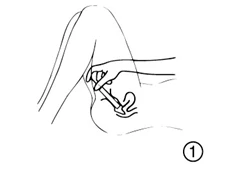
INSTRUCTIONS FOR USING COLPOGYN SUPPOSITORIES
Wash your hands thoroughly and take one suppository from the packaging.
Lie down with your knees raised and apart (as shown in figure 1).
Gently insert the suppository into the vagina as deeply as possible.
If you use more COLPOGYN than you should
If you use higher doses of COLPOGYN, you may experience: breast pain (mastodynia), breast tenderness, excessive vaginal mucus production, or vaginal bleeding (menometrorrhagia). In this case, contact your doctor, as your treatment may need to be adjusted (for example, by reducing the dose or increasing the interval between applications).
If you forget to use COLPOGYN
Do not use a double dose to make up for a forgotten dose.
If you stop using COLPOGYN
Do not stop treatment without consulting your doctor.
If you have any questions about the use of this medicine, consult your doctor or pharmacist.
4. Possible side effects
Like all medicines, this medicine can cause side effects, although not everybody gets them.
Stop taking COLPOGYN and contact your doctor immediately if you notice any of the following:
- itching and/or redness and/or skin lesions (possible signs of sensitization);
- swelling, redness and pain in one leg or arm (phlebitis);
- severe headache;
- difficulty in breathing (dyspnoea);
- problems with understanding or speaking (aphasia);
- disturbances in consciousness;
- disturbances in voluntary movements;
- changes in vision;
- yellowing of the eyes and skin (jaundice);
- abnormal vaginal bleeding.
Other side effects that may occur with the use of COLPOGYN include:
- headache (cephalalgia, migraine);
- dizziness;
- sudden, irregular, involuntary muscle movements (chorea);
- high blood pressure (hypertension);
- nausea;
- vomiting;
- stomach pain;
- slight vaginal bleeding;
- vaginal fungal infection (vaginal candidiasis);
- changes in vaginal discharge;
- breast pain (mastodynia);
- breast enlargement or secretion;
- swelling (oedema);
- weight gain;
- worsening of endometriosis (a gynaecological condition in which cells from the uterus implant outside the uterus);
- worsening of porphyria (a disease involving enzyme abnormalities in red blood cells).
Reporting of side effects
If you experience any side effect, including those not listed in this leaflet, talk to your doctor or pharmacist.
You can also report side effects directly via the national reporting system at https://www.aifa.gov.it/content/segnalazioni-reazioni-avverse.
By reporting side effects, you can help provide more information on the safety of this medicine.
5. How to store COLPOGYN
Keep this medicine out of the sight and reach of children.
Do not use this medicine after the expiry date stated on the packaging. The expiry date refers to the last day of that month.
COLPOGYN ovules: store in the original packaging at a temperature not exceeding 25°C.
Do not dispose of any medicine via wastewater or household waste. Ask your pharmacist how to dispose of medicines you no longer use. This will help protect the environment.
6. Package contents and other information
What COLPOGYN contains
The active substance is: estriol.
COLPOGYN ovules
Each 1 mg and 0.5 mg ovule contains 1 mg and 0.5 mg of estriol, respectively.
The other components are: polyethylene glycol; solid semisynthetic glycerides.
Description of the appearance of COLPOGYN and package contents
COLPOGYN ovules is available in cardboard boxes containing 10 or 20 white ovules, of 0.5 mg or 1 mg.
Marketing Authorization Holder
Angelini Pharma S.p.A. - Viale Amelia, 70, 00181 Rome
Manufacturer
A.C.R.A.F. S.p.A. - Via Vecchia del Pinocchio, 22, 60131 Ancona
for COLPOGYN 1 mg ovule also: